

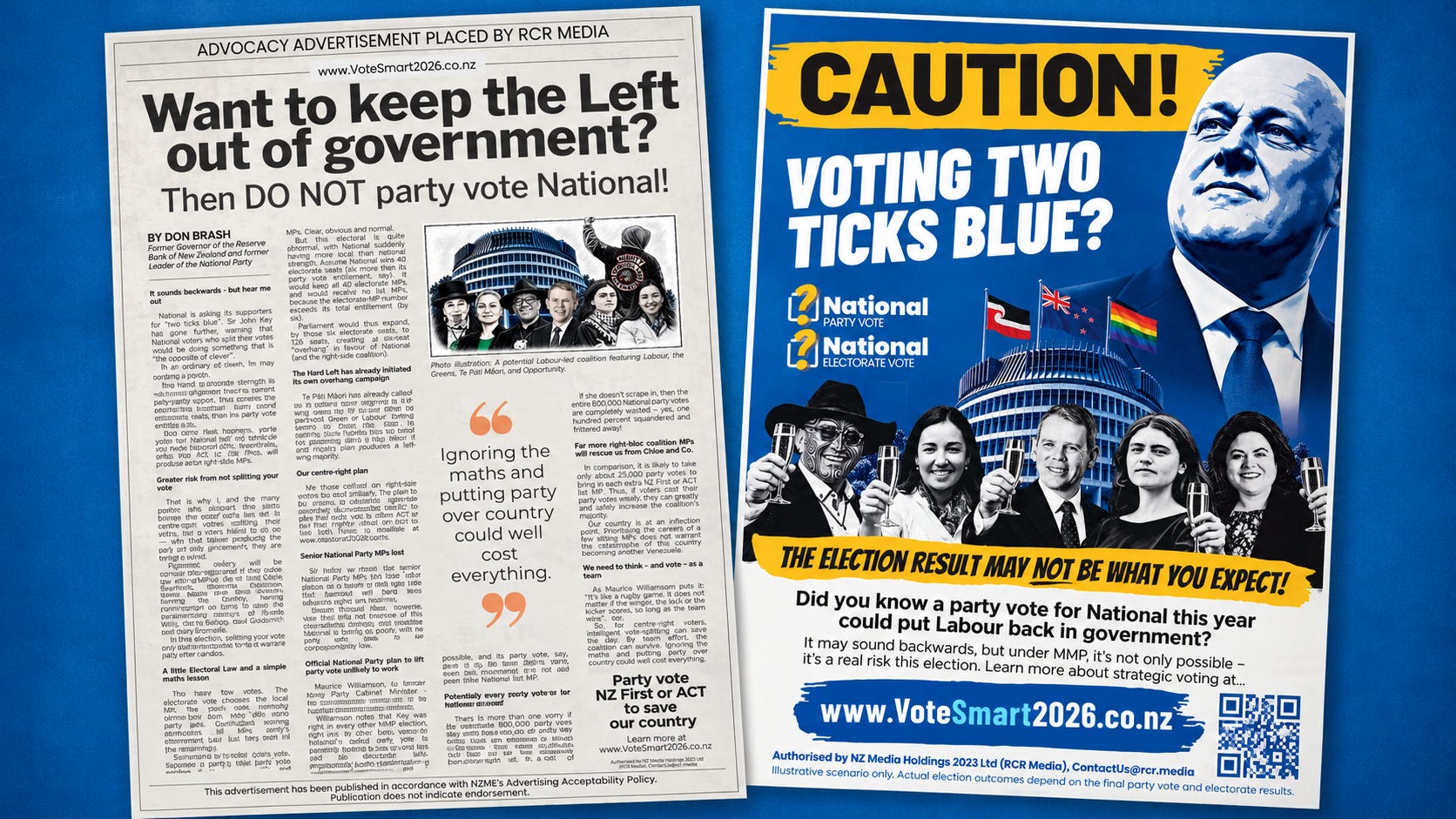
Today’s New Zealand Herald carries a full-page advertisement headed “Want to keep the Left out of government? Then DO NOT party vote National!”, which ends with the instruction “Party vote NZ First or ACT to save our country”. It was written by Don Brash and placed by RCR Media, the company behind Reality Check Radio. If the electoral rules have been followed, Act and NZ First have both authorised it.
Also this morning, Harry Mowbray told Sean Plunket on The Platform that he had put money into RCR’s campaign and had given money to social media commentators to boost posts promoting strategic voting, without saying how much. Most of the campaign’s backers remain unknown.
In the Further Analysis section below the paywall, I look at how the overhang became central to this election, and whether it could give the coalition a majority of seats but on a minority of the vote.
What the Herald ads tell us
The Electoral Commission’s rules require written authorisation from the party secretary of each party an advertisement promotes. RCR’s ad explicitly asks people to party vote for Act or NZ First while telling them not to party vote National, and Brash’s own ad in the same paper, urging Epsom and Tāmaki voters to give “two ticks to ACT”, needs Act’s sign-off too. The Electoral Act counts an authorised promoter’s spending as the party’s own election expense, so if Act and NZ First signed off RCR’s ad, it counts against their spending limits and must appear in their expense returns, even though RCR pays for it.
If they didn’t, RCR published the ad without permission, which would be a potential breach of electoral law, and neither a registered promoter nor Brash, who has led both National and Act, would be likely to make that mistake. The far more likely explanation is that both parties have given written permission for an advertisement telling voters to withhold their party votes from their senior coalition partner, a fascinating step for two governing parties to take nine days before polling day.
In public, both parties have been more guarded. Act told the Post on 16 October that its recent Paul Henry ad wasn’t meant to encourage vote splitting, and last night, before a crowd of about 500 in Taitā, Winston Peters asked NZ First supporters to give their Hutt South electorate vote to National’s Chris Bishop while insisting, the Post reported, that it was “not an endorsement of National”. His candidate there, Alistair Boyce, was blunter, telling RNZ “We believe in the overhang.”
In contrast, both Chris Hipkins and Christopher Luxon agreed in the final leaders’ debate that deliberately engineering an overhang is a rort of the MMP system that amounted to “cheating”.
In the case of those campaigning on the right, the strategy asks National supporters to give their party votes to Act or NZ First while helping National win electorates. If National wins more electorate seats than its party vote entitles it to, it keeps those extra MPs. Parliament expands, potentially giving the coalition enough seats to govern even if their opponents win more votes.
What Mowbray told Plunket
Mowbray, whose children founded the Zuru toy company, said the spread of vote splitting had gone “beyond all my expectations”. Plunket, who said a staff member had mistaken one of RCR’s billboards, with its big picture of Luxon, for a National Party ad, asked where the station had found the money. Mowbray said RCR had come to him for money and he had told them he wasn’t able to help. Brash and others had been trying to raise funds, he said, before adding “I put a little bit of money in there”, because “they were really trying to promote the same thing that we were working on”.
He said the social media commentator Chantelle Baker had been campaigning before they approached her, but that they had asked her to focus on marginal electorates. When Plunket said that made it sound as if she was working for him, Mowbray said she had money to boost her posts, and, pressed on who from, replied: “I have given her a little bit of money.” Plunket then raised Penny Marie, the podcaster whose interview with him went up yesterday. “Penny Marie, we’ve also started to help her boost things as well,” he said.
On 1 October this column reported that paid promotion through social media influencers was being considered on the right, and Mowbray has now confirmed it is happening, but he didn’t say which posts had been boosted.
According to Mowbray, his own Split Your Vote website, which now loads a blank page, was taken down after the Electoral Commission told him it breached the Electoral Act, because the $35 he spent on the domain name made it an election advertisement. “Yeah, there could well be. Yep,” he said, when Plunket asked whether the Commission was investigating. Four weeks ago he had told Plunket the Commission hadn’t contacted him.
What voters can’t see
RCR registered as a promoter on 9 October, allowing it to spend up to $424,000 during the regulated period. After receiving its flyer in Christchurch, the former Labour minister Lianne Dalziel checked the Companies Office and found that RCR’s directors and shareholders are Claire Deeks, a founder of Voices for Freedom, and Alia Bland.
Deeks told Politik’s Richard Harman that the network built by RCR and Voices for Freedom had been mobilised for a “coordinated campaign spanning more than one million printed flyers, newspaper advertising, billboards and social media”, paid for by fundraising from supporters.
Promoters don’t have to name their donors, and only those spending more than $100,000 must file a return of expenses, which isn’t due until 9 March 2027. Even after the election, voters may never learn who financed the advertising. As Dalziel wrote in Newsroom, “it is impossible to tell who their backers are”.
Answers before polling day
The campaigners are entitled to argue for strategic voting to create an overhang, as Te Pāti Māori does on the left, but advance voting has been under way since Monday, and voters deciding now can’t see who is paying for this campaign.
For the sake of transparency, Act and NZ First should confirm whether they authorised the ad and how much of its cost will count against their limits, and RCR and Mowbray should say how much he gave and who else is funding the campaign. Likewise, Christopher Luxon, whose partners appear to have signed off an ad telling voters not to party vote National, also owes voters a view on it before polling day.
Dr Bryce Edwards
Director of the Democracy Project
In today’s Further Analysis section below: the forecasts that have put a National overhang at the heart of this election, Winston Peters’ path from hints to an endorsement in Hutt South, the poll arithmetic behind each side’s chances, and the websites telling voters how to split – see: “When an overhang could decide the government”
Paid subscriptions fund this research.
