

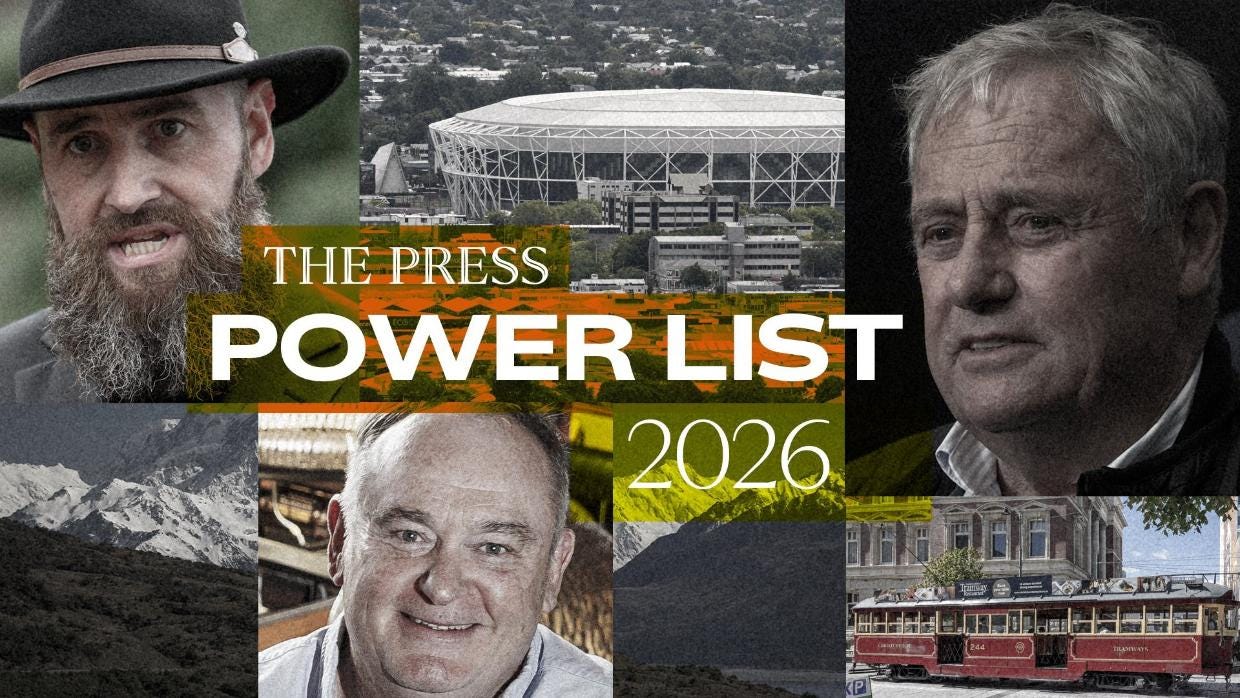
The Press newspaper in Christchurch has just published its “Power List” — a ranking of the fifty most influential people in the South Island. It’s a series of articles that updates the list they published two years. The 2026 edition, compiled primarily by senior journalist Philip Matthews, is worth reading closely. Not just for the names, but for what the list reveals about where power actually sits in Te Waipounamu, and how much of it has drifted away from anyone who ever faced an election.
I should say upfront that I’ve always been a bit ambivalent about “power lists”. I’ve reviewed quite a few of them over the years (the Listener’s annual Power List, Metro’s Auckland versions, the NBR Rich List, etc) and they tend to oscillate between the fully illuminating and the self-congratulatory. They can turn influence into a kind of parlour game. But when a good journalist takes the exercise seriously, as Matthews has here, the result can tell you things that daily political coverage misses.
Matthews makes clear that “Power is not the same as wealth and this is not a South Island rich list.” He is right. But neither is this simply a list of who has formal authority. What makes it useful is that it gets at something harder to pin down than formal authority: who actually sets the agenda, and whose phone calls get returned. Of course, any power list is also a political document in its own right, as the choices about who to include and who to leave off tell you something about the assumptions of the list-makers. It’s worth reading with that in mind.
The old idea of power in New Zealand was heavily political and Wellington-based: ministers, mayors, senior public servants, media bosses. But The Press list reveals something different in the South Island. Formal politics is weaker. Local government is less autonomous. Meanwhile, other forms of power are rising: property development, iwi leadership, university management, philanthropy. These newer forms of influence don’t face the same scrutiny that elected politicians do. Nobody gets to vote them out.
Property developers dominate
What jumps out first is the developers. By my count, at least six of the top fifty are primarily in the business of building, owning, and reshaping urban Christchurch: Richard Peebles at number one, Philip Carter at three, Matthew Horncastle at thirteen, Oliver Hickman and Vincent Holloway (of Brooksfield) at sixteen, Mike Greer at nineteen, and Tim Glasson at twenty-one.
It’s a blunt reminder of where economic power in the South Island now sits. It’s not in Parliament or the council chamber, but in the ownership of land.
Richard Peebles, the new Number One, is the developer behind Riverside Market and Little High, which are the hospitality hubs that have transformed central Christchurch’s post-quake landscape. His next project, a $130 million mixed-use development called Downtown, will add apartments, shops, and hospitality outlets to Manchester, Cashel, and Lichfield streets. That is an extraordinary amount of urban power concentrated in a few private hands.
Profiled by Liz McDonald for The Press, Peebles comes across as likeable and civic-minded: a local boy from Sockburn who narrowly survived the February 2011 earthquake and chose to stay and rebuild rather than take his insurance money and walk.
Fair enough: Peebles does come across as a decent person doing interesting things with the city. But step back and look at the structural picture: he now controls a major part of the physical heart of a rebuilt city. Urban New Zealand is increasingly shaped by the passions, tastes, and design instincts of wealthy developers. This is not democratic planning in any meaningful sense. It is a form of semi-private city-making. Sometimes it produces good results. Riverside and Little High have undoubtedly helped give Christchurch a new heart. But it also means unelected commercial actors are deciding more and more about the social geography of our cities.
Philip Carter, who topped the 2024 list, has slipped to third. Matthews explains that some of the Carter Group’s bolder ambitions have stalled: the planned Catholic precinct was scaled back, new buildings around Cathedral Square haven’t materialised. In the property game, power depends on what you can actually get built.
Matthew Horncastle, at thirteen, is the most politically outspoken of the developer contingent. He and his partner Blair Chappell have built 2,500 homes through Williams Corporation, and Horncastle has become a media personality: outspoken, rightwing, given to sweeping pronouncements. He told The Press: “I am not woke. But I’m a libertarian... I am just trying to save the country from communism.” The fact that Williams Corporation is planning to list on the stock exchange in 2027 suggests the influence is real, but it is just being packaged differently from the old corporate style.
This developer class overlaps significantly with the people identified in The Press’s earlier investigative series of late last year, “Who Owns Christchurch,” which mapped the city’s $170 billion property landscape and found it concentrated in remarkably few hands. In this, Peebles’ property interests were valued above $400 million; Carter’s exceeded $200 million. These are not just influencers. They are the people who own the city centre.
There’s a well-known research finding in American political science (from researchers Martin Gilens and Benjamin Page) that when the preferences of economic elites conflict with those of ordinary citizens, the elites almost always win. In the South Island, property developers shape zoning outcomes, sit across the table from council planners, and get to decide what the rebuilt city centre looks like.
And the basic Thomas Piketty point about inequality applies here too: the biggest South Island fortunes are built on land, and land keeps appreciating. Money makes money. That’s not a controversial observation, it’s just what the list shows.
The rise of Ngāi Tahu
If property developers are the most numerous presence on the list, the most significant trend is the growing power of Ngāi Tahu. Five individuals with direct leadership roles appear in the top fifty: Justin Tipa at two, Te Maire Tau at four, Tipene O’Regan at ten, Edward Ellison at seventeen, and Eruera Tarena at forty-five. Lisa and Francois Tumahai are at thirty-one.
This is more than token recognition. Ngāi Tahu is not just culturally significant or economically large — it is increasingly politically and intellectually assertive in national life. Matthews notes that Ngāi Tahu’s presence at Waitangi this year, leading the South Island delegation for the first time, signified “it’s new, more expansive view of its place in the national conversation.”
Justin Tipa, who became kaiwhakahaere of Te Rūnanga o Ngāi Tahu in 2023, has grown decisively into the role. His ranking at number two — ahead of the other property developers, every politician, every CEO — is a deliberate editorial choice, and a defensible one. Te Maire Tau, at four, is described by Matthews as “an ideas man.” Tau is the iwi’s lead plaintiff in a potentially landmark freshwater claim before the High Court, a case that could reshape the governance of South Island waterways and the agricultural industries that depend on them. The stakes here are real: this is power that can re‑write the rules for whole industries.
And then there is Tipene O’Regan at number ten. He is 86. The fact that a man who negotiated the Ngāi Tahu Treaty settlement in the 1990s still makes a top-ten power list three decades later says something important. Some influence lasts. O’Regan did not just win a settlement, he also shaped the cultural and legal framework through which the iwi operates.
The growing prominence of Ngāi Tahu raises important questions about the evolving relationship between iwi authority and democratic governance. Ngāi Tahu is a major commercial operator with a property portfolio approaching $300 million in Christchurch alone. But it’s also something more than that: a cultural body with formal, legislated representation on Environment Canterbury..
It’s a kind of power that doesn’t fit neatly into any category. It’s commercial, cultural, and political, all at once. And there’s nothing else quite like it on the list. Ngāi Tahu is a major corporate entity, but one whose stated purpose is the long-term wellbeing of its people. That’s a fundamentally different kind of accountability from a developer answerable to shareholders. In practice, it functions as something close to a parallel governance structure. Whether you find that reassuring or concerning probably depends on your politics. But either way, it’s a significant constitutional development.
This is one of the most significant developments in New Zealand power over the last decade. If older South Island power rested on farming, church networks, old business families, and provincial boosterism, the newer power map has iwi leadership close to the centre. That is a profound change.
The invisible politicians, and who has replaced them
What’s really telling is who isn’t on the list: politicians. Only three national politicians appear in the top fifty: Matt Doocey (Waimakariri, the only South Island Cabinet minister) at twenty-four; Megan Woods (Wigram, Labour) at eighteen; and James Meager (Rangitata, National) at forty-eight. That tells you everything.
Meager holds the title of Minister for the South Island, which is a position created to give the impression that the coalition cared about the region. Matthews is blunt: Meager has been “quiet and invisible” and has “failed to deliver very much.” As he writes, critics suspect the whole ministerial position “was a gesture to placate” the South Island at a time it was feeling “shortchanged by Wellington”. His placement near the bottom of the list is a damning assessment.
The late New Zealand political writer Bruce Jesson warned us decades ago about the creation of a “hollow society.” Jesson argued that the extreme free-market reforms of the 1980s allowed corporate leaders to colonise the public sector, disempowering democratic processes and reducing public policy to dollars and cents. Looking at the 2026 power list, Jesson’s fears have been substantially realised. Central government representation is shockingly low, and the politicians who do appear are ranked well below private capital.
Local government power is being actively curtailed too. Rates caps constrain councils’ financial independence. Regional councils face amalgamation or abolition. Central government is increasingly making decisions on housing, infrastructure, health that were previously the province of local authorities.
Matthews writes plainly: “Elections are won or lost in Auckland, not the South Island.” The Dunedin Hospital saga — where a community’s legitimate concerns about the scale of a public hospital rebuild have been systematically delayed by a Wellington-based health bureaucracy — is the clearest current example of what that centralisation looks like in practice. It is, in my view, the single most important political story in the South Island right now.
Business Canterbury’s quiet power
So if the politicians aren’t running things, who is filling the gap? Consider Leeann Watson.
Watson is the Business Canterbury CEO, ranked at twenty-eight. She is neither elected nor the CEO of a major corporation. She runs an industry advocacy group. And yet, as The Press reports, she has conducted more than thirty ministerial meetings in the past year, makes six-weekly advocacy trips to Wellington, and holds quarterly meetings with every Canterbury mayor and council CEO.
Most tellingly, Watson says: “If I need to pick up the phone and talk to a minister, I can”. She confirmed she has Prime Minister Christopher Luxon, opposition leader Chris Hipkins, and Finance Minister Nicola Willis on her phone.
Most citizens cannot do this. The average person cannot simply call the Prime Minister about the cost of living. But the representative of Canterbury’s business community can. Watson’s influence flows from relationships, information, and the trust of decision-makers. In a system with no lobbyist register and no formal record of who meets ministers, this kind of quiet access is both enormously consequential and entirely opaque to the public.
Watson describes her approach as “robust, but constructive,” and she is, by all accounts, skilled in how she exercises that access. But the structural point stands: informal, unelected influence of this kind is never equally distributed. Not every community group or environmental advocate gets thirty ministerial meetings a year. The Canterbury business community does.
That gap between who we elect and who actually calls the shots is one of the defining problems of modern democracy. I made a similar argument about the NBR Rich List last year: the lists themselves are interesting, but what’s more interesting is the gap between the wealth they celebrate and the democratic accountability we should expect from people with that kind of influence.
What the list tells us about power in 2026
What the list really shows, and what Matthews, to his credit, seems to understand even if the format doesn’t quite let him say it — is that the South Island is now run by developers who rebuilt a city in their own image, and by iwi leaders whose authority is growing in ways genuinely new in New Zealand politics. Behind them sits a professional class whose access to ministers is invisible to the public and unregulated by law.
Property capital is now the engine of South Island power. The earthquake created a window and those with capital walked through it. The result is is a concentrated ownership of the new urban landscape. Ngāi Tahu is in the ascendancy, and a meaningful counterweight to purely commercial power, accountable to a community and increasingly willing to take public positions on contested issues. The formal political system has largely abandoned the South Island: three politicians in the top fifty, none in the top ten, and the one with the specific ministerial brief for the region ranked forty-eight.
And then there are the names that make you wonder whether profile and power are really the same thing. Scott Robertson appeared at number six on the 2024 list, having just been appointed All Blacks coach. He does not appear on the 2026 list at all. As Matthews writes with a certain dry satisfaction: “Time did tell, as it turned out. Time has a funny way of revealing who really has power and who does not.”
Sam Neill, at six this year, is listed for his willingness to use his celebrity standing to criticise the fast-tracking of the Santana Minerals gold mine in central Otago. Fair enough. But is celebrity-driven moral advocacy the same kind of power as Justin Tipa’s institutional authority or Leeann Watson’s ministerial access? I’m not sure it is.
Sir Peter Talley, at twenty-two, is perhaps the most politically charged name on the list. The Nelson seafood magnate has a well-documented history of political donations and fierce opposition to environmental regulation. That Talley appears on a power list is accurate.
Traditional media clout has frayed. As Matthews notes with some honesty, no individual media figure made the top fifty: “The days when a daily newspaper editor was automatically one of the city’s power brokers are long gone.”
In place of old media gatekeepers, The Press has elevated a new range of social authority figures: Hugh Wilson is there because his restoration model at Hinewai has become a moral and ecological example. Melissa Vining is on the list for helping drive the Southern Charity Hospital into existence. Phil Rossiter built the Old Ghost Road trail largely through volunteer labour and sheer persistence. Callam Mitchell is there because Electric Avenue has put Christchurch on the entertainment map. These people do not have wealth or formal authority, but they have something that many politicians and businesspeople lack: moral credibility.
The list is also overwhelmingly Christchurch-centric: more than half the names are based in or around the city. This means that Dunedin, the West Coast, and Southland get comparatively little attention. And it is light on women. While Cheryl de la Rey, Megan Woods, Lydia Gliddon, and Suzanne Pitama feature prominently, the overall composition skews heavily male. Power lists everywhere tend to reflect rather than challenge existing inequalities.
That brings us to the limitations of the exercise itself. Power lists are, at their core, a series of portraits rather than an investigation into power structures. They name the influential and describe what those people have done. What they tend not to do is ask harder questions about how that power is exercised and who benefits from it. The Press Power List is better than most at pointing towards these questions, but it remains a collection of individual stories rather than a structural analysis.
For all their limitations, though, exercises like the Press Power List serve a genuine democratic function. They name the people who shape our lives — people who are often invisible to ordinary citizens because they operate through commercial decisions, institutional appointments, or quiet lobbying rather than elections. In a country without a lobbying register, where donation thresholds are weak and transparency is patchy, anything that names the people who actually hold influence is valuable.
Some of those named are entirely admirable. None of this is necessarily sinister. But let’s not kid ourselves about what it means for accountability. Modern power is harder to see than the old kind: it lives in boardrooms and quiet lobbying more than in parliamentary votes, and it often lasts longer precisely because nobody ever gets to vote on it. The Press has, perhaps unintentionally, documented that transformation.
If politicians matter less, and if local government is increasingly constrained, then where are the checks and balances on the new influential class? Who scrutinises the developers remaking our cities, the wealthy individuals whose “vision” increasingly becomes urban reality? We are witnessing the quiet consolidation of what I think we should start calling a new “southern oligarchy”.
Dr Bryce Edwards
Director of the Democracy Project
Further Reading: