

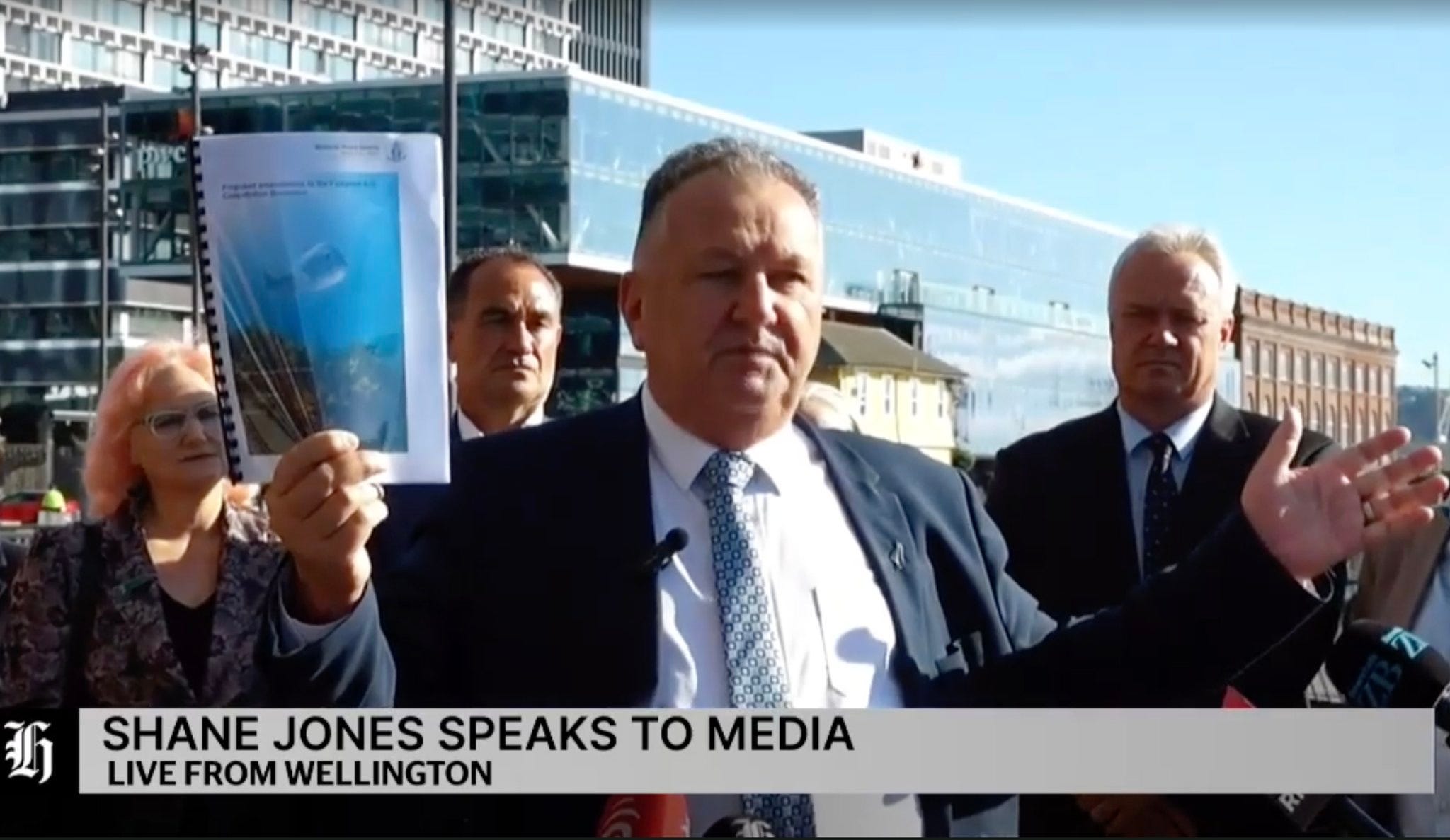
The Fisheries Amendment Bill has its first reading in Parliament this afternoon. It arrives after an embarrassing backdown over undersized fish, with Winston Peters and Christopher Luxon both scrambling to claim credit for forcing Shane Jones to retreat. But the real story is not the clause that was dumped. It is the rest of the legislation.
This is not just a messy fisheries bill. It is a bill that would hide camera footage from the public, make court challenges harder, normalise dumping fish at sea, and let catch settings run for years with less public scrutiny. And it is being fronted by a minister whose relationship with the fishing industry has long raised obvious questions.
The Government sells the bill as being about streamlining and “common sense”. But it’s deregulation dressed up as tweaks, fitting the Government’s pattern in other sectors, from mining to fast-track consents. Many of the changes sound technocratic and boring. But technical changes are where the biggest shifts in power hide, giving the fishing industry more power.
If any of that strikes you as concerning, read on. This is one of those policy fights that tells you a lot about how power works in New Zealand: quietly, technically, and usually in favour of those already at the table.
The U-turn that wasn’t enough
Last week’s drama centred on a clause buried deep in the bill that would have scrapped minimum size limits for commercial fishers, effectively allowing them to catch and sell baby snapper, tarakihi, and trevally. The clause was only discovered when volunteers from the recreational fishing advocacy group LegaSea read the draft legislation line by line after it was released with almost no notice.
The backlash was immediate. Matt Watson went hard, accusing Jones of writing rules for his mates in the commercial industry. Recreational fishers swarmed MPs online. Environmental groups joined in. Within days, what had looked like a technical amendment had become politically radioactive.
Jones was defiant, until he wasn’t. As recently as the Monday before the backdown, he was entirely unapologetic, dismissing critics as just “noisy voices.” He called Watson a small-tailed fish – “reflective of the biology of the person you’re referring to” – before walking off stage.
Within days, however he was talking about democracy in action, and on Wednesday he folded. Just like that. But the scramble for credit for his U-turn was something to behold. Winston Peters posted to social media claiming he had spoken to Jones and “decided to review this part of the legislation.” Nine minutes later, Christopher Luxon posted his own statement claiming he had spoken to Jones that morning and secured the removal. Act’s Cameron Luxton weighed in too: “Fishers spoke up, Act listened.”
Jones insisted only one person could instruct “the matua” and that was “the rangatira Winston.” Peters told Stuff that Luxon had “absolutely nothing” to do with it. Luxon said the important thing was the Government had “got rid of the most egregious” part of the bill. He then let slip something revealing: the size-limit changes were “not made clear as part of the cabinet process.”
That is quite something: the Prime Minister appearing to suggest he did not fully grasp what was in legislation that had gone through his own Cabinet. Either that process was remarkably sloppy, or Luxon is now trying to distance himself from a political embarrassment.
The Herald published an editorial correctly pointing out that it was public pressure, not internal politics, that forced the U-turn. The newspaper credited LegaSea’s Sam Woolford and Matt Watson, and acknowledged its own front-page splash had helped detonate the controversy. The Spinoff’s Hayden Donnell captured the absurdity, noting that the only ones not claiming credit were “Jones himself, the fishing industry and large fishes.” RNZ’s Jo Moir added that “Santa Claus seemed to be the only person not claiming to have put a stop to this controversial change.”
What makes this episode politically revealing is not just the policy itself. It is the way the Government handled it: the lack of scrutiny up front, the public squabbling afterwards, and the obvious attempt to treat one retreat as proof that the wider bill is fine.
What’s still in the bill
The size-limit clause was clickbait last week. That’s how LegaSea’s Sam Woolford put it. The real danger is everything elsewhere in the bill.
Start with the cameras. Since onboard cameras were installed on fishing vessels, reported fish discards increased by 46% and albatross bycatch incidents rose 3.5-fold compared to what crews had been self-reporting. Cameras proved the industry had been massively underreporting waste and wildlife kills.
The industry’s response? Not to clean up its act, but to lobby for less transparency. And Jones delivered. The bill would exempt fishing boat camera footage from the Official Information Act, meaning the public and journalists can no longer obtain videos of what happens at sea. It would even impose a $50,000 fine on anyone who publishes such footage.
As Greenpeace’s Elijah Hooper put it: “A transparent industry that boasts their world-leading fisheries management wouldn’t need these cover ups. It just looks like they’re trying to hide the plain facts of their activities, from hauling up coral to killing fur seals and dolphins as bycatch.”
Then there’s the restriction on judicial review. Environmental groups like Forest & Bird and the Environmental Law Initiative have won important court cases in recent years forcing ministers to rebuild overfished stocks and comply with sustainability requirements. In the tarakihi case, the Supreme Court confirmed that when a stock is overfished, the law requires rebuilding it based on biology, not economics. Jones’ response to being found wrong in court isn’t to correct course, it’s to limit the courts’ ability to say so.
He’s proposing strict time limits on challenges and narrowing the grounds on which decisions can be contested. The window for appealing fisheries decisions would shrink from several months to just 20 days. Matt Watson has pointed out that OIA responses routinely take longer than that, meaning opponents couldn’t even gather evidence before their time ran out.
Jones frames this as stopping “vexatious, protracted litigation that glugs the system up.” He wants to ensure that “an ecosystem-based approach doesn’t become an ideological weapon to wipe out commerce.” Watson’s response: “That’s not democracy.”
The bill would also legalise the discarding of unwanted fish at sea and give quota owners the right to carry forward increased amounts of uncaught catch into another fishing year. Fisheries scientists warn legalising discards will mask the true scale of fish mortality and incentivise high-grading – keeping only the best fish, tossing the rest. Forest & Bird was blunt: “It’s as if the Minister has looked through all the good things in the Act and wiped them out entirely.”
All of the above raises the obvious question: Why is Jones so determined to push through changes that overwhelmingly advantage the commercial sector?
Follow the money
All of the above raises the obvious question: Why is Jones so determined to push through changes that overwhelmingly advantage the commercial sector? To answer this, the money trail is worth examining.
The paywall now starts at halfway through all Democracy Project newsletters. Please take out a paid sub if you want to access the full content and support this service.