

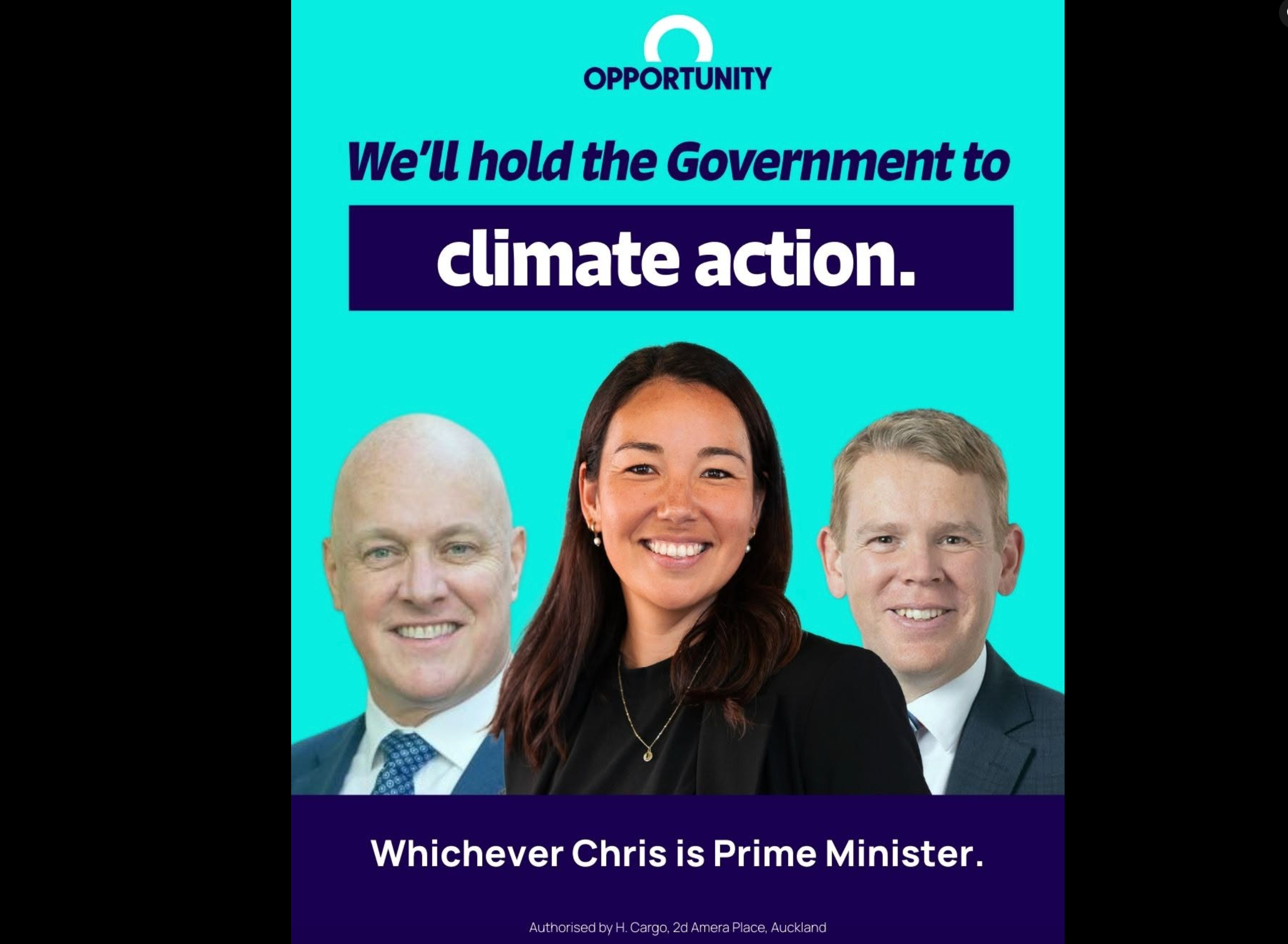
The Opportunity Party could end up deciding who governs New Zealand after the November election. Yet it still will not say whether it is more likely to put Christopher Luxon or Chris Hipkins into office.
This is not an accidental gap in the party’s pitch. Leader Qiulae Wong says the uncertainty is part of Opportunity’s bargaining power. Speaking to RNZ’s Alexia Russell, she dismissed suggestions of an electorate deal with Labour in Mt Albert, explaining: “I think it would be really hard for us to do a deal, because our leverage point is the fact that we can work with both sides, and to pick a side right now would really undermine that.”
Wong added: “And genuinely we want to keep that door open for either National or Labour. That’s how you can be a strong centrist party – that you can hold both sides accountable.”
In other words, the uncertainty is the strategy. Opportunity is campaigning to become the party that could hold the balance of power, while preserving as much freedom as possible to bargain after the election. From the party’s point of view, this is understandable. From the voter’s point of view, it is much less satisfactory.
None of this would matter if Opportunity were still stuck on 2%. But the RNZ-Reid Research poll last week had it on 4.7%, and June’s 1News-Verian poll on 4.6%. Opportunity is close enough to the threshold that what the party would do with parliamentary power has stopped being a hypothetical.
Opportunity’s coalition strategy
Opportunity presents itself as an alternative to New Zealand First. It wants to replace Winston Peters as the pivotal party in Parliament, but without the division, personality cult and endless political theatre associated with NZ First.
The two parties are obviously very different in policy and political culture. Opportunity is socially liberal, heavily focused on environmental reform and committed to a large redistribution through its land tax and Citizen’s Income. Its people tend to come from business, policy, consulting and environmental organisations. NZ First has moved in a nationalist and socially conservative direction, relying heavily on Peters’ personality and a politics of grievance.
Their methods of using power may nevertheless turn out to be rather similar. Across much of his career, Peters has gone into elections preserving considerable uncertainty about which major party NZ First might support afterwards. Once the votes are counted, negotiations take place in private. National and Labour compete to offer the best deal. Voters discover the result when Peters is ready to announce it.
Opportunity’s version sounds more orderly. Wong has told Stuff that the party would approach whichever of National or Labour won the most votes, enter a period of exclusive negotiations, and talk to the other side only if those discussions failed or stalled. She says the eventual choice would be made by a leadership group involving the parliamentary caucus and the party board.
This gives voters some information about the procedure, but not much about the outcome. Opportunity has explained the order of the phone calls. It has not explained who it is likely to make prime minister.
The resemblance to Peters’ approach is awkward because Opportunity has built much of its political identity around being a cleaner and more constructive alternative to NZ First. Yet on the central matter of post-election power, it is also asking voters to trust a small group to make a private decision after polling day.
The largest party does not automatically win
The promise to negotiate first with the largest party sounds clearer than it really is. Under MMP, the largest individual party has no automatic right to govern. A government is formed by whichever grouping can command confidence in Parliament.
National was clearly the largest party after the 2017 election, but Labour, NZ First and the Greens had enough seats between them to form a government. Had Opportunity’s proposed rule been applied then, National would have received the first negotiating opportunity even though another parliamentary majority was available.
Perhaps this approach can be defended. It might encourage stability, and it avoids the appearance that Opportunity has chosen its preferred partner before seeing what voters decide. But it is not an established constitutional principle, and Wong has not really explained why the largest single party should be privileged over the grouping with the clearest route to a majority.
Nor does the rule resolve the difficult cases. What happens if the largest party has no plausible path to power? What if the second-largest offers Opportunity almost everything it wants, while the largest offers very little?
Wong says the party will publish bottom lines before the election. That will help, but voters still need to know more than the sequence in which negotiations will occur.
What are its voters actually voting for?
The democratic problem becomes clearer when the preferences of Opportunity’s own supporters are considered. The latest RNZ-Reid Research polling asked voters whether they preferred a Labour-led or National-led government. Among Opportunity voters, 41.1% preferred Labour and only 21.3% preferred National. A large remainder selected neither or said they did not know.
Wong’s response was striking: “That doesn’t drive our decision making.”
Instead, she said the decision would depend on the parties involved, their policy offers and the form of government available. There is a fair argument behind this. Coalition negotiations cannot be reduced to a single polling question, and political parties should not be run entirely according to opinion surveys.
Still, Opportunity is drawing from a voter base in which a Labour-led government is preferred to a National-led one by almost two to one, while reserving the right to use those votes to keep the present Government in office. If the leadership is willing to go against the clearest preference of its own supporters, it should at least explain before the election how that might occur.
Many voters care as much about who governs as they do about individual policies. A progressive voter might strongly support the land tax and Citizen’s Income but refuse to back Opportunity if there is a serious chance it will return National, Act and NZ First. A centre-right environmental voter might like Wong’s presentation but not want their vote to help install a Labour-Green administration.
At the moment, both are being asked to vote without knowing the most important likely consequence.
The paywall now starts partway through all Democracy Project newsletters. Please take out a paid sub if you want to support this service and access the full content, including the following sections: “Centrism does not require secrecy”, “Clarity might help Opportunity”, “Gareth Morgan’s objection”, “Could Opportunity really work with the right?”, “The argument over Mt Albert”, “Who would make the decision?”, and “Opportunity needs to say more”.
