

The most revealing moment of Tuesday’s TVNZ leaders’ debate came when Jack Tame pointed out that the NBR Rich List now counts 26 New Zealand billionaires, up from 18 a year earlier, and asked Christopher Luxon and Chris Hipkins: “Is it morally acceptable for any one person to be a billionaire?” Neither would give him the yes or no he wanted, and the question has rather taken over the campaign since.
As Heather du Plessis-Allan said on Newstalk ZB on Thursday, “I don’t think anybody expected billionaires to become a topic of discussion in this election but here we are.” Since Tuesday, John Key, Tamatha Paul, Chris Penk, Simeon Brown and various commentators have all weighed in, often with considerably more conviction than the two leaders. The argument has ranged from whether New Zealand should celebrate its billionaires to whether the country would be better off without them.
The controversy also has a rather immediate relevance to the election. Some of the billionaires being defended and attacked are among the campaign’s biggest financial backers, while Harry Mowbray, the father of the billionaire Zuru entrepreneurs, is running a strategic-voting campaign designed to help the centre-right retain power. The question of what responsibilities come with extraordinary wealth is no longer just a theoretical one.
Was it a fair question?
Not everyone thought so. David Harvey, writing on his Substack today, objected that the question “assumes wealth needs moral permission, as if the default is guilt”, while National MP Chris Penk defended the leaders for refusing to give an instant moral judgment on something so complicated. Penk has a point. The demand for a simple yes or no was something of a gimmick, and Tame’s repeated interruptions made it difficult for either politician to develop a proper argument.
But the question itself was arguably the best of the night, precisely because neither leader could answer it from a script. For much of the debate the two Chrises had been arguing over tax policies, spending commitments and economic management. Tame suddenly asked them about the values underlying their economic policies. As Stuff’s Jenna Lynch observed, both seemed determined to avoid taking positions on unexpected questions, preferring the safety of their prepared messages.
Tame subsequently told his TVNZ podcast co-host Tova O’Brien that he had thought Hipkins might be the less comfortable of the two, but was surprised by both leaders’ reactions. They seemed to treat the question “like an unexploded hand grenade”. He couldn’t understand why Luxon hadn’t simply said that National wanted more billionaires, more successful businesses and more entrepreneurs creating jobs.
There was, of course, a deeper question sitting behind Tame’s rather crude formulation. Documentary maker Bryan Bruce, writing on his Substack, thought Hipkins had missed an opportunity to make a traditional social-democratic argument. Bruce asked: “How much inequality should a democratic society tolerate when some citizens cannot afford adequate housing, healthcare or food?” That’s a rather better question than whether someone becomes immoral the moment their fortune reaches $1 billion, and it is one that political parties should be able to answer.
John Key and Tamatha Paul had answers
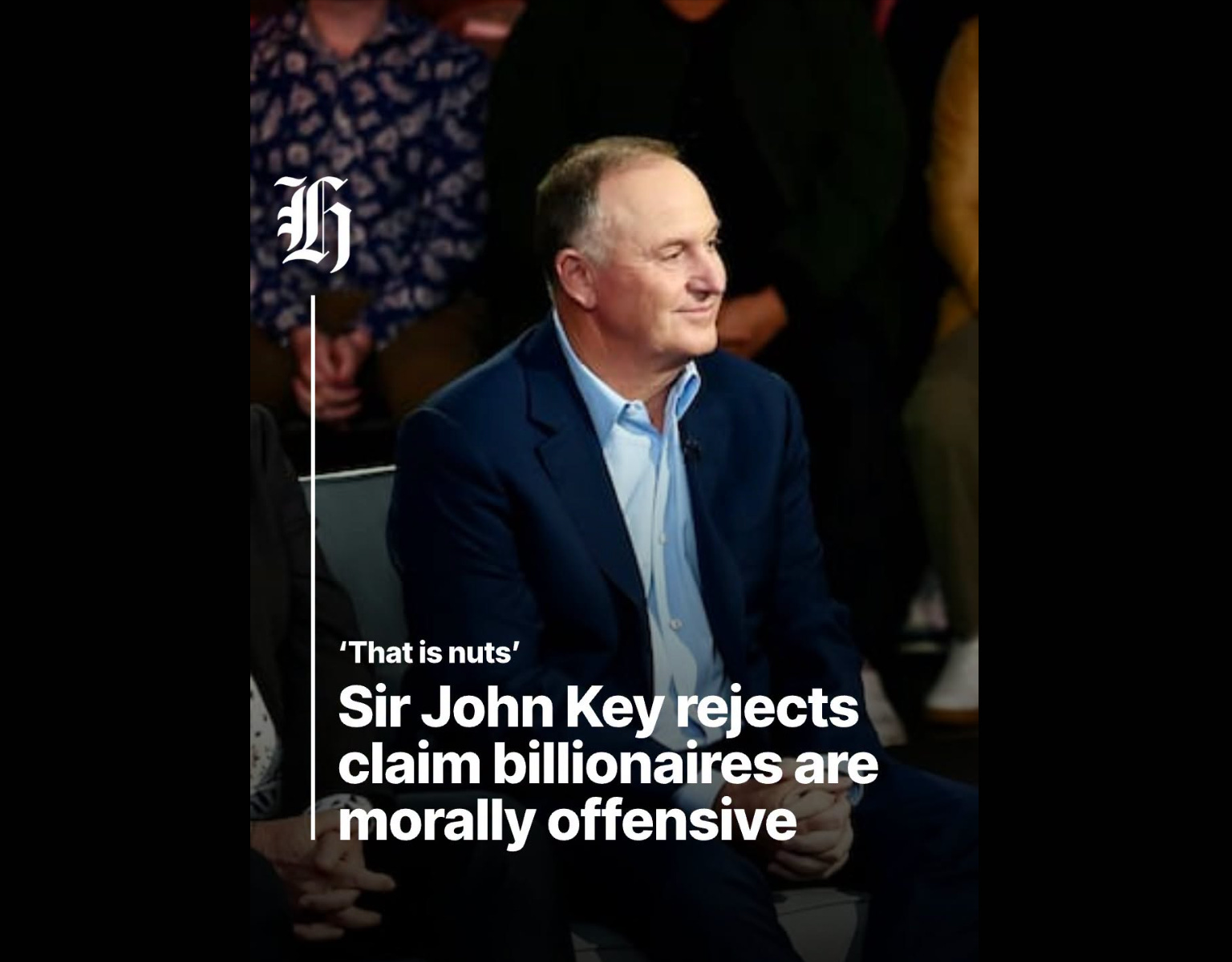
The most interesting response came the following evening at the Herald’s “Future of New Zealand” debate. Sir John Key took exception to Tame’s question, apparently without being asked about it. “What sort of wowsers have we become?” he demanded. Why, he wanted to know, did New Zealanders celebrate successful sportspeople and artists but regard someone who had built a world-class company as morally offensive?
Key pointed to Rocket Lab founder Peter Beck and packaging magnate Graeme Hart. Both had built extraordinarily successful international businesses, creating wealth and employment along the way. He thought the suggestion that there was something wrong with their achievements was “nuts”. New Zealand needed more ambition and more entrepreneurs prepared to build businesses of that scale.
This was classic John Key. He has always been comfortable celebrating business success and making money, including his own. Watching him at the Herald debate, it was hard not to wonder why Luxon had struggled to articulate essentially the same argument the previous evening. As the Herald’s Thomas Coughlan observed, Key sometimes appeared more convincing than either of the Chrises.
Green MP Tamatha Paul had the opposite answer. She had already posted a TikTok declaring that becoming a billionaire was immoral, describing extreme wealth as parasitic. At the Herald debate she argued that these fortunes were not simply the product of individual genius or hard work. Billionaires relied on publicly funded infrastructure, educated workers and the wider society to make their money, and should contribute accordingly.
“They need to pay their fair share”, Paul insisted, asking why nurses, teachers and tradies should pay higher effective tax rates than the very wealthy. She also made an important qualification: “I’m not saying they should not exist altogether.” Her immediate demand was for greater taxation, rather than the abolition of billionaires.
Paul’s sweeping moral language soon caused her difficulties. Having challenged people on TikTok to name an ethical billionaire, she was confronted by RNZ’s Guyon Espiner with filmmaker James Cameron, who appears on the Rich List and who, with his wife Suzy Amis Cameron, donated $50,000 to the Greens in 2023. Paul was reluctant to apply her condemnation to Cameron personally, prompting former Act leader Rodney Hide to accuse her of hypocrisy.
Paul’s sweeping denunciation was probably also a bit of a fail. There’s no shortage of good arguments for taxing extreme wealth more fairly without pretending that every billionaire is a bad person. But Key’s response was also inadequate. He turned a question about the concentration of enormous fortunes into a complaint about New Zealanders supposedly resenting success, neatly avoiding the harder questions about economic inequality and the distribution of wealth.
At least the two politicians were prepared to have the argument. The irony was that a former National prime minister and a Green MP were offering a more interesting ideological contest than the two men competing to lead the next government.
The paywall now starts partway through all Democracy Project newsletters. Please take out a paid sub if you want to support this service and access the full content, including the following sections:
“Why wouldn’t Luxon say yes?”
“Labour’s billionaire problem”
“Why has the billionaire question resonated?”
“The billionaires are not spectators”
“The question the leaders still need to answer”
