

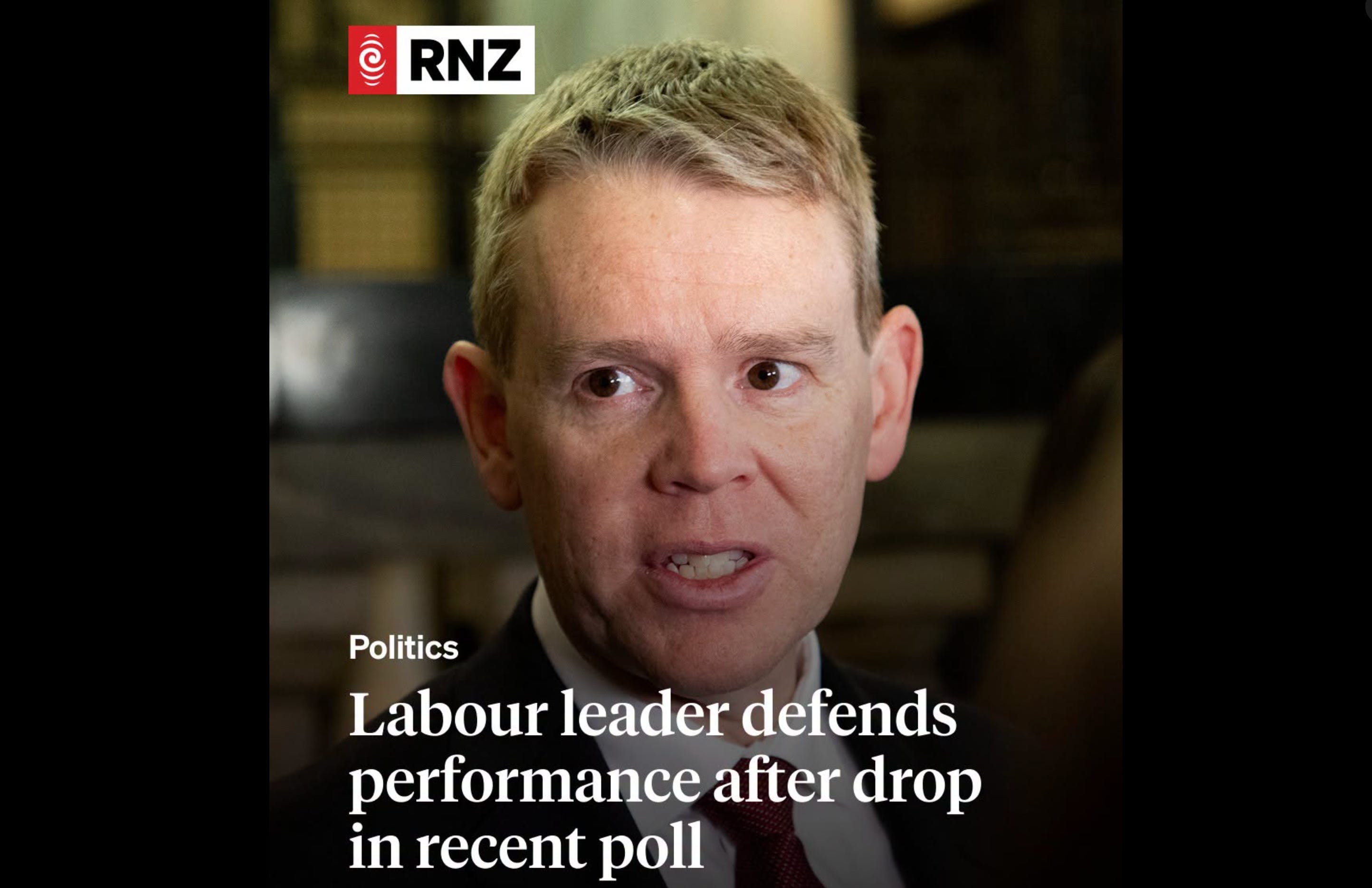
There is something strange about this election campaign. National has just put itself through another leadership crisis, Christopher Luxon looks weaker than ever, and Labour still doesn’t look like a party storming towards victory.
Luxon survived his second confidence vote in four months on Wednesday. Chris Penk lost his ministerial portfolios for launching the challenge that caused it. National MPs spent much of the week talking about themselves. All of this sits on top of the Government’s real problems: unemployment is high, living costs are still painful, public services are stretched, and a lot of voters think the country is heading in the wrong direction.
You would expect the Opposition to be cleaning up. Instead, the 1News-Verian poll released that same evening had Labour on 30%, down two points, with National just behind on 29. Luxon was still ahead of Hipkins as preferred prime minister, 17% to 15.
Labour reached 37% in the Verian poll taken in mid-April, its highest since Hipkins’ first poll as leader in January 2023. By June it had dropped five points to 32. It has kept sliding since.
Forget for a moment whether Labour is a point ahead or two points behind in any particular poll. The more interesting question is why it is not ten points ahead. For months the coverage has concentrated on what is wrong with National and Luxon. It is time to turn some of that scrutiny on the party that wants to replace them.
The small-target strategy
Labour has been running a deliberately boring “small target” strategy (say little, offend no one, let the incumbent implode). There was a very good reason for such a cautious approach. After the 2023 election the party was in a terrible position. It had fallen from 50% in 2020 to 26.9% three years later. Auckland had turned against it. Labour was associated with Covid, inflation, projects that didn’t work, Three Waters, co-governance battles and ministerial scandals.
Hipkins’ first job in Opposition wasn’t to excite anyone. It was to make Labour safe again. He has largely done that. There was no civil war after the defeat. He stayed in control, moved Barbara Edmonds into a central economic role, refreshed the candidate list and slowly rebuilt support. Labour no longer looks like the party voters were desperate to throw out in 2023. That is not nothing. It doesn’t follow that voters are desperate to put it back in.
Almost every recent analysis of Labour reaches for the same description: a small-target or “Ming vase” strategy, borrowed from Australian Labor in 2022 and UK Labour in 2024. Writing in The Spinoff this week, Joel MacManus asked whether it has begun to backfire. He quotes the lobbyist Georgina Stylianou, who describes Labour’s announcements as “tangible little droplets – they’re all good retail policies but they don’t have an overarching pitch”.
So, Hipkins has done the first part of the job: Labour is electable again. But it is much less clear that it is compelling.
An extraordinarily weak Government
Labour’s position becomes harder to understand when you look beyond the headline party numbers. The latest Ipsos Issues Monitor, reported by Stuff’s Emma Ricketts, found Labour was the most trusted party on all five of the issues voters ranked most important: cost of living, healthcare, the economy, housing and unemployment. National no longer leads on any of them. That is quite an advantage for an Opposition to hold.
Labour is ahead on so many issues, Sam Sachdeva wrote in Newsroom, “yet still seems unlikely to form government in most current polling”, which suggests “the party is failing to fully capitalise on its potential advantage”.
The Taxpayers’ Union-Curia poll at the start of the month was worse again, putting Labour at 27.8%, essentially back at its 2023 result. Hipkins dismissed it as a rogue poll, and he may be right, since other polls have Labour higher.
But there is enough here to say Labour has lost momentum. Its support has softened from the mid-30s it was reaching earlier in the year, and the energy in this campaign is going to other parties.
The Herald’s Jamie Ensor made the point after the Curia result. All the attention on Luxon’s mistakes should be producing a much bigger dividend for Labour by now. His conclusion is hard to argue with: “When others are coming for your vote, waiting for Luxon’s next faux pas just isn’t enough.”
National is doing almost everything an Opposition could reasonably ask of it. But you still have to put the ball in the net.
Former Labour adviser Vernon Small asked the question that ought to be uncomfortable inside Labour headquarters: “If Labour and the Opposition can’t open a significant lead in these times, when can they?”
The Opportunity problem
This is why the rise of the Opportunity Party should concern Labour. Opportunity reached 6.1% in the Curia poll and 8% with Verian this week, which on those numbers would give it nine seats.
We shouldn’t assume all of that has come out of Labour. Opportunity’s constituency looks more complicated than that. What matters is why people are going there. The party has one big, clearly stated idea: a land value tax funding a universal basic income. You can think that bold or barmy. Labour would reject most of the programme and plenty of people will find it frightening, but nobody is confused about what it is trying to do.
Danyl McLauchlan argued in the Listener in June that National’s KiwiSaver changes and the Greens’ tax package both have serious flaws, but that both parties are at least trying to fix something real. Labour has offered nothing on that scale. His conclusion was that the minor parties have been “more courageous with their policy proposals this year”. McLauchlan’s description of the larger contest is savage but difficult to forget: “The impression is of two leaders who have no plan except that each should be prime minister instead of the other.”
There is a second story in the Curia numbers. The combined National and Labour vote fell below 60% for the first time since that poll began five and a half years ago. On preferred prime minister, Toby Manhire wrote in The Spinoff, “neither Chris is inspiring hearts and minds”.
The paywall now starts partway through all Democracy Project newsletters. Please take out a paid sub if you want to support this service and access the full content, including the following sections: “Has Hipkins got another gear?”, “Where is the economic fight?”, “Who would Labour actually govern with?”, “Winning by default”, and “What this all means”.