

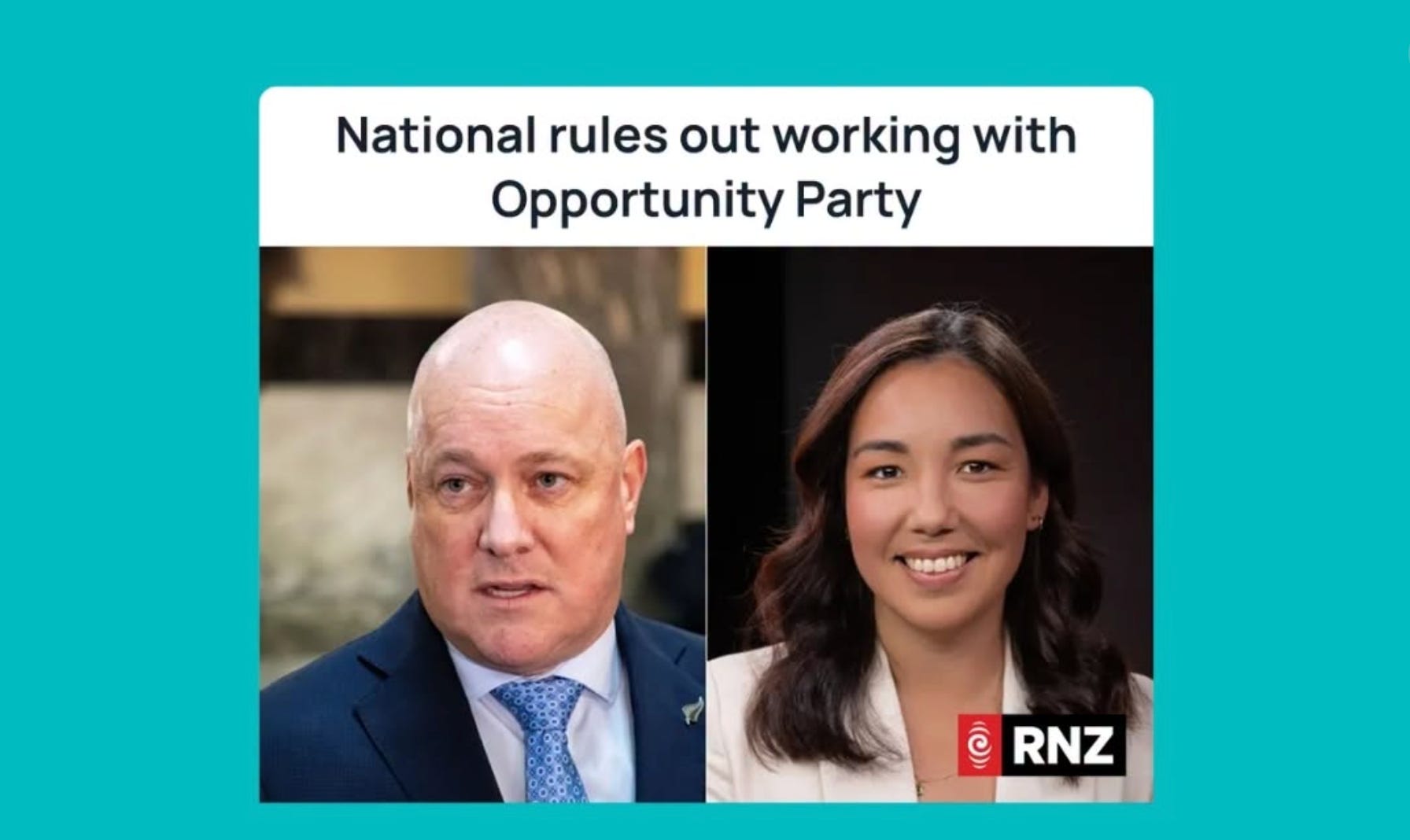
Christopher Luxon appears to have made one of the more important strategic announcements of the election campaign almost by accident. Asked at yesterday’s post-Cabinet press conference whether National could work with the Opportunity Party, the Prime Minister initially returned to his familiar lines about tax and spending. National would not “do business” with parties that wanted to “spend more, tax more, borrow more”, he said. When pressed on whether this amounted to formally ruling Opportunity out, Luxon eventually replied: “We wouldn’t be working with them.” He then noted that there was still “quite a long way to go to November 7”, ended the press conference and left. Luxon’s office subsequently told reporters that National was ruling out both a coalition and any confidence-and-supply agreement with Opportunity.
Labour campaign chair Kieran McAnulty quickly claimed Luxon had blurted out a new position without meaning to. “He did it by accident, and then he got flustered, and then he ran away,” McAnulty said. He also joked that Luxon “ran down the stairs like he was competing at the Commonwealth Games”, which suggested to him that the announcement had not been planned. The line was amusing, although the decision itself was probably not invented on the stairs. Luxon now says National’s caucus and board had been discussing Opportunity “for several months”. National had clearly been considering the issue, even if Luxon did not appear to have planned such a categorical announcement that afternoon.
The policies did not change – the polls did
National insists the rule-out is straightforward and principled. “This is a party that wants extreme policy on taxes,” Luxon told reporters the following day. “We’re a party of low taxes. It’s not a surprise we don’t want to work with them.” He also mocked Opportunity’s claim to occupy the political centre: “They’re as centrist as I am an All Black, frankly.” Previously, however, Luxon had normally responded to questions about Opportunity by saying he had not given the party much thought. He attacked its land-value tax and Citizen’s Income and suggested an Opportunity vote looked like a vote for Labour and the Greens, but stopped short of excluding it from any future arrangement.
What changed was not Opportunity’s tax programme. Versions of a land tax and universal income have sat at the heart of the party since Gareth Morgan founded it a decade ago. What changed was that enough voters began supporting it to make National nervous. Opportunity received 4.6% in the June 1News-Verian poll and 4.7% in the July RNZ-Reid Research poll.
It is still entirely possible that it will fall below the 5% threshold, but it is now close enough that neither National nor Labour can continue treating it as an interesting irrelevance. Using the RNZ-Reid Research numbers, Toby Manhire calculates that adding about 0.3 percentage points to Opportunity would carry it over the threshold and leave National, Act and NZ First without a majority.
The recent Talbot Mills polling also helps explain National’s concern. Former National voters were the largest single group among Opportunity supporters: 23% said they had voted National in 2023, compared with 18% who had voted Labour. Jamie Ensor, writing in the Herald, says National’s message is directed at traditional supporters who might be tempted to “shop around – you may not like what you end up buying”. As Ensor puts it: “With National sitting below where it polled at the 2023 election, the party will want to hold on to anyone considering wandering.”
That seems the most persuasive explanation for the rule-out. National fears that some of its own voters have decided Opportunity is a safe place to register dissatisfaction with Luxon and the present coalition. They may like Qiulae Wong’s less combative political style, want stronger environmental policy without voting Green, support reform of lobbying and political donations, or believe that weak competition in banking, electricity and supermarkets requires a more interventionist response. Some probably just want something new after years of voting for parties they no longer find convincing. National is telling these people they cannot support Opportunity while still expecting Luxon to remain Prime Minister.
National’s dream result
RNZ political editor Craig McCulloch has given the bluntest account of National’s strategy. “Christopher Luxon is clearly worried about Opportunity getting over that 5% line,” McCulloch said. “He is trying to stop the momentum, trying to box them in with the left and trying to dissuade any right-wing voters who might be considering Opportunity as an option.” McCulloch also described National’s ideal outcome. Former National voters would become frightened about helping Labour and return to National. Opportunity might gain replacement support from Labour and the Greens, but not quite enough to cross the threshold. “So that vote is wasted,” McCulloch said. “That would be his dream situation.”
McCulloch gets to the heart of the tactic. National wants Opportunity to lose enough centre-right support to remain below 5%, while continuing to take some votes from the left. In that scenario, those votes elect no MPs and are excluded when seats are divided among qualifying parties, slightly increasing the share available to those parties. National, Act and NZ First benefit. Luxon is therefore trying to change what an Opportunity vote means. Wong has presented it as an independent vote for a party capable of negotiating with either side. National wants voters to see it as a vote that could make Chris Hipkins Prime Minister.
Until now, Opportunity’s claim to be a two-way kingmaker has been central to its campaign. Wong says the party remains open to working with either major party. Its stated procedure is to negotiate first with whichever party receives the largest vote, and to approach the other side if those talks fail. The eventual result would presumably depend on what each side was prepared to offer, but the order of negotiations is not the same as simply supporting whichever party accepts the most Opportunity policies.
National’s announcement is intended to remove much of that ambiguity by declaring that, whatever Wong says, National will not enter an arrangement with her party. In practical terms, National is trying to close half of Opportunity’s political market before it reaches Parliament.
The paywall now starts partway through all Democracy Project newsletters. Please take out a paid sub if you want to support this service and access the full content, including the following sections: “A clear strategy, badly communicated”, “Principle until the numbers arrive”, and “Could the tactic backfire?”.
