

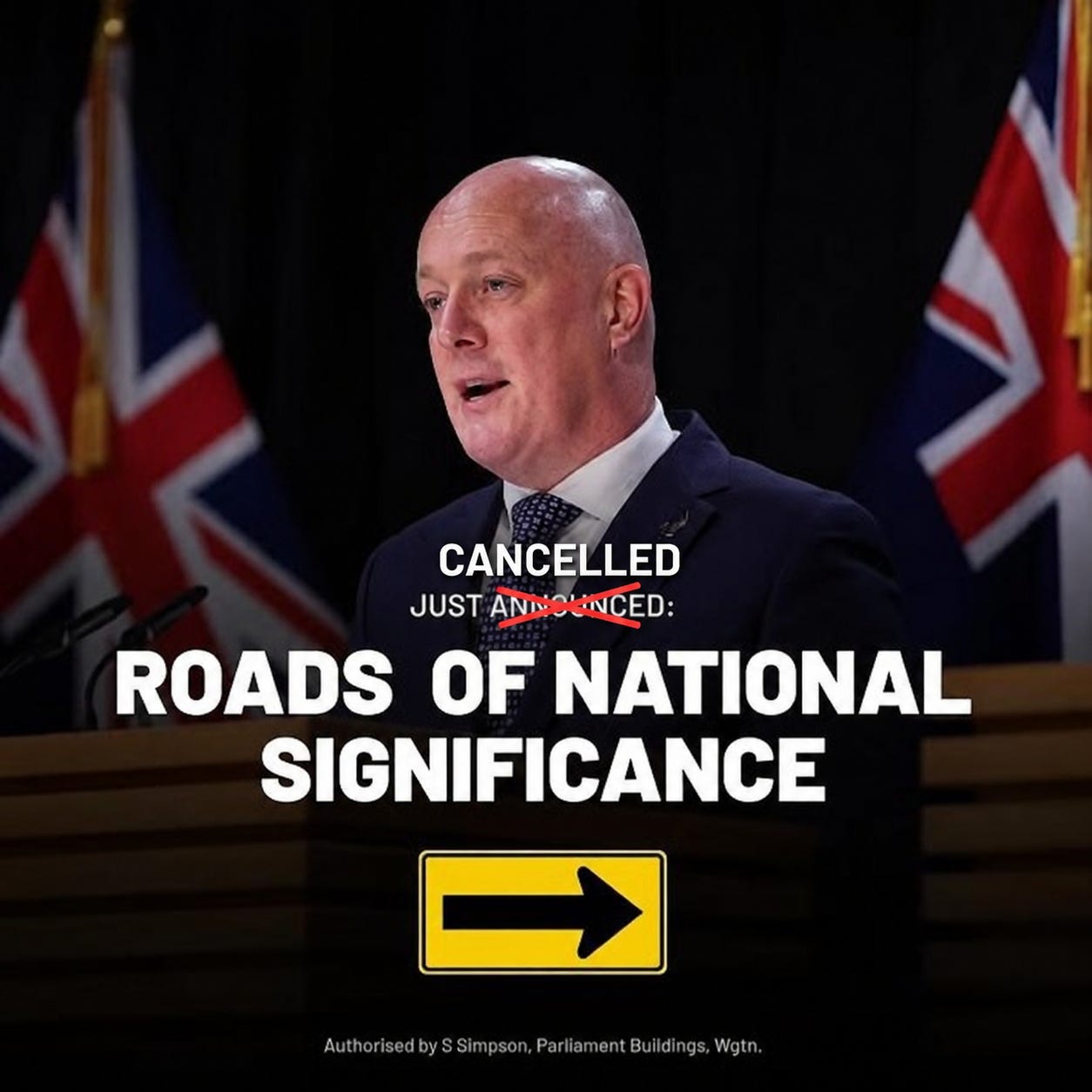
Responding to the Government’s Roads of National Significance backdown, Newstalk ZB’s Mike Hosking said yesterday that New Zealand has become famous for “talking big and doing little”. He pointed out that National has taken a credibility hit precisely because it was supposed to be the party that delivered.
Today on Stuff, Joel Maxwell calls the Government “tell-don’t-show” and describes the Roads of National Significance (RoNS) debacle as National’s version of KiwiBuild.
Even the road-freight industry is using much the same diagnosis. National Road Carriers chief operating officer James Smith says New Zealand is not good at delivering projects, especially at scale. He offered the Government a backhanded compliment: “The first step to recovery is acknowledging you have a problem.”
So the Government’s cheerleaders have ended up in the same place as its critics. This is not really an argument between motorists and urbanists any more, or between left and right. It is about whether the New Zealand state can get from announcement to asphalt.
Yesterday’s column dealt with the broken promise itself: seventeen Roads of National Significance, $56 billion, $49 billion of it unfunded, only six with credible construction dates. It is a major backdown, whatever Chris Bishop chooses to call it. But the more interesting question is why the system keeps producing promises like this one. Steven Joyce invented the Roads of National Significance in 2009. Seventeen years on, the method has barely changed.
The motorway comes before the business case
In theory, the motorway comes last. First decide what problem needs fixing, whether a motorway is the best answer and who will pay. RoNS politics starts at the other end: announce the road, name the date, then send officials away to make the numbers work.
Simon Upton, the Parliamentary Commissioner for the Environment and a former National minister, explained the mechanism in Newsroom last year. Upton is no anti-road campaigner. A rural landowner himself, he says plainly that the economy needs roads. His point in Newsroom was about the order in which decisions get made. Once a project is deemed a Road of National Significance, he wrote, “it goes straight to the front of the queue”, and calculating a benefit-cost ratio for it becomes “a rubber-stamping process”.
“If the RoNS came back below one, would they stop being RoNS?” Upton asks. “History suggests otherwise.”
With the RoNS, the political case had been settled before the economic work began.
BusinessDesk’s Thomas Manch points out this week that the new pipeline does not settle the second Waitematā Harbour Crossing, and offers nothing to replace Labour’s failed rapid-transit plan between central Auckland and Māngere. It arranges commitments politicians have already made. The pipeline sequences the projects National has already chosen. It does not show that they were the right projects in the first place.
A lolly scramble with no one in charge
The Roads of National Significance were produced by a political lolly scramble. Regional MPs want something to announce, while mayors want access to Wellington’s cheque book. The construction sector wants a steady run of contracts. Nobody turns up demanding that their own project be killed.
None of this proves improper conduct, and much of it is ordinary advocacy in an open democracy. But every incentive in the system points towards adding a project, and almost nobody inside it is rewarded for killing one.
Bishop’s announcement produced the predictable revolt. Auckland freight interests want the East-West Link and Mill Road restored. Canterbury says Woodend has waited twenty years. Wellington wants its tunnels, while Northland sees an expressway as a route out of isolation and poverty. No region has any reason to volunteer to lose, so the easiest election policy is not to choose at all. Call every desired motorway “nationally significant” and let voters assume the lot is coming.
Hosking made an observation more damaging than he perhaps intended. The problem was not the admission that the promises had been ambitious. It was the admission that “the promises were driven largely by the construction industry wanting a pipeline of work”. Furthermore, he said it “smacks of politics of convenience. It smacks of a party telling you what you want to hear.”
Eventually the bill returns as tolls, road-user charges or higher fuel taxes. But fuel taxes and tolls are eventually paid by actual commuters, many living in outer suburbs or satellite towns with no useful bus or train to switch to.
The three-year windscreen wiper
Auckland’s Mill Road proposal has become a parody of New Zealand infrastructure politics. Herald political editor Thomas Coughlan has set out the sequence: “it was part of the RoNS package National took to the 2017 election but cancelled by Labour in 2018, resurrected by Labour in 2020, cancelled by Labour in 2021, then resurrected by National in 2023 and now cancelled again by National in 2026.” Five reversals, and not one metre of motorway.
National owns the current failure, but Labour’s fingerprints are all over the same file. Every reversal produces new designs, fresh consultation, more legal work and another round of consultancy bills. Then the project returns to roughly where it started. While Bishop was announcing that Petone to Grenada will not be seriously considered for another decade, Hutt City Council was out hiring consultants to protect the route for the Cross Valley Link, the road that feeds into it.
Auckland light rail ended in much the same graveyard. So did the first Cook Strait ferry plan. Motu Move, on a vastly smaller scale, has managed its own years of redesign and delay.
Vernon Small has the best rule I’ve seen for infrastructure promises: “An election policy for the next three-year term is a promise. For the three years after that it’s a plan. For the third term it might qualify as an aim.” And beyond that? “At best it’s a slogan.”
Big infrastructure takes longer than the politicians who announce it stay in office. New Zealand has never built any protection around worthwhile projects so that they survive a change of government, and it has never built a process trusted enough to kill the bad ones early. We end up with the worst of both: weak projects gathering momentum, sound projects at the mercy of the next reshuffle.
And the churn is not free. Economist Shamubeel Eaqub, in a report commissioned by three infrastructure-sector organisations with an obvious interest in a steadier programme of work, put the cost of the stop-start cycle at $11.8 billion over 25 years. Designs are commissioned and then abandoned. Projects are rescoped and assessed again. The report says taxpayers and ratepayers can end up funding the same work twice, while plans that never proceed still have to be paid for. Some of the planning and professional costs are incurred whether the physical project survives or not. The public pays for the plan, then pays again for changing it.
Tim Welch at the University of Auckland puts the structural problem plainly: “Politicians need quick wins within three-year electoral cycles, while infrastructure projects take decades to deliver. Projects are approved based on lowball estimates, with the outcome inherited by another administration.” No minister needs to be stupid for the result to be stupid.
The paywall now starts partway through all Democracy Project newsletters. Please take out a paid sub if you want to support this service and access the full content, including the following sections: “Maintenance does not cut ribbons”, “The numbers you are not allowed to see”, and “A pipeline worth believing in”.
