

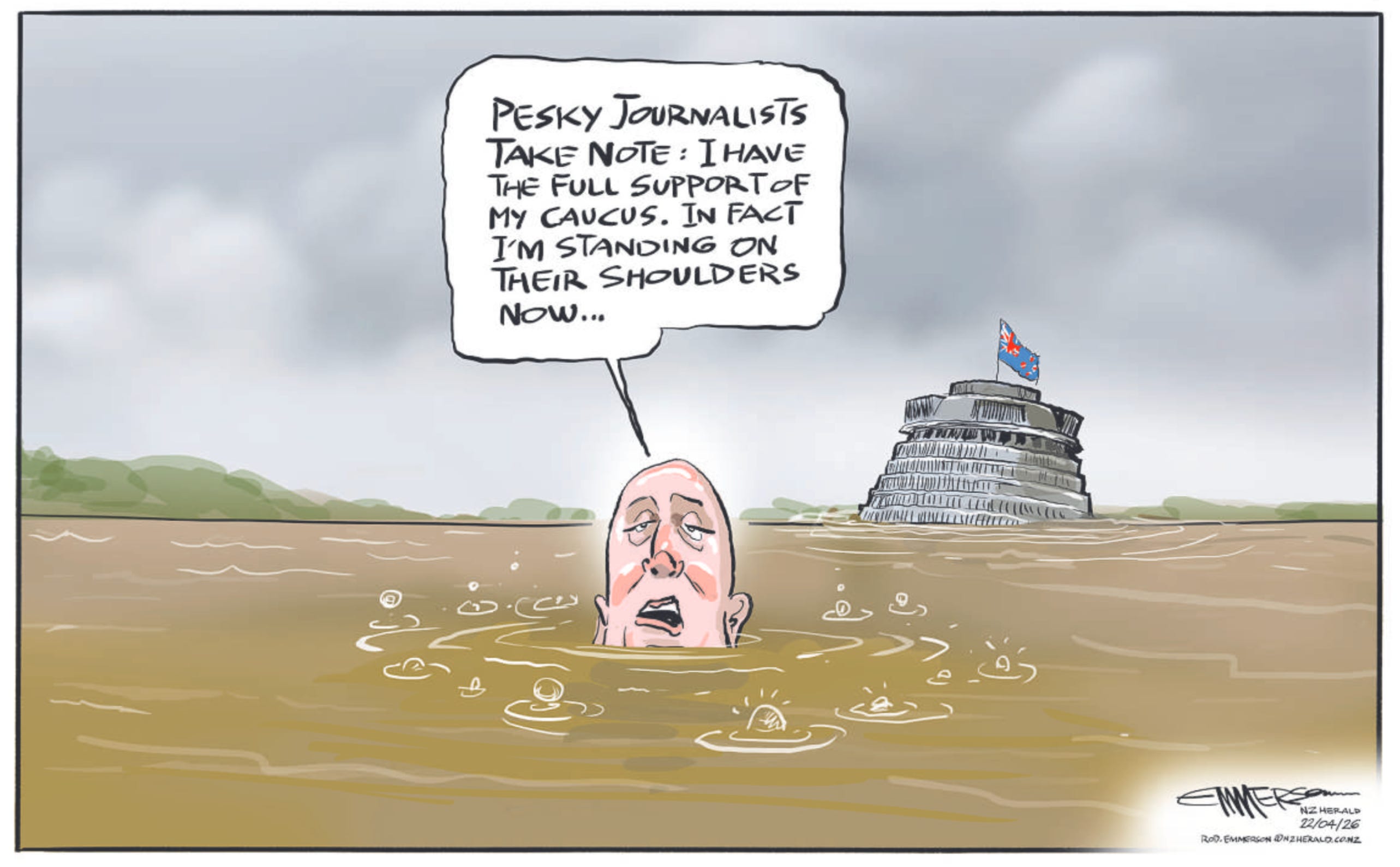
Christopher Luxon survived. Yesterday he walked into a National caucus meeting and called an unexpected confidence vote on his own leadership. He won it. The doubters didn’t put up. So for now, they’ve been told to shut up.
It’s the framing Luxon wants us to take away. And it’s not entirely wrong. It was a bold move. He called his detractors’ bluff, and they blinked. Stuff’s political editor Jenna Lynch put it best: “His doubters were told to put up or shut up. They didn’t put up anything. So for now they have to shut up.”
But the interesting question isn’t about Luxon surviving yesterday. It’s how long he goes before he has to do something like this again.
A Vote won, not a problem solved
The most useful line from the day is Luke Malpass’ in The Post: “A vote won, not a problem solved.” And every serious political editor has said some version of that. Coughlan in the Herald: “if the polling continues to suffer, then unity will, too”, and “Luxon is far from being out of the woods”. Sam Sachdeva at Newsroom: “silencing internal dissent will not magically reverse” a party’s “sagging popularity and the parlous state of the economy.” Thomas Manch at BusinessDesk: “confirming the caucus’ confidence only solves the immediate problem. What he really needs is the country’s confidence.” The Otago Daily Times editorial today was even more blunt, saying: “this matter is far from closed.”
None of this should be comforting for Luxon.
The caucus vote only measures where support is on a given morning. It doesn’t measure the deeper problem, which is that Luxon’s personal polling is heading towards what Coughlan calls the “death zone,” that National is tracking somewhere around 29% in the poll of polls, and that nobody seriously expects either number to improve by accident.
Malpass is right that no caucus has yet decided 29% is the line for getting rid of a leader. But a line exists. If National drops another two or three points, as Heather du Plessis-Allan warned, “all of this is just going to start up again. MPs will see themselves at risk of losing their jobs, they’ll freak out and the chatter will resume.” Hard to argue with.
The Rebels weren’t beaten, just silenced
A confidence vote doesn’t turn enemies into friends. All it does is put them on the back foot for a while. Every political editor who has written about the vote accepts that the underlying dissent has not gone away. Coughlan puts the arithmetic plainly: “Forty-nine MPs is a lot of people to keep in line, particularly when National’s polling continues to suffer. Someone, probably multiple people, are likely to break ranks again.”
Richard Harman at Politik, who is possibly better connected with the National caucus than anyone writing today, says the Hosking-named five are not the whole story: “as far as POLITIK understands, there may be at least another three or four.” Coughlan agrees: “Luxon is likely to know those names only scratch the surface of dissent.”
Matthew Hooton (writing in his Patreon newsletter) has gone further, arguing that the five who were named are likely fronting for a larger group – MPs who hold safe seats and can afford to be visible, acting on behalf of list MPs and those in marginal electorates who can’t afford the same exposure: “That also suggests to me that they have been put up to make complaints to the whips about the Prime Minister’s incompetence on behalf of a bigger group which includes MPs from the list and with smaller majorities who are not so politically safe personally”.
Van de Molen, for what it’s worth, was asked directly whether he had written a letter of no confidence for Stuart Smith to pass on. He did not respond. That’s not quite a denial.
Coughlan’s line on this is the one to remember: “What is being said in public is not the same as what is being said in private. Can the National Party continue to sustain this kind of double life?”
The Stuart Smith mystery
Why wasn’t Stuart Smith at the caucus meeting yesterday?
The official explanation of a “longstanding personal appointment” began to strain credibility almost immediately. As Coughlan noted, Smith had told The Post on Monday night that he’d been trying to fly to Wellington but had been delayed by weather, and intended to arrive on Tuesday morning. By Tuesday morning, he hadn’t arrived on any flights.
Henry Cooke at The Post asked the right question: “What on earth was going on with chief whip Stuart Smith?” Smith had spent days neither confirming nor denying the original Herald story — the story, sourced to four people including multiple MPs, that he had sought a meeting with Luxon to convey flagging caucus support, and that Luxon had ignored the request. Then, on Tuesday, after days of silence, the Prime Minister’s office released a statement in Smith’s name offering a more emphatic denial: “I did not contact the Prime Minister or his office seeking a meeting.”
Cooke again: “If the Prime Minister had a statement like that in his back pocket, why not use it to douse the fire on Friday?”
Jo Moir at RNZ noted that “Smith’s statement and denials needed to have landed on Friday if he and Luxon wanted them to be believed. It’s not credible to wait four days to put out that statement.” She also observed that when Simeon Brown was asked whether Luxon or his office had pressured Smith into making the statement, Brown refused to answer multiple times.
The Herald, for its part, says it stands by its original reporting and has not been asked to issue a correction. Neither, apparently, have any of the other outlets that confirmed the story with their own caucus sources.
Moir has speculated that Smith’s days as Chief Whip could be numbered: “The next caucus vote could end up being for a replacement senior whip.” The fact that Smith was absent from yesterday’s meeting meant he was also absent from the count — the scrutineers were party president Sylvia Wood and junior whip Suze Redmayne, not Smith, who would normally have played that role. In a meeting that was specifically about Luxon’s leadership.
At the very least, it doesn’t pass the smell test.
Was the Vote Really Unanimous?
Luxon, in the House, declared after the vote that he had the “absolutely” unanimous support of his caucus. Finance Minister Nicola Willis reiterated the National Party convention that only the scrutineers know the actual numbers. The two claims don’t really fit.
The Herald has said plainly that it has “good reason to believe” the vote was not unanimous. Malpass notes that “Luxon described the result as ‘clear and decisive’ but the convention of the National Party is that the caucus only find out the end result — only the scrutineers know the numerical result of the vote. No one outside them should know.” The Otago Daily Times editorial made the same point: the very fact that a vote was necessary at all tells you that unanimity was never the reality.
If the numbers weren’t as clean as claimed — and there’s good reason to think they weren’t — this will matter to the dissenters. Lynch: “If there’s any indication it was a close vote, that could kick off another round.”
The paywall now starts at halfway through all Democracy Project newsletters. Please take out a paid sub if you want to support this service and access the full content, including the following sections: “Naming names on Newstalk ZB”, “The Polls are Luxon’s real problem”, “Attacking the media is another tell”, and “When does it bubble up again?”.
