

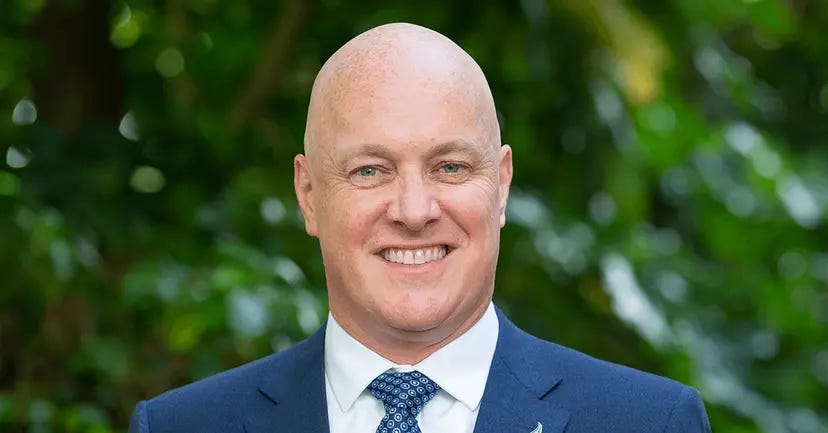
Christopher Luxon’s position as Prime Minister and National Party leader is looking increasingly precarious as the 2026 election approaches. Polling data has been unrelentingly bleak for Luxon.
Luxon’s personal popularity is deeply underwater, with net favourability ratings “between -10 and -24 in recent polls” according to Heather du Plessis-Allan, writing today in the Herald on Sunday. She quips that Luxon’s support is “so low it’s almost drilling through to China”.
In a recent The Post/Freshwater Strategy poll, fully 49% of voters (and nearly a quarter of National voters) said the party should replace Luxon as leader. National has been trailing the opposition in most surveys – winning outright in only 7 of the past 23 polls (Labour led in 16).
Even more worrying for National, last week’s Ipsos issue survey showed voters now trust Labour more than National to manage the economy, which is a stunning loss of what used to be National’s core strength. But most concerning, the survey showed voters giving the Government a rating of 3.9 out of 10 for its performance.
As Luke Malpass, the political editor of the Post, notes, Luxon’s numbers are “devastating” for him and “a damning indictment on Luxon’s performance”. Malpass writes in the Sunday Star Times today that by historical standards, “he is a very unpopular prime minister”.
The real question isn’t only whether Luxon can survive politically, but whether he, or any successor, can meet a basic integrity threshold at a time when public trust in government is fragile.
Mounting speculation and criticism from all sides
Unsurprisingly, the Wellington political scene is abuzz with speculation about Luxon’s future. Commentators across the spectrum are openly questioning whether he can or should survive as leader much longer.
For example, Heather du Plessis-Allan writes today that National MPs “have to choose. Do they continue with Chris Luxon and hope their leader improves? Or do they choose someone else? She reports that talk of rolling Luxon has become rife in the capital – at a recent Parliament event, “the possible rolling of Luxon was the talk of the event… One name kept popping up. Chris Bishop” as a better alternative. Bishop, she argues, possesses many qualities Luxon lacks (“political instinct, clear answers… confidence”). Meanwhile, Luxon is seen as a “drag on National’s popularity”, with personal ratings so poor that “sticking with Luxon is a risk” in itself.
Du Plessis-Allan warns that National “can’t continue as it is. Something has to change. And time is ticking.” In her view, if a move against Luxon is coming, it should happen before Christmas to give voters the summer to adjust to a new leader.
Seasoned National-aligned provocateur Matthew Hooton has gone even further. Back in September, he essentially called time on Christopher Luxon’s leadership and sketched out scenarios for his exit. In NZ Herald columns, Hooton has painted a picture of approaching doom for Luxon, replete with rumours of a “smooth transition before Christmas” to some fresh-faced successor.
Hooton wrote that the caucus consensus is that the election cannot be won under Luxon. And he highlights dire polling, citing one survey where Luxon’s preferred-PM rating slid to 20%. According to Hooton, Luxon is likely to get a gentle push for a “managed exit” to save face, rather than face a messy coup.
In his most recent column on the topic, on Friday, Hooton delivered perhaps the most devastating assessment. Senior ministers, he reports, “say this Government lacks a Prime Minister who can comprehend and pull it all together, communicate the vision that underpins it and build confidence among voters and the business community that he and his ministers know what they are doing.”
But if Hooton wasn’t clear enough about what he thought of Luxon’s leadership, he elaborated on Friday in an interview on Herald NOW: “I think that he lacks a deep knowledge of New Zealand and its people. I think he lacks intelligence. I don’t think he is able to talk in a sophisticated manner about anything really, and he is reduced to slogans and he just isn’t connecting with the public”.
This aligns with veteran journalist Audrey Young’s observation that Luxon appears to be “running the Government like a sports team”, focusing on management metrics and game plans rather than the political substance and vision required of a Prime Minister.
Other journalists have also chronicled the leadership chatter. NZ Herald political editor Thomas Coughlan wrote yesterday about “the week the National coup rumour went into overdrive”, describing an unusual frenzy of speculation of recent days. He reports: “Senior MPs, and figures with support, are dead set against a change, not because a better leader cannot be found, but because change is itself destabilising.”
He plays down the chance of a coup, but says: “Chris Bishop is the person rumour puts at the top of the ticket. Erica Stanford, progressive, and seemingly well-liked, would be deputy, shattering years of National Party tradition of having a liberal and a conservative at the top of the party.”
There is even murmuring from within Luxon’s own Government. Multiple ministers and backbenchers are privately grumbling about the direction of the party. Coalition partner Winston Peters has been openly undercutting Luxon too – pointedly refusing to say Luxon is doing a good job, and posturing as if Luxon’s National Party needs NZ First more than vice-versa. All of this creates a perfect storm of pressure on Luxon’s leadership.
The Dilemma: Stick or twist?
Despite the growing chorus of criticism, actually removing a sitting Prime Minister is no simple matter. National’s caucus faces a high-stakes dilemma: risk a change at the top, or persevere and hope for a turnaround. There are several reasons why, so far, Luxon’s job remains intact.
First, the risks of a coup are profound. As du Plessis-Allan notes, “rolling a Prime Minister is a different ballgame from rolling an Opposition leader”, as it telegraphs instability, infighting and distraction to voters. A mid-term leadership change could spook the public and break the image of a government focused on doing its job.
It could also wreak havoc on National’s governing arrangements. The National-led coalition depends on support from Act and NZ First, whose mercurial leaders might not react kindly to a new prime minister mid-stream. Indeed, rumours circulated that Winston Peters believes coalition agreements are personal to the leaders who sign them, implying NZ First’s deal might be void if Luxon is replaced.
The fear that Act or NZ First could walk away from the coalition is the only thing holding up the challenge, according to some analysis. In short, a leadership coup could trigger a government collapse or snap election, a scenario most National MPs desperately want to avoid.
Second, there’s the Nicola Willis problem. Willis is Luxon’s Deputy and Finance Minister, and by many accounts, she shares in the blame for the Government’s poor performance. The economy has been teetering on recession, and much of the bad news (shrinking GDP, rising unemployment, etc.) can be traced directly to Willis’ austerity-focused decisions.
As veteran columnist Gordon Campbell observes, Luxon might have been “replaced long ago if doing so didn’t compound the vexed problem of what to do with the Finance Minister”. Pushing out Luxon but keeping Willis in place could look like “re-arranging the deck-chairs… after hitting the iceberg”, since Willis herself helped steer the ship into trouble.
On the other hand, ousting both Luxon and Willis – a double purge of the leadership – would smack of outright panic. National’s caucus has to consider whether they have the appetite to not only knife their leader, but also effectively demote the second-highest ranking figure in their government.
This leads to paralysis: Luxon stays, in part, because removing him alone might not be enough to impress voters, yet removing his deputy as well is too explosive. In Campbell’s eyes, it doesn’t help that Willis and Chris Bishop are extremely close allies who have “operated as a team” for years. Bishop himself is said to flatly oppose any move that would “demote Nicola Willis”, making it “impossible to imagine” him leading a coup against Luxon that forces out his friend. This tight alliance effectively ties the fates of Luxon, Willis, and Bishop together, complicating any leadership change.
Finally, National MPs are known for their caution and inertia. They remember the chaos of opposition in 2020–2021 when the party went through three leaders in quick succession. This has made Luxon’s critics somewhat cowardly, keeping to the status quo, even though they know it’s not going to work out.
Hence, even with dire polls, no delegation has marched to Luxon’s office with an ultimatum. So, barring an absolute calamity in polling, the default mindset is to give Luxon more time. The party’s hope is that an improving economy in 2026 might lift National’s fortunes (and perhaps Luxon’s personal appeal) enough to scrape through.
All that said, National’s patience is not unlimited. Insiders suggest that if a move on Luxon is to happen, it would need to occur very soon. Heather du Plessis-Allan argues today that they need to move quickly: “If they choose to pull the pin and gamble on a new leader, they really should do it this side of Christmas.” A pre-Christmas change minimises disruption, giving the new leader the summer to introduce themselves to voters and present a refreshed image.
Once 2026 is in full swing, it may be too late (or too close to the election) to change horses. Every National MP knows the stakes: at current polling, du Plessis-Allan says “plenty of them will lose their seats next election”. That pressure for self-preservation could yet override their reluctance. The coming weeks will be decisive in showing whether Luxon really has stemmed the bleeding, or whether caucus nerves snap and a coup is attempted despite the risks.
The Contenders: Who might replace Luxon?
If National did roll Luxon, the next question is: who would take the helm? A number of names are circulating in media and political circles. Here are the leading contenders often mentioned, and the pros and cons they carry:
Chris Bishop: Currently Minister of Transport, Infrastructure, and Housing (and Leader of the House), Bishop is widely seen as the front-runner to succeed Luxon. He’s often described as National’s rising star: a workhorse minister whom one veteran journalist even labelled a “superman in terms of workload and achievement”.
In that recent poll of National changing its leadership, Bishop was the public’s preferred alternative for National leader, and commentators like Duncan Garner have dubbed him “the Prime Minister in waiting”.
However, serious questions hang over Bishop’s approach to politics and integrity. As I have written in another column recently, Bishop’s career has become “a case study in ethical corner-cutting”, and I have described him as a consummate political “operator”, “captured by big business and crony capitalism.” And this week’s relatively minor “pork-barrel” scandal over his decision to divert $27 million from a housing infrastructure fund to pay for a pet project in his own electorate seems to bear this out.
Similarly, Janet Wilson, the former National Party staffer turned columnist, wrote scathingly this week about Bishop’s integrity deficit: “Increasingly, riding roughshod over process is branding Bishop less as a guy who gets stuff done and more as one indulging in good old-fashioned pork barrelling.”
She sums up Bishop: “Power confers this hypocrisy, as does increased aggression, less empathy and a sense of entitlement, all of which characterise this Government.” Furthermore, Wilson argues that this sense of entitlement has “tightened National’s circle of influence so much that now it’s a corset around its girth”, warning that the party is increasingly only listening to those with financial reasons for talking to them.
Critics also point to Bishop’s early career as a lobbyist for tobacco giant Philip Morris, suggesting that his lobbying instincts never left and have informed his cavalier attitude toward public process. On the upside, Bishop is undeniably a skilled communicator and strategist, and his push-the-boundaries style appeals to National’s more hard-nosed operatives who just want to “get things done.” He would likely relish taking on Labour’s Chris Hipkins in an election fight. But Bishop’s ethical baggage and ruthless reputation could just as easily turn off voters (and coalition partners). What is viewed as political savvy by the National establishment may be seen as a red flag by the public. These concerns make Bishop a polarising choice – simultaneously the most capable candidate and the most potentially compromised.
Nicola Willis: As Deputy Prime Minister and Minister of Finance, Willis would ordinarily be the presumptive next-in-line for leadership. She is experienced, articulate, and was instrumental in rebuilding National’s machine alongside Luxon in opposition. Some in the party’s base would welcome her as a stabilising, collegial leader. But Willis’ chances are hampered by both performance and political dynamics. Fairly or not, she is identified with the Government’s current economic troubles – one commentator bluntly writes that Willis “steered the economy straight into th[e] iceberg” with cost cutting.
Economic pain (high interest rates, rising unemployment, falling business confidence) has badly hurt National’s standing, and much of it “can be traced directly back to the decisions made by Willis”. If Luxon is seen as underperforming, Willis as Finance Minister arguably shares the blame, meaning simply swapping Luxon for Willis might not satisfy the public.
Hooton notes that Willis’s close loyalty to Luxon has blemished her shine as a fresh alternative. Furthermore, Willis faces a structural obstacle: her partnership with Chris Bishop. The two have long been allies (famously plotting together in 2021 to install Luxon as leader) and are viewed as leading the party’s liberal wing in tandem. It’s widely believed that Bishop would never topple Luxon in a way that “demotes” Willis, given their friendship. Conversely, if Willis tried to take the leadership herself, she may lose Bishop’s support and perhaps that of his faction in the process.
National’s caucus also has to consider balance: Willis, like Bishop, is a social liberal from Wellington. Would the party accept two liberals in the top two jobs? Many doubt it. In fact, insiders suggest that if Willis somehow became leader, Bishop might have to be sidelined (or vice versa) to placate National’s more conservative base. All this makes Willis’ path to the top complicated. She remains a key powerbroker and is likely to stay as Finance Minister, but as a leadership contender, her moment may have passed.
Erica Stanford: The Education Minister and MP for East Coast Bays, Stanford has recently emerged as a dark-horse leadership prospect. She is relatively young, with a reputation as one of National’s more progressive and well-liked MPs. Her advocates argue she could broaden National’s appeal, especially in Auckland and among women, and bring a more compassionate image. She’s known as a capable media performer and is credited with a good instinct for retail politics.
However, Stanford’s elevation faces significant hurdles. For one, choosing her would break an unwritten National Party tradition of balancing a leader-deputy ticket between a liberal and a conservative. Stanford and Bishop together (the most likely pairing in a coup scenario) would put two urban liberals at the top. Thomas Coughlan explained in yesterday’s Herald that National’s still-sizeable social conservative bloc (until recently nicknamed “the Taliban” in caucus lore) “probably has other ideas” about that kind of ticket. They might insist on a more right-leaning counterweight or simply oppose Stanford’s promotion outright.
Additionally, questions have been raised about Stanford’s untested baggage. Martyn Bradbury, channelling his Labour sources, says this week that, “It can’t be Erica because of her skeletons”, suggesting there may be personal or past issues that, once she’s in the spotlight, Labour would immediately weaponise. Whether or not such ominous predictions are fair, the mere whisper of hidden controversies will make some National MPs nervous about backing Stanford for the top job.
Louise Upston: Upston is the name that Labour figures raise as a conservative with low baggage who could steady the ship. She has not, however, been a prominent fixture in public leadership speculation. Yet some in the caucus reportedly see Upston as a potential “compromise candidate” for leader in the event Luxon is rolled. Upston is a party veteran (first elected in 2008) with ministerial experience in the Key/English era. She’s regarded as a steady pair of hands and sits ideologically toward the centre-right of the caucus – more traditional and low-profile, which could reassure colleagues.
The scenario being floated is intriguing: in a leadership spill, Chris Bishop would take over the finance portfolio (replacing Willis as National’s economic figurehead) while Upston becomes leader as a safe, unifying choice. In essence, Bishop would supply the policy heft and campaign savvy behind the scenes, and Upston would serve as the amiable, uncontroversial front-woman for the party. This approach would aim to avoid the divisiveness of a Bishop-or-Willis showdown by elevating a neutral third party. It would also answer the caucus desire for a leader from the more conservative/provincial wing to balance Bishop’s liberal influence.
Upston’s appeal is that she carries little baggage and might keep both the base and coalition partners comfortable. However, it’s unclear how much traction this idea really has. Such an arrangement would be highly unusual, and it’s questionable whether Upston has enough support to clinch the leadership on her own merits. There’s no guarantee it would boost National’s electoral chances, and it might even create new problems if the public doesn’t warm to her quickly or if the Government falls apart.
Outlook: Will Luxon last until 2026?
National MPs are caught in a bind. On one hand, the evidence against Luxon’s leadership is mounting: dismal polls, an unhappy caucus, restless coalition partners, and a sense that the government has lost its narrative. These factors have led many observers to conclude that Luxon’s tenure may be untenable. On the other hand, the risks of change are enormous, and no consensus alternative has yet united the party.
As things stand, the safest prediction is that National will hesitate to pull the trigger – at least in the immediate term. The party’s recent history and cautious culture suggest Luxon could very well lead them into the 2026 election by default, simply because MPs cannot agree on a better path.
Matthew Hooton has updated his assessment of the probabilities of change on a blog post on Patreon this week: “the chances of a leadership change, at least this side of the election, are below 50%. Erica Stanford’s advisors, in particular, think there is no hurry. And the caucus, while having no confidence in Christopher Luxon, thinks the transaction risks are too high.” He adds: “Still, as long as the polls suggest the Coalition will be re-elected by even this narrow margin, the National caucus will almost certainly hold the blade at the top of their guillotine.”
Therefore, being “safe for now” is a far cry from truly secure. Luxon heads into election year as a marked man, under extraordinary pressure to improve National’s fortunes. If the polls continue to flatline (or worse, fall further), the grumbling in his caucus will only grow. There is a point at which even risk-averse MPs may conclude that any change is better than certain defeat.
Dr Bryce Edwards
Director of the Democracy Project
Further Reading:
