

It has been one of those days in politics when everything accelerates. This morning I published a briefing warning that Christopher Luxon and National were in serious trouble after leaks of a dire Taxpayers’ Union-Curia poll. By lunchtime the numbers were official: National on 28.4 percent. By mid-afternoon the conversation had shifted from “if” Luxon might leave to “when and how”.
I don’t normally publish two columns in a day. But when the question of whether a sitting Prime Minister will survive the weekend becomes the dominant political story in the country, it’s worth making an exception.
So here’s where we are, as of Friday evening: a large chunk of the press gallery is now openly asking whether Christopher Luxon will resign, be pushed, or somehow dig in and survive. Here’s what the best political journalists in the country are reporting and arguing.
From “if” to “when”
Perhaps the most significant piece of analysis today came from the Herald’s Jamie Ensor and Thomas Coughlan, who wrote that today’s poll “shifted the needle on the likelihood of Prime Minister Christopher Luxon’s premature departure “from an ‘if’ question to something closer to a ‘when and how’ question”. They add the important caveat: “That doesn’t mean a leadership change will happen, just that it feels far more likely now than it did at the beginning of the week.”
But what’s most telling in their reporting is what didn’t happen. The MPs who usually hose down unhelpful leadership speculation were, Ensor and Coughlan write, “suspiciously silent on Friday.” National MPs went to ground after much chattering about the poll on Thursday night. And there are rumours that Luxon is considering his future, though “short of admitting this is the case himself, those rumours can’t be substantiated to a high level of certainty.” Of course they can’t. Because, as the Herald notes, “Luxon can’t admit he’s considering his future, because that would effectively bring about his end.”
But there’s arevealing detail. One view within the party is that Luxon will be given the weekend to make his own decision. And within that view, Ensor and Coughlan detect “the hope that Luxon, in considering his position, will stand down.”
If he doesn’t, the consequences could get ugly. MPs who want Luxon to go “may begin undermining him. That may include briefing unfriendly details to the media,” the Herald reports. “That could get particularly ugly just months out from the election.”
Luxon “shaken” and gone to ground
Stuff’s Jenna Lynch reported that Luxon has “gone to ground, deciding to hole up and have a good hard think.” He cancelled a planned appearance at the Auckland Boat Show on Sunday (although his office says that had nothing to do with the poll). Political insiders, Lynch writes, “have indicated to Stuff that the prime minister is shaken by today’s horror poll result, and he is taking some time to consider his options.”
For those who know Luxon, even the idea that he’s pausing to reflect is extraordinary. Lynch describes him as “a man who is very confident in his abilities, often-times to his detriment.” He is known, she writes, to “shirk advice from staff and even political veterans seeking to help him out, so sure he is in his own direction and management-style.”
Lynch makes the important point that Luxon can’t entirely blame his Iran debacle for this poll. The polling was conducted between Saturday and Tuesday, so the worst of Luxon’s cringe-worthy post-Cabinet press conference wouldn’t have registered with the wider public in time. But, as she says, “it definitely reverberated through his caucus and the Beehive. It’s uncomfortable watching someone fail.”
And then Lynch lands what is perhaps the best single-line summary of the mood inside National right now. Behind the scenes, she writes, MPs have been saying things like: “he has support for as long as he wants to do it.” Think about that phrasing. “As long as he wants it” – that puts the onus back on Luxon. It’s not a vote of confidence. It’s an invitation to leave.
The Deputy’s devastating remarks
Much of the political commentary today has focused on what Nicola Willis said this morning – and what she carefully didn’t say. Willis told Newstalk ZB the 28% recorded by National was “not a good number,” that if reproduced at the election it would be “unacceptable,” and that “it had not been a great week for the Prime Minister.”
Asked if Luxon was the right person for the leadership, she simply said: “He has the backing of the National Party caucus.” That phrasing, as Ensor and Coughlan note, was “about as scathing as you can get before being outright disloyal.”
They compare Willis’s carefully calibrated fence-sitting with what Justice Minister Paul Goldsmith said: “Luxon won’t be going anywhere. He is doing a very good job.” That’s loyalty. They say it “suggests a balancing act between Willis’ loyalty to the current regime and the fact that she has to position herself for a potential future one.” She also said she didn’t believe a coup would occur before the election. That, of course, does not rule out Luxon resigning.
“Insiders are preparing for Luxon to resign”
Andrea Vance, writing in The Post, is perhaps the most direct of all the press gallery commentators: “Insiders are preparing for Luxon to resign rather than be pushed. His confidence has been visibly shaken in the last couple of weeks and he looks increasingly fed up in the job, irritated with media questions.”
Vance opens with a memorable line: “When Donald Trump fired a strike to take out the Supreme Leader, it probably wasn’t Christopher Luxon he had in mind. But here we are.”
Her assessment is that a voluntary resignation would actually be the tidiest outcome for National, as it removes “a highly unpopular figurehead” without requiring an internal coup, and it would settle Winston Peters, currently in Brazil, “who does not take kindly to moves made at the top of Government without him.”
But Vance adds an important warning about what comes next: “This poll means Luxon’s exit may now be inevitable. But National’s real test will come in what, and who, follows.”
The John Key factor
RNZ’s Jo Moir has written one of the most insightful pieces of the day, focused on what it would actually take to get Luxon to quit. Her answer: John Key.
Key and Luxon are close, Moir writes, and throughout Luxon’s time in office “he has checked in almost weekly with the former prime minister.” They usually catch up at the weekend, and the next 48 hours will be pivotal.
But Moir also exposes a key problem with the Key-as-saviour theory: one of Luxon’s great weaknesses is “his inability to take feedback from colleagues, staff or officials.” That has even extended to Key, “where it’s understood Luxon has been keen to do most of the talking while Key has been left to do the listening.”
And then there is what Moir calls “another Achilles heel” – Luxon’s “complete lack of self-doubt.” This trait has recently extended, she reports, to Luxon “not reading focus group reports because much of the criticism is that it’s Luxon who is the problem.”
Moir sets out the three possible triggers for a departure: Luxon deciding he’s had enough (the least likely scenario), those closest to him – his wife Amanda and Key – convincing him the best path is stepping aside, or the caucus and his staff making it clear on Tuesday when Parliament is back sitting that he no longer has their confidence.
The Titanic metaphor
Former National MP Maurice Williamson, speaking on the Duncan Garner podcast today, offered perhaps the most colourful assessment: “Nobody ever applied for the job of captain of the Titanic after it hit the iceberg, so there’s nobody there wanting to take this job right now.”
Williamson’s view is that none of the ambitious MPs actually want the leadership at this point. “Seriously, none of them that want that, have got leadership aspirations, none of them are wanting to show that right now.” He believes “it’s past the point of no return. I just don’t think they can change.”
His prediction? “I think Luxon will try to dig in and hold the ground.” But Williamson warns the destabilisation from changing leaders could be worse than keeping Luxon, and if it’s seen as him being “hounded out of office, that it actually makes them go further down.”
On the potential loss of seats, Williamson was blunt. “Don’t rule out Chris Bishop in Lower Hutt – I don’t think he can win that seat.” And then the kicker: “Imagine that – imagine Bishop, Willis, Brownlee, all gone.” As he puts it: “Speaking of the finance minister [out of Parliament], it’s not fantasy.”
Who would replace Luxon?
Every journalist in the gallery has been running the same names. The consensus is clear on one thing: there’s no obvious frontrunner.
The name most frequently mentioned is Education Minister Erica Stanford. Andrea Vance writes that she’s “the current frontrunner” – liked by the public, especially parents, and TV-friendly. Vance says: “The consensus is any new leader must be Auckland-based”, and Stanford fits that bill. But there’s a catch: “insiders are openly fretting she could self-destruct within months under pressure.” The Herald also notes she “isn’t considered by some in the party as a team player.”
Jenna Lynch reports that Stanford “has taken some advice from a master of political manoeuvres, former foreign minister Murray McCully.” That’s worth watching.
Chris Bishop is undoubtedly capable, described by the Herald as “he is extremely talented in all the ways Luxon is not. A champion debater, Bishop would quite easily be able to argue himself out of the corners.” But he tried and failed to mount a challenge late last year, and his Auckland intensification plans have put noses out of joint. In a detail too good for the press gallery to resist, Bishop boarded a flight to India on Friday morning as the poll broke. The Herald compared it to the series finale of Friends: “Did Bishop get on the plane? He did.” If things start moving fast this weekend, it wouldn’t be surprising if he got back on a plane before the first ball was bowled at the T20 Cricket World Cup final.
Mark Mitchell is well-liked and relatable. Vance describes him as “the surf lifesaver dad you can have a beer with.” As a conservative who doesn’t alienate liberal voters, he could be a unifying figure. But he’s a Luxon loyalist who wouldn’t move against him; a vacancy would need to open for him to throw himself in.
Nicola Willis and Bishop, despite being among the most high-profile ministers, are not widely seen as being in the running. Both are liberal Wellington MPs, Vance writes, “not an attractive choice for a party that needs to win Auckland while keeping its rural spine intact.”
In all likelihood, the Herald reports, the party will try to stitch up these competing factions – conservative versus liberal, Auckland versus non-Auckland – into a leader-deputy ticket. There would be a desire to have the next leader agreed behind closed doors. Expect a lot of horse trading behind the scenes.
Why Luxon might survive
All that said, Luxon could still be PM on Monday.
This caucus is scarred. As Ensor and Coughlan point out: “The National Party caucus of today still feels the scars of cycling through three leaders within months. Most MPs place a higher premium on stability than those who rolled Simon Bridges.” Most of the front bench lived through that period with anguish. Ensor and Coughlan say: “This is not a trigger-happy caucus.”
There is also a genuine fear that a visible leadership fight this close to an election could be even more damaging than keeping Luxon. As Lynch writes, “the public hates it when political parties focus internally and start talking about themselves. Especially with the way households are struggling with right now.”
And then there’s the vacuum problem. As Lynch puts it, “there is a vacuum of actors to undertake a challenge. The bloc who would normally have the power to put things in motion, the backbench, is not overly organised. There is much less political acumen among the newer intakes when compared to some of the backbenches of National past.”
Jo Moir also sounds a note of caution about what any new leader would face: “a new leader will be coming into the job at the exact point in the electoral cycle where the coalition parties are trying to present a strong and stable government while simultaneously trying to distinguish themselves from each other.” Managing David Seymour and Winston Peters is hard enough for an experienced Prime Minister, let alone a freshly installed one.
The Numbers that matter
Let’s be clear about what 28.4% means. If that result were replicated at November’s election, National would receive just 36 seats, down from the 48 it won in 2023. National would lose 12 MPs. Many backbenchers, and even some frontbenchers, would lose their jobs.
For context: Luxon’s 28.4 is worse than the numbers that ended Bridges (30.6) and Bolger (34), and only slightly above the 26.9 that finished Collins. The key difference: those were all in opposition. Luxon’s doing this in government
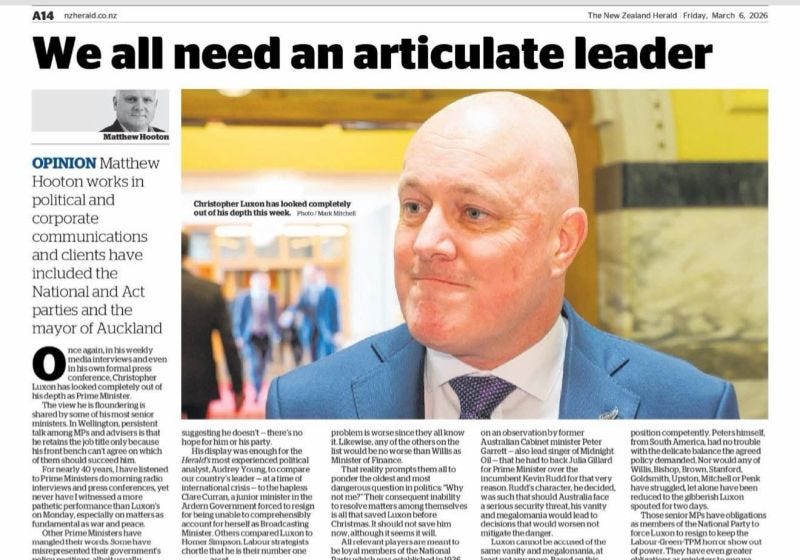
Hipkins has also overtaken Luxon as preferred Prime Minister, 22.7 to 21. And Luxon’s net favourability has hit a new low of -19. As Matthew Hooton bluntly puts it: “Luxon cannot win an election.”
What happens next
All eyes are on the weekend now. Luxon isn’t scheduled to front media again until his Monday morning slots. That’s a very long time in politics.
If he was going to take advice from anyone, it would be John Key. But as the Herald confirmed on Friday afternoon, they had no solid plans to talk. The political world will be watching for any signs, such as a cancelled engagement, a quiet meeting, a shift in language from senior ministers.
On social media and in online forums, the reaction has been ferocious. On Reddit, one user summed it up: “Party insiders anticipate that any further polls of this nature will lead to his resignation.” Duncan Garner Garner says the party has essentially told Luxon to go home and think about it.
What’s most striking about this crisis isn’t that it’s arrived – Luxon’s weaknesses have been apparent for some time. It’s that the entire senior leadership of National can see the problem, privately acknowledge it, and yet remain frozen. As Ensor and Coughlan write: “And as of Friday afternoon, National isn’t entirely sure the Prime Minister is considering his future.”
We should know more by Monday. But by then, the damage may already be done – one way or another.
Dr Bryce Edwards
Director of the Democracy Project
Further Reading:
