

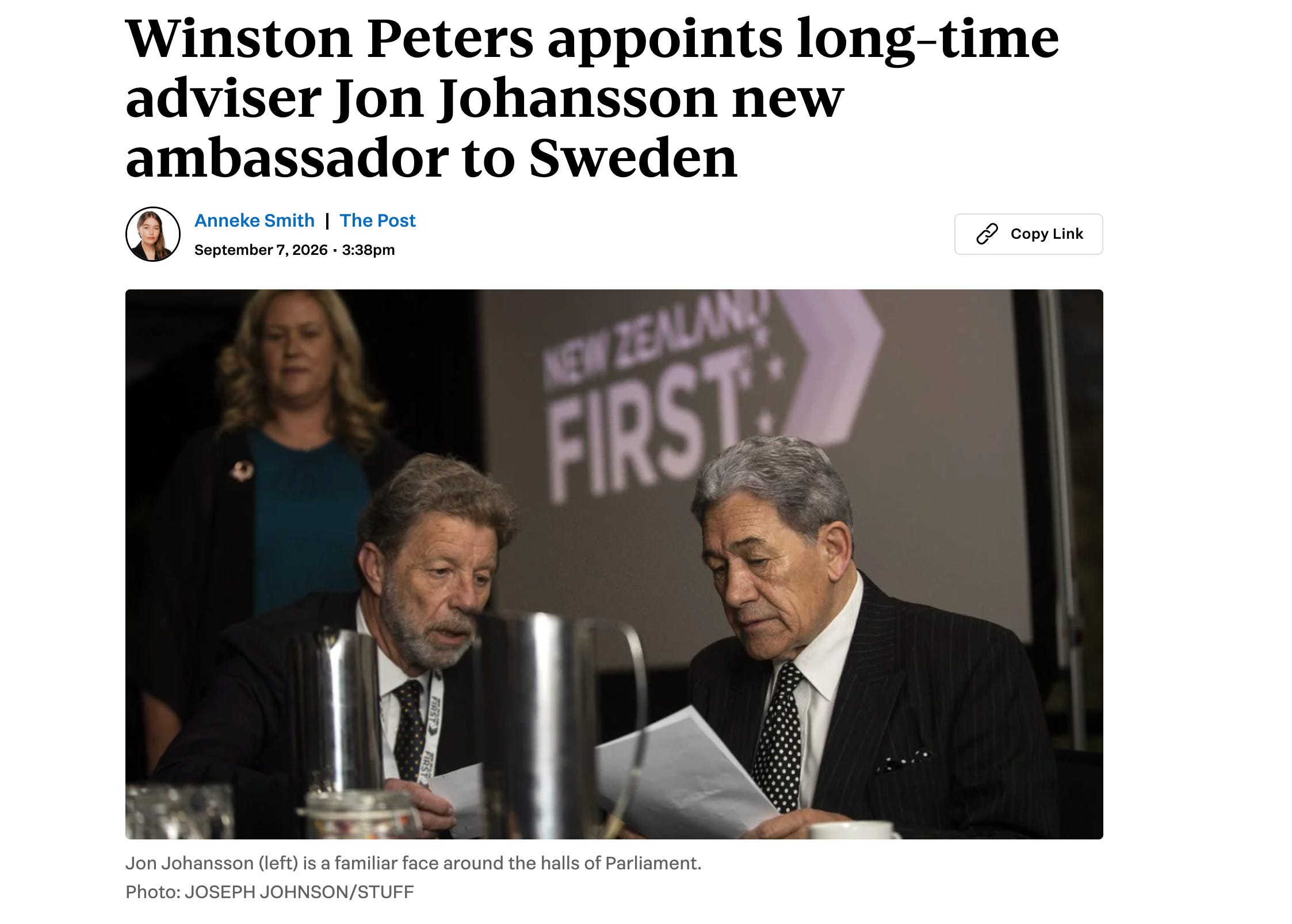
Foreign Minister Winston Peters has spent years railing against governments handing diplomatic jobs to political insiders. He has called it “jobs for the boys” and complained that trained diplomats are elbowed aside to reward politicians. In 2016 he described the pattern as a “mainly white brorocracy”. Last year, when he brought Trevor Mallard home early from his posting as Ambassador to Ireland, Peters said politicians should not be getting diplomatic jobs at all.
Now one of Peters’ own closest political advisers, Jon Johansson, has been appointed as New Zealand’s next Ambassador to Sweden.
Johansson has worked closely with Peters for much of the past decade. He was Peters’ chief of staff during the 2017–2020 Labour-NZ First government and returned after the 2023 election as a senior specialist ministerial adviser with a particular focus on foreign affairs. He travels overseas with Peters, has sat in meetings with foreign ministers, and has helped with some of Peters’ more substantial speeches. Before entering the Beehive he spent 17 years as a political scientist at Victoria University of Wellington and was a regular political commentator.
Johansson plainly has relevant experience and may well be a good ambassador. That is not really the dispute.
The problem for Peters is reconciling this appointment with the standard he has spent years demanding of everyone else. There is also a basic question about process: how are New Zealanders meant to know that Johansson was the best person available for the job, rather than simply the person the Foreign Minister already knew and trusted?
Peters’ own standard
Peters could hardly have been clearer in the past. For example, speaking to politics students at the University of Otago in 2022, he attacked the practice of governments using diplomatic postings to reward politicians leaving Parliament. He stated: “Diplomacy and diplomats should be confined to careerists dedicated to the art of diplomacy and not former politicians being ‘grass widowed’, ‘rewarded’, or as a ‘trade off’ for early retirement from politics”.
He compared appointing inexperienced people to diplomatic positions with putting “a novice into a surgeon’s operating room or a gyrocopter operator into a cockpit of a 747”. Peters added: “Only in exceptional exceptions should this rule not be followed.”
That was not a one-off. RNZ’s Russell Palmer has pointed to another particularly awkward Peters quote from 2016. Peters complained then that meritocracy in diplomatic appointments had been abandoned in favour of a “mainly white brorocracy”. Political appointments, he said, should be “the absolute exception”.
The same year, after former National minister Maurice Williamson was appointed Consul-General in Los Angeles, Peters called it “just another example of National’s jobs for the boys and born to rule sense of entitlement”. He said: “The government has elbowed aside professional and experienced diplomats who are trained and know what they are doing”. Furthermore: “We have seen too much of this sort of thing under National with former politicians holding positions of authority that rightfully should be filled by our diplomatic corps.”
And then came Trevor Mallard. Peters attacked Labour’s decision to send the former Speaker to Dublin. When he ended Mallard’s posting early last year, Peters went further: “It’s a circus where instead of looking at the national interest, you’ve got people like Jacinda Ardern appointing politicians to important jobs, and that should not be happening.” He then said: “We should not be having politicians in diplomatic jobs, full stop.” And: “I’ve opposed it in all my career.”
That was last year.
Johansson is not a former MP, and Peters can reasonably point to that distinction. He is not Trevor Mallard heading overseas after leaving Parliament.
But Peters’ 2022 argument was broader than simply keeping former MPs out of embassies. He defended a professional diplomatic service and said diplomacy should ordinarily be the preserve of people who had made a career of it.
Johansson is certainly outside that conventional career-diplomat route. He is also about as politically close to the Foreign Minister as it is possible to be. Audrey Young reported in the Herald in 2024 that Johansson’s advice to Peters was independent of the official advice supplied by the Ministry of Foreign Affairs and Trade, and that he had written some of Peters’ “chunkier speeches”. The Post has described Johansson as belonging to Peters’ closest circle of advisers. Peters himself described Johansson in a 2019 speech as his “most senior and trusted advisor”.
So this is not just another outsider with some political experience. The appointee was serving as one of the Foreign Minister’s own most trusted advisers.
Yet there has been surprisingly little scrutiny of how Johansson actually got the job.
The paywall now starts partway through all Democracy Project newsletters. Please take out a paid sub if you want to support this service and access the full content, including the following sections: “How did Johansson get selected?”, “Diplomatic jobs have become part of politics”, “Labour will not make too much noise”, “The Wellington revolving door”, “Why now?”, and “Peters should explain the appointment”.
