

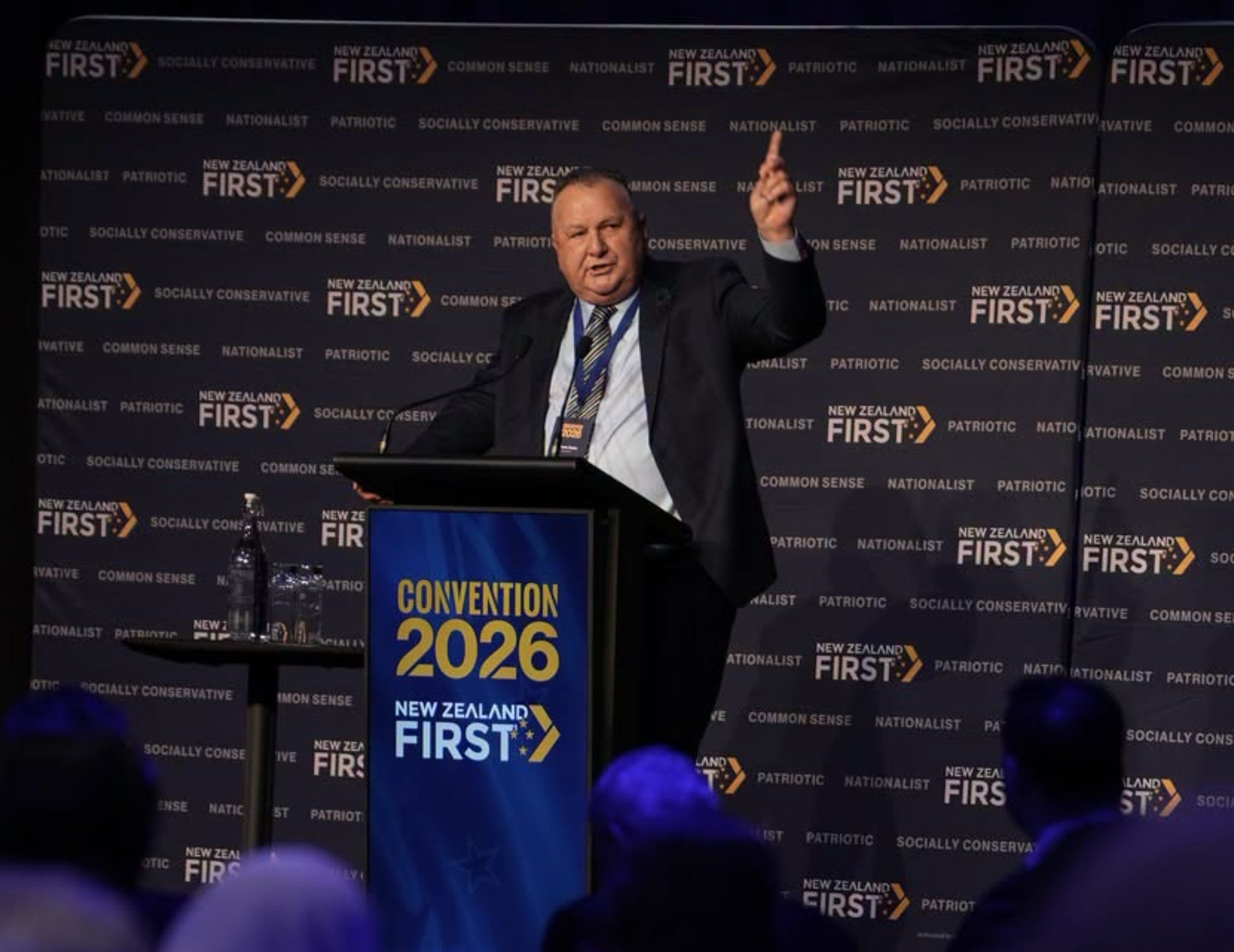
Shane Jones had a serious argument available to him at the New Zealand First conference in Auckland at the weekend: New Zealand politicians should not grovel before foreign leaders; a trade agreement should not be used to surrender control over immigration policy; New Zealand should also be careful about becoming economically dependent on a much larger country.
Instead, Jones told the other parties to “take off your knee pads”. Stuff reported that it “appeared to be a crude reference to oral sex”. Here’s the full sentence: “Labour Party, National Party, Act Party, Green Party, the next time you go to an ethno-nationalist rally to receive a foreign leader, take off your knee pads”.
It was crude and unnecessary. Jones later told The Post’s Anneke Smith that “knee pads” was a common expression he had used to illustrate “a ridiculous level of obsequiousness”. National called the remark “weird” and said the explanation was “even weirder”. Christopher Luxon was blunter, describing it as “crass and unprofessional”.
But it played well in the room, and it told us quite a lot about where New Zealand First is heading.
The party is positioning itself as interventionist on the economy, nationalist in outlook, conservative on social issues and unrestrained by the polite habits of Wellington politics, offering protection against a world that many of its supporters believe has changed too quickly, and without asking them. Jones’ contribution compressed much of that into a single ugly line: national sovereignty, hostility to elites, suspicion of India, and the claim that every other party is too weak to say what it really thinks.
The two faces of NZ First
Richard Harman has provided the best description of what emerged over the weekend. There are, he says, “two faces to New Zealand First”. One is “an anti-immigrant, anti-elite, anti-vax populist party”. The other is “a conservative, regionally focused economic development party”. Both faces were on display in Auckland, and neither is an act.
The economic-development version deserves more attention than it normally gets. Its programme would break up the supermarket duopoly, split the big electricity gentailers, buy back the Bank of New Zealand, and pour state money into manufacturing, mining, water storage and regional infrastructure, all wrapped in a deep suspicion of foreign ownership and the free-market settlement of the 1980s and 1990s. Act wants the state to retreat; NZ First wants an active state that protects national industries, directs investment and confronts concentrated corporate power. An old Labour voter could support plenty of that.
Michael Laws supplied the frame: 40 years after Peters fought the “far right” belief that “if the rich get richer and the poor get poorer, then that is a good thing”, the party now confronts “another ideology, as ruinous to our nation as that. It is the ideology of the liberal and the left.”
Peter Dunne says NZ First is trying to become “the National Party of the 1970s”. In his words, it is “back to Muldoonism”. Muldoon was no small-state politician: he regulated prices, protected industries, and made himself the champion of people who felt sneered at by liberals, economists and Wellington experts. NZ First is reviving much of that tradition. Only now it comes with showgirls and sparklers.
Showgirls, sparklers and political belonging
Fox Meyer’s Newsroom account captured the odd mixture of the weekend. Peters entered Sunday’s campaign launch through smoke and sparklers. The stage had hosted Vegas-style showgirls the night before, including dancers wearing disco-ball headpieces. The national anthem was played with electric-guitar backing, and the atmosphere was closer to a concert than a normal political gathering.
None of it happened by accident. Party president Julian Paul told Meyer that other parties organised events resembling PowerPoint presentations. New Zealand First wanted something more emotional. “People want to get excited about something, people want to have hope and some positive kind of emotion,” he said. “Vibe is very important to our leadership team, because that’s what draws people in.”
There is an obvious logic to it. Where Labour and National increasingly present politics as administration, NZ First offers a show, and with it a sense of belonging: delegates told Meyer the gathering felt like a family reunion.
Meyer says the campaign is targeting “everyday Kiwis” frustrated by how the world has changed around them. The trouble is that the version of NZ First which gets the conference hall going may not be the version most likely to win another three or four percentage points.
The crowd wanted something else
Hayden Donnell attended the public campaign launch for The Spinoff and noticed a revealing difference between the policies Peters promoted and the subjects that stirred his audience.
Breaking up the supermarket duopoly received polite applause, as did splitting up the power companies. Getting fluoride out of drinking water produced a much stronger response. “When Peters mentioned his advocacy for a government inquiry into vaccine injuries,” Donnell writes, “the crowd went wild.” There were cheers when Peters spoke about resisting digital identity, boos for the United Nations, and warm approval for complaints about Britomart station being renamed Waitematā. Peters’ boast about getting “men out of women’s sports” was one of the louder applause lines.
Donnell says the audience appeared to be “the hardest of the hardcore supporters”, and conference activists are always more ideological than the casual voters a party needs to grow. Even so, the reaction says something. The leadership has spent months rolling out big economic interventions, yet much of the emotional energy inside the party still comes from the culture wars, Covid grievances and opposition to social change.
Harman reports that the anti-vaccine wing was less dominant than at the previous conference, when delegates booed speakers they disagreed with, including people who invoked medical qualifications. Some of the more extreme proposals were voted down this year, and economic remits dominated the order paper, so the leadership plainly retained control. But Harman’s first face of the party (the culture wars populist version) was the one that made the most noise.
The paywall now starts partway through all Democracy Project newsletters. Please take out a paid sub if you want to support this service and access the full content, including the following sections: “Then Jones turned to India”, “Then came the converts”, “The Norway promise”, “Peters against the establishment”, and “How far can it go?”.
