

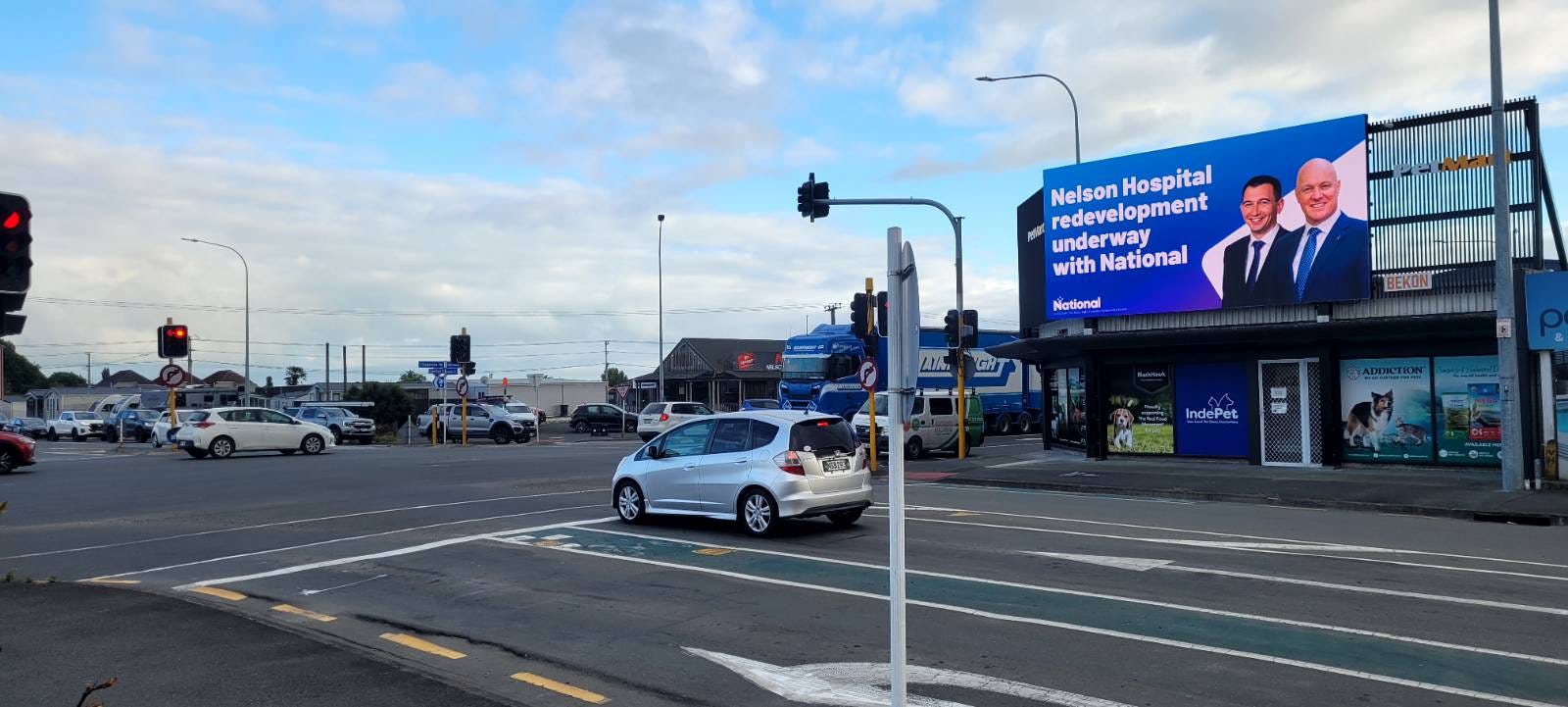
How much taxpayer funding will politicians spend this year on election advertising? It will be many, many millions of dollars, but we won’t know much about it, because the rules have been written to help MPs electioneer with parliamentary funding, without transparency.
You would have already seen plenty of billboards and election ads for the various parties. National MPs have recently been carrying out a blitz of billboards and online ads, but what is often unclear is that the taxpayer is paying for them. See, for example, the billboard above in Nelson recently, featuring Simeon Brown and Chris Luxon, and the message of: “Nelson Hospital redevelopment underway with National”.
Or if you’re reading the news online, you might have seen the articles yesterday on the Stuff website that looked for all the world like regular journalism but were actually paid content from the National Party.
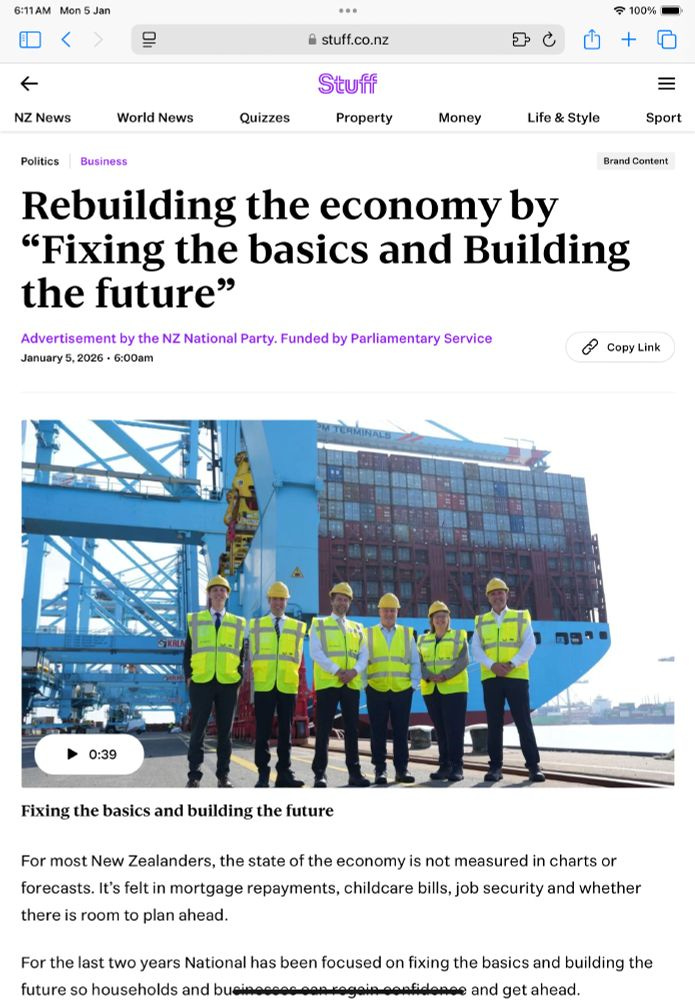
These election articles and billboards are paid for out of large budgets that MPs have at Parliament. In theory, the budgets are to help MPs carry out their Parliamentary duties and to communicate with the public about policy issues. In practice, they are a slush fund for electioneering ads. All political parties in Parliament use them for this.
Parliamentary budgets as slush funds for electioneering
The scale of taxpayer funding for political parties is staggering. Vote Parliamentary Service allocates approximately $134 million over three years for “Party and Member Support” funding. These funds are distributed roughly in proportion to party size, meaning a large party like Labour or National might receive $15 to 20 million or more annually in support.
What can this money be spent on? The rules, set out in the Speaker’s Directions and the Members of Parliament (Remuneration and Services) Act, explicitly forbid using parliamentary funds for electioneering. The principle seems clear enough: “Funding and services provided under these directions must only be used for parliamentary purposes… [which] does not include electioneering.” Taxpayer money can fund MPs to do their jobs as legislators and representatives, but not to run their re-election campaigns.
That’s the theory, anyway. The reality is rather different.
The definition of “electioneering” has a specific meaning in this context. Under the Parliamentary Service Act, electioneering includes any communication that explicitly seeks support for votes or donations, or encourages joining a party. It also includes any election advertisement published during the official regulated period before an election, usually the three months before polling day. During that formal campaign period, parliamentary funding cannot be used for advertising that promotes a party or candidate.
Outside the regulated period, however, the line becomes remarkably blurry. The rules allow publicly funded communications as long as they don’t explicitly say “vote for us” or something similar. Parties have seized on this loophole, pouring public funds into ads touting their policies or attacking opponents well ahead of writ day. As long as the content stops short of an outright “please re-elect us” message, they argue it’s “parliamentary” communication rather than electioneering.
This is why opposition parties can run taxpayer-funded billboards lambasting the government’s tax policy mid-term. It’s why governing parties can mail pamphlets highlighting budget accomplishments, all under the rubric of informing the public of MPs’ work. Technically, such material is not election advertising if published before the regulated campaign window and if it avoids phrases like “Vote Green.”
Practically, of course, it serves exactly the same purpose: boosting a party’s public profile and support.
As political scientist Claire Robinson put it last July, MPs have turned the non-election period into a publicly funded “free-for-all of 24/7 campaigning.” The only real check on this behaviour is the Speaker, who oversees Parliamentary Service spending, and ultimately the court of public opinion. Enforcement is lax unless a flagrant breach occurs.
In practice, parties navigate around the rulebook by carefully crafting publicly funded ads that stay technically within the rules while serving their political objectives. As long as an ad can be framed as “issue information” or “policy explanation” and is published before the official campaign, the Speaker’s office typically greenlights it. Critics say this makes the rule against electioneering largely toothless. It’s an “honour system” that relies on parties exercising restraint, which in the heat of political competition is often wishful thinking.
I wrote about this problem back in 2018 for Newsroom, pointing out that “in theory, all of these budgets are for Parliamentary purposes, but in reality, they’re used for ‘the permanent campaign’, in which the politicians convert these resources into techniques designed to build their party vote.” Out in the electorates, regional party organisers previously paid for by the party organisation have been replaced by electorate agents paid for by the Parliamentary Service. The electorate offices they work in are now de facto regional party headquarters. Mail-outs, glossy leaflets, and newspaper advertisements are also paid for by parliamentary funding.
Politicians essentially self-regulate on what electioneering they can carry out with their parliamentary budgets. It’s something of a rort. This works for the politicians because of their cartel arrangement – all the parties in Parliament benefit from the subsidy, so none complain about the egregiousness of their opponents’ use of taxpayers’ money.
The History of the Pledge Card and politicians designing the rules
The most infamous example of this system being abused came in 2005, when the incumbent Labour Party spent $446,000 of parliamentary funds on its “Pledge Card,” a brochure of campaign promises. The Auditor-General subsequently found that Labour had breached parliamentary spending rules.
But Labour wasn’t alone. The Auditor-General’s 2006 investigation found that $1.17 million had been improperly spent on electioneering by parties using parliamentary funds in the three months before the 2005 election. Labour accounted for $768,000 of that total, but National spent $99,000 improperly, NZ First $80,000, United Future $60,000, ACT $35,000, the Progressives $35,000, and the Greens $32,000.
The legal findings from this controversy established crucial principles that remain relevant today. The Auditor-General and Solicitor-General established what became known as the “bright line” test. They determined that “it is not necessary for there to be an express soliciting of votes to establish an electioneering purpose. Rather, the question is whether the advertisement as a whole would be likely to persuade a voter to vote in a particular way.”
This is important. Material can have an electioneering purpose even without explicitly asking for votes.
The Parliamentary Service contested this approach at the time. They argued it was “very difficult, if not impossible, to draw a line in the sand that separates any sort of promotional activity from what could be construed as business that is strictly parliamentary.” The Service maintained it excluded only “blatant” electioneering, meaning explicit vote solicitation.
The Auditor-General rejected this narrow interpretation, stating that “material can have an electioneering purpose” even without explicitly asking for votes. The distinction is important: “The Party and Member Support appropriations authorise expenditure for parliamentary purposes only. An advertisement paid for on the basis that it is for a parliamentary purpose therefore cannot lawfully have an electioneering purpose as well.”
National leader Don Brash accused Labour of being “the most corrupt government in New Zealand history” over the pledge card affair. Labour ultimately repaid the money identified as unlawful, and the Government passed retrospective validating legislation in October 2006.
The 2006 pledge card controversy should have led to fundamental reform of how parliamentary parties spend public money. Instead, the rules have been made vaguer, enforcement weaker, and so the politicians continue to exploit the system for partisan advantage. The experience highlighted systemic weaknesses in oversight, but little has changed in substance.
Two decades later, National appears to be using similar techniques themselves, using taxpayer money to run what are effectively campaign advertisements disguised as “communications.”
The Problems of a state slush fund for electioneering
Even if parties’ use of parliamentary funds for advertising stays within legal boundaries, it raises serious ethical questions. The core of the criticism is that it amounts to taxpayer-funded electioneering by stealth. Parties are leveraging public money, provided to support their democratic duties, to give themselves an extra campaigning advantage that new or outside challengers cannot match.
Consider the unfair incumbency advantage this creates. Parliamentary funding is only available to parties already in Parliament, effectively entrenching the incumbents’ position. Established parties can saturate the public with positive messaging through billboards, online ads, and mailers in the pre-election period without touching their campaign budgets. A new party or independent candidate outside Parliament has no such benefit.
This skews the playing field considerably. As I’ve noted before, “new parties face big barriers to getting into Parliament,” and lack of access to these state resources is one such barrier. Every other new party in recent decades, including the Greens, Alliance, New Zealand First, United Future, Progressives, Mana, and the Māori Party, has been launched by at least one existing MP. Other new parties struggle to compete with the millions of dollars of state-funded resources at the disposal of parliamentarians.
There’s also the blurring of “government and party”. When governing parties use parliamentary budgets to tout their policy successes, or opposition parties use them to attack the government, it blurs the line between official communication and partisan propaganda. Taxpayer-funded communications are supposed to inform citizens about parliamentary business in a neutral way, not to campaign.
Using “public information” as a fig leaf for what are essentially attack ads or self-promotional ads erodes the distinction between serving the public and serving the party. This can undermine citizens’ trust. People may not realise a billboard or Facebook post is financed by public money, implicitly carrying the authority of an MP’s office, yet delivering a highly partisan message.
Then there’s the problem of circumventing spending limits and transparency. Outside of the regulated election period, there are no spending caps or disclosure requirements for what parties spend on advertising via their parliamentary budgets. This creates a loophole in New Zealand’s electoral finance regime. During the official campaign, parties have strict spending limits and must disclose expenses and donors. But millions in taxpayer funds can be spent on “messaging” prior to the campaign with no equivalent transparency.
Effectively, parties get a head start: a publicly funded campaign before the official campaign. This raises questions about whether our election spending laws are fit for purpose, if so much can be done outside the regulated period.
Claire Robinson was especially sharp on this point. She labelled it “an abuse of power” that taxpayers are effectively “condoning” by funding it. If MPs use public money to publish a pamphlet deriding their opponents or to plaster their faces on billboards touting “achievements,” is that a responsible use of the public purse? Many would say no, that it violates the spirit of stewardship expected of public funds. After all, not all taxpayers agree with or support the messages their money is being used to broadcast.
Robinson gave examples such as Act MPs’ staff using official funds to produce abusive social media memes, even branding them with the Parliamentary Service logo, to attack critics. Her verdict was unsparing: this practice is an “abuse of power” and our “precious tax money” should not be paying for MPs to “troll and bully on the public dime.” It “chips away at democratic norms, one Facebook shtpost at a time.”
Over time, normalising this behaviour can erode democratic norms. Citizens could become inured to the idea that parliamentary parties essentially have a state-funded PR machine perpetually at work. This starts to resemble less democratic systems where state resources are routinely abused for partisan ends. New Zealand is still far from such extremes, but the trend is worrying.
As I argued back in 2017, “It sounds like an authoritarian country rather than a liberal democracy” when taxpayer funds get misused by politicians for electioneering. Reliance on state funding has reduced parties’ incentive to maintain robust memberships and genuine public engagement. If parties can campaign with public money and hired consultants, why bother mobilising volunteers? The long-term health of participatory democracy suffers.
New Zealanders are paying for National to advertise to them. Every dollar of parliamentary funding spent on billboards and sponsored content is a dollar taken from taxpayers to promote the political interests of the party in power. This is not “communicating with constituents.” It’s campaigning on the public dime.
Election paid content on news sites
National’s election article on the Stuff website has led to some complaints that it is not ethical. One person, Rob Dickinson, says he has complained about the National article to the Advertising Standards Authority on the basis that “it is not clear it is an advert and not a news article”.
On social media there have been complaints about the National Party paid articles on the Stuff site. Media commentator Ben Torkington explained the problem was that National’s paid content on Stuff was “Using the same typefaces and editorial style. So people are tricked into thinking it’s journalism”.
Similarly, the Listener’s media commentator Russell Brown posted online his criticism of what he called a “fake lead story,” arguing that “not only giving up the lead spot of your Business section, but running it with the same style as real editorial is horrible.” Brown said that more information was required: “The interesting thing — and hard to know because the Parliamentary Service is not subject to the OIA — is whether the lead position and use of editorial style were a specific request in the commercial deal. Because I think that would reflect poorly on everyone involved.” His harsh conclusion was: “I hope anyone working for Stuff as a journalist is feeling deeply embarrassed by this.”
When a National Party advertisement appears on Stuff formatted to look like a news article, with only a small “Brand Content” label, the intention is clear: to blur the line between advertising and journalism. That this is funded by taxpayers makes it worse.
The NZ Media Council and the Advertising Standards Authority both insist that the public must be able to distinguish news from advertising. The ASA specifically states that “advertisers’ efforts to make their advertising more engaging must not disguise the fact that it is advertising” and that “content provided by the advertiser must be clearly recognisable to an audience as advertising.”
The question is whether “Brand Content” is sufficiently clear to ordinary readers. The smaller the disclosure, the greater the risk of confusing readers.
In the case of the National Party’s sponsored articles on Stuff, Stuff did include a small “Brand Content” label and an explanatory blurb. This likely satisfies the bare minimum standard, meaning the content was technically identifiable as advertising. However, some argue the labelling was too inconspicuous, risking that readers would mistake the piece for an objective news story.
The Media Council’s position is that if a sponsored item looks like a news article, it “should, at least, be held to the same standards as news content” in terms of accuracy and fairness. Even paid political content shouldn’t be allowed to deceive or spread false claims just because it’s an ad.
When political advertising is formatted to resemble news articles, it confuses readers about what is independent journalism versus paid content. It undermines trust in media institutions. It allows parties to bypass journalistic scrutiny and editorial standards. And it contributes to the broader misinformation environment.
The recent National Party advertorials adhere to the letter of the rules, though they blur the spirit of independent journalism. The onus is ultimately on media companies to maintain trust by prominently flagging such content.
This is a bipartisan problem
The examples of taxpayer-funded electioneering in this column might suggest this is a critique of the National Party. I have used these images because it is currently National that is undertaking a significant election campaign with taxpayer funds. However, all the parties will be doing the same this year, to different degrees.
The pledge card controversy showed Labour exploiting these advantages in 2005. National appears to be doing the same now. This is a bipartisan problem, and any critique of the practice needs to acknowledge that.
It’s also worth looking back at the last election year. At the start of 2023, the incumbent Labour Party – flush with the largest caucus in Parliament at the time – went on what the Opposition called a taxpayer-funded “advertising spree.” National Party campaign director Jo de Joux publicly claimed that Labour was using a “huge taxpayer-funded war chest” on a blitz of ads before the regulated campaign period. National’s analysis found that in January–June 2023 alone Labour spent about $260,000 of parliamentary budget on Facebook and Instagram ads, with over $160,000 in just two months leading up to winter. (One such campaign promoted a new pathway to Australian citizenship for Kiwis – targeted at New Zealanders living in Australia – and yes, taxpayers footed the bill for those overseas social media ads.) All of this was done under the banner of “communicating MPs’ work,” yet the content was indistinguishable from electioneering: feel-good promotion of Labour’s achievements and implicit appeals to stick with the government.
Ahead of the 2017 election I asked, “How much will political parties misuse parliamentary funding for their election campaigns?” I pointed out that politicians can simply vote themselves increased advertising budgets and have “easily rewarded themselves with new election advertising funding,” blurring the line between governing and campaigning. Such misuse of taxpayer funds for partisan purposes contributes to public cynicism.
Outside the regulated election period, parties face little real accountability for how they use their taxpayer-funded advertising allowance. One could invoke a simple ethical test: “Would a reasonable taxpayer be comfortable knowing their taxes paid for this ad?” In the case of a neutral electorate newsletter, perhaps yes. In the case of a thinly veiled attack ad or self-congratulatory billboard, likely not. By that measure, much of the current parliamentary-funded advertising fails the test.
All major parties have engaged in this arms race, so any solution or reform would need cross-party agreement. Since turkeys rarely vote for an early Christmas, public pressure is key. The Speaker or Parliament could tighten the definitions even further. An independent watchdog like the Auditor-General or Electoral Commission could get jurisdiction to review parliamentary advertising for partisan content in real-time.
At the very least, a bright light of transparency should be shone on this spending. If parties had to publish reports of exactly what they spend parliamentary funds on, including advertising, mailers, and social media, they might be more restrained for fear of public backlash.
The overall effect of the taxpayer-funded life-support system has been to consolidate the status quo in Parliament and prevent the entry of outside competitors. Public subsidies have fostered the development of a “political class” in New Zealand politics made up of career professionals. This makes New Zealand’s democracy seem less fair, and undermines the integrity of elections by giving incumbent parties a major advantage.
Until the rules are properly reformed, expect more of the same. We’ll keep seeing billboards touting government achievements, online ads disguised as news articles, and glossy pamphlets paid for from the public purse. And we’ll keep being told it’s all perfectly legitimate “communication with constituents.”
Dr Bryce Edwards
Director of the Democracy Project
Further examples:
