

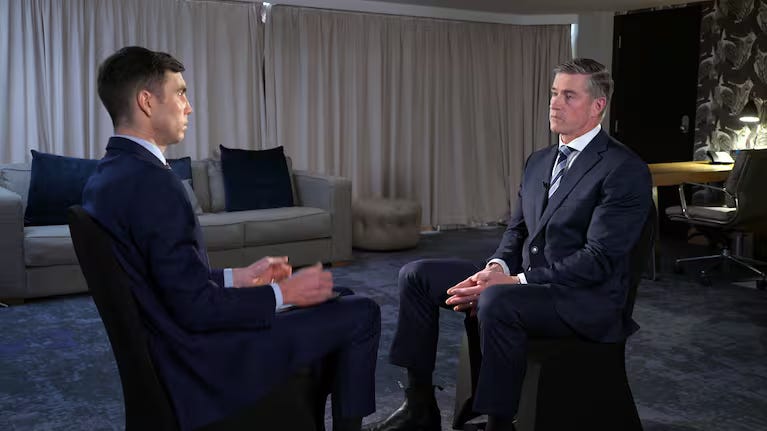
Andrew Coster’s appearance on Q+A yesterday has made one thing abundantly clear: there are now so many conflicting accounts of what happened in the police integrity scandal that the public cannot possibly know who to believe. The only way to establish the truth is through an independent inquiry with the power to compel evidence and cross-examine witnesses under oath.
In his first televised interview since the IPCA report, the former Police Commissioner came out swinging. He insisted he “acted honestly” and made decisions “in good faith.” He claimed he told both Chris Hipkins and Mark Mitchell about the McSkimming situation long before they say they knew. And he flatly denied knowing anything about the protocol that diverted 36 complaint emails away from the Minister’s office. “The first I heard of that,” he said, “was when I heard that allegation made.”
Within hours, both politicians had rejected Coster’s account. Mitchell called Coster’s denial of the email protocol “unfathomable”. Hipkins said he had “no recollection” of ever being briefed. We are now in classic “he said, they said” territory – except with national stakes.
The Credibility problem cuts all ways
Let’s be blunt: we don’t know who is telling the truth. No one watching this unfold does. That’s precisely the problem.
The deeper problem is not that memories differ. It is that each of these men has a powerful incentive to misrepresent events. Coster is fighting for his legacy, Hipkins for his judgement as Police Minister, and Mitchell for his credibility as the supposed outsider who would “clean up” the executive. When everyone at the top of the system has a motive to shade the truth, the public is left with an accountability vacuum.
Coster’s credibility took a severe hit from the IPCA report, which found his recollections “were often found to be inconsistent and unreliable” – specifically regarding his claims about briefing Deputy Public Service Commissioner Heather Baggott. She explicitly denied Coster’s account, and the IPCA found her version more credible. David Farrar at Kiwiblog made the logical observation yesterday: “If he had already briefed Mitchell on the issue, why did his office instruct seconded Police staff in Mitchell’s office to hide all e-mails about McSkimming from Mitchell and his staff?”
Yet we also know that politicians have every incentive to distance themselves from this toxic mess. As Coster himself observed on Q+A: “No one wants to be close to this. This is really nasty and toxic, and, frankly, who would want to acknowledge being anywhere near it at any stage?” He has a point. The scandal is politically radioactive for both major parties – for Labour because McSkimming was promoted to Deputy Commissioner under their watch, and for National because Mitchell received 36 complaint emails that somehow never reached him.
The documented evidence further muddies the waters. There is a handwritten file note from January 17, 2024 recording the email diversion instruction. Mitchell says it came from Coster’s office. Coster says he knew nothing about it. One of them must be wrong – but which one?
This is not merely a bureaucratic mystery; it is a potential constitutional outrage. In our system, the Police are operationally independent but accountable to the civilian government through the Minister. If a government department effectively seizes control of a Minister’s inbox to withhold information from elected representatives, it is a profound subversion of democratic oversight. It suggests a ‘deep state’ mentality where the bureaucracy manages its political masters to ensure the ‘right’ outcomes are achieved.
The IPCA investigation was never designed to answer these questions
Here is the uncomfortable reality that the Government seems reluctant to acknowledge: the IPCA investigation that brought this scandal to light was narrowly focused on complaints about Jevon McSkimming. It was never a comprehensive investigation into whether there was a coordinated coverup at the highest levels of police, or what politicians knew and when they knew it.
The IPCA itself was explicit about this limitation. Their report states: “The report describes complaints and allegations made against Mr McSkimming. It does not make any findings as to the truth of these allegations”. More importantly, it was examining only “the first aspect” of their investigation - whether police responded appropriately to complaints before November 2024. A separate report on the adequacy of the investigation that eventually occurred is still pending.
Crucially, the IPCA made no finding of corruption or coverup. Sir Brian Roche emphasised this point, noting the report found “no evidence of any actions involving officers consciously doing the wrong thing.” Andrew Coster seized on this, complaining that ministers had publicly “implied corruption and sometimes expressly saying cover-up” when “the independent body assigned to investigate these things has not found that.”
But this misses a fundamental point. The IPCA didn’t find evidence of conscious wrongdoing because that wasn’t what they were looking for. Their mandate was to examine complaint handling procedures, not to investigate whether senior officers deliberately conspired to protect one of their own. As I have written previously, an IPCA investigation is no substitute for the kind of thorough, wide-ranging inquiry that New Zealand has conducted after previous police scandals.
The treatment of the complainant, Ms Z, remains the most disturbing aspect. Instead of investigating her allegations, police leadership allowed her to be prosecuted under the Harmful Digital Communications Act—a law designed to protect vulnerable people, not silence them. This decision alone suggests an institution more concerned with reputation management than with justice. It is precisely the kind of cultural failing the Bazley Commission warned about nearly 20 years ago.
We have been here before
The parallels to the 2007 Bazley Commission are stark. That inquiry, triggered by the Louise Nicholas rape allegations against police officers, exposed a culture that “enabled and protected sexual predators within its ranks.” Dame Margaret Bazley found an “insular culture” that “distrusted outsiders and fostered protection of fellow officers over accountability to the public.”
The Government accepted all 47 of Bazley’s recommendations and committed to ten years of monitoring. Yet here we are, nearly two decades later, reading an IPCA report that documents very similar failures – “unquestioning acceptance” of a colleague’s narrative, failure to investigate serious allegations, prioritisation of an officer’s career over accountability.
Investigative journalist Jared Savage put it well: “I think this is such a big scandal that there needs to be a similar Commission of Inquiry or Ministerial Inquiry to look into the wider issues... Twenty-odd years after the last report, I think it’s time to have another good look under the covers, really, because clearly not as much progress has been made as police would like us to believe.”
The Government disagrees. Ministers Mitchell and Collins have said the IPCA report was “thorough enough” and pointed to the announcement of a new Inspector-General of Police as the solution. But the Inspector-General addresses future oversight - it does nothing to establish what actually happened in this scandal, or to resolve the competing accounts that are now swirling in public.
What an independent inquiry could establish
Consider what remains genuinely unknown:
Did Andrew Coster brief Chris Hipkins about McSkimming in July 2022?
If he did, why did Hipkins allow McSkimming to be promoted to Deputy Commissioner in 2023? Did Coster brief Mark Mitchell “informally through 2024”?
If so, why did Mitchell’s office continue operating under the impression that the Commissioner was handling the matter appropriately?
Who authorised the email diversion protocol, and why?
Did Coster genuinely not know about it, or was he deliberately kept out of the loop by his own staff?
Was the email-diversion protocol used in other ministerial offices?
Did senior police attempt to influence IPCA timing to protect the Commissioner appointment?
These are not trivial questions. If Coster is telling the truth, then two senior politicians are either lying or conveniently forgetting inconvenient conversations. If Mitchell and Hipkins are telling the truth, then Coster is attempting to spread the blame for his own failures. Either scenario has serious implications for our democracy.
Only an independent inquiry with proper investigative powers could compel testimony, examine documents, and cross-check accounts to establish a coherent factual record. The IPCA cannot lay criminal charges. It cannot compel politicians to testify. It was never equipped to adjudicate the kind of high-level political dispute we are now witnessing.
The Corruption question remains unanswered
Public Service Minister Judith Collins famously said of this scandal: “If it walks like a duck and quacks like a duck.” Police Minister Mark Mitchell initially agreed, telling Q+A the system had “a corrupt police executive” – before his office rushed out a statement saying he had “misspoke.”
The semantic dance around the word “corruption” reveals deep institutional discomfort. Transparency International NZ’s Julie Haggie insisted it was “not outright corruption” but a “cultural integrity problem.” The IPCA found “serious misconduct” but explicitly avoided finding “collusion” or “corruption.”
Yet by any ordinary understanding of the word – dishonest behaviour by people in authority to protect themselves and their institution - what happened fits the definition. As Farrar wrote: “By any common-sense definition... what happened is clearly corruption. It was clearly dishonest behaviour by people in authority.”
We are likely seeing a classic case of what sociologists call “noble cause corruption”. This is where officers bend the rules or bury the truth not for personal financial gain, but because they believe it serves a greater good: protecting the reputation of the Force or the career of a “talented” colleague. The IPCA report describes a culture of “groupthink”; that is simply a polite way of describing a culture where loyalty to the tribe overrides the law. When an institution closes ranks to protect its own against a vulnerable member of the public, that is corruption, pure and simple.
The problem is that without a proper independent investigation, we will never know how far the rot extended. Was this about one man’s misguided loyalty to a colleague, as Coster’s account suggests? Or was it, as the evidence of the email protocol suggests, a coordinated institutional effort to suppress complaints and protect reputations? The IPCA investigation was not designed to answer that question. Nothing currently underway is designed to answer it.
Luxon is ruling out an inquiry
On Monday, Prime Minister Christopher Luxon has ruled out having an independent inquiry on the matter. He argued that the IPCA inquiry had already found the answers, and he stated that “I can tell you what the outcome of that would be.” Rather than going over what exactly had gone wrong, Luxon wanted focus to be on the future: “For me, I’m more focused on what’s the solution. Because we can talk about the process story and the beltway story as much as you like, but actually what’s most important is that this is an organisation that needs to make sure this never ever happens again.”
This isn’t convincing everyone. Today’s New Zealand Herald editorial argues that the Coster interview shows that “there is much more still to be learned. It also helps to justify the calls from those wanting a further investigation”. The newspaper isn’t convinced that this is a case of the politicians telling the truth and the disgraced former Commissioner being in the wrong, and they point out that Coster “has never displayed - throughout an extensive career - a tendency to, nor be caught, outright lying”. “Something doesn’t add up” about the various accounts of what has happened and “the public rightly have a lot more questions and deserve answers.”
The Herald suggest that the politicians and the Police might wish that we would all move on from the scandal and questions soon, but without any real transparency this is impossible: The ninth floor of the Beehive and Police HQ will likely be thinking the summer holiday break can’t come soon enough. But they’ve got to be completely open with all of us and address this issue now. They’d be kidding themselves if they think Kiwis spending a couple of weeks at the beach will fix this fiasco.”
Stuff journalist Tova O’Brien is even more scathing about the PM ruling out a proper inquiry. She mocks his argument that he already knows what a high level inquiry would conclude: “Well, he can’t. That’s simply impossible… That’s like saying he knew the outcome of the IPCA investigation before it started.” O’Brien argues that the strongest reason for a proper inquiry is to restore trust in Police, as currently the whole 15,000 men and women of the police have had their reputations tarnished.
O’Brien also finds inconsistencies in Police Commissioner Mark Mitchell’s explanations, which provides further reasons for an inquiry: “all this murkiness in an already mucky scandal can only have any hope of being cleaned up with a further independent inquiry that looks into the roles of government ministers and MPs including Hipkins. The IPCA investigation did not cover ministers and MPs. It also found shortcomings in its own processes when dealing with the McSkimming allegations and that its response was inadequate”.
New Zealanders deserve to know
The police integrity scandal has already claimed Andrew Coster’s career. He resigned from the Social Investment Agency after Sir Brian Roche made clear he would have been sacked. Three other senior officers are under employment investigation. Jevon McSkimming has pleaded guilty to possessing child sexual exploitation and bestiality material. Commissioner Richard Chambers has called his predecessors’ conduct “an absolute disgrace.”
But none of this tells us whether the system has actually been fixed, or whether similar failures could happen again. The complainant, Ms Z, has called for a wider government inquiry into police culture. Labour’s Ginny Andersen has indicated the party would support “a broader inquiry into police culture.” Even some within the commentariat who normally give institutions the benefit of the doubt are asking hard questions.
The Government’s response – an Inspector-General for the future, but no inquiry into the past – suggests a desire to move on without fully reckoning with what occurred. That is understandable politically. But it leaves the public in an impossible position: asked to trust police have reformed themselves, while fundamental questions about what happened remain contested and unresolved.
When the former Police Commissioner and two senior politicians are publicly contradicting each other about basic facts, and when the only investigation conducted was never designed to resolve such disputes, the case for an independent inquiry is overwhelming. New Zealanders deserve to know whether there was a police coverup. They deserve to know whether politicians were briefed and failed to act. They deserve to know whether the police executive was, as Mitchell briefly said before retracting, “corrupt.”
The Government can announce all the new oversight mechanisms it likes. But until there is a proper, independent reckoning with what actually happened in this scandal, public confidence in the police will remain fundamentally compromised. The conflicting accounts we heard this morning make that case more powerfully than any commentary ever could.
If public servants can decide which information an elected Minister receives, then civilian control of the police becomes a fiction rather than a convention.
Structural reforms are meaningless if they are layered on top of an unresolved scandal. Until the basic facts are settled, the public cannot know whether the new oversight architecture is fixing real problems or merely plastering over unknown ones.
An inquiry is not about punishing individuals. It is about restoring public trust by establishing an uncontested factual record.
Dr Bryce Edwards
Director of the Democracy Project
Further Reading: