

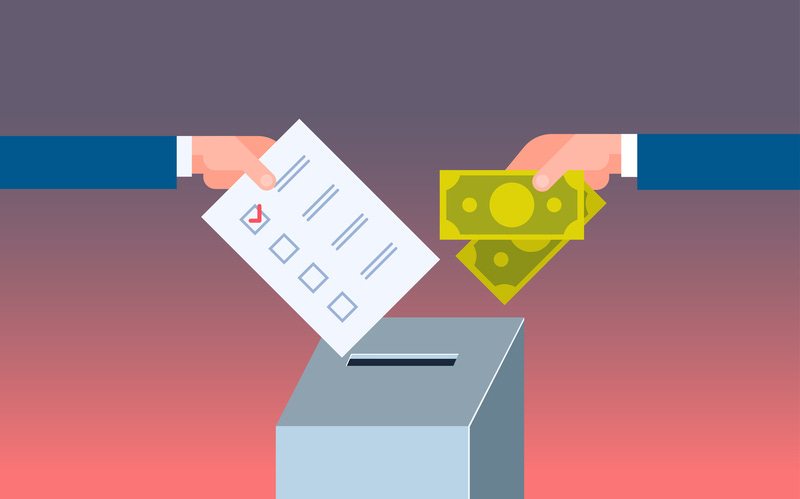
The local government election donation returns are in, and they tell a familiar story. Auckland Mayor Wayne Brown raised a staggering $617,000 for his re-election campaign, backed by a parade of property developers, construction firms, and billionaires. His nearest rival, Kerrin Leoni, scraped together $83,000 – much of it in small donations from ordinary voters. In Wellington, Andrew Little had the unions and Labour establishment in his corner, while the defeated Ray Chung’s funding arrangements have been murky.
These returns, released last week as legally required within 55 days of the October election, offer a rare glimpse into the financial machinery of local politics. What they reveal is troubling. Money talks in local government, and it speaks loudest on behalf of those who have the most to gain from council decisions.
The 2025 campaigns in Auckland, Wellington, Christchurch and Dunedin were awash with cash from property developers, corporate magnates and other vested interests. This isn’t a level playing field of ideas, it’s a battleground of bank balances.
Big money in the big city
Nowhere was the money gap starker than in Auckland. Incumbent Mayor Wayne Brown went into the 2025 race armed with a war chest of roughly $617,000. That’s an eye-watering sum for a local campaign, and it didn’t come from sausage sizzles and bake sales.
Brown’s donor list reads like a who’s who of the mega-wealthy: New Zealand’s richest man Graeme Hart dropped a cool $50,000 via his Rank Group company; the Tramco property empire (with massive waterfront land interests) chipped in another $50,000; major developers like CP Group and Peninsula Capital each gave $25,000; and corporates like Golf Warehouse ($20,000), Bayleys Real Estate ($10,000), and even the luxury Park Hyatt Hotel ($18,400) all opened their wallets. Many of these donors gave in the tens of thousands. It was the “big end of town” backing their guy to the hilt.
Brown’s only serious challenger, first-term councillor Kerrin Leoni, simply couldn’t compete with that financial firepower. Leoni scraped together about $83,000 for her campaign, and nearly all of it was from ordinary grassroots supporters contributing under the $1,500 disclosure limit. Her largest declared donation was around $7,576 from longtime Labour activist Greg Presland, with a few other modest contributions from former politicians like Judith Tizard ($5,000) and former mayor Phil Goff ($1,500). In blunt terms, Brown out-fundraised her roughly seven to one.
Why does this matter? Because the donors behind Brown’s victory aren’t neutral benefactors. They’re business figures and developers who often have skin in the game when it comes to council decisions.
Take Tramco Group – its directors hold huge leasehold properties in the Viaduct Harbour and downtown waterfront. The council is effectively the landlord (or regulator of the landlord) for much of the waterfront. A mayor sympathetic to keeping leasehold terms favourable or investing in waterfront amenities (like the America’s Cup infrastructure) directly benefits Tramco’s bottom line. When a stakeholder with such specific, geographically concentrated interests donates $50,000, it becomes incredibly difficult to argue that future decisions regarding the waterfront are made without a “shadow of influence” looming over the council table.
Or consider Precinct Properties, which gave $10,000 to the mayor. This is the same entity currently in the process of purchasing the council’s downtown carpark building – a controversial divestment of a strategic public asset. The optics of a developer donating to the political leader of the organisation it is actively buying assets from are, to put it mildly, not great. It blurs the line between a political donation and a transactional cost of doing business.
Then there’s Golf Warehouse, which contributed $20,000 to Brown’s campaign. As Jonathan Killick reported in The Post, Golf Warehouse has offered to redevelop the council-owned A.F. Thomas Park into a new nine-hole course. Here, the link between donation and potential policy outcome is explicit. A private entity wants to commercialise public parkland. That entity gives $20,000 to the mayor. The mayor leads the council that will decide the fate of that parkland. For the residents who use that park, the message is clear: your voice in the submission process is competing against a $20,000 donation sitting in the mayor’s campaign account.
The Chow brothers’ Stonewood Group gave $20,000. Peninsula Capital and CP Group (one of New Zealand’s largest hotel owners) gave $25,000 each. These are entities that thrive on favourable zoning, relaxed height restrictions, and expedited consenting processes. Their collective investment in the Brown mayoralty represents a bet on a deregulation agenda and a bet that the mayor will “fix” Auckland by removing the hurdles that frustrate capital accumulation.
The Park Hyatt and the payroll paradox
Perhaps the most optically challenging donation comes from the AHIL Park Hyatt Hotel, which contributed $18,400. The luxury waterfront hotel is owned by China’s Fuh Wah group. This financial support is compounded by the revelation, reported by Todd Niall in Newsroom, that Fuh Wah’s Auckland office manager, Jean Wen, is employed by Mayor Brown on a $2,000 monthly retainer for “Chinese translation services.”
While translation is a legitimate service, the triangulation of a foreign-owned developer, a significant campaign donation, and a staff member on the mayoral payroll creates a vector for influence that demands scrutiny. There is no suggestion this arrangement breaches any rule. But it raises questions about access: does the Park Hyatt get their calls returned faster than a local community board chair?
The “Fix Auckland” patronage machine
Brown didn’t just receive money; he acted as a kingmaker, distributing funds to secure a compliant council. In a move described as “unusual” in Auckland local body politics, Brown donated $4,568 to Victoria Short, a candidate for his “Fix Auckland” ticket in the Albany ward.
Short’s subsequent victory over incumbent Wayne Walker (a long-time critic of the Mayor) was celebrated by Brown, who dubbed her the “Albanian killer.” This marks a shift towards a US-style system where the mayor acts as the financier for a partisan bloc, punishing dissenters and rewarding loyalists with access to the campaign war chest.
Fix Auckland candidate Vicky Hau’s return shows a $1,793 “in kind” donation, described as coming from “Wayne Brown ℅ Office of the Mayor.” Fix Auckland’s campaign manager Tim Hurdle confirmed to Newsroom that Brown had personally paid for joint advertising hoardings for the ticket’s Manukau candidates. The mayor’s office, meanwhile, said it had not contributed in any way to any campaign. Someone is being economical with the truth or crossing lines in how they are recording donations.
The Leftover quarter-million
Another glaring issue is what happens after the campaign. Wayne Brown didn’t even need to spend all his money, as he has nearly $280,000 left over from those wealthy backers. He’s indicated he won’t run again, so what will he do with that leftover quarter-million?
But there are no rules governing it. Auckland Council electoral officer Dale Ofsoske confirmed that candidates can do “what they like with the money.” Brown refused to divulge his plans for the surplus, dismissing questions by saying it’s “other people’s donations” and citing the support they showed for his agenda. The sheer fact an outgoing mayor can sit on a pile of other people’s money with zero transparency or regulation is a huge red flag. It leaves the door wide open for slush funds or future influence-peddling.
Wellington: The Beltway and the black box
If Auckland’s story is one of corporate dominance, Wellington’s is one of establishment consensus and a murky “dark money” scandal that highlights the gaping loopholes in our electoral laws.
The victor, Andrew Little, won comfortably, and his donation return reflects his status as the “safe pair of hands” for the capital’s elite. Little raised funds from a coalition that crossed the traditional left-right divide, illustrating how the “Wellington Beltway” often coalesces around a centrist figure to ensure stability.
Little’s donor list is a testament to his dual appeal. On one hand, he had the industrial muscle of the unions: the Maritime Union, Amalgamated Workers Union, E Tū, and the Dairy Workers Union each contributed $5,000. This reflects his Labour roots and ensures that the organised labour movement retains a seat at the table in the capital.
However, Little also drew significant support from the city’s wealthy patronage network and even political rivals. Former National Party minister Chris Finlayson gave $2,000 – a cross-party endorsement that signals the business and legal establishment’s preference for Little’s brand of pragmatic management over the chaos of recent council terms. Prominent property developer Ian Cassels, a man who has fought the council for years over the Shelly Bay development and urban intensification, contributed $5,000. Former Labour minister Dame Annette King and her husband gave $2,500. Little also received $2,075 from a 20-person fundraising dinner hosted by former mayor Justin Lester.
Little spent just under the $60,000 mayoral spending cap and declared all donations above the threshold before voting began. He’d campaigned on transparency, and he delivered. This is how it should work.
The Better Wellington shell game
The campaign of runner-up Ray Chung, running under the “Independent Together” banner, offers a stark lesson in the perils of “dark money” and the structural weaknesses of the Local Electoral Act. Chung’s campaign claimed a war chest of up to $200,000, fuelling a lavish billboard and media blitz that promised to disrupt the status quo.
However, when the returns were filed, the transparency evaporated. Chung and his slate of candidates listed a massive chunk of their funding – $27,500 in one instance – as coming from a single entity: “Better Wellington.” This entity was essentially the campaign committee or trust backing the ticket. By listing “Better Wellington” as the donor, Chung’s team effectively engaged in a shell game, obscuring the identity of the original donors who put the money into the trust.
This practice, known as “grouped donations,” is a notorious loophole. The Local Electoral Act requires the disclosure of any donor giving more than $1,500. However, if a donor gives $5,000 to “Better Wellington,” and “Better Wellington” then passes that money to the candidate, the candidate can technically declare the trust as the source, shielding the original donor from public view. It is a laundering mechanism for political influence.
Wellington’s electoral officer, Warwick Lampp, rightly queried this practice, demanding a list of the actual people behind the Better Wellington money. This mirrors the “United Hutt” scandal of 2022, where candidates used an incorporated society to hide their backers and were eventually found to have “misinterpreted the rules” – a generous framing, given the effect was to hide their financial backers from voters.
The danger of this practice cannot be overstated. It allows controversial figures – perhaps a developer with a hated proposal, or an industry group with a toxic reputation – to fund a slate of candidates without the voters knowing until it is too late. If Ray Chung had won, Wellingtonians would have woken up to a mayor beholden to secret financiers whose identities might only be revealed months later, if at all.
However, today Better Wellington declared that it had collected $147,000 in donations, which included:
· Tory Holdings: $50,000 (a company owned by Lord of the Rings Oscar-winner Jamie Selkirk and his wife)
· Tirohanga Ltd: $35,000 (According to The Post, “Many companies are listed with variations on the name, but no direct match is listed for a current company.” A similar company, Tirohanga Holdings, was owned by the late Bob Jones, and had previously donated to the Labour Party, NZ First, and Stuart Nash).
· Sir Mark Dunajtschik: $25,000
· BBV Ltd: $10,000 (a property developer owned by Craig Walton)
· The Thorndon Group: $10,000 (owned by Wayne Coffey)
· Eyal Aharoni: $10,000
Christchurch: The City of silence
Further south, the re-election of Phil Mauger in Christchurch provides a case study in the “compliance over transparency” mindset that pervades local government.
During the campaign, Mauger steadfastly refused to release his donor list, deflecting inquiries with the legalistic defence that he would “detail every donation after the election, as required.” This is the “compliance defence”: doing the bare minimum the law requires, even if it violates the spirit of democratic accountability. Voters were asked to re-elect a mayor without knowing who was paying his bills.
His eventual return showed $116,000 in donations and $68,000 in expenses. The list is heavy with construction and automotive interests: Bruce and Kaye Miles (car dealership owners) gave $7,000; Miles Yeoman contributed $11,000; Buzz March gave $8,000. Multiple $5,000 contributions came from developers and business owners such as Lindsay O’Donnell, Angus Cockram, and the JT Turner Trust. These are exactly the sectors that deal regularly with council contracts, consents, and infrastructure decisions.
Progressive challenger for mayoralty, Sara Templeton raised $29,000, much of it from individuals like Dave Kelly ($9,070) and Judith Tizard ($5,000), and spent $68,000, roughly matching Mauger’s outlay but starting from a far smaller base.
This is the “Christchurch way” – a network of business elites who quietly fund the status quo, ensuring the mayoralty remains in safe, business-friendly hands. The refusal to be transparent before polling day treats voters with contempt, asking them to trust a candidate without knowing who pays his bills.
Dunedin: A Flicker of hope?
In Dunedin, we actually saw a flicker of hope that big money doesn’t always guarantee victory. Incumbent Mayor Jules Radich, who had been swept in back in 2022 with strong backing from local business groups (under the “Team Dunedin” ticket), was ousted after a single term. Radich’s network was the typical alliance of pro-development, pro-business folks who supported him financially and politically.
But his challenger Sophie Barker ran a textbook grassroots campaign and narrowly prevailed. Barker, a former councillor and one-time deputy mayor, didn’t have major corporate benefactors lining up at her door. She saved for three years for her campaign and spent $26,467.78.
Meanwhile, unsuccessful mayoral candidate Andrew Simms has declared campaign costs of $45,000 and stumped up tens of thousands more for his team-mates on the Future Dunedin ticket. The campaign spend totalled $158,480, split between nine candidates. In a revealing interview with the Otago Daily Times, Simms – a car dealer – said the campaign boosted his personal profile despite his disappointing election result. “My anxiety over that is mollified by the fact that we’ve probably got a threefold return from that, in terms of the increase in business [car sales].”
When asked about his business profiting from a campaign funded in part by others, Simms said it would be “recompense for the assistance that I’ve given them throughout”. It’s an unusual admission: that a political campaign can be a personal branding exercise with a commercial return on investment.
The Mechanisms of concealment
The 2025 election returns expose a legislative framework that is no longer fit for purpose. The Local Electoral Act 2001 is a relic, designed for a simpler time, and it is being run roughshod by modern political operatives.
The most egregious failure is the timeline. Requiring disclosure 55 days after the election is an absurdity in the digital age. It allows candidates to run entire campaigns funded by secret interests. Voters should have a right to know who is paying the piper before they dance to the tune. In national elections, large donations now trigger more immediate disclosure; there is no technological or administrative reason why local candidates cannot be required to file real-time, online returns for any donation over $1,000.
Then there’s the $1,500 threshold. The disclosure requirement sounds reasonable until you realise how easily it’s gamed. Candidates are only required to declare donations exceeding $1,500. This has created a cottage industry of $1,499 donations. Using a process of “splitting”, where a donor will give $1,499 multiple times via family members and subsidiary companies, just under the limit, to avoid their name appearing on the public list.
The Integrity deficit
What is the cost of this system? It is not just financial; it is a cost paid in trust. When a voter sees their mayor accepting $50,000 from the company that owns the waterfront, or $20,000 from the company wanting to privatise a park, their faith in the impartiality of local government shatters.
We are witnessing a “plutocratic drift” in our local democracy. The ability to run for office is becoming a privilege of the wealthy or the well-connected. The ability to influence policy is becoming a function of one’s bank balance.
Inequality is baked into this system. The voices of renters, of young families, of the working poor are not backed by $50,000 donations. They are backed by submissions and votes. But in a system where money buys the megaphone, those voices are increasingly drowned out by the amplified demands of the donor class.
There is no suggestion of illegality here. But in politics, the scandal is often what is legal. When developers fund the campaign of the man who leads the council that regulates them, the conflict of interest is structural. It creates a perception that access and influence are commodities that can be purchased. For the average ratepayer, struggling with cost-of-living increases and crumbling infrastructure, the message is clear: you have a vote, but they have a cheque book.
Time for reform
The solutions aren’t complicated. They just require political will.
First, require donation disclosure before voting begins, not after. Voters have a right to know who is bankrolling candidates before they cast their ballots. We need a centralised, online register where every donation over $500 is logged within 48 hours. If you want to fund a politician, you should be willing to put your name to it in the daylight, not two months after the victory party.
Second, strengthen the rules on grouped donations to prevent intermediary organisations from being used to hide donors. The law must be amended to require “look-through” disclosure: if a trust gives money, it must declare where it got that money from. Without this, we will see a proliferation of “Better Wellingtons” and “Future Aucklands” – blandly named fronts for controversial industries.
Third, lower the anonymity threshold. The current $1,500 threshold is too high and too easily gamed. We should bring it down to $500 or even lower for mayoral races.
Finally, consider caps on donations. It’s time to discuss limiting the amount a single entity can give to a local candidate. If we want a fair fight, we cannot allow a billionaire to outspend a community by a factor of 100. A cap of $5,000 per donor would still allow for robust fundraising but would force candidates to seek broad support rather than relying on a few sugar daddies.
A Democracy in decay
Local elections matter. They determine who controls billions of dollars in public assets, who shapes the planning rules that affect where and how we live, who manages the infrastructure we depend on daily. Those decisions shouldn’t be for sale. Right now, we can’t be sure they aren’t.
Our councils make decisions that affect our daily lives: our housing, our transport, our rates, our community services. Those decisions should be driven by the public interest, not the narrow interests of big donors looking for a return on their political “investment.” If we don’t fix the system, we risk local government becoming a playground for the wealthy and well-connected, while ordinary citizens lose faith that their voice matters.
The returns are in, the money has been counted, and the verdict is clear: the price of our democracy is rising, and the public is paying the bill.
Dr Bryce Edwards
Director of the Democracy Project
Further Reading:
