

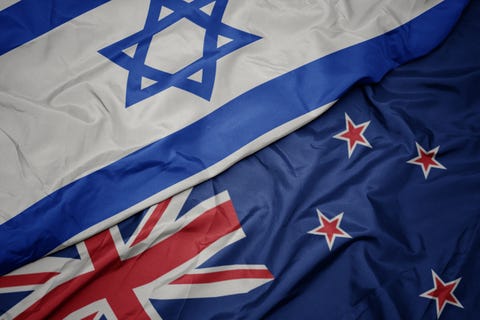
The weekend's surprise and brutal attack on Israel by Hamas fighters has the potential to reshape the Middle East - and will only further increase global geopolitical instability. As of Sunday night NZT, the initial 24 hours of the assault by Hamas on Israel had already taken at least 250 Israeli lives - easily making it the bloodiest day for Israel since the 1973 Yom Kippur War. In addition, dozens of Israelis have been kidnapped and taken back to Gaza to be used as bargaining chips. While there will be a range of motivations for why Hamas chose to act in the way it did now, the symbolic timing of Hamas' assault - almost 50 years to the day after Yom Kippur - is unlikely to be a coincidence.
In recent years, Western countries such as New Zealand have largely taken their eye off the region to focus on the war in Ukraine and rising geopolitical tensions in the Indo-Pacific. A staple of New Zealand's world news diet in decades past, of late the Israeli-Palestinian conflict has only rarely made the headlines. When it has, New Zealand has preferred not to become involved to any real extent beyond expressing sympathy with the victims. For example, when conflict broke out over Gaza in 2021, Jacinda Ardern cut an image that resembled more that of an observer or commentator, rather than of a participant in international affairs.
The new Hamas assault is a reminder of the continued power of the Middle East to shock and surprise. While it is too early to tell how the conflict will exactly unfold, one of the most concerning aspects will be the extent to which other nation-states become involved - particularly Iran, a close supporter of Hamas. The risk is that the war could spiral out of control and become a wider conflict with an even greater global impact, in an echo (or, potentially, an even more dangerous version) of the Yom Kippur War of 1973.
Determining New Zealand's response to the new war in the Middle East will be one of the new New Zealand government's first challenges - and as shown by the fierce reaction to the initial lack of direct condemnation of the Hamas assault by Nanaia Mahuta, it will not be an easy path to navigate. A sustainable and durable two-state solution is the only long-term answer to the Israeli-Palestinian conflict. But with Israel now defending itself against a vicious and horrific attack by Hamas, and planning a new ground invasion of Gaza, this will not be on the table in the near future.
However, New Zealand should resist the temptation to lose hope or to see the war as simply someone else's problem. As a small democracy far from the epicentre of the conflict, New Zealand could eventually play a role in peacemaking efforts - if it wanted to. We should not forget that as horrific as the Yom Kippur War in 1973 was, the Camp David Accords came just five years later in 1978. These led to Egypt signing a peace treaty with Israel, a settlement that has endured. The darkest moment can sometimes come before the dawn. There will absolutely be a need for de-escalation, dialogue and diplomacy in the days, weeks, months and years ahead - and countries will be sorely needed to lead and support these efforts.
For now, these ambitions may seem like a pipe dream. But as the war in Ukraine has shown, even distant wars can have an outsized impact, even half a world away. Crude oil prices have already risen sharply this year - and combined with a strengthening US dollar, these have caused New Zealand petrol prices to head back up to levels last seen in the immediate aftermath of Russia's invasion of Ukraine. The pain caused by rising inflation and the cost-of-living crisis - the number one issue of the election campaign - may not be over yet.
Geoffrey Miller is the Democracy Project’s geopolitical analyst and writes on current New Zealand foreign policy and related geopolitical issues. He has lived in Germany and the Middle East and is a learner of Arabic and Russian. He is currently working on a PhD on New Zealand’s relations with the Gulf states.
This article can be republished for free under a Creative Commons copyright-free license. Attributions should include a link to the Democracy Project (https://democracyproject.nz)
Not a close student of the political detail of this area, what comes to my mind, is that from the time of Britian's guiding the creation of the State of Israel, there have been significant issues regarding the status of the Palestinians. The support, particularly by the lobby groups located in the USA, for the Jewish state but from other political groupings as well, have led to wars, as you mention in your article. This would appear to allow the emboldening of various Israeli administrations having taken grievous licence with Palestine land holdings, in the, relatively newly named, state of Israel. The current Prime Minister of Israel, Netanyahu, has continued to exacerbate the Palestinian's problems by his continuation of displacing them from their own traditional land holdings. That the Hamas attack is seen as brutal is no surprise to me, but I think it needs be seen against the history of the Israeli attacks against them, and the people that they are a part of.
I see the Ukrainian conflict developing into a European version of Gaza. Until countries stop using other areas as proxies for their own political goals we will never have global stability. Peace making has to be the primary objective over arms supply. I agree New Zealand can play a role in that. Until that happens innocent people on all sides will pay the price.