

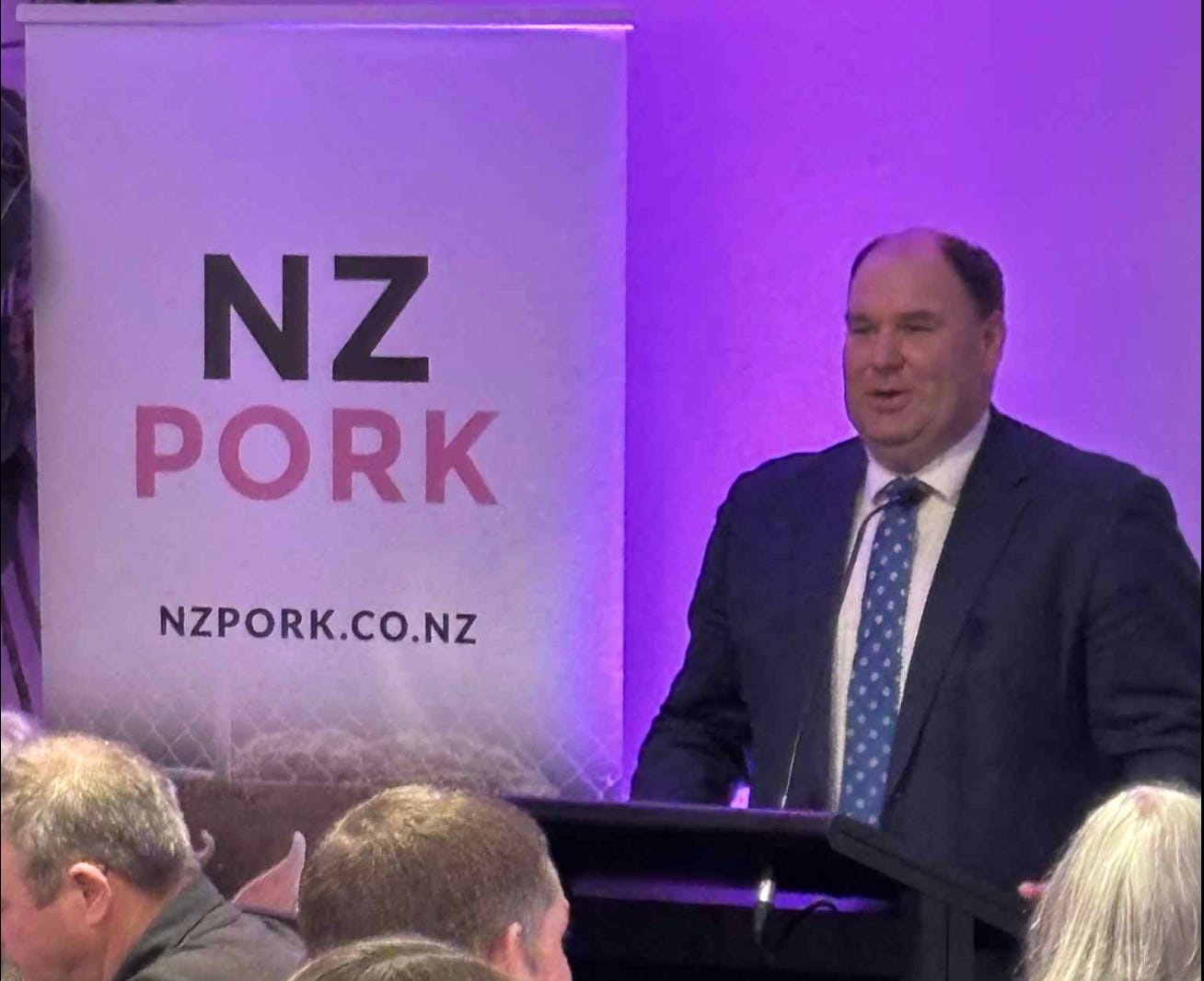
When Associate Minister of Agriculture Andrew Hoggard announced the Government’s new pig welfare regulations earlier this month, the language was triumphant. The changes, he declared, would “raise welfare outcomes for pigs” and create standards “amongst the highest in the world”. But for anyone paying attention, this was a masterclass in what the Otago Daily Times aptly described as “weasel words”. The announcement was not progress; it was a profound betrayal of animal welfare, legal precedent, and public trust, all wrapped in the deceptive packaging of reform.
The grim reality behind the spin is this: the Government has just legislated to reverse a legally mandated ban on farrowing crates, which was due to come into effect on December 18, 2025. Instead of abolition, the industry has been granted another decade of permission to use these cruel contraptions.
The new rules, which only take full effect at the end of 2035, merely tinker at the edges of a practice many consider institutionalised torture. Farrowing crates are metal enclosures so small that a mother sow cannot even turn around. She is confined for up to five days before giving birth and for weeks after, unable to perform the most basic natural behaviours, such as building a nest for her young. This is the practice the Government has just enshrined in law for another ten years.
This policy reversal was executed with a manufactured urgency that speaks volumes about its intent. The amendment bill was introduced and rushed through its first reading in Parliament within a week. The public and interested groups were given just two weeks to make submissions. This timeframe, the SPCA notes, is a fraction of the standard six weeks afforded for such processes.
This was not the careful deliberation of a government seeking broad consensus; it was the swift, decisive action of a government executing a pre-determined agenda. The strategy is a classic example of what legal scholar Marcelo Rodriguez Ferrere calls “Orwellian doublethink”: a significant regression in animal welfare is being sold to the public as a progressive step forward. This is not just political spin; it is a calculated inversion of reality, designed to mislead the public on a matter of deep ethical concern.
How expert advice was deliberately ignored
At the heart of this policy failure is a story of how expert advice was systematically and deliberately ignored. Anusha Bradley’s investigation for RNZ, which was published on Friday, lays the process bare, revealing a Government that worked in lockstep with industry while dismissing the very experts it is legally required to consult.
The National Animal Welfare Advisory Committee (NAWAC) is the Government’s statutory body of scientific and policy experts, established under the Animal Welfare Act to provide independent, evidence-based advice. Its purpose is to ensure that animal welfare policy is guided by science, not commercial pressure. On the issue of farrowing crates, its advice was clear and has now been comprehensively disregarded.
Bradley’s reporting, based on newly released documents, shows that NAWAC raised serious concerns directly with Minister Hoggard about his plans. The committee fundamentally disagreed with the reforms.
Where the government’s new bill mandates a mere 13.3% increase in space for growing pigs, NAWAC’s own code had proposed a far more meaningful increase of either 56% or 140%. More fundamentally, the extensive public consultation in 2022, which was based on NAWAC’s work, canvassed two options: a complete ban on farrowing crates, or a system of free-farrowing pens. The government’s decision to simply extend the use of existing crates was never on the table.
This is a calculated sidelining of expertise. As Marcelo Rodriguez Ferrere observes, “the government is essentially sidelining the very body that the Act trusts with this sort of work, and the government is ignoring the agency that is supposed to be advising it”. This elevates the decision from a mere policy disagreement to a flagrant breach of good-faith governance. The Government has effectively rendered its own expert advisory body impotent, sending a chilling message that its function is merely performative when its advice conflicts with a predetermined political and economic agenda.
Minister Hoggard’s hollow claim of having conducted “five years of consultation” further exposes this disregard for process. As Bradley’s investigation confirms, and as the SPCA’s Chief Scientific Officer, Dr Arnja Dale, has stated, this refers to the previous consultation process under the Labour government – the very process that led to the ban this Government has now overturned. When it came to drafting the new bill, the “further targeted consultation” was conducted almost exclusively with NZ Pork, the industry’s lobby group. Key animal welfare stakeholders were shut out entirely.
The Architects of the rollback: A revolving door of influence
To understand how this happened, one needs only look at the key individuals who architected this policy reversal. The decision is the direct, predictable outcome of placing industry insiders into the most powerful decision-making roles, creating a textbook case of regulatory capture.
The minister responsible for animal welfare is Andrew Hoggard. Before entering Parliament, he was the national president of Federated Farmers, the country’s most powerful agricultural lobby group. His public statements and directives since becoming a minister have consistently shown a desire to prioritise the economic concerns of the industry, even instructing NAWAC to give greater regard to the “practicality and economic effects” of its proposals. This move fundamentally undermines the committee’s primary focus on animal welfare.
Even more telling is the appointment of the Minister’s key adviser on this issue, Nick Hanson. Until 2024, Hanson was the policy and issues manager for NZ Pork, the primary lobby group for the pig industry. He has moved seamlessly from advocating for the industry’s commercial interests to advising the minister tasked with regulating that same industry. This is the revolving door of influence in its most blatant form, blurring the lines between lobbyist and lawmaker to the point where they are indistinguishable.
This insider access is reflected in the Government’s engagement (or lack thereof). While the RNZ investigation found that consultation on the new bill was held with NZ Pork, and the minister’s own diary for February 2025 shows a scheduled meeting with the group’s leadership, the same courtesy was not extended to welfare advocates. According to the Minister’s published diaries, Hoggard met with NZ Pork representatives at least eight times since taking office late last year – far more than he met with any animal welfare group.
Arnja Dale of the SPCA stated unequivocally that she and her colleagues were “blindsided” by the announcement and had not been engaged in any consultation on farrowing crate standards under the current government. The policy was not developed through a balanced consideration of evidence; it was developed by individuals whose professional careers have been dedicated to advancing the interests of the very industry they are now supposed to hold to account. The policy is, in effect, the industry regulating itself.
A Mockery of the law and the public
Beyond the procedural failings and conflicts of interest, this decision represents a profound contempt for the rule of law and the democratic will of the public. The Government has used its parliamentary majority not to forge new policy, but to subvert a legal judgment it found inconvenient.
In 2020, the High Court ruled that regulations permitting the use of farrowing crates were “unlawful and invalid” under the Animal Welfare Act. The court found that confining a sow in a cage where she cannot turn around violates the Act’s core obligation to provide for an animal’s “opportunity to display normal patterns of behaviour.” This was not a political opinion; it was a definitive legal interpretation of New Zealand’s highest animal welfare law. In response, the previous government began a phase-out, due to conclude in December 2025.
The current government, faced with this legal reality, chose not to comply but to rewrite the law itself. As Marcelo Rodriguez Ferrere has argued, the government deliberately “ran the clock down” to create a “manufactured crisis”, allowing it to claim that urgent legislation was needed to prevent legal chaos when the deadline arrived. The amendment bill is an extraordinary piece of legislative manoeuvring, designed to retroactively legitimise a practice the judiciary had already declared illegal. Ferrere rightly calls this a “dark day for the rule of law” and a betrayal of the democratic process.
This move also flies in the face of overwhelming public sentiment. A 2018 petition to ban farrowing crates gathered more than 112,000 signatures, and polls have consistently shown that a clear majority of New Zealanders oppose the practice. The Government is not only dismissing the courts and its own experts but also the expressed will of the people it purports to represent. The frustration is palpable among those who were shut out of the process. As Arnja Dale put it, “It is unacceptable to see decisions of this scale being made without transparency and public input”.
Cruelty as the cost of business
The farrowing crate decision is not an isolated incident. It is the latest and most egregious example of a systemic problem in New Zealand politics: the immense power of the agricultural lobby to shape policy in its favour, consistently at the expense of animal welfare.
We see the same dynamics at play in the Government’s determined push to overturn the ban on live animal exports, a trade halted after the tragic sinking of the Gulf Livestock 1, despite widespread public and expert opposition. We have seen it for years in the stubborn refusal to ban cruel rodeo events and the long, drawn-out battle to end the demonstrably harmful greyhound racing industry. In fact, the same could be said in terms of the weakening of water quality regulations that affect farming practices.
In each case, the pattern is the same. Scientific evidence of suffering is dismissed, expert advice is ignored, and public opinion is overridden. The justification is always the same: protecting the economic interests of a small but powerful sector. As the Post columnist Virginia Fallon has repeatedly chronicled, these industries operate with a sense of entitlement, seemingly immune to ethical arguments or public pressure.
This reveals a fundamental and deeply cynical contradiction at the heart of our national identity. We market ourselves to the world as a nation of high animal welfare standards, a “clean, green” paradise where animals are treated with respect. Our law even formally recognises animal sentience. Yet our government simultaneously carves out legal exemptions to allow practices that inflict profound and unnecessary suffering, simply because they are profitable.
The decision to legislate for the continued imprisonment of intelligent, sentient mother pigs in metal cages is a stain on our nation’s character. It tells the world that our proclaimed values are a marketing tool, not a moral compass. It demonstrates that in New Zealand, if your lobby is powerful enough, you can write your own laws. And it confirms that for all our fine words, the most vulnerable among us — in this case, the animals — are left to pay the price for our caged integrity.
The Otago Daily Times got it right when it stated on Friday that Hoggard’s claims are weasel words. The reality is that this Government has chosen to serve the pork industry’s commercial interests rather than protect pigs from unnecessary cruelty. That choice reveals something important about where power really lies in New Zealand’s agricultural policy, and whose interests really matter when decisions get made.
Dr Bryce Edwards
Director of The Integrity Institute
Further reading:
Anusha Bradley (RNZ): Govt’s independent animal welfare experts disagreed with pig welfare reforms
Anusha Bradley (RNZ): “Animal experts against plans to keep pregnant pigs in crates” (Morning Report interview)
ODT: Editorial – Pig welfare weasel words (paywalled)
Alexia Russell (Newsroom): The pig welfare reforms that roll back pig welfare
Sudesh Kissun (Rural News Group): Pig farmers respond to new welfare standards
Virginia Fallon (Post): Cruelty ruled unlawful? Just change the law (paywalled)
Henry Cooke (Post): Ten more years of farrowing crates after Minister intervenes to double time until new rules (paywalled)
Marcelo Rodriguez Ferrere (Newsroom): Govt’s pig welfare amendment bill is Orwellian doublethink
Lillian Hanly (RNZ): New rules for welfare of pigs on farms - in 10 years
I hope you send your writings to the the relevant ministers inboxes?
Thanks Bryce for shining a light on what appears to be a very worrying decision by the Agriculture Minister. Although in these difficult economic times I believe the country needs to get behind wealth creating exporters and perhaps be prepared to accept a certain amount of wheeling and dealing that might not always seem democratically fair, I draw the line when it comes to animal welfare. Whilst reluctantly accepting the slaughter of animals for food, it is to me entirely unacceptable, despicable actually, to be profiting from their discomfort and suffering.