

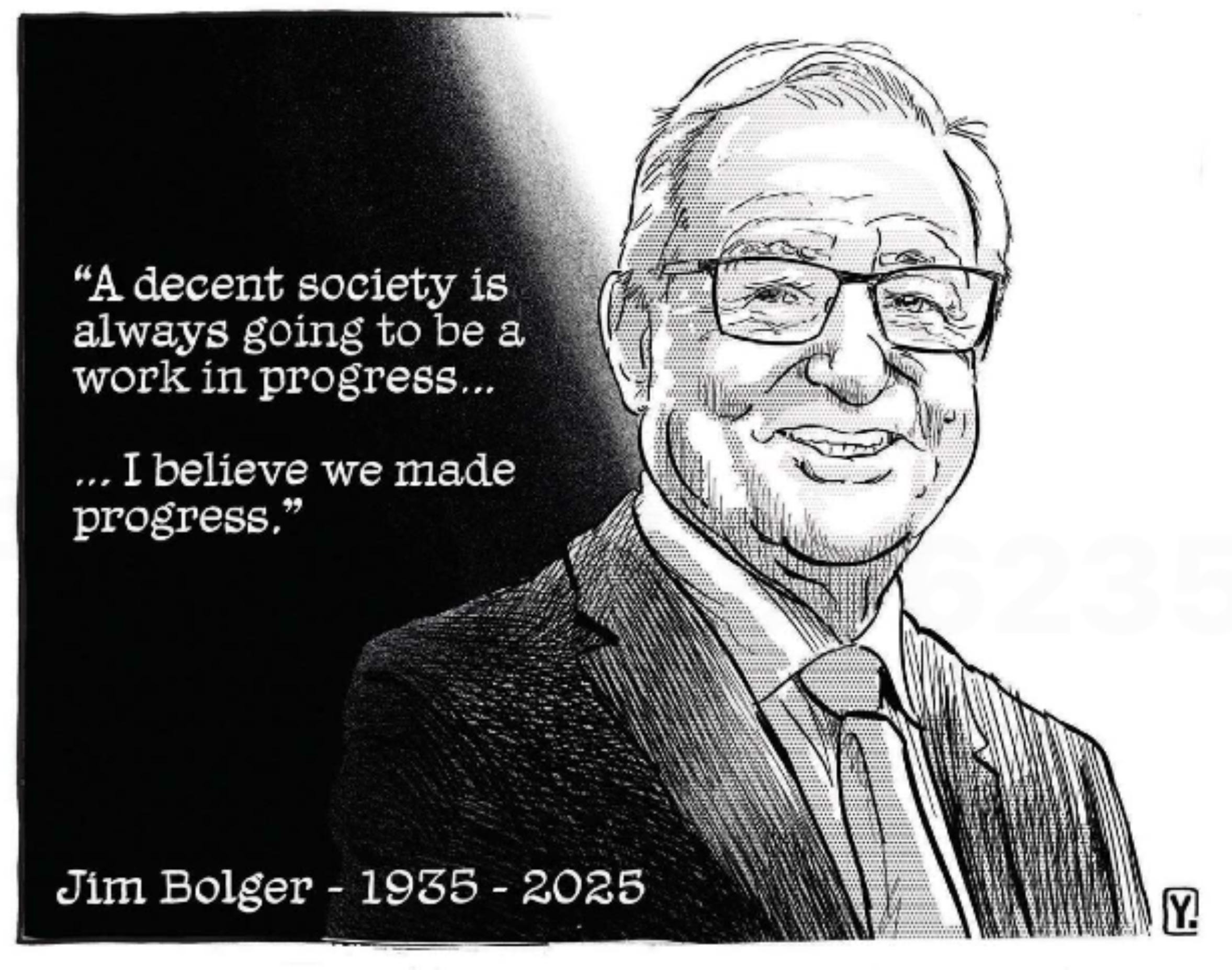
With the death of Jim Bolger at the age of 90, it is striking that New Zealand’s political community is remembering two very different men. As Prime Minister Christopher Luxon put it, Bolger was “a towering figure in New Zealand’s political life – a leader of conviction, a reformer of consequence.” Yet as the tributes and obituaries pile up, it’s as if there are two Jim Bolgers being laid to rest. Reconciling these two legacies is the great challenge in assessing his integrity and impact.
On one side stands Bolger the 1990s conservative reformer. Thus was the rural National Party Prime Minister who oversaw what many describe as brutal neoliberal reforms: the infamous 1991 “Mother of All Budgets” with deep welfare cuts, the Employment Contracts Act that smashed union power, and a rush of privatisation and deregulation. This is the Bolger whose government’s policies left lasting scars on the left and on the welfare state he had promised to protect under the banner of a “Decent Society.”
As TVNZ’s John Campbell recalled in a heartfelt tribute, “There were times when some of the policies of that National government of 1990–1993 felt almost wilfully cruel.” Those early Bolger years are remembered by many with bitterness and a sense of betrayal that a man campaigning on decency could preside over what unions and beneficiaries experienced as an assault on society’s most vulnerable.
On the other side stands a very different figure: Bolger the elder statesman and progressive conciliator. This is the man praised by Māori leaders for his “deep commitment to reconciliation,” who alongside Minister Doug Graham pushed through New Zealand’s first major Treaty of Waitangi settlements in the mid-1990s against considerable opposition.
It’s also the later-life Bolger who underwent a remarkable ideological change of heart, publicly lamenting the outcomes of the economic revolution he once led. Labour leader Chris Hipkins, in his tribute, highlighted how Bolger in recent years could see that “the growing marginalisation of large segments of our society was leading to us becoming more divided,” and spoke out against it. This Bolger even came to champion unions and criticise capitalism, sounding more like a social democrat than a National Party grandee.
How do we make sense of these contradictions? Was Jim Bolger a hard-right ideologue who conveniently grew a conscience in retirement? Or was he a pragmatic leader forced by circumstance into policies he never loved, finally free to speak his mind later in life? There is no simple conversion story here. Bolger’s journey is a complex interplay between crisis-driven necessity, political pragmatism, and a latent conscience that only fully emerged once he was out of power. Reflecting on his legacy, you can see a paradox, but also an instructive example of political integrity in an unexpected form.
The Decent Society’s bitter medicine
Context is everything. To understand the radical free-market reforms of Bolger’s first term, we must remember the dire economic situation he inherited in 1990, and the deep sense of betrayal that Bolger felt toward the outgoing Labour government. Bolger swept to power promising a “Decent Society,” only to find within 24 hours of his victory that this promise would be shattered by a fiscal nightmare. Treasury officials sat the new Prime Minister down and revealed the truth: the outgoing government’s supposed $89 million surplus was, in Bolger’s own blunt word, “bullshit.” The reality was a $1 billion deficit, projected to blow out to $5 billion within two years, and a state-owned bank (the BNZ) on the brink of collapse needing a massive bailout. Bolger later said he felt “totally gutted” by this deception. In his view, outgoing PM Mike Moore had “totally misled the public... it was just a great big lie.”
That narrative of betrayal set the stage for what came next. The crisis gave Bolger’s government a mandate – or in their minds, a license – to administer bitter medicine. What looked like an ideological crusade can also be seen as a panicked scramble to save a sinking ship. As his combative Finance Minister Ruth Richardson later reflected, “Jim’s hand was forced... the imperative was to be transformational.” Richardson saw reform as a personal crusade; Bolger, at least by his own account, saw it as a grim necessity to save capitalism in crisis.
The results were policies that defined Bolger’s reputation for a generation. Richardson’s 1991 budget, branded the “Mother of All Budgets,” delivered shock treatment to public spending – slashing welfare benefits, trimming superannuation, introducing hospital user charges, and more. It was an assault on the post-war welfare state so severe that even many National voters winced.
Equally seismic was the Employment Contracts Act 1991 (ECA), which radically rewrote labour laws. Political commentator Chris Trotter has called the ECA “one of the most extreme examples of anti-union legislation in post-war history” – noting that the Act even expunged the word “union” from the law. This was union-busting on a grand scale, and its impact was immediate. Within just a few years, union membership in the private sector plummeted from nearly 50% of workers to not much more than 10%. Decades later, veteran unionists like Laila Harré would describe the ECA’s arrival as a “tsunami” that swept away hard-won labour rights – a blow from which organised labour in New Zealand never fully recovered.
These policies formed the core of Bolger’s first-term legacy. They also nearly cost him power. The public backlash was intense; by 1993, Bolger’s government was hanging on by a single seat. John Campbell isn’t alone in remembering those early 90s reforms as deeply painful. I was a university student at the time, and I distinctly recall the protests, the stories of families pushed into poverty, the anger that this wasn’t what people thought they’d voted for. Bolger had campaigned on healing a divided, indebted nation (a “Decent Society”) yet to many it felt like his government was making society meaner and more unequal.
This is the first Jim Bolger we must reckon with at his death: the Prime Minister whose name is synonymous with austerity and neoliberal revolution. In the court of public opinion, this Bolger was long viewed as either a necessary strongman who dragged New Zealand into the modern economy, or a callous turncoat who broke the social contract.
And the truth is, he was a bit of both. He was a leader of conviction and toughness.
Matthew Hooton, a staunch rightwing commentator, even lauds Bolger today in the Herald for “showing what real leadership looks like” by not flinching in the face of economic fire. But Bolger also bore the moral burden of the harm those decisions caused. “There were times,” John Campbell said, “when those policies felt almost wilfully cruel.” For a generation of New Zealanders, especially on the left, that hurt has never fully healed.
The Statesman’s moral compass
And yet, paradoxically, even as Bolger’s government was dismantling parts of the welfare state and smashing union power, it was simultaneously doing something visionary and just on another front. One of the great contradictions of the Bolger years is that this hard-edged neoliberal administration also became a pioneer in Māori reconciliation and Treaty of Waitangi settlements.
Bolger’s government in the mid-90s concluded the first major Treaty settlements, notably with Waikato-Tainui in 1995 and Ngāi Tahu in 1997. This created a template for all the settlements that followed. These were landmark moments in addressing historical injustices against Māori. They were also highly controversial among many Pākehā and even within Bolger’s own National Party caucus. At the time, pursuing Treaty settlements was seen by some conservatives as divisive or even a waste of money. Bolger, however, was resolute. In one Cabinet meeting, when a minister questioned why they were pushing ahead with settling grievances from the 1800s, Bolger simply responded: “Because it is the right thing to do.”
Where did this part of Bolger’s character come from? Bolger often linked it back to his roots as the son of Irish immigrants. In his memoir A View from the Top, he reflected: “Something within me – perhaps it is my Irish heritage, of a nation oppressed for centuries – demanded that I listen to the Māori story.” In one of his final interviews, Bolger said he instinctively understood “what it was like to be treated as second-class citizens, and Māori were treated as second-class citizens.” Here was a personal identification with the underdog, the colonised, that seemed completely at odds with the dry, fiscally tough farmer image that dominated his economic policy.
This reveals how Bolger was operating on two parallel tracks of logic. On economics, he was the pragmatic farmer who left school at 15, a man who saw a broken economy like a broken farm that needed drastic treatment, ideology be damned. On Treaty and social justice, he was motivated by a moral compass and a sense of historical injustice that had to be righted, politics be damned. In Bolger’s mind these two tracks did not conflict; they addressed different problems. He could pursue radical free-market reforms as tools for national survival, and simultaneously pursue reconciliation with Māori as a non-negotiable matter of conscience.
As an observer of his career, I find this duality fascinating. It’s why some of us can speak of Jim Bolger with both anger and admiration in the same breath. It’s also why, even before his late-life ideological shift, there were hints that Bolger was not the one-dimensional “neoliberal ogre” some thought. There was always a decent society impulse in him. It just manifested unevenly.
On issues of race, culture, and basic fairness beyond the economy, Bolger often proved to be more compassionate and farsighted than many expected from a conservative farmer-politician. That doesn’t erase the very real harm of his government’s economic choices, but it does complicate the picture of his integrity and values.
Damascene conversion or convenient recanting?
For years, the contradiction in Bolger’s record remained an enigma. He rarely expressed regret while in office or even in the years immediately after. If anything, in the 2000s he stayed relatively quiet, serving as Ambassador in Washington and then taking on roles like chairing NZ Post and Kiwibank (ironically helping oversee a state-owned bank after presiding over so much privatisation). But then came 2017, and what I can only describe as Bolger’s public road to Damascus moment.
In April 2017, Guyon Espiner interviewed Jim Bolger for RNZ’s excellent series The 9th Floor. In that conversation, which landed like a bombshell in political circles, Bolger recanted neoliberalism. He stated, plainly and unequivocally, that the neoliberal economic model had “absolutely failed.” He went on to condemn the core outcomes of the very policies he once championed: “They have failed to produce economic growth and what growth there has been has gone to the few at the top… that model needs to change.”
Hearing those words in Bolger’s own voice was startling. Here was the architect of benefit cuts and union busting, lamenting inequality and weak unions. In the interview, Bolger even bemoaned that unions were now “probably too small now to have the influence they should have”. This was an extraordinary admission from the man who passed the Employment Contracts Act! As Espiner noted, to hear this from a former National Prime Minister who had pursued privatisation, deregulation, welfare cuts and tax reductions was “pretty interesting.” That’s putting it mildly. It was like hearing the Pope announce he’s now an atheist.
Reactions poured in. Many on the left were astonished and cautiously pleased. Former Labour figure Bryan Gould wrote that Bolger’s conversion was a surprise, but a welcome one from a “decent and humane man” who had clearly done some hard thinking over the years.
On the right, blogger David Farrar quipped that he wasn’t surprised at all, as Bolger had been sliding leftwards for years. Farrar joked that Jim now seemed “to the left of Helen Clark.” Meanwhile, commentators debated whether this was sincere or revisionist. Some, like Liam Hehir, pointed out that Bolger never called his reforms “neoliberal” at the time (true enough, that term wasn’t in vogue in the 90s) and that he wasn’t exactly apologising for specific policies even in 2017, more acknowledging the overall model’s shortcomings.
As someone who follows ideological shifts closely, I saw Bolger’s 2017 recanting as genuine but incomplete. He didn’t say “I’m sorry” outright for 1991, but he effectively said “we got the big picture wrong.”
That’s no small thing. And it wasn’t just talk: in 2018, the following year, Bolger put his money where his mouth was. The new Labour-led government (under Jacinda Ardern) appointed none other than Jim Bolger to head the Fair Pay Agreements working group, tasked with designing a system to boost collective bargaining and sector-wide employment deals. In other words, Bolger was recruited to help undo some of what the ECA had done.
The irony was lost on no one. Here was Bolger, the union-slayer of 1991, now essentially helping to empower unions in 2018. Many in the union movement were flabbergasted. Laila Harré said she was “aghast” at the choice – and some on the right were bemused. One left-wing wit, Ben Rosamond, tweeted a scathing line: “Bolger in 1991: Almost completely destroys NZ’s union movement. Bolger in 2018: Hired by Labour to fix the union laws. I’m reminded of Thatcher saying her greatest achievement was Tony Blair….”
It’s a cutting remark, but it captures the feeling of whiplash. Was Bolger’s transformation an act of true integrity, a man acknowledging mistakes and trying to make amends? Or was it a convenient evolution for a retiree seeking relevance or redemption, long after the damage was done?
Surely it can be a bit of both. Bolger’s change of heart was certainly convenient in that it cost him nothing by then. He wasn’t going to re-enter politics, and in fact he gained a sort of elder-statesman respect from the left for “seeing the light.” It’s much easier to blast neoliberalism when you’re 80 years old and fondly removed from the fray.
Yet, it’s also easy to believe his conversion was sincere and rooted in a broader shift among many of Bolger’s generation globally. After the Global Financial Crisis of 2008, even institutions like the IMF and World Bank started questioning the laissez-faire orthodoxies of the ’80s and ’90s. Bolger, ever the pragmatist, read the room. By 2017, it wasn’t radical to say inequality is bad and neoliberalism failed. It was almost mainstream.
In that sense, Bolger was personifying a larger ideological retreat of the political elite. He was hardly alone; think of other elder statesmen like Australia’s Paul Keating or even some Reagan/Thatcher acolytes who moderated their tone later on. Bolger simply went a step further in walking the talk (or at least, talking the talk very bluntly).
From an integrity perspective, there’s something admirable in Bolger’s evolution. There’s a quote often attributed to Keynes: “When the facts change, I change my mind – what do you do?” Bolger changed his mind when the facts of outcomes became clear. Not while he had the power to fix it, and that will always be the tragedy of his story. But at least he did so publicly and used his voice to validate those calling for change. In 2018, I even wrote in a Newsroom column that putting Bolger in charge of rethinking industrial relations was a “masterstroke” by Labour: it showed that even a former National PM agreed the balance had swung too far against workers. It lent cross-partisan legitimacy to the cause. And Bolger, to his credit, threw himself into that work with real interest.
Incidentally, a few years ago I ended up talking about all this to Jim Bolger at a University function. I told him he now seemed more like Jim Anderton in his older age. He found that amusing, but admitted there was some truth in that, and agreed that Andertson’s political agenda of a few decades had more going for it than he had appreciated at the time. He also bought up Bernie Sanders as someone he admired.
The Negotiator and the pragmatist
There’s a final aspect of Bolger’s legacy that has been highlighted by those who worked with him: his political pragmatism and deal-making skill. Bolger was often branded as ideologically rightwing, but those who knew him often say he was more of a centrist manager at heart.
The seeds of his later moderation were actually visible in how he adjusted course while in power. After the near-death experience of the 1993 election, Bolger made a dramatic pivot. On election night, as his huge 1990 majority almost evaporated, a shocked Bolger muttered “bugger the pollsters”, then he swiftly took action. He sacked Ruth Richardson as Finance Minister, dumping the hardline architect of “Ruthanasia” in favour of the more pliant, pragmatic Bill Birch.
This was a clear signal that Bolger was moving away from ideological purity and back towards the political centre to save his government. As commentator Bernard Hickey noted in his own tribute, Bolger might best be remembered as “the National PM that sacked Ruth Richardson” – an act which proved he was not a true believer in free-market dogma when it became an electoral liability. Bolger was a survivor above all, and survival in politics often demands flexibility over rigidity.
His pragmatism was further demonstrated in two other major shifts he navigated. First, he honoured a campaign promise to hold a referendum on MMP (Mixed Member Proportional representation) after the 1993 election, even though he personally opposed changing the electoral system.
When the public voted for MMP, Bolger adapted to that new reality without kicking up a fuss. Second, after the 1996 election (the first under MMP) Bolger managed to form an unlikely coalition with Winston Peters and New Zealand First. This was an incredible turn of events considering Bolger had sacked Peters from his Cabinet back in 1992 and the two men had been at odds for years. Yet Bolger the negotiator swallowed his pride, cut a deal, and gave Peters the Treasury benches (as Deputy PM and Treasurer) to form a government.
That took immense political skill and a certain lack of ideological rigidity. Peters, in his own memorial comments this week, called Bolger “a man of his word” in that 1996–98 coalition – meaning Bolger honoured their agreement even if it was an odd marriage.
Journalist Tim Watkin once dubbed Bolger “The Negotiator,” a master of the old-school “smoke-filled room” deal-making. Watkin observed that Bolger understood politics as “the art of the possible” rather than a grand battle of ideas. This speaks to Bolger’s pragmatic core. He wasn’t an intellectual visionary or an ideologue; he was, as Richard Harman also wrote, in some ways our most ordinary Prime Minister – a farmer who prized common sense and keeping the show on the road. And when the winds changed, he would trim the sails.
This pragmatic streak doesn’t excuse or erase the ideological zeal of his first term, but it does contextualise it. Bolger was willing to change course, whether in 1993 by moderating policy, or later in public life by changing his economic tune. When he thought the country or his government’s survival depended on it. In a way, his integrity was tied not to unwavering principles but to a belief in doing what needed to be done in the circumstances. Sometimes that led him astray into harsh policies, other times it led him to bold and principled ones. It’s why his legacy is so hard to pin down as simply “good” or “bad.”
A Legacy of contention and conscience
In the end, I keep coming back to the idea of two funerals for Jim Bolger. We might mourn one Jim Bolger: the tough reformer of the early ’90s, whose name is forever linked to policies that cut deep into the social fabric and ushered in an era of inequality and labour weakness. We also celebrate another Jim Bolger: the elder statesman who devoted himself to Māori reconciliation, and the unexpected critic of neoliberalism who, late in life, championed a fairer, more inclusive economic model. Both of these figures are real, and both were Jim Bolger. They coexisted uneasily within one career, and indeed within one man.
Does Bolger’s late-life change of heart redeem him? Not entirely. The hurt and social damage from the reforms he led are real and linger on. You only have to look at child poverty stats or the state of our unions to see that. His recanting doesn’t undo those consequences.
But it does speak to Bolger’s character in a way that is ultimately positive: it showed he was capable of growth, reflection, and even remorse (implicitly). In politics, that’s rarer than it should be. Most politicians defend their legacy to the grave. Bolger instead complicated his own legacy by admitting parts of it had failed. To me, that displays a kind of integrity. It’s an honesty and willingness to question oneself that is all too absent in our political culture.
Bolger’s story is one of the most compelling in modern New Zealand history precisely because of these contradictions. He was a man shaped by his times. He was pragmatic Kiwi farmer thrust into a fiscal crisis, who did what he thought he had to do. Yet he also retained enough of a conscience that, over time, he could admit where it went wrong.
It’s been said that politicians often do their best work after leaving office, when they are freed from party constraints and the need to appease voters. Jim Bolger may be a prime example of that. In retirement he arguably became more radical (in a good way) than he ever was in power – perhaps even, as one commentator mused, the most progressive ex-Prime Minister since Norman Kirk.
One question still nags: was his transformation too little, too late? For those who suffered under his policies, yes, it likely was. Better late than never, as Chris Trotter wryly wrote – but also, as I might say directly to Jim if I could, why on earth couldn’t you have “seen the light” and found that road to Damascus a little sooner? That, unfortunately, is not how life works.
Finally, it’s worth remembering a piece of advice Bolger himself gave in one of his final interviews. Reflecting on leadership, he said: “Don’t try and dictate to [the people], listen to them, see what they’re saying… then you might be able to make a sensible suggestion to help their lives.” This from a man whose first term as PM was largely about dictating sweeping changes with little consultation. The irony is stark, but so is the wisdom.
Jim Bolger’s legacy will be debated for years to come. But perhaps the ultimate tribute we can give is an honest one that embraces the complexity: he was a leader of consequence and contradiction, whose conscience eventually caught up with his conviction. New Zealand is both better and worse for his time in power, and considerably wiser for the two different Jim Bolgers.
Dr Bryce Edwards
Director of The Integrity Institute
Further reading:
John Campbell (TVNZ): Bolger had a genuine impact on New Zealand
Matthew Hooton (Herald): Jim Bolger showed what real leadership looks like (paywalled)
Luke Malpass (Post): Jim Bolger: The man who shepherded in modern NZ (paywalled)
Toby Manhire (Spinoff): Jim Bolger in his own words
Jonathan Milne (Newsroom): ‘Even in the darkest times, he understood the need to build our nation’
Russell Palmer (RNZ): ‘Humble, dedicated, passionate’ - MPs remember Jim Bolger in Parliament
Emma Ricketts (Stuff): How Bolger’s NZ has changed: Are we better off now than we were in the 90s?
Eva Corlett (Guardian): Jim Bolger, former New Zealand prime minister who drove reconciliation with Māori, dies at 90
Luke Malpass and Henry Cooke (Post): ‘A towering figure in NZ’s political life’: Vale Jim Bolger (paywalled)
David Cohen (Post): Remembering Jim and his conversations about our country (paywalled)
Harriet Laughton (Post): Politicians pay tribute to former PM Jim Bolger (paywalled)
Tim Watkin (RNZ): How Jim Bolger became the master of the ‘smoke-filled room’
Audrey Young (Herald): Jim Bolger remembered: The man who left school at 15 and went on to become PM. His legacy is remarkable (paywalled)
David Farrar: RIP Jim Bolger
Richard Harman: Jim Bolger – one of our greatest PMs (paywalled)
Jim Bolger didn't just inherit a fiscal crisis. He also inherited a restructured "deregulated" economic system wide open to foreign capital that could not survive without first smashing the trade unions. Labour had created both the fiscal "crisis" and the new economic model, and Labour knew that breaking the power of unions was an essential prerequisite for the effective and sustainable operation of the new system of economic management. So Jim Bolger had to do what Labour did not dare to do itself, yet had made absolutely necessary.
Fantastic article Bryce. However Norman Kirk never got to be ex-PM. He died in office.