

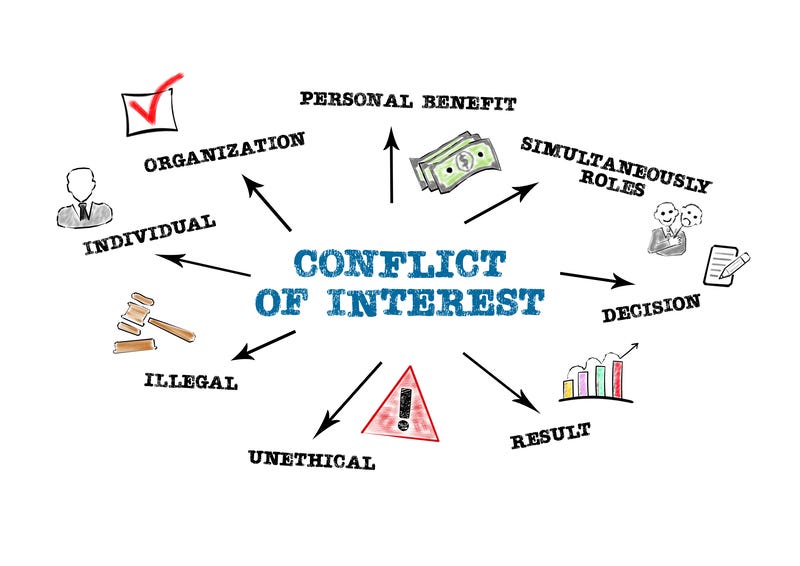
The coalition Government is facing another embarrassing conflict-of-interest saga that raises serious questions about ministerial integrity. At the centre is Mark Patterson, a New Zealand First MP-turned-Cabinet Minister, whose private business interests have collided with his public duties. Patterson sat in on crucial Cabinet discussions about climate policy – despite personally standing to gain from those decisions. The conflict involves Ngapara Farms Ltd, a company Patterson co-owns that is registered in the Emissions Trading Scheme (ETS) and earns revenue from carbon forestry. In other words, Patterson has a pecuniary interest in the price of carbon credits, yet he participated in setting those very policies.
The revelations, uncovered by Newsroom’s Marc Daalder, show Patterson “refusing to answer questions about a newly disclosed conflict of interest” and declining to say whether he was conflicted during Cabinet talks on carbon markets. You can read Marc Daalder’s two Newsroom stories here: Call for PM to step in over minister’s carbon trading conflict of interest and Minister was involved in carbon price decision despite owning carbon forestry block (paywalled)
It’s a scenario that should never have been allowed to happen – at least not if the Cabinet Manual’s conflict-of-interest rules were rigorously followed from the start. Instead, the issue appears to have been caught only belatedly, well after Patterson had already influenced policy outcomes.
Timeline: From appointment to aftermath
To grasp the seriousness of Patterson’s conflict, consider the timeline of events and decisions:
• November 27, 2023: Mark Patterson is sworn in as Minister for Rural Communities and Associate Minister of Agriculture in Prime Minister Christopher Luxon’s incoming government. As an MP, Patterson discloses that he is a director and 50% shareholder of Ngapara Farms Ltd, a sheep, beef and forestry company. Ngapara Farms holds an ETS account to trade carbon credits. Ideally, any conflict with ETS policy should have been flagged immediately – “the day that Mark Patterson was appointed,” as one commentator notes – but no special restrictions are put in place at this point.
• May 2024: Patterson participates in a Cabinet committee decision on annual ETS unit settings. Cabinet documents confirm he took part in at least one market-sensitive decision on ETS settings (launching a consultation on carbon unit volumes/prices) in late May. This consultation had to be announced before financial markets opened, underscoring how insider knowledge of ETS policy can yield a trading advantage. Patterson’s dual role – policy-maker on one hand, carbon credit investor on the other – is a textbook conflict of interest, yet it went unmitigated at the time.
• June 11, 2024: The Government publicly confirms it will remove agriculture from the ETS. Patterson’s name appears as a co-author on the Beehive press release announcing this policy shift – see: Agriculture to come out of the ETS. As Associate Agriculture Minister, he even provides a supportive quote about “future-proofing export growth” while lifting sustainability credentials. Whether removing agriculture from the ETS technically falls under his specific conflict is debatable, but Patterson’s involvement in climate-policy announcements continued in June unabated.
• August 14, 2024: The conflict of interest is finally formally addressed. Nine months into his ministerial tenure, Patterson’s pecuniary interest in carbon forestry is at last acknowledged by the Cabinet Office. An official entry is added to the Ministerial Conflicts of Interest list, noting a “potential conflict between government decisions in relation to the pricing or other settings of ETS units and a pecuniary interest” for Hon. Patterson. The prescribed solution took effect on August 14: Patterson would “not receive papers or participate” in decisions on ETS unit pricing or settings from that point forward. In other words, he was barred from involvement in carbon market policy – but only going forward, not retroactively.
• April 2025: Public revelations and political fallout. The conflict remained behind closed doors until Daalder’s investigation brought it to light this week. The Cabinet Office’s updated public list of ministerial interests tipped off journalists to Patterson’s situation. Facing media queries from Daalder, Patterson’s office refused to answer whether he “held a pecuniary interest that could be affected by ETS settings when he was participating in decisions on those settings” earlier in the term. The Minister dodged specifics, citing the longstanding practice of keeping conflict-of-interest disclosures confidential within Cabinet processes. This stonewalling only amplified criticism from watchdogs and the Opposition that the issue had been mishandled and obscured.
Delayed disclosure and evasive explanations
What stands out in Patterson’s case is not just the conflict itself, but the delay in managing it and the reluctance to fully disclose the details. By the Government’s own admission, Patterson’s conflict was not formally resolved until mid-August 2024 – well after he had been privy to sensitive ETS deliberations. For roughly eight to nine months, a Minister with a direct financial stake in carbon credit prices was inside the room on carbon policy discussions.
It appears that Patterson either did not initially declare the specific conflict or that the Cabinet Office failed to act promptly on information he provided. Ministers are expected to proactively identify any potential conflicts upon taking office. Indeed, the Cabinet Manual (2023) instructs ministers to “avoid any situation in which their private financial interests conflict or appear to conflict with their public duty” (Cabinet Manual 2.59). In Patterson’s situation, a cursory review of his interests should have raised red flags immediately – yet the precautionary step (excluding him from ETS matters) only came after a significant lag. This raises, once again, concerns about the adequacy of the Cabinet Office’s procedures and whether all ministers’ disclosures were rigorously analysed when the Government was formed.
When pressed by Newsroom, Patterson’s spokesperson leaned on procedural justifications. They argued that details of ministers’ conflict disclosures are “not generally released, to ensure the confidentiality of Cabinet proceedings… and in some cases, to protect personal privacy”, noting that successive governments have followed this approach. In short, Patterson’s team claimed their hands were tied from commenting – as if transparency would somehow violate sacred Cabinet secrecy. However, this stance has been challenged as an excessive and self-serving interpretation of the rules.
Daalder’s first article cites The Integrity Institute’s Senior Researcher Jem Traylen stating that Patterson is perfectly free to be more transparent if he wished: “It’s quite obvious that the minister can disclose whatever additional information he wants to about his pecuniary interests. Traylen noting that Patterson “is in a position to confirm whether or not he had that conflict of interest prior to 14 August”.
In Traylen’s view, the Minister hiding behind confidentiality conventions “simply doesn’t cut it” when the public interest in clarity is so high. The rules do not forbid a Minister from explaining himself; they merely don’t require public disclosure. Thus, Patterson’s silence looks more like a political choice than a legal necessity – a choice to “obfuscate” rather than come clean.
Notably, previous governments have struck a more transparent balance in similar situations. Back in 2018, when NZ First’s Shane Jones had a conflict involving a forestry company seeking funding from the Provincial Growth Fund he oversaw, the Labour–NZ First Cabinet publicly disclosed the specific nature of Jones’ conflict in response to questions. That set a precedent that conflicts can be acknowledged openly without breaching Cabinet confidentiality. Critics argue Patterson’s case warranted the same candour. As Traylen points out, knowing whether Patterson had this conflict during earlier ETS decisions is clearly in the public interest. The refusal to answer that basic question suggests an attempt to avoid scrutiny and accountability.
Luxon’s defence and Cabinet process under fire
Prime Minister Christopher Luxon now finds himself having to defend how this situation was handled – or mishandled – under his watch. So far, Luxon’s line has been that the system ultimately worked as intended, once the conflict was identified. He emphasizes that the Cabinet Office process did result in Patterson’s conflict being managed (albeit belatedly), and that ministers are following the Cabinet Manual.
In the related case of National MP Scott Simpson, for example, Luxon praised how “our process worked well” when a conflict was promptly flagged. Simpson had alerted the PM to a personal conflict upon his appointment to Cabinet, and Luxon agreed to reassign certain duties to mitigate it.
But Patterson’s conflict tests the credibility of that defense. Unlike Simpson’s proactive approach (more on that shortly), Patterson’s issue lingered unaddressed for months. If the Prime Minister was unaware of Patterson’s carbon forestry interest until after the fact, that suggests a worrying gap in oversight. And if he did know and yet allowed Patterson to engage in ETS policy through mid-2024, that would be even more troubling.
Opposition MPs are seizing on this discrepancy. Labour’s Climate Change spokesperson Deborah Russell argues Luxon “cannot turn a blind eye to this potential conflict of interest” now that it’s public. She is calling on him to be fully transparent about “what he is doing to get to the bottom of it” – effectively challenging the Prime Minister to show that he’s addressing any earlier lapse.
So far, the official line is that Patterson’s conflict has been handled in accordance with the Cabinet Manual since August 14, and that going forward he’s excluded from carbon-market decisions. The Prime Minister’s office would likely argue that once the conflict came to light, they took the appropriate steps (recusal and non-receipt of papers) to manage it.
Indeed, this is documented in a proactive release of Cabinet Office records, indicating Patterson “will not receive papers or participate” in ETS unit pricing decisions from mid-August 2024. However, what this line of reasoning downplays is the significant policy involvement that had already occurred prior to August. The horse had bolted before the stable door was shut.
Luxon faces a delicate task in defending Patterson. He must avoid undermining his own multi-party government while also upholding integrity standards he has promised. It hasn’t escaped observers that the two most problematic conflict-of-interest cases thus far – Patterson and another involving Act’s Andrew Hoggard – both concern coalition partner ministers, not Luxon’s own National Party MPs.
That puts Luxon in a bind: he must appear fair and firm on integrity issues, regardless of party. Yet he also has political reasons to avoid publicly rebuking or micromanaging his NZ First and Act colleagues. Luxon’s measured response has been to express general confidence in the processes, emphasizing that any conflicts are being managed appropriately once identified. But as The Integrity Institute and others have highlighted, the efficacy of those processes is only as good as the timeliness and transparency with which they are applied. In Patterson’s case, both were lacking – something Luxon has yet to fully acknowledge.
Not an isolated case: Hoggard and Simpson’s conflicts
The Patterson affair is part of a broader pattern of conflict-of-interest issues emerging in the early days of the Luxon-led government. Two other examples – one involving Act Party Minister Andrew Hoggard, and another involving National’s Scott Simpson – illustrate both the similarities and contrasts in how such conflicts are handled. All three cases underscore the importance of clear rules and consistent enforcement when private interests collide with public responsibilities.
Andrew Hoggard’s baby formula lobbying conflict: Andrew Hoggard, a high-profile Act MP (and former Federated Farmers president), was appointed Associate Agriculture Minister and Minister of Food Safety in the new government. In April 2025, RNZ revealed that Hoggard’s own sister had lobbied him and his office to oppose tougher regulations on infant milk formula. His sister, Kimberly Crewther, happens to be the executive director of the Dairy Companies Association (DCANZ) – a key industry group with a stake in formula standards.
Emails obtained under the OIA show she was even invited to meetings with Hoggard and sent detailed critiques of proposed standards to his staff. Crucially, Hoggard did not recuse himself from decisions on these regulations. He was among the ministers who ultimately dropped the new infant formula standards, aligning with the position his sister and the industry were pushing for. Hoggard maintains he “was not aware” of his sister’s specific communications and that they “did not usually discuss business”. He also says he declared a general conflict of interest regarding his sister (and a brother in the dairy industry) in December 2023 when the Government was formed.
However, merely declaring it on paper did nothing to prevent the perception – if not the reality – that family ties could have influenced his ministerial decisions. As I’ve already observed, declaring a conflict of interest isn’t enough. You actually have to manage those and be seen to manage them. In Hoggard’s case, the conflict was not managed; he did not step aside or delegate the formula issue to an unbiased colleague. The result is a lingering suspicion that policy might have been shaped by behind-the-scenes family lobbying, which erodes trust in the decision-making. It’s a scenario strikingly parallel to Patterson’s – both men’s private connections (be it a business or a sibling) overlapped with their official work, and both chose not to opt out of the relevant decisions until questions were raised publicly.
Scott Simpson’s supermarket sector recusal: In contrast to Patterson and Hoggard, National’s Scott Simpson provides an example of a conflict handled in textbook fashion. Simpson became the Commerce and Consumer Affairs Minister in early March 2025, after a mini-reshuffle in which he replaced fellow National MP Andrew Bayly. Almost immediately upon appointment, Simpson “proactively identified” a conflict: a close family member of his owns a supermarket. This mattered because one of Simpson’s new responsibilities was overseeing government efforts to increase competition in the grocery sector – essentially regulating supermarkets.
Recognising the clear conflict, Simpson and the Prime Minister agreed to wall him off from any supermarket-related decisions. Finance Minister Nicola Willis was swiftly assigned to handle all matters of grocery market regulation in Simpson’s stead. According to the PM’s spokesperson, Simpson’s conflict was managed “in accordance with the Cabinet Manual” by transferring those duties, and these arrangements were in place “with the Prime Minister’s agreement” from the get-go. Importantly, the government publicly acknowledged this conflict and the resulting recusal in response to media queries in March. Simpson himself stated he would “have nothing to do with grocery sector regulation” due to the family connection. This level of transparency and rapid management defused the issue – there was no suggestion that Simpson had influenced any policies improperly, because the safeguard (recusal) was implemented before any decisions were made.
Prime Minister Luxon even noted that he was aware of Simpson’s conflict before appointing him and that “our process worked well [and] identified the conflict” early. Simpson’s case, therefore, stands as a positive contrast, demonstrating that the Cabinet Office system can work when ministers and leadership are proactive and upfront. It highlights what should have happened with Patterson and Hoggard: early identification, formal delegation of affected duties, and clear public communication to leave no doubt.
Patterns and differences: All three ministers – Patterson, Hoggard, and Simpson – began the term with interests that intersected with their portfolios. However, the way those interests were handled spans the spectrum from poor to exemplary. Patterson and Hoggard allowed months to pass and decisions to be made before effective conflict management kicked in (if at all), whereas Simpson immediately took himself out of a conflicting role.
The similarity in the Patterson and Hoggard cases is notable: both involved a failure of process early on, followed by reactive justifications once exposed. In Patterson’s case it was a business interest in carbon credits; in Hoggard’s, a familial/professional network in dairy regulation. Both are exactly the kinds of conflicts the Cabinet Manual warns about, yet neither was dealt with until journalists and opposition MPs started asking uncomfortable questions.
The difference is that Patterson’s conflict was eventually formalized (albeit late), whereas Hoggard’s was essentially papered over by “declaration” without recusal – leaving an ongoing cloud over his actions. Simpson’s example demonstrates that conflicts themselves are not abnormal in a small country – it’s the mitigation and transparency that determine whether they become scandals. His quick recusal avoided a scenario where anyone could accuse him of biasing policy to benefit his family. Patterson and Hoggard, unfortunately, now face exactly that accusation.
Beyond these individual stories, there is a broader pattern emerging: the new government is hitting speedbumps over integrity issues. It suggests uneven standards among the coalition partners when it comes to identifying and handling conflicts. National’s ministers under Luxon have sought to show a stricter approach (perhaps mindful of public expectations), while NZ First and Act ministers have stumbled into trouble.
Such inconsistencies can undermine the public’s confidence in the Cabinet as a whole. After all, a government’s integrity is judged by its weakest link, not its best performer. Luxon, as Prime Minister, wears the ultimate responsibility for ensuring all his Ministers – whether National, Act, or NZ First – uphold the same high standards.
Governing with integrity: A test for the coalition
In the end, the saga of Mark Patterson’s carbon conflict is about more than one minister or one oversight – it’s a stress test for the integrity systems of New Zealand’s government. The Luxon administration campaigned on restoring competence and accountability, after a period in which the public’s trust in politics was shaken by various scandals. Now in office, they must show that rules matter and will be enforced evenly, regardless of political expediency. Each conflict-of-interest case that arises is an opportunity for the government to demonstrate its commitment to clean governance, or to falter and invite criticism.
So far, the evidence is mixed. On one hand, the Scott Simpson example shows that the coalition can get it right: identify a conflict early, neutralize it, and be upfront with the public. This proactive approach aligns with best practices and maintains public confidence.
On the other hand, the Patterson and Hoggard cases reveal blind spots – instances where either the individuals or the system around them failed to nip a conflict in the bud. In both of those cases, the public only learned of the issues through investigative journalism, not through any voluntary disclosure by the ministers or the government. That reactive pattern is concerning. It suggests that if journalists hadn’t dug into the Cabinet conflict register or OIA’d ministerial communications, the public might still be in the dark. As The Integrity Institute’s Jem Traylen indicates, transparency is being treated as a last resort rather than a guiding principle.
Moving forward, Prime Minister Luxon would be wise to implement a more rigorous vetting and monitoring regime for ministerial interests. This could include regular audits of ministers’ interests against their portfolios, refresher briefings on obligations, and a culture where ministers are encouraged to err on the side of over-disclosure and early recusal. The political cost of doing so is minor compared to the cost of a scandal down the line.
Luxon’s own comments imply he supports such a culture – he acknowledged knowing Simpson’s issue and dealing with it straight away. The challenge is ensuring all ministers are on the same page, especially those from partner parties who may not have been through the fire of high-level office before. Both Patterson and Hoggard were first-time ministers; a more experienced hand might have been more attuned to conflict pitfalls.
There is also a larger lesson here about the importance of perception. In governance, perceived conflicts can be as corrosive as actual conflicts. Patterson might insist that his involvement in ETS decisions was benign and that he didn’t exploit any knowledge for personal gain – but the point is that he should never have been in that position to begin with.
The mere possibility that he could benefit financially from secret Cabinet information (like carbon price settings) is enough to damage credibility. As the old adage goes, “Not only must Justice be done; it must also be seen to be done.” The same applies to ministerial integrity: it must be seen to be upheld. By initially keeping Patterson in those discussions, the Government failed to uphold the appearance of integrity. That gives political ammunition to critics and feeds public cynicism (“politicians are in it for themselves”). The corrective action, coming only after months, feels like shutting the gate after the horse has bolted.
For NZ First, which has long tried to champion the “battler” and rail against elitism, Patterson’s misstep is particularly awkward. Winston Peters and his team will need to demonstrate that they are not bringing old-school wheeling-and-dealing back into government.
From an academic perspective, these incidents will no doubt be discussed as case studies in political ethics. They highlight how governance relies not just on rules, but on norms and leadership. New Zealand’s public sector ethos has historically been one of high trust, with relatively minimal formal enforcement because ministers are expected to “do the right thing.”
But as governments become more complex – and as more scrutiny comes from media and civil society – there is a need to possibly strengthen the institutional mechanisms. The Cabinet Office might consider publishing more frequent and detailed conflict-of-interest updates (with consent of the ministers involved) to enhance transparency. Parliament’s Opposition and select committees can be more proactive in questioning ministers on their interests. And ultimately, ministers themselves must take ownership, as the primary custodians of their integrity.
In conclusion, the conflict surrounding Mark Patterson serves as a cautionary tale for the Sixth National Government. The Luxon government will need to restore confidence by learning from this episode. That means closing any loopholes in process, holding ministers to account consistently, and embracing a culture of transparency. Voters expect – and deserve – a Cabinet that puts the public interest ahead of personal or partisan interests at all times.
Dr Bryce Edwards
Director of The Integrity Institute
These are just more recent examples of a long trail of conflicts of interest and potentially undue influence under this government.
Three examples:
- the changes to the tobacco laws - and the Minister's and Prime Minister's connections to tobacco industry
- the changes to the bright line test and the Prime Minister's property holdings and sale of some properties after the bright line test was changed
- several ministers and donors to political parties throughout the fast track bill process.
A great article. The common thread in these various cases is that each involves a very well-off person trying to screw an even bigger share of the pie. An ugly manifestation of entitlement magnified by greed. The more sunlight cast on this sort of stuff the better.