

Is New Zealand “languishing” at the moment? Or is the nation getting “Back On Track” as the National Party promised it would if they became the government?
An annual inflation rate of 3% has just been declared, which will give rise to more malaise about the country’s direction. It comes after similarly poor economic stats about low growth and high unemployment. And this week’s “mega-strike” of teachers and health professionals gives a further sense of gloom, highlighting discontent and broken parts of New Zealand.
National isn’t getting NZ “back on track”
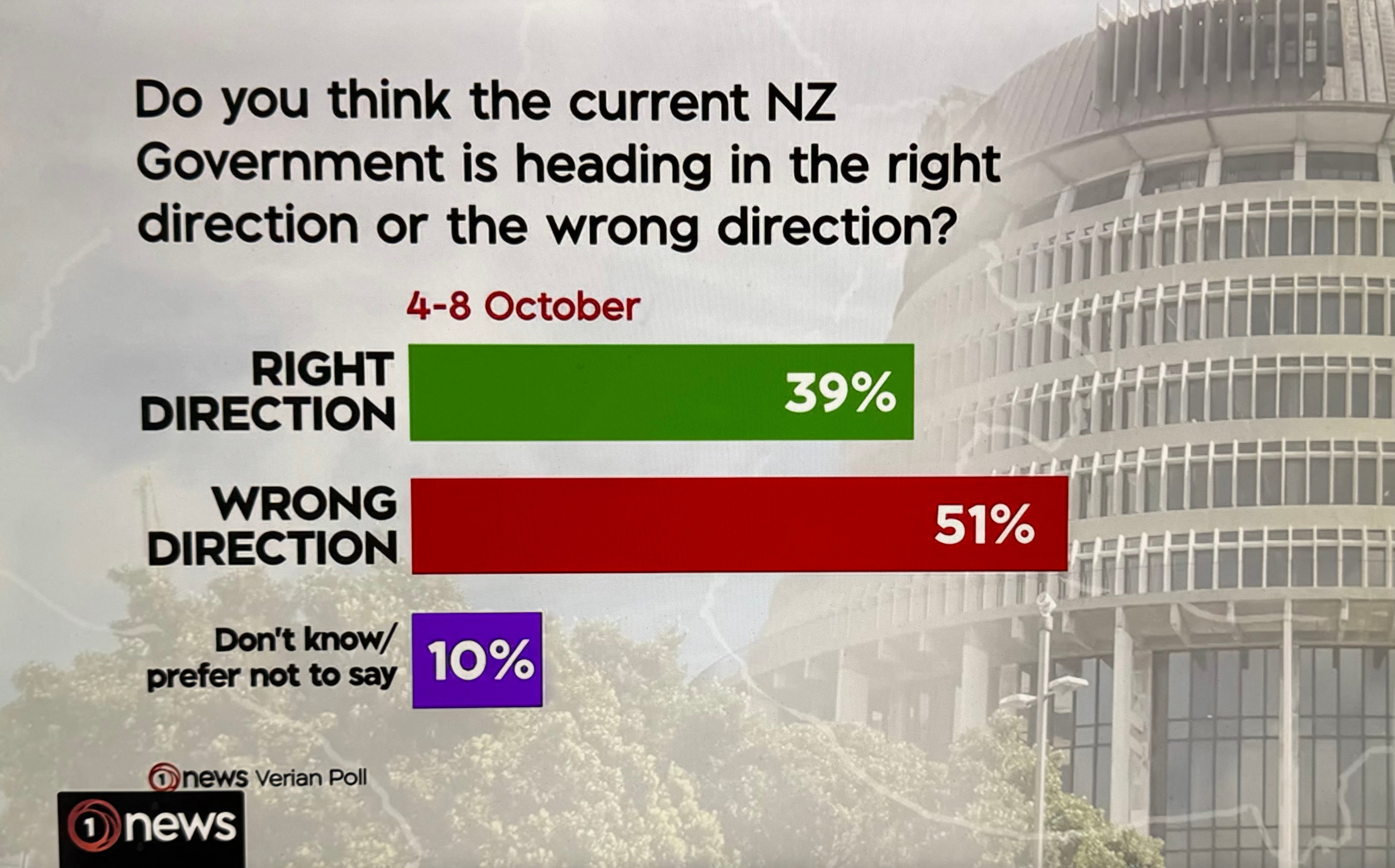
Last night, 1News confirmed that the malaise is widespread, reporting the latest Verian opinion polling, which showed that New Zealanders don’t believe that the National-led Government is getting New Zealand “back on track”. The 1News-Verian poll asked this month: “Do you think the current NZ Government is heading in the right direction or the wrong direction?”. Here’s the response:
Right direction: 39%
Wrong direction: 51%
Don’t know; prefer not to say: 10%
Such polling arguably illuminates more about the big political issues than the party vote and preferred PM polling results that get more headlines. It shows how grumpy we are with the status quo. It provides the clearest barometer of the national mood.
This sentiment isn’t an outlier; recent polls from 1News-Verian, RNZ-Reid Research, Curia, Freshwater Strategy, and Roy Morgan all show a consistent and deepening pessimism, with “wrong direction” sentiment outweighing “right direction” by double-digit margins.
The September RNZ-Reid Research poll found a significant plurality of New Zealanders believe the country is on the wrong path. 49% stated the country was heading in the wrong direction, compared to only 34% who believed it was on the right track. This produces a negative net score of -14.9.
The data indicates a rapid deterioration in public sentiment throughout 2025, with the net score sliding from a marginally positive +2.9 in March to a deeply negative -14.9 by September. Notably, discontent extends even to supporters of the governing coalition; 47% of New Zealand First voters said the country was on the wrong track, versus only 30% who said it was on the right track.
The October Taxpayers’ Union-Curia poll corroborates the RNZ-Reid findings, showing that 50.8% of voters believe the country is heading in the wrong direction, while 35.8% see it as on the right track, for a net score of -15.
The Post/Freshwater Strategy poll series has also captured the negative trend. A poll in June 2025 found that almost half of voters believed the country was heading in the wrong direction. By October, this sentiment had intensified, with 54% of voters saying “wrong track” compared to just 33% saying “right track”, resulting in a net score of -21.
The Roy Morgan poll in September also registered 49.5% for “wrong direction” and 39% for “right direction”. Analysis of Roy Morgan’s historical data shows that a brief period of post-election optimism in early 2024, where “right track” numbers were positive, was quickly reversed, with a consistently negative outlook taking hold from March 2024 onwards.
The Government’s performance deemed very poor
When the public is asked to rate the performance of the Government, the results are also abysmal. The Ipsos Issues Monitor in March 2025 recorded the lowest government approval since 2017 – an average score of just 4.2 out of 10 for the administration’s performance, down from 4.7 the previous year.
Over 40% of people rated the Government’s performance as a 3 or lower. Such low confidence, last seen just before the 2023 election ousted Labour, suggests that a large segment of the public feels this Government is not addressing the nation’s problems.
Indeed, the same Ipsos survey underscored those persistent problems: housing (mentioned by 27% of respondents) had grown as a worry nearly on par with the perennial concern of healthcare, and economic angst was overtaking even crime in the issue rankings. New Zealanders are essentially saying that on critical fronts – from affordable homes to safety to health outcomes – the system is not working, and their trust in leaders to fix it is evaporating.
Also of interest, this month The Post published a Freshwater Strategy poll showing unprecedented frustration with the Government’s leadership. Nearly half of voters (49%) in the October survey said the National Party should replace Prime Minister Luxon before the next election, versus 38% who wanted him to stay. Even among National’s own supporters, almost one-quarter favoured a leadership change
Commentators picking up on the Zeitgeist of discontent and disillusionment
A significant body of commentary now suggests that the national mood in New Zealand has soured, moving beyond simple economic anxiety into a state of collective psychological fatigue. The most important in this regard has been the columns of Stuff’s Verity Johnson.
Her column today proposes “languishing” as New Zealand’s “word of the year for 2025”, articulating a collective “restless, listless, lifeless feeling”. Johnson argues that the promised post-pandemic “survive till 2025” bump in spirits has failed to materialise, leaving a sense of “restless paralysis” and “lethargic hopelessness”. The column posits that the country is stuck in a state where things were supposed to improve but have “resoundingly failed to do so”, leaving everyone feeling “resoundingly, meh, about the state of, well, everything”. This analysis provides an emotional and psychological framework for understanding the hard data on public discontent, suggesting a deep-seated national malaise.
Today’s column follows on from another bleak one last month, titled “NZ is broken and you’d be dumb to stay”, and another one called “Card Declined on $6.99”. Similarly interesting columns on the problems have been written by Josie Pagani and Janet Wilson. Pagani’s column from late last year, titled “A good place to bring up kids, but not good enough to keep them here”, expresses her lack of faith in the country, attributed to the country being “much, much poorer than other developed countries” and having “mediocre” educational standards.
Also around this time, Janet Wilson also wrote an influential column for The Post, titled “In the Age of Meh, voters are sending a message loud and clear”. She quipped that the Government’s endless self-congratulation had worn thin: far from getting the country “back on track,” people saw things continuing to deteriorate. She pointed out New Zealand’s dismal 177th out of 190 ranking for GDP per capita growth, noting that National was elected to fix this but “they’re not doing it fast enough”.
Perhaps people might see all this commentary as coming from anti-Government voices. It’s not. Even today, Barrie Saunders (former Chair of the Taxpayers Union) has written a column asking: “Why is NZ stuck in the slow lane?” He argues that New Zealand fundamentally lacks a “growth culture” and is consequently “slipping slowly down international rankings of GDP per capita”. He identifies several structural impediments to economic growth.
Also, it’s worth pointing out that this year’s Mood of the Boardroom survey, published last month, was the grumpiest in many years, with CEOs giving a scathing report on the performance of the Government. Most notably, Prime Minister Christopher Luxon received a shocking ranking of 15th out of 28 ministers, with an average score of just 2.96/5. Finance Minister Nicola Willis fares little better, ranked 13th with a score of 3.09/5.
I’ve written before on the “broken” state of New Zealand – especially under the previous Labour Government. It seems like it’s time to further analyse what is wrong with the country and how it might be turned around. Future columns will look at the problems of New Zealand business, the problems of the political right, the problems of the politics left, the brain drain, social cohesion, and broken markets (such as electricity, housing, supermarkets, banking, etc), and in general, the way that wealthy vested interests have taken a toll on New Zealand.
Dr Bryce Edwards
Director of The Integrity Institute
Further reading:
Verity Johnson (Stuff): Languishing - NZ’s word of the year for 2025
Verity Johnson (Stuff): We’re broke, exhausted, doing everything right - yet still called ‘merchants of misery’
Verity Johnson: Card declined on $6.99
Barrie Saunders: Why is NZ stuck in the slow lane?
Roy Morgan Research: New Zealand: In September, National-led Government and Labour-led Parliamentary Opposition are level
Roy Morgan Research: New Zealand – Government Confidence (2007-2025)
RNZ: National falls below 30% in latest Curia poll, left bloc could form government
Giles Dexter (RNZ): RNZ-Reid Research poll: More voters blame struggling economy on coalition than previous govt
Ipsos: NZ Issues Monitor February 2025
Ipsos: NZ Issues Monitor June 2025
Ipsos: New Zealanders’ concern about cost of living significantly increases
Andrea Vance (Stuff): The Post-Freshwater Strategy Poll: ‘No BS’ Budget fails to deliver National poll lift (paywalled)
Andrea Vance (Post): Red renaissance? Or has the country just got the blues (paywalled)
Josie Pagani (Post): A good place to bring up kids, but not good enough to keep them here (paywalled)
Janet Wilson (The Post) In the Age of Meh, voters are sending a message loud and clear (paywalled)
Yes, we are languishing and the recovery is taking too long.
I however don't take any notice of any articles in the MSM with their biased views. I recently looked at articles from Stuff from 2022 and 23 when inflation was becoming a problem. I have to ask, why were they not jumping up and down then, they put out articles like "Have economists misunderstood inflation" and "Inflation, interest rates, labour and depreciation feed into rates rise", "Think inflation is biting? Spare a thought for Turkey" , yet at every opportunity they now put a picture up of the wet blanket Luxon and have the economy front and center expressing doom and gloom at every opportunity and strangely enough interviewing politicians about it......but they only put a few basic articles in 2022/23 when it was happening and not a single interview with Grant or Jacinda nor asking for comments from the opposition from any of the articles I could find online.
I also wouldn't pay much attention to someone who can't balance their own accounts when it comes to the economy.
The positive I take out of the Nats is that if Labour was still in charge things would be twice as bad.
Yes the economy isn't good but as the polls and pundits indicate, the malaise goes beyond economics. I believe the non-economic malaise began with the previous government and the divisiveness that emerged under it, on Maori and trans issues etc. House buying becoming unaffordable for the young is another factor.