

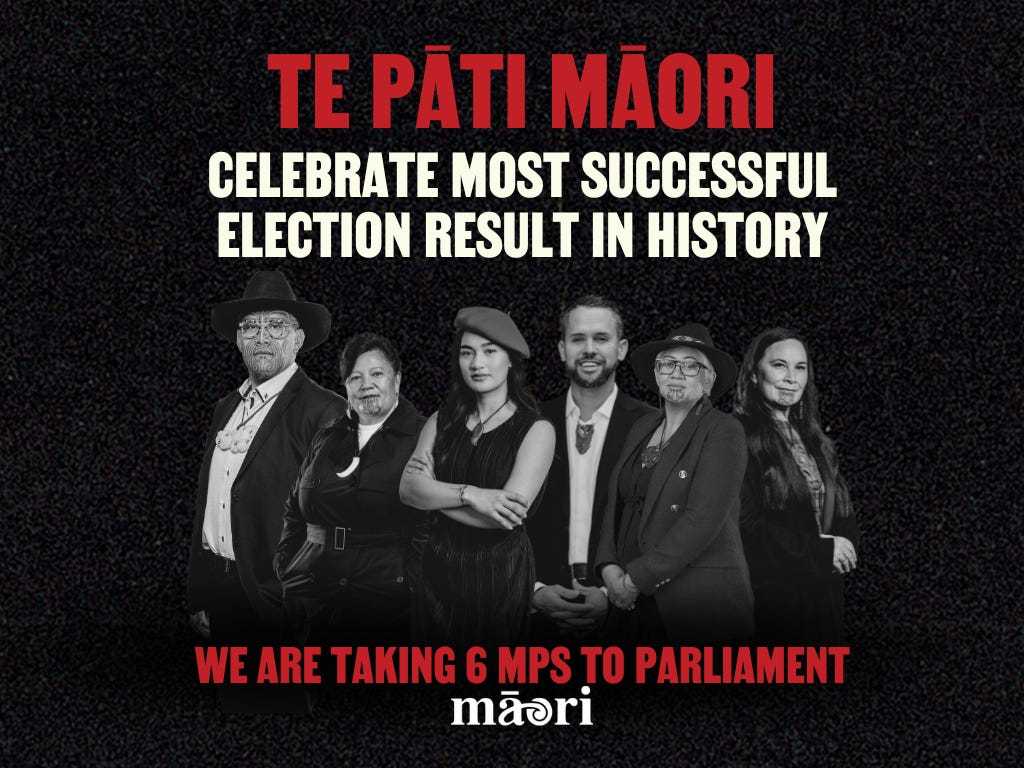
Tomorrow is a big day for Te Pāti Māori. The party hopes to move beyond its recent bout of toxic internal turmoil with a “reset” timed to follow the maiden speech of its newly elected Tāmaki Makaurau MP, Oriini Kaipara. Yet ongoing revelations suggest Te Pāti Māori might be too damaged for a quick revival.
Allegations of misspent parliamentary funds
The latest allegations, reported by 1News political editor Maiki Sherman, are that Te Pāti Māori MP Mariameno Kapa-Kingi overspent her taxpayer-funded parliamentary budget. Kapa-Kingi confirmed to 1News that she did go over budget, though she insists the overspend was “certainly not” the $200,000 figure being rumoured online.
Kapa-Kingi would not elaborate on how or why she overspent. She told Sherman only that, “There was an adjustment that I had to make, and I did that in line with Budget rules and with the Speaker’s directions.” There is no way for the public to verify the details of such spending because Parliament has exempted itself from the Official Information Act, shielding MPs’ budget use from external scrutiny. For her part, Kapa-Kingi is refusing to provide any further explanation for the overspend, citing “privacy issues.”
Kapa-Kingi’s son, Eru Kapa-Kingi, claims the news of his mother’s budget breach was leaked by others in Te Pāti Māori, possibly as retribution. (Online speculation has suggested the overspent funds went into Eru’s own initiative, the Toitū te Tiriti movement.) Mariameno Kapa-Kingi herself hinted that the leak likely came from within, telling 1News, “I don’t know where else that information could have come [from].”
Sherman bluntly asked Kapa-Kingi if she was the victim of a smear campaign by her own colleagues. Kapa-Kingi responded, “I’d be disappointed if that was the truth, and I honestly don’t know. It’s a really challenging time at the moment.” In an earlier interview, she had already described the party as “dysfunctional.”
“Dictatorship” in Te Pāti Māori
Te Pāti Māori’s leadership has often been dismissive of Western-style democracy, at times characterising it as a “colonial” concept. This stance begs the question of how the party makes its own decisions and treats its MPs, activists, and supporters. In particular, it raises the question: who is really in charge?
Many critics suspect that John Tamihere, the party’s president, is the one steering the waka. Tamihere built a formidable power base in Auckland — with the Waipareira Trust often described as his personal fiefdom — and then expanded his influence by effectively taking over the dormant Māori Party in 2020 after its previous leaders had stepped aside. He rebranded that moribund party as Te Pāti Māori and recruited a new cast of politicians to fill its ranks. Tamihere even stepped down as a Te Pāti Māori co-leader in order to serve as president — a move that, counterintuitively, gave him even more control over the organisation. He has been accused of running the party in an autocratic fashion and bending it to his own agenda.
Te Pāti Māori’s constitution grants its president extraordinary authority, and Tamihere is bolstered by a close-knit “leadership group” of four. Two members of that group are the official co-leaders, Rawiri Waititi and Debbie Ngarewa-Packer, who serve as the party’s public faces in Parliament. The third key figure, however, is Kiri Tamihere-Waititi (also known as Christine Tamihere) — John Tamihere’s daughter and Rawiri Waititi’s wife. Kiri serves as the party’s General Manager, and she is also the sole registered owner of the Toitū te Tiriti movement, which has worked closely with Te Pāti Māori (organising a major hīkoi to Parliament last year).
The party’s power structure is tightly bound by whakapapa-driven alliances at the top. On the other side of a growing factional divide is Eru Kapa-Kingi (Mariameno Kapa-Kingi’s son) who has been a prominent figure in what might be considered a rival camp within the party. While Kiri Tamihere-Waititi is the official owner of Toitū te Tiriti, Eru has often been seen as the movement’s de facto leader. He has now very publicly fallen out with Tamihere and the co-leaders, alleging that Te Pāti Māori’s decision-making is “effectively a dictatorship model.”
Eru Kapa-Kingi hasn’t stopped there. Until recently he was the party’s vice-president and has twice been an election candidate, so his criticisms carry weight as an insider. He is now lambasting the party for what he calls a toxic culture. He also points out that the leadership has apparently violated the party’s own constitution by failing to hold a required Annual General Meeting and national council hui. Eru says the leadership operates under an “ego-driven narrative” that the Māori electorate seats belong exclusively to the current leaders.
Eru has even announced that Toitū te Tiriti is formally cutting ties with the party. It’s unclear whether he actually had the authority to make that call — reportedly, a vote on disaffiliating from Te Pāti Māori was held without Kiri Tamihere-Waititi present.
In the aftermath, Toitū te Tiriti’s leadership released an official statement seemingly rebuking Eru. It stressed that any recent commentary in the media “reflects individual views, not the collective position of Toitū te Tiriti.” The statement confirmed that the movement will remain independent of all political parties, but it downplayed the idea of “cutting ties” with Te Pāti Māori.
Mariameno Kapa-Kingi’s demotion
By most accounts, the flashpoint for the current unrest was last month’s sudden demotion of Mariameno Kapa-Kingi from her role as the party’s Whip in Parliament. The Whip’s job is to keep the caucus organised, managing MPs’ participation in votes and their parliamentary schedules. Kapa-Kingi’s removal from this position came out of the blue, with no public explanation at the time.
The move not only humiliated Kapa-Kingi but also cost her financially, as the Whip position comes with an extra $19,000 in salary, which she lost. The job was handed to co-leader Debbie Ngarewa-Packer, who already earns a co-leader’s salary of $202,600.
According to party insiders, Kapa-Kingi’s demotion involved no consultation or due process. However, the party’s leadership rejected that characterisation; RNZ reported that Te Pāti Māori insisted all such decisions were made through proper constitutional and tikanga-based procedures, and noted that no formal complaints had been lodged about the reshuffle.
So, why was Kapa-Kingi demoted in the first place? The alleged misuse of her parliamentary budget could well be one explanation. When asked about it, John Tamihere responded only that “the truth will come out in the fullness of time.”
Besides the budget issue, Audrey Young of the NZ Herald has reported today on two other factors that irked the Te Pāti Māori leadership. First, Kapa-Kingi took part in a parliamentary delegation to Japan — essentially a political junket. Some in the party felt this trip was a needless luxury inconsistent with Te Pāti Māori’s kaupapa (core values). Second, Young reports: “It is also understood that some party members in the regions were recently sounded out about the possibility of Mariameno Kapa-Kingi becoming a future leader and that found its way back to the leadership group.”
Is the party over for Te Pāti Māori?
All this turmoil risks alienating grassroots supporters who value tikanga-led unity. Political commentator Duncan Garner has even speculated that Te Pāti Māori may be headed for a formal split, and perhaps even terminal decline. In his latest Listener column (aptly titled “Is the party over for Te Pāti Māori?”), Garner writes that “the circus appears to be collapsing” in reference to “the messy public unravelling of Te Pāti Māori’s MPs, who are no longer able to hide internal struggles and dissent. When you have just six MPs and they start turning on each other, then you know something is not right.”
Garner pulls no punches in his critique of the party. He argues that “this version of Te Pāti Māori has lacked humility, empathy and general decency towards anyone who isn’t Māori. Its leaders have been rude, arrogant and dismissive. Its politics have been toxic and self-serving.” He warns that it may ultimately be Te Pāti Māori’s own supporters who turn away in disgust. Māori voters, Garner writes, have “little appetite for self-centred, power-hungry, ego-driven vanity,” especially when many are struggling in tough economic times. In short, “their tolerance for this tussle will be limited.”
Garner also singles out John Tamihere as the pivotal figure in this drama. He portrays Tamihere as the undisputed power behind the throne — “the shadowy figure in the background who wields power and keeps things really tight.” In Garner’s view, Te Pāti Māori “isn’t a team effort anymore; it’s a fight for control of the party.” According to Garner, “insiders say Tamihere is the gatekeeper: deciding candidate lists, managing communications and calling the shots on major internal decisions. The MPs may sit in the House, but it’s Tamihere who sets the tone. Public messaging is tightly managed. No one seems to move without the president’s approval.”
This top-heavy, opaque leadership style is plainly not a recipe for a healthy political party. In an environment with so little transparency, minimal grassroots input, and so much power concentrated at the top, a party becomes ripe for capture by vested interests. The conditions are perfect for the agendas of business elites, lobbyists, and wealthy donors to take hold at the expense of the public interest.
Te Pāti Māori’s reset matters
The turmoil within Te Pāti Māori also carries serious implications for the wider political landscape. The Labour Party, in particular, has reason to feel anxious about the chaos. Many in Labour would quietly prefer to see Te Pāti Māori fall apart sooner rather than later, clearing a path for a Labour–Green (or even Labour–New Zealand First) coalition to form after the next election without needing Te Pāti Māori’s seats.
Labour leader Chris Hipkins is already under pressure to categorically rule out any coalition or deal with Te Pāti Māori. Associating with a party in disarray could be politically toxic for him. Indeed, new polling by David Farrar shows that Te Pāti Māori is deeply unpopular beyond its base. Farrar’s survey found Te Pāti Māori has a net favourability of –19% among current Labour voters, and an even worse –52% among undecided voters. Tying Labour’s fortunes to a troubled Te Pāti Māori risks alienating a large swath of the electorate.
All eyes will now turn to Parliament on Thursday. Around 3pm, Oriini Kaipara — Te Pāti Māori’s newly elected MP for Tāmaki Makaurau — is set to deliver her maiden speech. This is noteworthy because, up until now, Kaipara has been effectively muzzled by her party. Former co-leader Te Ururoa Flavell revealed that when Kaipara was elected, she was “pretty much told not to speak” in public, with others often speaking on her behalf.
Unfortunately for Kaipara, her moment in the spotlight will likely be eclipsed by the party’s planned “reset” event immediately afterward. Te Pāti Māori has announced it will live-stream an address outlining “our reset and our vision for the path ahead” right after Kaipara speaks.
By the end of the day, observers will learn whether Te Pāti Māori’s internal civil war has been quelled — or if it’s only just beginning.
Dr Bryce Edwards
Director of The Integrity Institute
NZ Lobbying & Influence Register:
Further reading:
Audrey Young (Herald): MP Mariameno Kapa-Kingi - in the thick of Māori party troubles (paywalled)
1News: Demoted Te Pāti Māori MP speaks out ahead of party ‘reset’
Lillian Hanly (RNZ): Te Pāti Māori president John Tamihere bats off questions about leadership
Duncan Garner (Listener): Is the party over for Te Pāti Māori? (paywalled)
Tuwhenuaroa Natanahira (RNZ): Former Māori Party co-leader Te Ururoa Flavell backs Toitū Te Tiriti split
Henry Cooke (The Post): Te Pāti Māori’s ‘reset’ next week will shape next year of politics (paywalled)
Ani O’Brien: Civil war in Te Pāti Māori as the Kapa-Kingis come out swinging
1News: ‘Dictatorship model’ - Te Pāti Māori slammed by hīkoi leader
1News: Te Pāti Māori MP speaks of ‘dysfunction’ after whip demotion
Jaime Lyth (Herald): Former Te Pāti Māori leader says party has ‘issues’ after Toitū Te Tiriti split
My own experiences have tended to confirm that in Māori culture it is leadership mana that endows the right to allocate resources, with other rules and regulations fair game to be circumvented. So it should come as no surprise when inappropriate spending occurs, whether on silk under garments or election campaigns. Tribal warring should of course also be no suprise. More generally though, in 2025 it is disappointing that we should have any political parties, let alone those actually making it to parliament, representing specific races, religions or genders. TPM has got to be the ultimate lobby group.
Everything you write resonates with me. I have only one phrase to sum up what Te Parti Maori has become: a shambles. And I'm sad about this, as I think NZ needs a genuine party aligned with Maori values, but with JT in the driving seat, this ain't going to happen.