

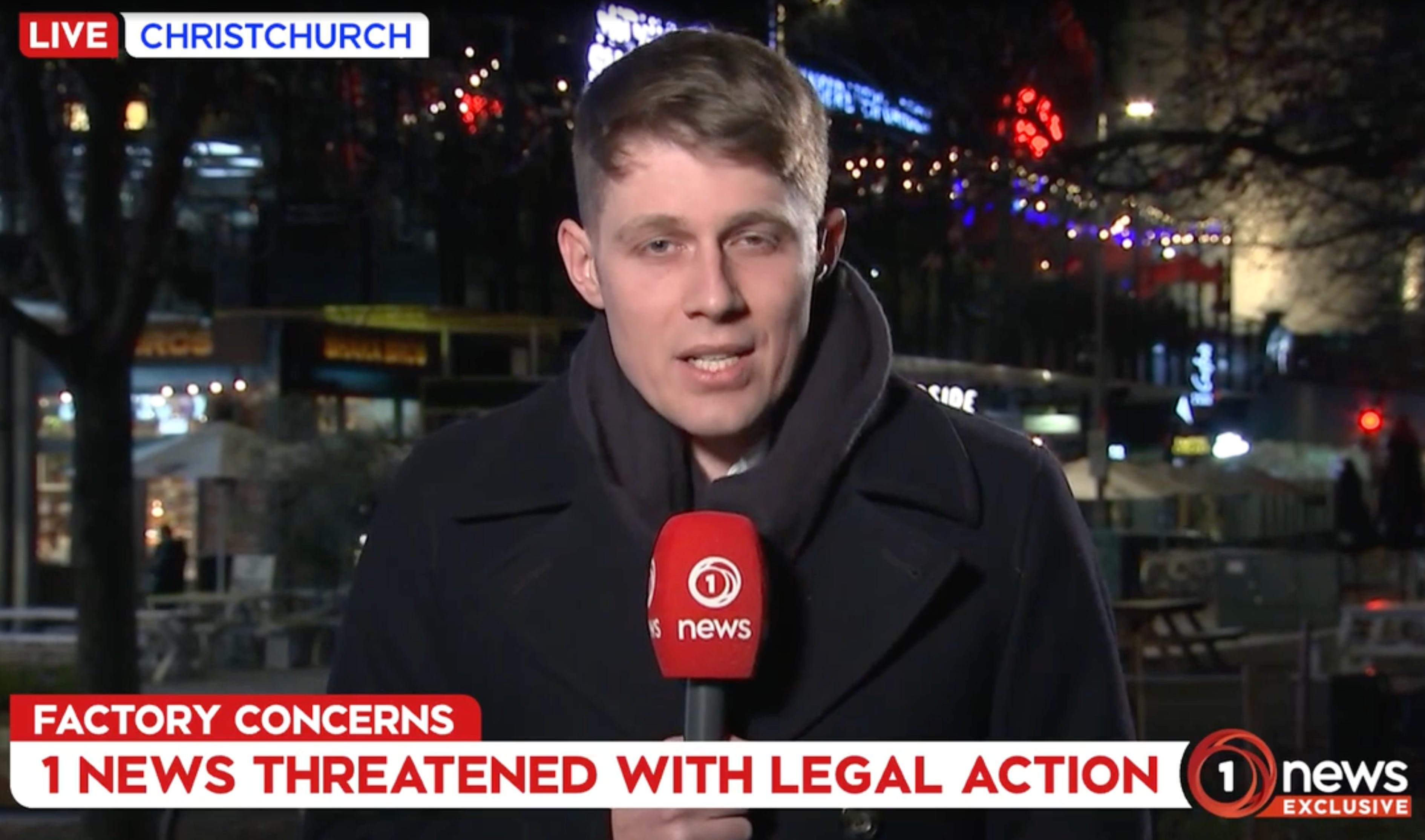
Much is made of “cancel culture” these days, but the biggest impediment to free expression in New Zealand isn’t an online mob fighting culture wars – it’s the cold, hard power wielded through our outdated defamation laws. For decades, the rich and powerful have used these laws as legal weapons, as a form of “lawfare” to silence critics, discourage investigative journalism, and shield themselves from scrutiny. And nothing illustrates this better than agribusiness giant Talley’s dragging TVNZ through a marathon High Court defamation trial over six news reports.
The trial, which concluded yesterday, was ostensibly over those 1News reports from 2021–22, but was in reality a battle for the soul of journalism in this country. It put the very right of the media to hold power to account in the dock, creating a textbook “chilling effect” – the insidious deterrent that the threat of ruinously expensive litigation casts over newsrooms.
TVNZ’s lawyer, Davey Salmon KC, argued that New Zealand is importing the kind of lawfare seen overseas. He noted that the “responsible publication” defence in the UK was developed in case law because “Russian billionaire defamation plaintiffs were choking journalism”. Salmon’s warning was stark: “We are not meant to have that here.”
Yet, we do. New Zealand’s Defamation Act 1992 is a relic. It was conceived before the internet and left largely untouched while comparable jurisdictions like the UK and Australia have introduced modern reforms (and Ireland is now following suit).
Crucially, New Zealand has no legislated “serious harm” threshold (unlike the UK) that would require plaintiffs to show upfront that a publication caused significant reputational damage. There are also no anti-SLAPP (Strategic Lawsuit Against Public Participation) provisions to protect public interest speech from vexatious lawsuits. These omissions make it dangerously easy for any entity with deep pockets to initiate proceedings and immediately shift an immense burden of cost and uncertainty onto the media defendant, regardless of the case’s ultimate merit.
Legal expert Graeme Edgeler has argued that defamation law is the biggest threat to free speech in New Zealand, noting that the prohibitive cost of defending complex defamation proceedings means that even mainstream news media can be reluctant to publish important information in the public interest in respect of wealthy individuals and organisations.
Unfortunately, you won’t hear the Free Speech Union talk much about this. That organisation raises many important civil liberties issues, but the Talley’s case exposes a far more concrete threat. Only the extremely wealthy can wield the power to drag critics through a multi-week, multi–million-dollar trial in the High Court — a true form of speech suppression. That is the real chilling effect, not a social media pile-on, but being hauled into court by a corporate Goliath and forced to defend your journalism at crippling expense.
For Talley’s, litigation is a calculated strategy. Notably, the company didn’t sue for damages at all. Instead, it asked the court only for a declaration that the stories were defamatory, seeking vindication rather than compensation (apart from seeking indemnity costs).
It wasn’t about money; it was about PR and deterrence. By dragging the state broadcaster through a multi-year ordeal, Talley’s sent an unmistakable warning to all journalists: investigate us, and you’ll pay dearly. The lawsuit is a strategic investment in silence.
Public interest journalism under fire
To understand the stakes of this trial, consider the journalism Talley’s sought to suppress. Thomas Mead’s six 1News investigations were no frivolous gossip or hit-jobs. They were evidence-based reports on matters of profound public interest: the health, safety and well-being of thousands of workers inside the factories of one of New Zealand’s largest food companies.
The allegations were specific and severe:
Dangerous and unsanitary conditions: A whistleblower’s photos from Talley’s Ashburton plant revealed filthy, hazardous machinery.
Inadequate safety measures: Workers said the Ashburton factory had only 10–15 emergency stop buttons on its machines — dangerously few for a plant of its size.
A Pattern of injuries: One 1News report revealed 174 injuries at Talley’s sites in a single region over a one-year period.
Mismanagement of injury claims: Whistleblowers claimed Talley’s self-managed ACC injury unit was suppressing claims to save money, with managers interfering in worker compensation decisions. In court, Talley’s HR manager admitted a former IMU manager likely falsified ACC records in 2019, validating those fears.
Underpinning this entire investigation was a pervasive culture of fear among the Talley’s workforce. In his evidence to the court, Mead made a statement that should resonate through every newsroom and boardroom in the country: “In 13 years in this job, I have never seen anything like the fear that I saw while reporting on Talley’s.” That palpable fear, he explained, was exactly why he granted anonymity to so many of his sources. This is standard, vital journalistic practice, and is essential for exposing wrongdoing inside powerful organisations where people are terrified to speak out.
The necessity of this protection is underscored by Talley’s own actions. The company’s lawyers relentlessly attacked TVNZ’s use of anonymous sources as “irresponsible,” yet this was the same company that had gone to court before the trial to try to force TVNZ to unmask those whistleblowers. The workers’ fear and Talley’s aggressive tactics are two sides of the same coin. The fear necessitates confidentiality, and then the use of confidentiality is cynically weaponised by Talley’s in court as evidence of journalistic bad faith. It’s a classic catch-22: without the promise of anonymity, employees would never dare tell these stories — and because anonymity was given, the company claims the stories are untrustworthy.
This body of evidence stands in stark contrast to the narrative Talley’s presented in its defence. The company even hired former Police Commissioner Mike Bush, whose consulting firm produced a report portraying a “positive” safety culture at Talley’s. But as TVNZ’s counsel pointed out, there was a glaring omission in the company’s case. While management and paid consultants testified on Talley’s behalf, “what’s lacking is a single worker from a single factory floor”, Salmon observed.
This juxtaposition is devastating. On one side, a journalist backed by dozens of fearful workers. On the other, company executives and their hand-picked reviewer. The trial did not just put Thomas Mead’s reporting on the stand; it laid bare the chasm between a corporation’s polished PR and the often dangerous reality experienced by its workers.
Putting the process of journalism on the stand
For five weeks in the High Court, unable to refute the evidence of its poor safety record, Talley’s legal team instead put the process of journalism itself on trial. Their strategy was to take routine newsgathering practices and, through forensic and often absurd scrutiny, paint them as sinister and malicious. It was an attempt to distract from the substance of the reporting by attacking the reporter.
No detail was too small and no private exchange too trivial to weaponise. The most headline-grabbing example was the obsessive focus on a flippant text message between Mead and a cameraman, who jokingly nicknamed the reporter a “baby-faced assassin.” Talley’s lawyers trotted out this offhand joke as supposed proof of Mead’s “animus” toward the company. The claim was so flimsy that Salmon offered a commonsense reality check: no one’s casual work texts would hold up to that kind of microscope.
Throughout, the attack was intensely personal. Talley’s lawyer Brian Dickey KC repeatedly labelled Mead’s work a “hit piece” and, in a moment of drama reported by Newsroom, the lawyer asked during cross-examination: “You know you have to tell the truth, Mr Mead, don’t you?” It was pure intimidation. It was the theatrics of outrage aimed at rattling a journalist whose real offence was doing his job too well.
This strategy reveals the true nature of such a lawsuit. It is an inversion of scrutiny. In principle, a defamation trial should examine the truth and fairness of the reporting. But here it was Talley’s conduct that escaped serious examination, while TVNZ’s entire newsgathering process was hauled under the microscope.
Every note, email, text message and editorial decision was dragged into discovery and hostile cross-examination. The goal was clear: to put the media on the defensive and send a message to every reporter in New Zealand that “if you dare investigate us, your motives and methods will be publicly dissected and twisted against you”.
Furthermore, the trial exposed a fundamental asymmetry of evidence and accountability. The company was obliged to prove it suffered financial loss, yet Talley’s Chief Financial Officer, Greg Kingston, admitted under oath it was impossible to quantify any financial loss from Mead’s reporting. TVNZ had to bare its internal communications to scrutiny, while Talley’s central claim of harm remained essentially unprovable and unfalsifiable. This imbalance turns the courtroom into an uneven playing field, favouring the corporate plaintiff.
Talley’s political and economic clout
This lawsuit cannot be understood in a vacuum. It is not the action of an aggrieved party with an otherwise spotless record seeking to correct a single journalistic error. It is a strategic move by a corporate behemoth (owned by a family worth an estimated $1.6bn), with a long and controversial history. Talley’s is a company that leverages not only legal action but also immense economic and political influence to protect its interests and shape its operating environment.
Talley’s history illustrates why TVNZ argued the company’s reputation was already tarnished. The Talley’s Group has a long track record of workplace accidents and industrial strife. These range from illegal lockouts of union workers, to dozens of WorkSafe enforcement notices and fines, to a horrific case of a crewman being decapitated on a Talley’s fishing vessel. The company’s safety culture was so poor, the defence argued, that Mead’s reports caused little additional reputational harm.
Yet Talley’s doesn’t rely on the courts alone to shield itself. The company wields immense economic and political clout to ward off scrutiny. It was a large political donor in 2017, even making stealth donations to the New Zealand First party that evaded disclosure.
It aggressively lobbies against regulation, such as fighting requirements for cameras on fishing boats. Greenpeace even accused the company of leveraging government connections to get a Talley’s trawler off an international illegal fishing blacklist. As one of regional New Zealand’s biggest employers, Talley’s holds an outsized influence over communities. Workers and local officials alike know not to cross the company.
By launching this defamation suit, Talley’s sought not only to deter future criticism but to rewrite the narrative, painting itself as the victim of a biased media and diverting attention from its own failings. It’s a cynical, but often effective, form of reputation management by a powerful entity.
A Verdict beyond the courtroom
The trial may be over, but its chilling effect is already reverberating. A formal judgment from Justice Pheroze Jagose might not arrive until well into 2026, yet regardless of the eventual legal outcome, this case has delivered a damning verdict on press freedom in New Zealand. Here, the process is the punishment. The sheer scale of this five-week, resource-intensive court battle represents an enormous cost for TVNZ.
And that is precisely the point. As Salmon warned, if the country’s largest and best-resourced newsroom can have its standard practices subjected to such an ordeal, what hope is there for smaller outlets or independent journalists? Who among them would dare take on a powerful corporate, knowing the likely consequences?
The punitive (rather than compensatory) nature of Talley’s lawsuit was crystallised by one striking moment in Salmon’s closing argument. He gestured to the public gallery, where Talley’s executives sat every day of the trial. These were the same executives who, in claiming financial loss, argued their time was so valuable that Mead’s reporting cost the company dearly. “I’ve seen the people who I cross-examined, who apparently couldn’t spend time away from their desks,” Salmon noted. The image said it all: it was never truly about quantifiable harm; it was instead about flexing power and inflicting costs.
Even the long wait for the verdict serves as a victory of sorts for those who seek to deter scrutiny. For months – potentially more than a year – a cloud of uncertainty will hang over TVNZ and the wider media industry. Journalists and editors considering similar investigations will know that they could be in for a multi-year legal ordeal with no guaranteed outcome. That prolonged ambiguity creates a vacuum of accountability, allowing the powerful to operate with less fear of exposure. The damage isn’t just in the verdict; it’s in the waiting.
This case must serve as a wake-up call. It should catalyse a serious and urgent conversation about reforming our defamation laws. The Defamation Act 1992 remains a blunt instrument, forged in a pre-digital age and dangerously ill-equipped to protect public interest journalism from litigation designed to suppress speech. It’s a legal framework that currently prioritises the reputational sensitivities of the powerful over the public’s right to know.
Ultimately, the Talley’s v TVNZ saga poses a fundamental question for New Zealand society: What do we value more? The right of a powerful corporation to manicure its public image, or the right of the public to be informed about dangers in our workplaces and supply chains? A legal system that allows public-interest journalism to be so easily and punitively attacked is a system failing the public it is meant to serve. The judge’s verdict will come in due course, but the broader verdict on our democracy is already in, and it is deeply troubling.
Dr Bryce Edwards
Director of The Integrity Institute
Lobbying and Influence Register:
Further reading:
Matt Nippert (Herald): Talley’s defamation trial: TVNZ warns of chilling effect on NZ journalism (paywalled)
Catrin Owen (Stuff): Talley’s v TVNZ defamation case comes to a close, decision lies with judge
Catrin Owen (Stuff): Defamation case against TVNZ a threat to journalism, court hears
Tim Murphy (Newsroom): TVNZ trial: Judge probes media’s duty to run fair responses
Tim Murphy (Newsroom): TVNZ chief defends filming private homes as channel rebuts ‘animus’ claims
Catrin Owen (Stuff): Former Labour minister Michael Wood grilled over ’s concerns in defamation case
Catrin Owen (Stuff): TVNZ’s head of news stands by reporting subject to defamation proceedings
Tim Murphy (Newsroom): Former minister accused of telling ‘horror story’ about Talley’s
Steve Braunias (Newsroom): The secret diary of .. the Talley’s defamation trial
Catrin Owen (Stuff): TVNZ reporter stands by Talley’s stories amid defamation claims
Catrin Owen (Stuff): Whistleblower quote scrutinised in Talley’s v TVNZ defamation case
Tim Murphy (Newsroom): ‘You know you have to tell the truth … don’t you?’
Matt Nippert (Herald): TVNZ reporter defends anonymous sources as Talley’s alleges defamation (paywalled)
1News: ‘Hit piece’: 1News reporter appears in Talley’s defamation case
Catrin Owen (Stuff): Whistleblower quote scrutinised in Talley’s v TVNZ defamation case
Matt Nippert (Herald): TVNZ reporter defends anonymous sources as Talley’s alleges defamation (paywalled)
John Weekes (Herald): Talley’s defamation trial: Mike Bush tells court he is ‘far too experienced to purely defer to other people’s views’
John Weekes (Herald): Talley’s defamation trial hears about ‘extremely lucky’ forklift accident escape, safety checks in Ashburton
1News: Talley’s admits in court it can’t quantify money lost due to news coverage
1News: Talley’s begins High Court defamation case, claims TVNZ ‘put the boot in’
Matt Nippert (Herald): Talley’s defamation case against TVNZ begins in High Court (paywalled)
1News: Talley’s admits in court it can’t quantify money lost due to news coverage
1News: Former Talley’s manager ‘likely’ forged documentation, company tells court
1News: Talley’s loses court bid to force TVNZ to reveal sources
David Burton (Post): At work, as in life, information is power (paywalled)
Thomas Mead (1News): ‘I don’t want these out there’ - An inside look at Talley’s attempts to shut down a 1 NEWS investigation
Thomas Mead (1News): Talley’s interfered with injury claims, whistle-blowers claim
Thomas Mead (1News): Female fishing observer ‘repeatedly sexually harassed’ in nightmare Talley’s voyage
Thomas Mead (1News): ACC found ‘critical issues’ in care of injured workers at Talley’s Group in 2019
Thomas Mead (1News): A History of Suffering: Food giant Talley’s Group underpaid injured workers
Thomas Mead (1News): WorkSafe to ‘look into’ Talley’s after whistleblowers come forward to 1 NEWS
Thomas Mead (1News): Former Talley’s employee feared he would die on the job
Thomas Mead (1News): Whistleblower shares images of filthy conditions at Talley’s factory
Graeme Edgeler (Herald): Defamation law biggest threat to free speech (paywalled)
I haven't been following this saga but this is a sickening example of one of several attempts to muzzle free speech. Thanks for the info.
Like many laws, out defamation laws probably are worryingly outdated. However I have to say that if the law in this area was amended to better account for digital connectedness, its reach would likely expand rather than reduce, e.g. copyright.
On the face of it Talley's doesn't sound like a terribly endearing organisation, but then TVNZ's reputation for high quality, unbiased reporting isn't exactly squeaky clean. Ultimately though this appears to be yet another case of the law being unfairly leveraged by those with deep pockets, which hasn't as far as I'm aware been satisfactorily resolved anywhere.