


Top “NZ Politics Daily” stories today
Below are some of the more interesting and insightful New Zealand politics items from the last 24 hours.
1) “Both National and Labour are now mere empty vessels for the personal ambitions and brands of whoever gets control of them.” That’s the scathing summary about New Zealand’s major parties from Matthew Hooton today, who characterises both as vehicles for the entrenchment of the status quo rather than fixing the problems of the country – see: What Labour must do to reclaim its core support (paywalled)
Hooton complains that the new Government is looking just as hollow and lacklustre as the last Government. He says that the National-led government don’t appear to be up to delivering much of the change that they promised the electorate last year with “the Coalition mimicking the Ardern-Hipkins Government with announcements of announcements, scrapping existing policy and moaning about the status quo without identifying alternatives and appointing working groups instead. Like the Goff-Shearer-Cunliffe-Little-Ardern debacle before it, the National opposition’s lack of any serious policy work or even ideological reflection left it with no real idea of what it wanted to do in office. Christopher Luxon tries his best to paper-over the paucity of material but lacks Jacinda Ardern’s knack for making nonsense sound meaningful. More substantively, his Government has been astonishingly slow to get going, despite its unfulfilled promise to work through summer. Its mini-Budget contained no substantive decisions. Its Budget Policy Statement, usually ready before Christmas, is not yet agreed and won’t appear until March 27. The Budget itself isn’t until May 30. In the meantime, Nicola Willis’ proposed cuts to the Wellington bureaucracy entirely lack ambition”.
But Hooton suggests that Labour isn’t going to be a very strong opposition, and it may be a very long time before they are ready to regain the government benches. This is especially because they appear to have given up their traditional role of being big change agents for the working class, but are mostly just in favour of administrating the status quo these days in favour of the Liberal Establishment of the party’s new core, which is more Grey Lynn than working class.
He says that Labour was “supposed to be about redistributing at least some power and wealth, from capital to labour and from the ruling establishment to ordinary people.” But looking through Labour’s last two times in office, Hooton suggests that the party has given up on its traditional constituency in favour of conservatism, and this will need to change if it is to be re-elected: “Labour will never win back the working-class and middle-income voters who switched to National in 2023 until it offers more change than Ardern and Hipkins were comfortable with. If there is to be a do-nothing Government, former Labour voters may as well stick with National, which is historically so good at it, but isn’t seen to pander to the woke, Wellington, pounamu- and David Jones-wearing, yet mainly Pākehā elites.”
2) Another commentator writes today about Labour’s crisis of identity and substance – Peter Dunne says the party has been captured by “special interests”, and so it’s losing its reason to exist as the organisation to advance the cause of progressives – see: Labour’s power struggles are going to be harder than National’s
Dunne suggests that the party entered its real decline in the Helen Clark years: “Since then, Labour has become a party of passing causes rather than deep-set convictions. It has become the captive of special interests, more focused on doing their bidding in the hope of an electoral dividend than promoting its own values and policies. Simultaneously, it has managed to appear on the proper side of all the concerns of the left, while itself standing for nothing. Hence, when it came to government – albeit unexpectedly – in 2017, it could say all the right things but had little in the way of clearly thought-out policy to implement.”
3) The Green Party’s future under the co-leadership of Chloe Swarbrick is also doubted today in Chris Trotter, writing in the Otago Daily Times about how the putative leader has lost her earlier qualities of an open mind and flexibility, and is becoming too dogmatic and even zealot-like. He’s reflecting on her recent interview on Q+A, which has led others to question whether she’s passed her peak – see: Iron has entered her soul — Swarbrick’s inflexibility exposed (paywalled)
Trotter argues that “Swarbrick cannot replace the qualities the Greens are losing with [James] Shaw.” He suggests that the Greens are moving more and more away from a focus on climate change more into wanting to fight culture wars: “Shaw has found it increasingly difficult to make his colleagues understand that their electoral success depends on voters seeing them as the only party dedicated to combatting global warming effectively. Shaw’s implied warning: that a Green Party which cares less about climate change than it does about fighting the culture wars will end up bleeding away its support (a proposition confirmed by the latest Curia poll) went unheeded.”
4) Yesterday the consultancy firm PWC hosted a forum for lobby group Energy Resources Aotearoa in which government ministers Shane Jones and Simeon Brown spoke to industry bosses about their plans for the energy and mining sectors. It was quite revealing, according to BusinessDesk’s Greg Hurrell who reports that the ministers conveyed that “Economic resilience and productivity should trump just about everything else” – see: NZ needs to get back to drilling and mining, minister Jones says (paywalled)
Hurrell says: “Jones didn’t exactly say ‘drill baby drill’ (or ‘dig baby dig’), but the message was clear, it was time to get back to business in the petroleum and mining industries.” And in terms of the challenges of climate change, Jones told the energy and mining bosses: “I'm New Zealand's number one doubting Thomas about the climate religion and the fact that we have obfuscated the genuine costs of adjustment in our New Zealand economy.”
Not surprisingly, the lobby group’s chief executive John Carnegie was reported as praising “the cool heads he saw in the new government’s approach.” But as to whether the politicians and the industry are too closely connected by money, Jones told the audience about articles published about the donations he’s received from fishing bosses: “Please read the articles over the last 48 hours. If you've been, for example, a recipient of donations from an industry that you're involved in, then you're stigmatised or ruled out of that industry; I utterly reject that.”
5) Shane Jones also spoke about the Supreme Court’s decision to allow environmental activists to sue companies over climate change, saying “I personally am horrified by the notion that offshore mining can turn on the court’s view of tikanga Maori… It is the weaponisation and distortion of my culture driven by people who want to substantially change the ethos and the direction of our country on the basis of eco-catastrophisation and colonial guilt. I deeply resent that.” He’s quoted on this by Richard Harman in his report today, Dig this (paywalled)
Harman says that “Jones believes the final decision on big resource consents should be with Parliament.” And he quotes Jones explaining: “Parliament is sovereign in New Zealand… We are a Westminster democracy where sovereignty lies in Parliament.” Jones argues that the Supreme Court decision amounts to “the Americanisation of NZ's legal system.” He asked the industry bosses “You want the elected representatives to make the trade-offs on your behalf? Or do you want the Supreme Court, who, by the way, has just given [climate activist] Mike Smith the ability to sue you at will?”
6) Consultancy PWC is advocating against tax reform, with its tax partner Sandy Lau giving a talk yesterday arguing that “The tax system is structurally sound and doesn’t require a radical rethink in how it is run in New Zealand” – see the NBR article by Jonathan Mitchell: ‘Take the politics out of tax’: PwC partner (paywalled)
At the NZ Economics Forum, hosted by the University of Waikato, the PWC representative argued that overall “the system was not out of whack relative to how much tax was collected from individuals and businesses” and that business was disadvantaged by politicians proposing tax reform, which could be confusing and disrupting: “She said confidence in the system could easily be eroded with political interference and proposals for change.” The article also reports that Chartered Accountants Australia and New Zealand are arguing against tax increases on trusts, saying it would have a “disproportionate effect” and amount to over-taxation for most.
7) Government departments have been releasing their Briefings to Incoming Ministers, and leftwing commentator Josie Pagani writes about these today in her Post column, expressing her exasperation about how empty they all are, lamenting the lack of accountability of public servant bosses. She is especially disappointed about how the government departments lack any innovation or dynamic fresh thinking about New Zealand’s problems – see: Time for the public sector to take out the rubbish (paywalled)
Pagani’s conclusion about the health of the public service is worth quoting at length: “When endless meetings and complexity are in favour, you get a public sector that selects people who are... good at meetings and complexity. Instead of daring innovators we get risk-adverse bureaucrats. The Public Service Commission suggests even more shuffling of managers between departments. It’s like saying the only problem for Fletcher Building is that failing executives haven’t had the chance to mess up more divisions. What’s needed is a transformational overhaul of public sector management. That can’t be left to the public sector to pursue itself. It no longer has the capability. Just as failed CEOs have to carry the can – even if their accountability is symbolic, firings are part of what leaders are compensated for. The new government needs to wield the axe. If you think I’m being harsh, ask yourself why I have to read about the latest economic ideas in the Financial Times, not in the public sector’s reports to government. Ask why in the same week the Auditor-General damns the public sector for its lack of accountability, the Public Service Commission congratulates itself on doing a great job.”
Dr Bryce Edwards
Political Analyst in Residence, Democracy Project, School of Government, Victoria University of Wellington
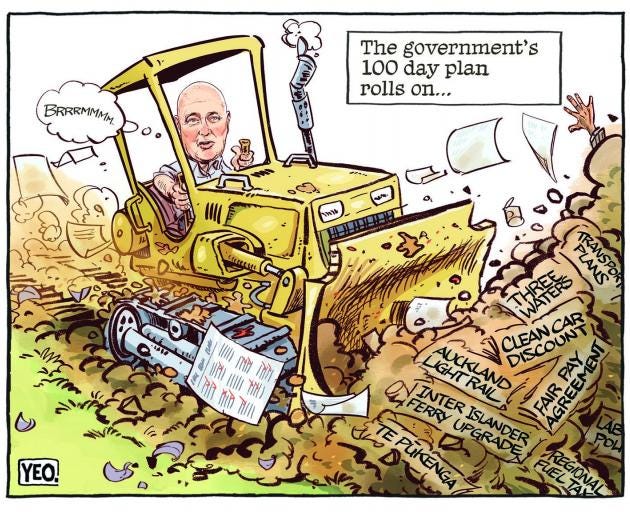
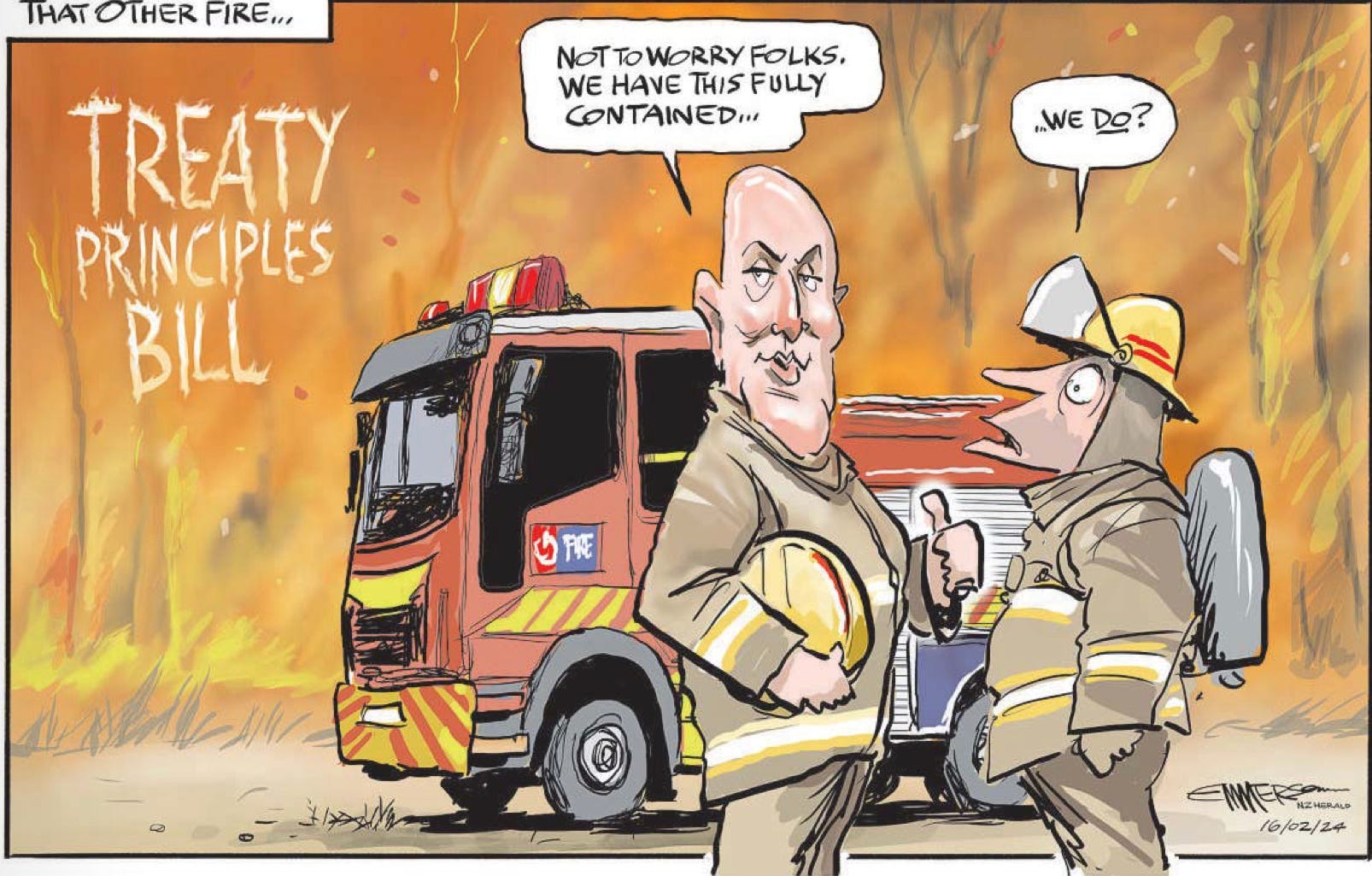
Today’s cartoons
NZ Politics Daily – 16 February 2024
EXTRACTIVE INDUSTRIES, ENVIRONMENT, CONSERVATION
Tom Pullar-Strecker (Post): Shane Jones: ‘Some of the rhetoric will appear cavalier and slightly over the top’ (paywalled)
Greg Hurrell (BusinessDesk): NZ needs to get back to drilling and mining, minister Jones says (paywalled)
Richard Harman (Politik): Dig this (paywalled)
Robin Martin (RNZ): Fast-tracking consent bill backed by seabed mining company eyeing Taranaki
Eric Frykberg (Interest): Shane Jones says weaponisation of Maori culture, unelected judges and irrational politicians are blocking essential development
John Anthony and Ian Llewellyn (BusinessDesk): Would-be Taranaki seabed miner optimistic of getting fast-track consent (paywalled)
Robin Martin (RNZ): Waitangi Tribunal to hold inquiry into climate change policy
David Williams (Newsroom): Climate hearing to explore ‘catastrophic Treaty breaches’
Emma Ricketts (Spinoff): Environmental groups hate the government’s new fast-track consenting proposal
No Right Turn: A rejection of the rule of law
Andres Valencia (Post): Christchurch burns again - now what? (paywalled)
Richard Smith (Post): Finding a way to make disaster recovery less painful (paywalled)
Mary Williams (ODT): Approach to climate change hailed by watchdog
Matthew Scott (Newsroom): Water water everywhere, and not a place to swim
David Williams (Newsroom): SailGP yachts killing rare dolphins ‘not ideal’ for tourism image, minister told
Paid subscribers can access the full “NZ Politics Daily” from here. The following categories of news and analysis continue: PARLIAMENT; INEQUALITY, COST OF LIVING; ECONOMY, BUDGET; HEALTH; TRANSPORT, INFRASTRUCTURE; WATER; LOCAL GOVERNMENT; FOREIGN AFFAIRS; DEFENCE; MEDIA; EDUCATION; EMPLOYMENT, INDUSTRIAL RELATIONS; BUSINESS; HOUSING, PROPERTY INDUSTRY
