


Top “NZ Politics Daily” stories today
Below are some of the more interesting and insightful New Zealand politics items from the weekend and this morning.
1) Yesterday’s politics was dominated by Prime Minister Christopher Luxon – with a State of the Nation speech and an appearance at the Big Gay Out – both of which were probably good for his poll ratings. Stuff’s Tova O'Brien has a good summary of the contrasting day for the PM: “Over the course of just a few hours on Sunday the Prime Minister received a standing ovation, applause, cheers and chants from supporters quickly followed by boos, jeers, chanting of ‘wanker’, ‘shame, shame, shame’ and ‘genocide’ as Police called in backup to herald him through protesters” – see: Praise and protest, big day of contrasts for Chris Luxon. There wasn’t really much interesting politics in either event, but it’s well covered by O’Brien’s summary.
2) Matthew Hooton says today that Luxon’s events were very successful – see his paywalled Patreon blog: Luxon’s Successful Sunday. In terms of Luxon’s big speech, the only memorable line from it was that “the state of the nation is fragile”, and Hooton suggests that message will serve the Government well. But Hooton says that the protests against Luxon will make him even more popular: “Things only got better for Luxon when he headed to the Big Gay Out. The TV pictures of him laughing and chatting in good faith and with goodwill to the Rainbow community made it through the TV editors … but better still were the pro-Hamas protestors forcing him to leave the event on police advice. The combination of his commitment to pluralism and their yelling and screaming can only be to his advantage politically. More of this please Mr Luxon.”
3) The Post’s Andrea Vance says that although there wasn’t a lot of substance in Luxon’s speech yesterday, there was a significant turn-around in his communication style – see: Who de-programmed Chris Luxon? (paywalled)
Vance suggests that this shift is a big deal: “Up until now, the former CEO has clung to management speak: drab, robotic prose complemented with a lifeless delivery. Sunday’s speech was good. Better still was the presentation Luxon sounded like a normal person. He was speaking informally, taking the audience by the shoulder and inviting them to see what he sees. The comparisons are, by now, overdone but there were shades of John Key’s vernacular style. Relaxed, if you like. Or certainly more at ease in the role. Luxon isn't yet ready to let go of mindless campaign slogans: Back on Track is his comfort blanket. And a US-rally-esque chorus of whooping and applause is his pump-up soundtrack. Ugh. But whatever works for him. It might seem shallow to hone in on “the vibe”. But this marks a turning point for Luxon. His inability to connect completely and communicate with the public has hampered his leadership.”
4) Chris Trotter isn’t so sure that Luxon delivered such a great speech yesterday – see his column this morning, The questions Luxon needs to ask boil down to just two
Trotter is especially critical of Luxon’s focus on “welfare dependency” and his accusations that the poorest New Zealanders have been receiving a “free ride”. Here’s his key point: “Has Luxon ever done what every prime minister of New Zealand should do – sit down with a group of unemployed New Zealanders for a day and just listen to their stories? The chances are high that he hasn’t. A poll of National Party members revealed that 70% of them knew no one who was living on a benefit. Presumably, this is why Luxon is able to describe National’s latest effort at punishing the poor as ‘tough love’. Well, the “tough” is certainly there, but where is the love? The fragile state of our nation will not be strengthened by applying pressure to its weakest citizens.”
5) Related to this, one of the authors of the Salvation Army’s State of the Nation report argued in the weekend that it is the poorest in the country that are now shouldering the biggest burden in the fight against inflation. Salvation Army senior policy analyst Paul Barber says that the Reserve Bank’s attempts to kill off high inflation by increasing unemployment are too harsh: “We should be questioning the logic behind making the poorest pay to bring down inflation. It’s no comfort to the thousands of people losing their jobs now that inflation is coming down, when their income is falling further” – see Susan Edmunds’s ‘Why should poorest lose jobs to get inflation down?’
6) Andrea Vance also argued in the weekend that National’s current approach of austerity for fixing the economy was going to punish the poor the most. She outlines the current narrative is about how National will fix things: “A well-worn tale that goes something like this: an economic (or other crisis) led to rising government debt, that National pretends is a consequence of Labour profligacy. This rising deficit is in turn a crisis that can only be fixed by austerity, a necessary evil with no economic alternative. It’s a story with heroes: the hard-working strivers and the politicians making tough choices to fix a broken economy. And it has villains: a bloated government, at once controlling and out-of-control; and the skivers: beneficiaries who are lazy and addicted to handouts. In this telling, economies can cut their way to growth. Slashing welfare and other public expenditure lowers taxes and increases the wealth available for private investment. Increased economic confidence stimulates enough private spending to compensate for the budget cuts. Except, it never works out that way. The story’s end is not a happy one. Almost always it is spending on the poor, not the rich, that is cut. And already we know that beneficiaries will be worse off under National’s plan to index unemployment benefits to CPI inflation rather than wage growth, and will face more sanctions. There is no good economic reason to cut the incomes of those bearing the brunt of a slump. Even less so to advance tax cuts for those who have hung onto their jobs” – see: National needs to start telling a new story on the economy (paywalled)
Vance also reviews Finance Minister Nicola Willis’ latest speech, and argues that National – and the political right in general – is flailing around trying to find a new way forward in terms of economic ideology: “Neo-liberalism, once a force as unstoppable as gravity, has fallen to its knees. Like trickle-down economics, austerity was consigned to the scrap heap of bad policy in the years following the Global Financial Crisis. Post-pandemic, austerity is having a bit of a resurgence, although politicians now take care not to use the ‘a-word’. But it is not a complete economic philosophy. For decades we’ve cycled in and out of periods of starving public services and the welfare safety net, followed by emergency funding injections. The result is under-resourced services and a general decline resulting from chronic lack of investment. Lower taxes, freer trade and immigration did create growth, but it was unequal.The theory of how a market economy delivers was very different to the reality. Its structural weaknesses have been exposed. An obsession with keeping taxes low means the schools, hospitals, public transport systems that sprang from a post-war building boom are coming to the end of their life. Conservatism is now less attractive to younger people because there is nothing left for them to conserve. Free trade has retrenched into protectionism, globalism is a dirty word, and Trumpism has dragged the right into a grievance culture.”
7) The Labour Party is also lost on its way forward after losing nearly half its vote last year, and there is increasing scrutiny of its leader. Chris Hipkins went on TVNZ’s Q+A yesterday but failed to project much confidence in the way forward or reflection on what Labour had done wrong in government – see 1News’ Labour's Chris Hipkins reveals one election regret
8) For an utterly scathing review of the leader’s performance (and politics), see Tim Selwyn’s Labour’s drip in need of a wipe: Hipkins on Q+A
9) Stuff’s Tova O'Brien is equally critical of Hipkins – her Saturday column looked at Labour’s lack of press releases this year: “You’re in opposition, start opposing! Eight press releases. Eight. That’s all the Labour Party has released all year. Compare that to the same period last year from National when they were in opposition - they’d released 33 press releases by now. And before you go yelling about apples and oranges, cast back further to Jan-Feb 2021 when National MPs were licking their wounds from an even more severe electoral defeat in 2020. Productive even when down and out, National put out 43 press releases in the same 2021 period in which Labour released eight… What’s worse for Labour is that none of the eight releases have come from the actual Leader of the Opposition, Chris Hipkins” – see: Labour, where the bloody hell are ya?
10) With Hipkins vulnerable to being replaced, O’Brien suggests that Kieran McAnulty could soon topple him. And in the weekend, Newstalk ZB political editor Jason Walls outlined other rising stars in the depleted party – see: Who are Labour’s up-and-coming heavy hitters? (paywalled)
Walls says that other former ministers like Ayesha Verrall, Ginny Andersen and Barbara Edmonds are the future front-bench leaders, with the latter being viewed as replacing Grant Robertson as Finance spokesperson before long. The others singled out are Tangi Utikere, Arena Williams, Camilla Belich, and Rachel Brooking.
11) New Zealand public services, welfare state, markets, and infrastructure appear to be in a terrible “omnishambles” at the moment. So how did we get here? BusinessDesk’s Dileepa Fonseka argues that it has a lot to do with politicians’ predisposition towards creating monopolies: “Whatever the problem in NZ, the preferred solution of policymakers generally ends up being the creation of a monopoly rather than the busting of one. Leaky home crisis? Give that great reliable company Fletchers a near-total monopoly on Gib because then we will really know what we are getting. High cost of living? Allow the grocery market to turn into a duopoly so the business is more sustainably profitable. Is the housing crisis due to a shortage of land? Provide even fewer opportunities to develop land so there is less competition” – see: Health not the only system ailing (paywalled)
Fonseka’s article is a report from last week’s economic forum held at Waikato University – with a suggestion that the private sector might be the answer to state monopolies: “A hot topic of discussion at the economics forum in Hamilton revolved around whether another such monopoly should be maintained in the area of social services or if private companies should be given a turn at competing for the provision of services. There is something to be said about the forces of competition and how they can drive competitors to deliver a better service.”
Also, an interesting analysis is provided of how the New Zealand health system has descended into its’ current “death spiral”, in which staff are leaving because the system is so dysfunctional, which in turn makes things much worse, and underfunding means that all sorts of expensive costs are being incurred. The idea that the current health system crisis is somehow the result of covid is also debunked, with information going back decades showing that politicians made choices to keep the system in a dysfunctional state despite many warnings from experts.
12) The state of the 111 emergency call system is also laid bare by the Post’s Mike White, who illustrates how this communication mechanism is currently collapsing. Once, again successive governments had been made aware of the growing crisis, but did little, kicking the can down the road – see: Who you gonna call? Not the cops... (paywalled)
13) The Official Information Act is also broken according to Andrea Vance. She also wrote in the weekend about her experience trying to get information from government agency Aviation Security about why their airport security systems have become so poor, leading to huge queues, flights missed by passengers, etc, but she reports: “More than five months later, like you, I’m still waiting… Waiting… Waiting” – see: How Aviation Security screens information it doesn’t want made public (paywalled)
Going through the whole exercise of trying to find out details of what should be publicly available information, Vance says: “What unfolded was the worst breach of freedom-of-information laws that I have experienced in 25 years of journalism.” And she laments that although government agencies regularly break the law, there are no real disincentives for them: “the Ombudsman information watchdog has no such authority. There are no penalties for withholding information from the public, to whom it belongs, and that’s not going to change any time soon. Justice Minister Paul Goldsmith has reconfirmed his intention to review the 40-year-old legislation ‘however the timing is yet to be considered in relation to other priorities’.”
14) Public servants seem to be increasingly releasing information to the public themselves. This is especially the case under the new rightwing government, with the suspicion that some public servants are trying to undermine their bosses. This isn’t good enough according to journalist Max Rashbrooke, who says today that he appreciates the need for whistleblowers in government departments, but that this could cause ministers to stop trusting public servants: “This government already has a low-level dislike, sometimes veering into contempt, for public servants. (If you don’t believe me, just listen to Chris Bishop on the subject of Kāinga Ora officials.) Should ministers start to feel, with some justification, that they cannot trust public servants with confidential information, they will hold their plans and information ever-tighter, diminishing scrutiny and leading to more sub-par policies. Or they may seek counsel elsewhere, effectively privatising advice. An oppositional relationship with civil servants will be cemented, leading to further moves to diminish the public service and bulldoze through policies against agencies’ advice” – see: Public-sector leakers are playing a dangerous game
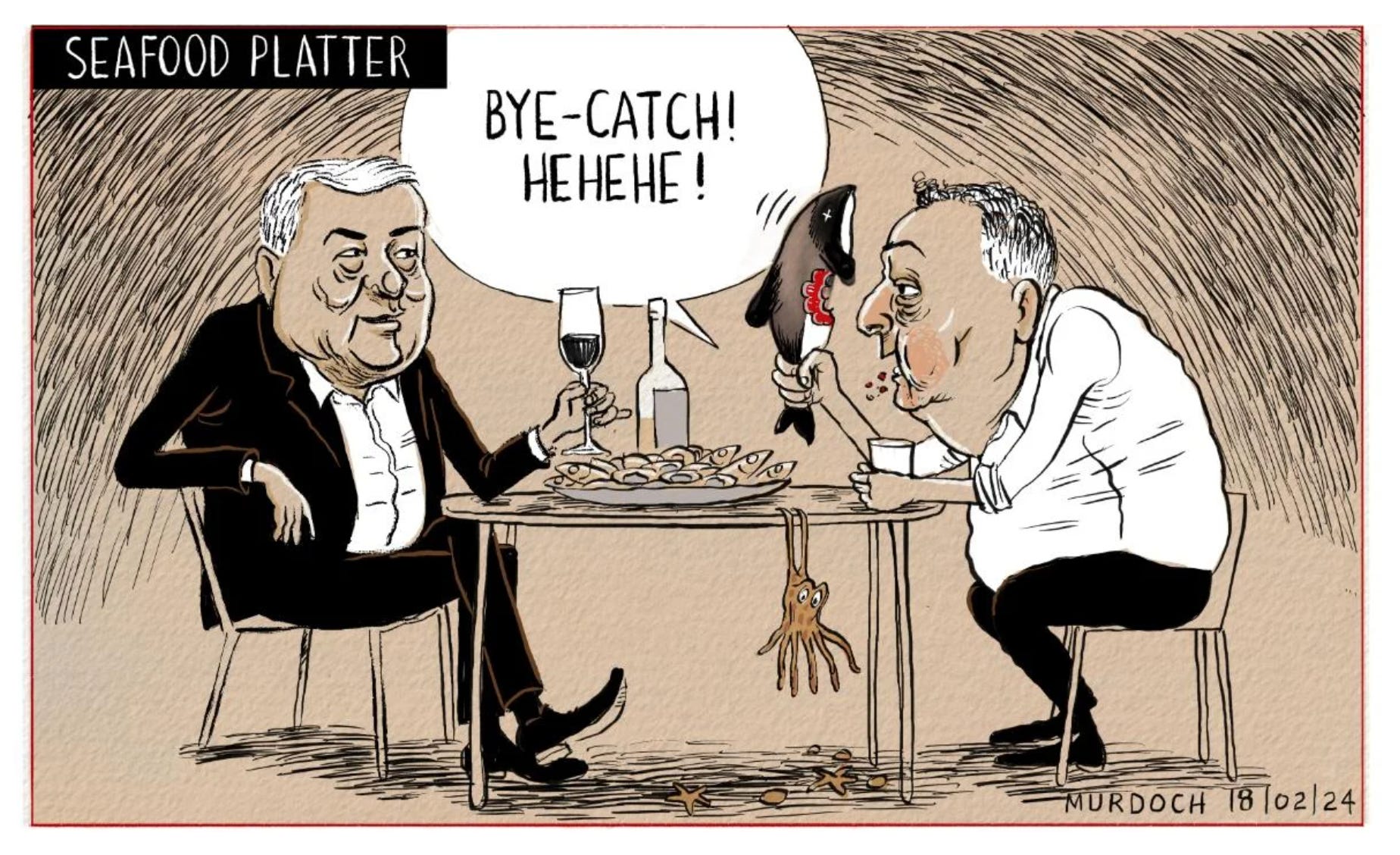
15) A new poll is out that shows 85% of the public does not trust the Minister of Fisheries, Shane Jones, to look after New Zealand’s ocean and fisheries. The Horizon Research poll commissioned by Greenpeace also found that 57% agree that MPs who accept donations from the fishing industry should not be the Minister for Oceans and Fisheries. And today Jones is set to meet again with Fisheries bosses at the Ministry for Primary Industries in Wellington to discuss further loosening of the rules and regulations for the industry – see Jonathan Milne’s Fisheries minister looks to save industry, ‘not just sponges’
Dr Bryce Edwards
Political Analyst in Residence, Democracy Project, School of Government, Victoria University of Wellington
Today’s cartoons
NZ Politics Daily – 19 February 2024
GOVERNMENT, STATE OF NATION SPEECH
Chris Trotter (Interest): Is applying 'tough love' to a 'fragile' nation the right answer?
Pattrick Smellie (BusinessDesk): Scoring Chistopher Luxon’s State of the Nation speech (paywalled)
Thomas Manch (Post): Luxon's 'fragile' NZ speech: what’s the plan? (paywalled)
Andrea Vance (Post): Who de-programmed Chris Luxon? (paywalled)
Tova O’Brien (Stuff): Praise and protest, big day of contrasts for Chris Luxon
Jason Walls (Newstalk ZB): Plenty of People Still Back Luxon Despite Grim SOTN Speech
1News: PM talks 'tough choices' on benefit sanctions, infrastructure
William Hewett (Newshub): Prime Minister Christopher Luxon says New Zealand in 'fragile' situation, warns of tough decisions
Thomas Coughlan (Herad): State of the Nation speech: Prime Minister Christopher Luxon takes aim at Labour over transport cash shortfall (paywalled)
RNZ: Watch: 'State of the nation is fragile', Christopher Luxon says
Thomas Manch (Post): ‘Tough love’ needed to restore ‘fragile’ New Zealand (paywalled)
Brent Edwards (NBR): Prime Minister confident about the future despite challenges (paywalled)
Trent Doyle (Newshub): PM Luxon's State of the Nation speech a 'buffet of buzzwords' and full of 'nonsense' - Opposition
—————
Isobel Ewing (Newshub): Prime Minister Christopher Luxon forced to abandon visit to Auckland's Big Gay Out by pro-Palestine protesters
RNZ: Christopher Luxon leaves Big Gay Out after heated protest
—————
1News: 'Outcomes', 'deliverables' - Luxon's business-like language unpacked
Gordon Campbell: On National passing bad policies under urgency
Grant Duncan: Nicola Willis Resurrects 'Social Investment'
Andrew Gunn (Post): Baffled of Botany seeks advice on their relationship with ‘two great guys’ (paywalled)
Steve Braunias (Herald): The secret diary of ... supermarket vermin (paywalled)
Paid subscribers can access the full “NZ Politics Daily” from here. The following categories of news and analysis continue: LABOUR; POLLS, PARLIAMENT, PARTIES; PUBLIC SERVICE; WATER, INFRASTRUCTURE; LOCAL GOVERNMENT; TRANSPORT; INFRASTRUCTURE; HEALTH; IMMIGRATION; ECONOMY, COST OF LIVING; BUSINESS; JUSTICE, CRIME, POLICE; HOUSING; EDUCATION; TREATY; MEDIA; FOREIGN AFFAIRS
