

Following The Money in 2025: The Democracy Project Annual Audit of Political Donations in New Zealand
By Dr Bryce Edwards, Director, the Democracy Project
Executive Summary
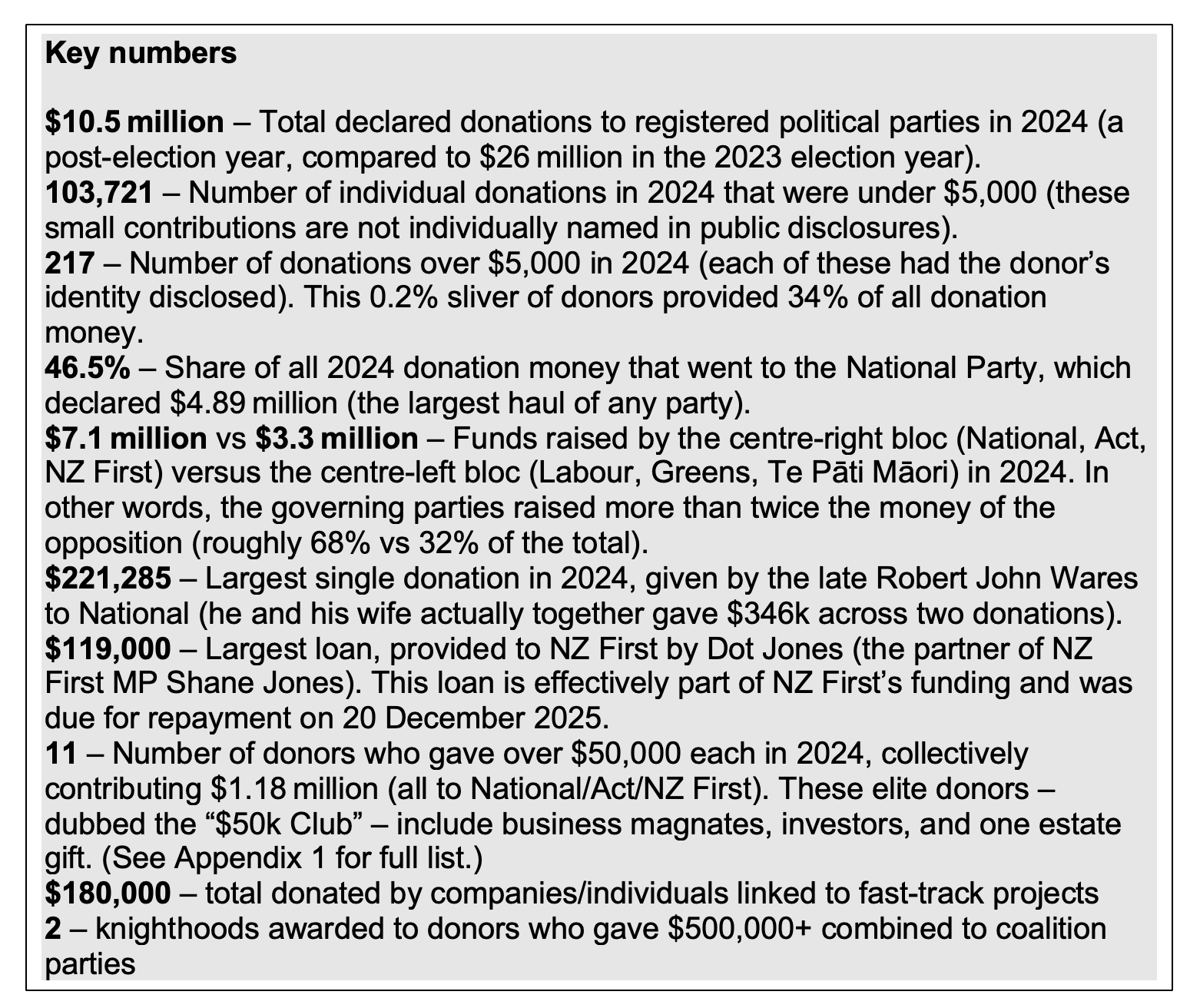
This report provides a comprehensive analysis of the $10.5 million in declared political donations received by New Zealand’s parliamentary parties last year. The findings reveal a political financing system under significant strain. While New Zealand maintains a global reputation for low corruption, the patterns of giving documented in this report point to a troubling disconnect between that perception and the reality of how political influence is sought and wielded.
The central argument of this report is that the proximity between large financial contributions from wealthy vested interests and favourable government outcomes is now too close and too frequent to be coincidental. While usually technically compliant with the law, the patterns of these donations are creating undeniable conflicts of interest, eroding public trust, and threatening the foundational principle of democratic equality.
This report is based on data submitted by all registered parties about their donations in the 2024 calendar year, first published in May 2025 by the Electoral Commission, in line with the Electoral Act. This report is the first of a regular annual series on political donations for the Democracy Project, an advocacy and research organisation set up to foster an improved political process in New Zealand.
Key findings of the 2025 report include:
Concentration of Influence: A tiny cohort of donors wields disproportionate financial power. Just eleven donors, all backing the Coalition Government parties, contributed over $1.18 million — more than 10% of all declared funds. Donors giving over $5,000 represented just 0.2% of total donors but accounted for 34% of all money given.
A Tale of Two Funding Systems: New Zealand politics is now funded by two distinct models. On the one hand, the governing coalition (National, Act, New Zealand First) is overwhelmingly financed by large donations from corporate entities and high-net-worth individuals, particularly from the property, construction, and extractive industries. In contrast, the Opposition (Labour, Greens) is funded by a broader base of smaller individual donations and a transparent system of MP tithing.
Systemic Conflicts of Interest: The report details multiple case studies where large donations were followed by significant, tangible benefits for the donor. These include:
1. The Fast-Track Approvals Act: Companies and individuals linked to projects included in the government’s fast-track consenting regime donated over $180,000 to the National and New Zealand First parties in 2024 (Electoral Commission 2025). In several significant cases, the responsible ministers did not recuse themselves from the decision-making process.
2. The Dynes-KiwiRail Affair: A sequence of events saw a transport company donate $20,000 to New Zealand First, receive an $8 million government loan from a fund overseen by a New Zealand First minister, and have one of its directors appointed to the board of KiwiRail by the party’s leader (Hancock 2025a).
3. Perceptions of “Cash for Honours”: Two prominent businessmen were awarded knighthoods in 2025 following their families and companies making a combined total of over half a million dollars in donations to the governing parties over the preceding two years.
Inadequate Regulatory Framework: Current laws fail to prevent practices that obscure the true source of funds, such as “donation splitting” across multiple entities controlled by a single individual. The official processes for managing conflicts of interest, while sound on paper, are proving insufficient to address the public perception that policy and appointments can be bought.
This analysis concludes that New Zealand is at a critical juncture. The “legality defence” — that no rules were broken — is no longer a sufficient answer to the public’s growing cynicism about money in politics. To restore the balance and safeguard the country’s democratic health, this report proposes options for urgent reform, including donation caps, a ban on corporate donations, mandatory stand-down periods for honours and appointments, and enhanced transparency rules to bring New Zealand in line with international best practice.
Introduction: How money in politics is growing discontent
In May this year US President Donald Trump accepted a gift of a US$400 million dollar luxury jet from the government of Qatar (Bruggeman & Barr 2025). The plane is being used by Trump during his term as president and will then be transferred to his presidential library. Trump and his family have also been innovators in the field of accepting political gifts and donations. In late 2024 they launched cryptocurrency products that would allow potential investors to transfer vast sums of money to the Trump family with no transparency or oversight (NPR 2025; Yaffe-Bellany 2025).
Traditionally politicians who accept compromising gifts would attempt to conceal the transaction from the public, and it was often the cover-ups that destroyed careers. 21st century democracies are changing the norms around money and political influence: leaders in the UK, Canada and Germany have also faced serious ethics scandals in recent years, with little or no legal censure (BBC News 2023; House of Commons Privileges Committee 2023). The norms around political influence are changing across liberal democracies, and New Zealand needs to act quickly to protect what integrity remains in our political system.
In July of 2025 Radio New Zealand reported that Dynes Transport Tapanui, a South Island based trucking company that donated $20,000 to New Zealand First in 2024 had received an $8,000,000 regional infrastructure loan (Hancock 2025a). One of the ministers overseeing the infrastructure fund was New Zealand First MP Shane Jones, who insisted that there was no conflict of interest because the donation went to his political party, not to him (Hancock 2025a).
Both New Zealand First and National received donations from applicants to their fast-track process, in which commercial development projects can be deemed exempt from normal laws around consenting and development. Neither party considers this a conflict of interest (Hancock 2024; Hancock 2025b).
The New Zealand public, however, are increasingly suspicious of the funding arrangements of parties. And there is plenty of further evidence from the last year that should be of concern to those worried that donations to politicians might influence the decisions that are being made about the country.
This report considers the 2024 annual returns for the nation’s parliamentary political parties, examining who donated money, to whom. It examines the role that money plays in modern New Zealand politics, the laws that govern it, the problems this poses for democracy and proposes potential solutions.
Unless otherwise cited, all donation amounts and donor information in this report are drawn from the 2024 annual returns submitted by registered political parties to the Electoral Commission and published on 30 April 2025 (Electoral Commission 2025).
Section 1: A System under strain
New Zealand’s political system is defined by a deep and unsettling paradox. Internationally, it is consistently lauded as a bastion of transparency and integrity, ranking among the world’s least corrupt nations (Transparency International 2025). Domestically, however, a profound and growing cynicism has taken hold. A landmark 2023 New Zealand Electoral Survey found that 45% of New Zealanders agree with the statement, “The New Zealand government is largely run by a few big interests,” with only 27% disagreeing (Krewel & Vowles 2024).
This chasm between our international reputation and our domestic reality — an “Integrity Gap” — is the central challenge facing our democracy. It suggests that while we may be free from the overt bribery that plagues other nations, a more subtle and systemic corrosion of our political process is underway.
This report argues that the primary driver of this corrosion is the role of money in politics. The 2024 political donation returns, examined here in unprecedented detail, provide the evidence for what a significant portion of the public already suspects: that access and influence are available for purchase, and that the outcomes of public policy are becoming increasingly tied to the private interests of a small, wealthy donor class. From fast-tracked consents for property developments to seats on state-owned enterprise boards and even the bestowal of knighthoods, the correlation between large financial contributions and favourable government action has become too stark to ignore.
[This investigation considers the annual returns for the nation’s parliamentary political parties, examining who donated money, and to whom. It examines the role that money plays in modern New Zealand politics, the laws that govern it, the problems this poses for democracy, and proposes potential solutions to safeguard what integrity remains in our political system.]
1.1 The 2022 Electoral Amendment Act as a catalyst
The depth of this year’s analysis has been made possible by a crucial, if modest, legislative change. In December 2022, the then-Labour government passed the Electoral Amendment Act, which sought to increase transparency in political financing (Electoral Commission 2022; New Zealand Parliament 2022). The key changes, which took effect from the beginning of 2023, included:
Lowering the threshold for public disclosure of a donor’s identity from any donation over $15,000 to any donation over $5,000.
Requiring parties to report the number and total value of all smaller, non-anonymous donations (between $1,500 and $5,000).
Reducing the threshold for rapid disclosure of large donations in an election year from $30,000 to $20,000.
Parties must commission an auditor’s report if annual donations exceed $50,000 (was $30,000) or if they have any loan over $15,000 outstanding.
Every registered party must file full financial statements (income, expenses, assets, liabilities) plus an auditor’s opinion; the Commission must publish them (Electoral Commission 2022).
This reform was not a panacea, but it has acted as a powerful new lens. By forcing a significant amount of previously “grey” money into the light, the amendment has created a transparency shock. A donation of $14,999 was once invisible to the public; now a donor’s name is required for a contribution less than half that size. The 2024 data, therefore, represents the first full-year picture of political financing under these more revealing conditions, establishing a crucial new baseline for understanding the flow of money in New Zealand politics.
1.2 Thesis statement
The central argument of this report is that the patterns of high-value donations from vested interests in 2024, while usually technically compliant with the law, reveal a system of political financing that is creating dangerous and undeniable conflicts of interest. These patterns are eroding public trust and threaten the foundational principle of democratic equality.
The defence that no specific law was broken is no longer credible when the systemic outcomes so clearly favour a narrow group of financial backers. New Zealand is at a critical juncture and requires urgent, substantive reform — not merely to tweak disclosure rules, but to fundamentally reassert the principle that political decisions must be made in the public interest, free from the distorting influence of private wealth.
Section 2: The New landscape of political finance: Following the $10.5 million
The 2024 annual returns provide a clear statistical snapshot of the financial landscape of New Zealand politics. While a non-election year, the total declared amount indicates a system flush with cash, with funds heavily concentrated among the parties of the governing coalition.
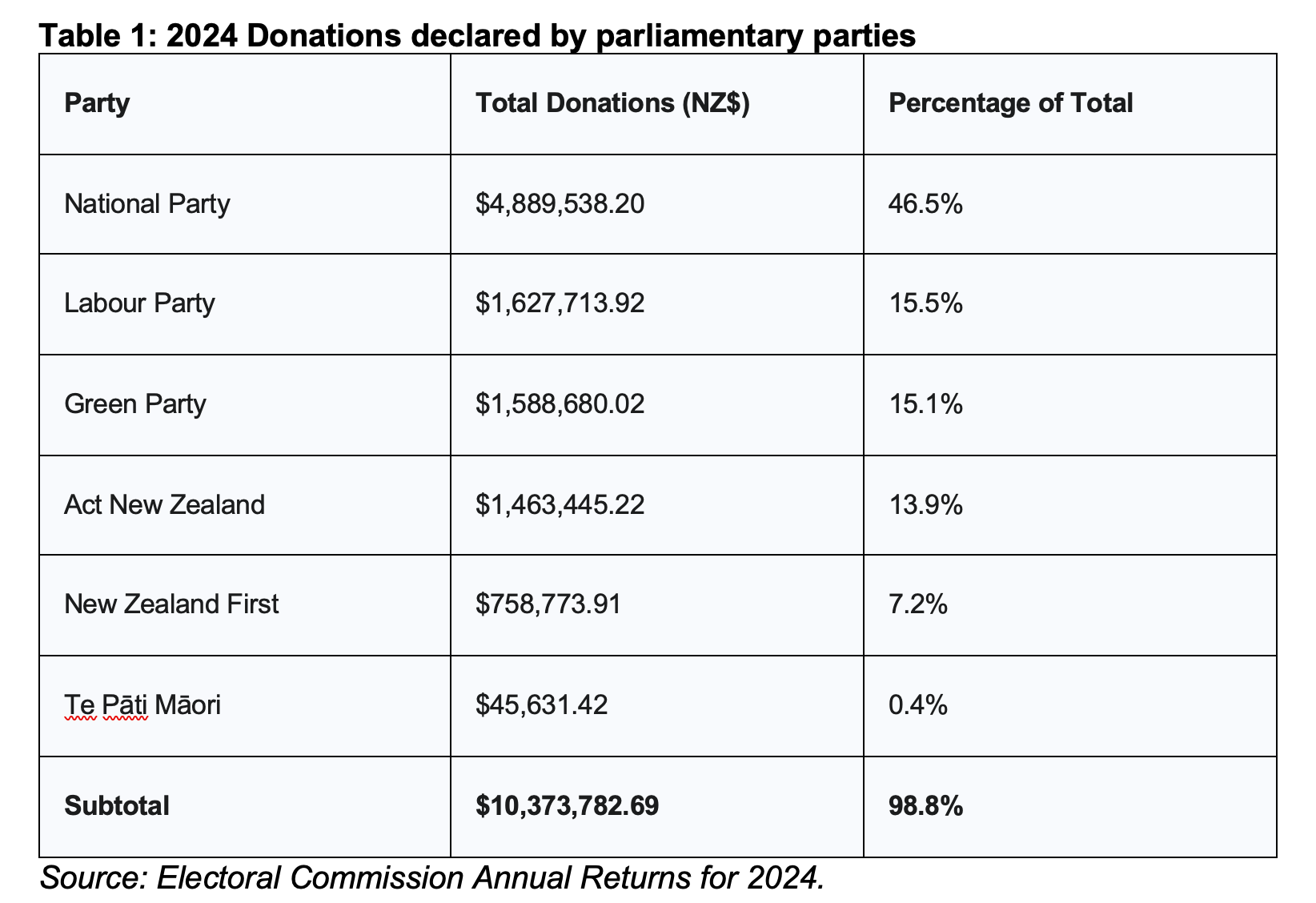
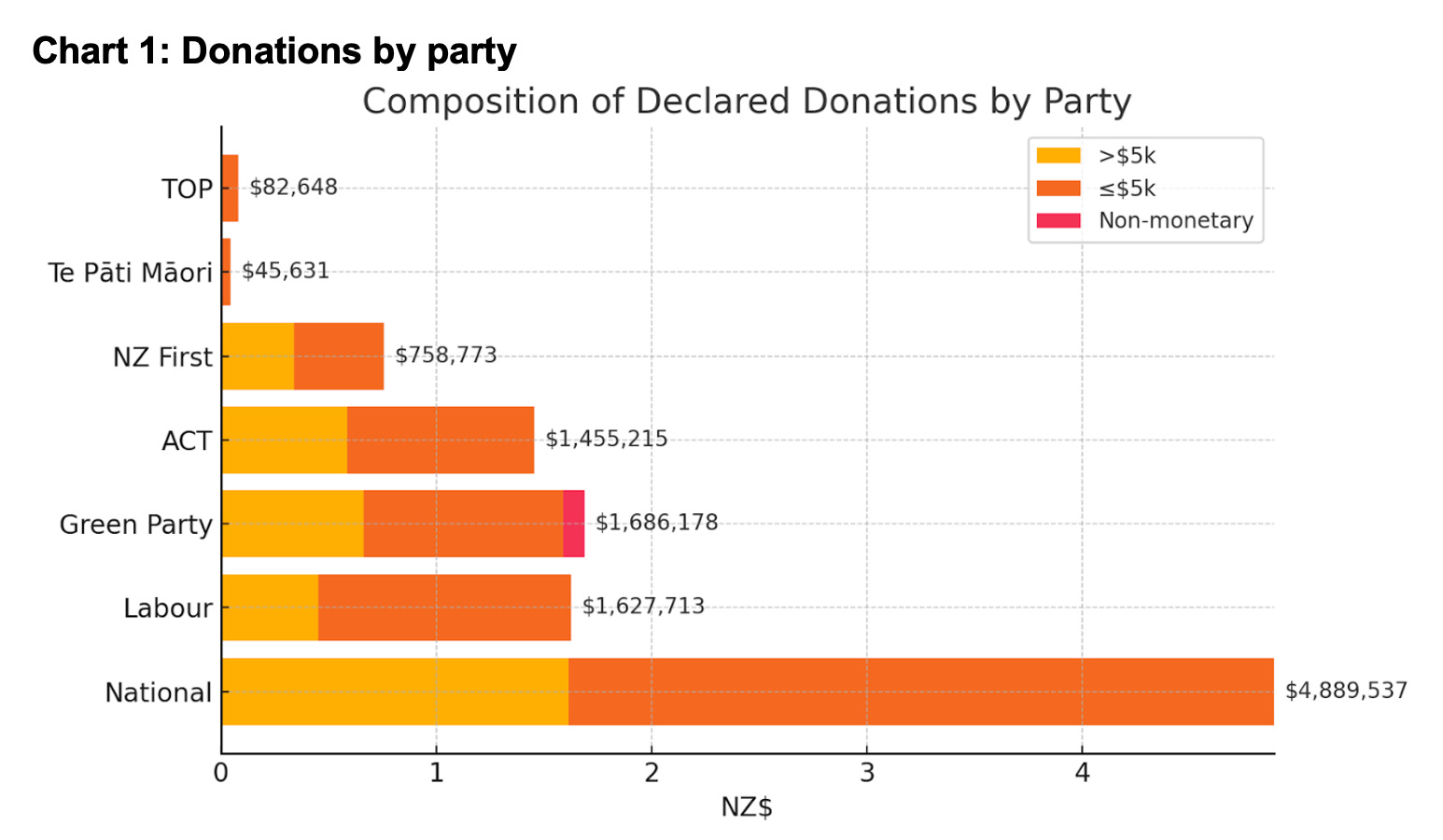
Below, in Table 1, the total donations declared by the parliamentary parties are expressed, showing how the National Party received the highest amount, taking 46.5% of all donations declared. Chart 1, further below, expresses the total differently, and includes TOP from outside of Parliament, with more detail about the types of donations received, as the data now includes information about the quantum of donations received below the declarable threshold of $5000.
2.1 Macro-level data presentation
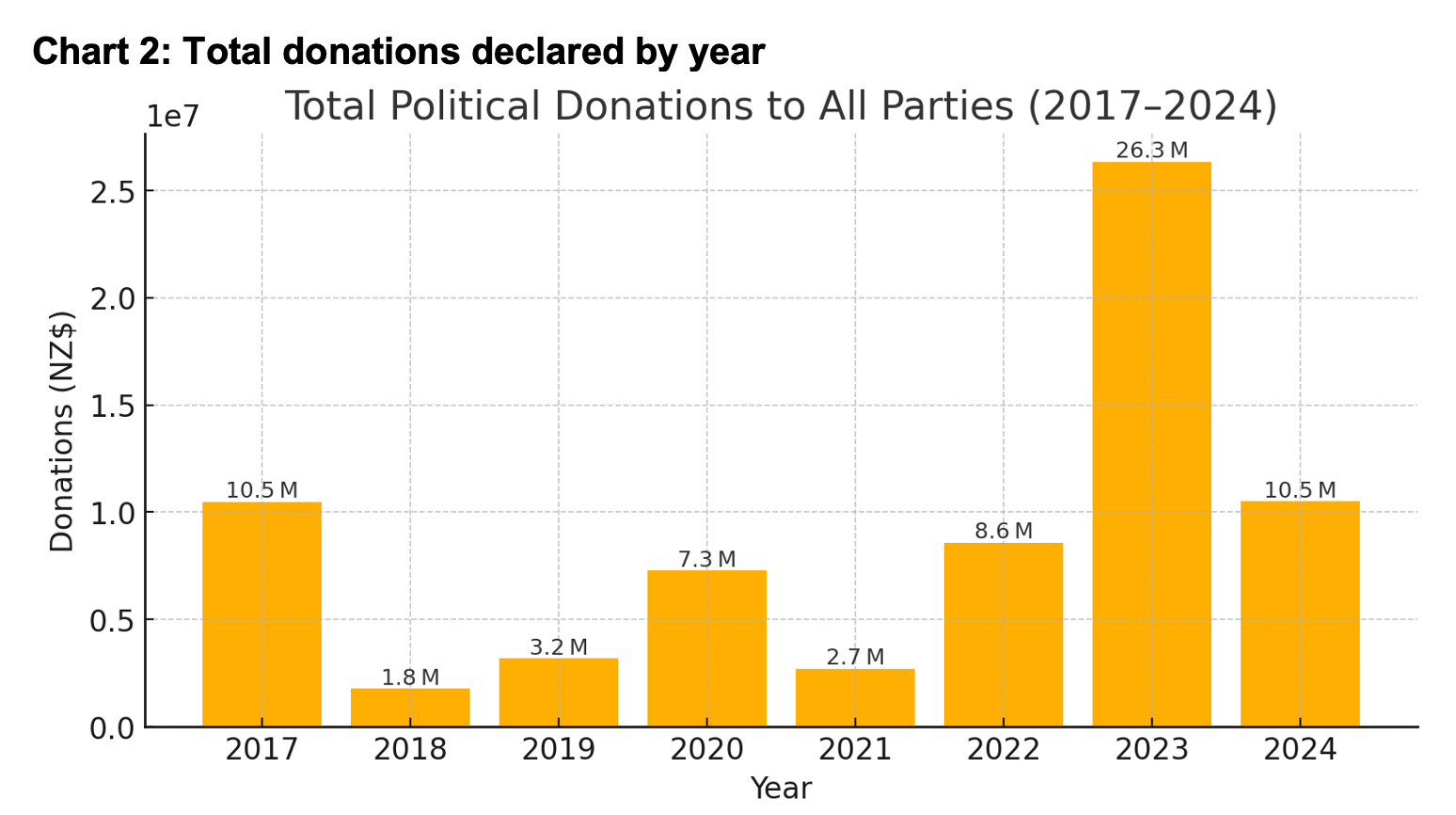
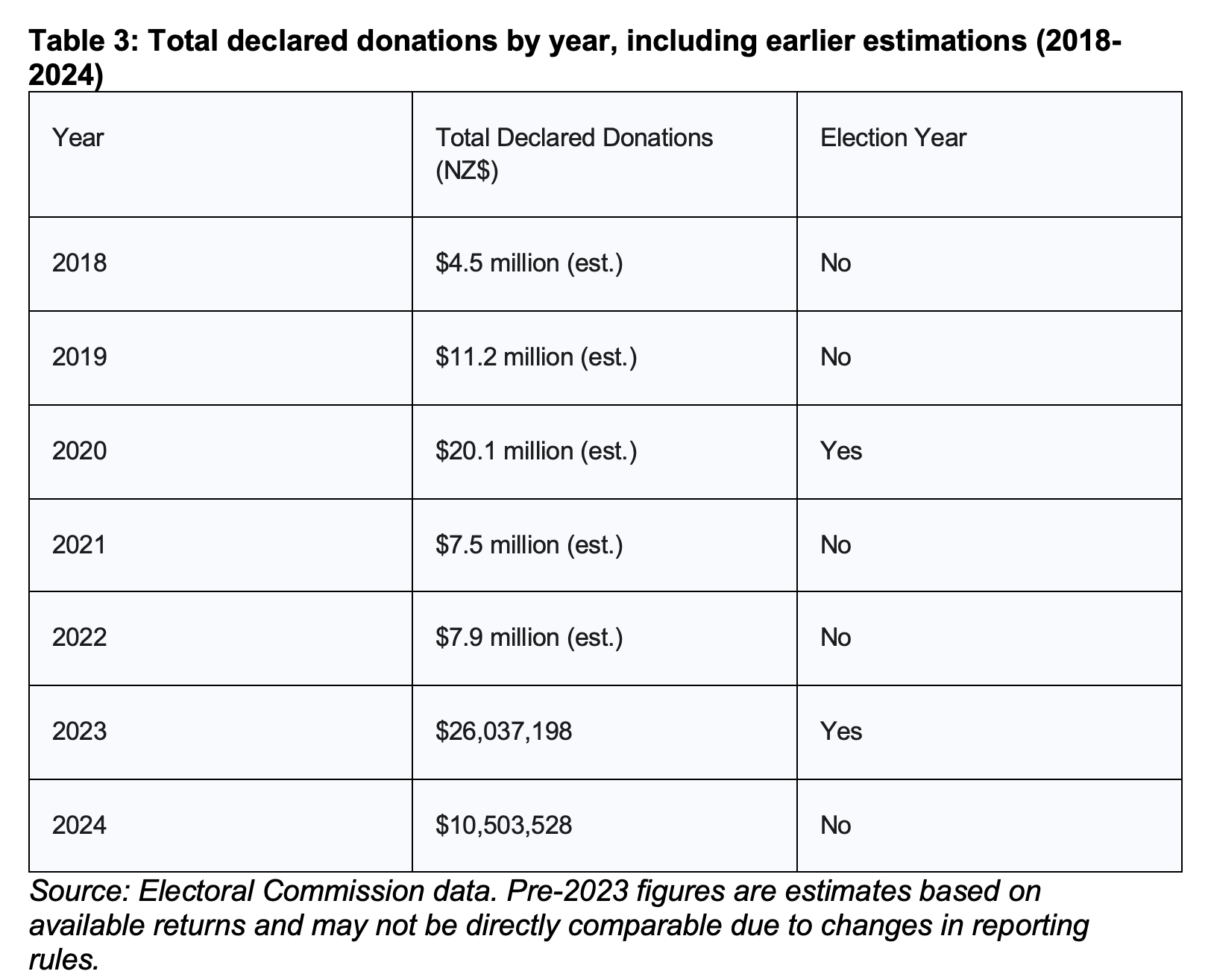
In total, New Zealand’s registered political parties declared $10.5 million in donations for the 2024 calendar year (Electoral Commission 2025). As expected, this figure is substantially lower than the $26 million declared in the 2023 general election year.
It is clear that the lower disclosure threshold has dramatically increased the quantum of donations declared, with the 2023 election year far in excess of the previous two election years. However, it is interesting to observe that 2024 returns show a higher value of declarations than previous years immediately post-election as a proportion of the election year total. 2024 saw approximately 40% of the election-year total donated, compared with 36% in 2021 and 17% in 2018.
Of this total, 94% of all funds — approximately $9.87 million — went to the seven largest parties, six of which are represented in Parliament. The National Party was the dominant recipient, securing 46% of all donated funds, a total of nearly $4.9 million (Electoral Commission 2025; Ensor 2025a).
The new thresholds and reporting laws mean that a much higher volume of donations have been declared for 2024, which can’t be directly compared with earlier years. Nonetheless, the new configurations of data allow calculations to be made about what previous year totals might have been, going back to 2018. See Table 2, below, which indicates that the volume of donations has been increasing quite significantly in recent years.
2.2 Analysis of funding models: A Tale of two systems
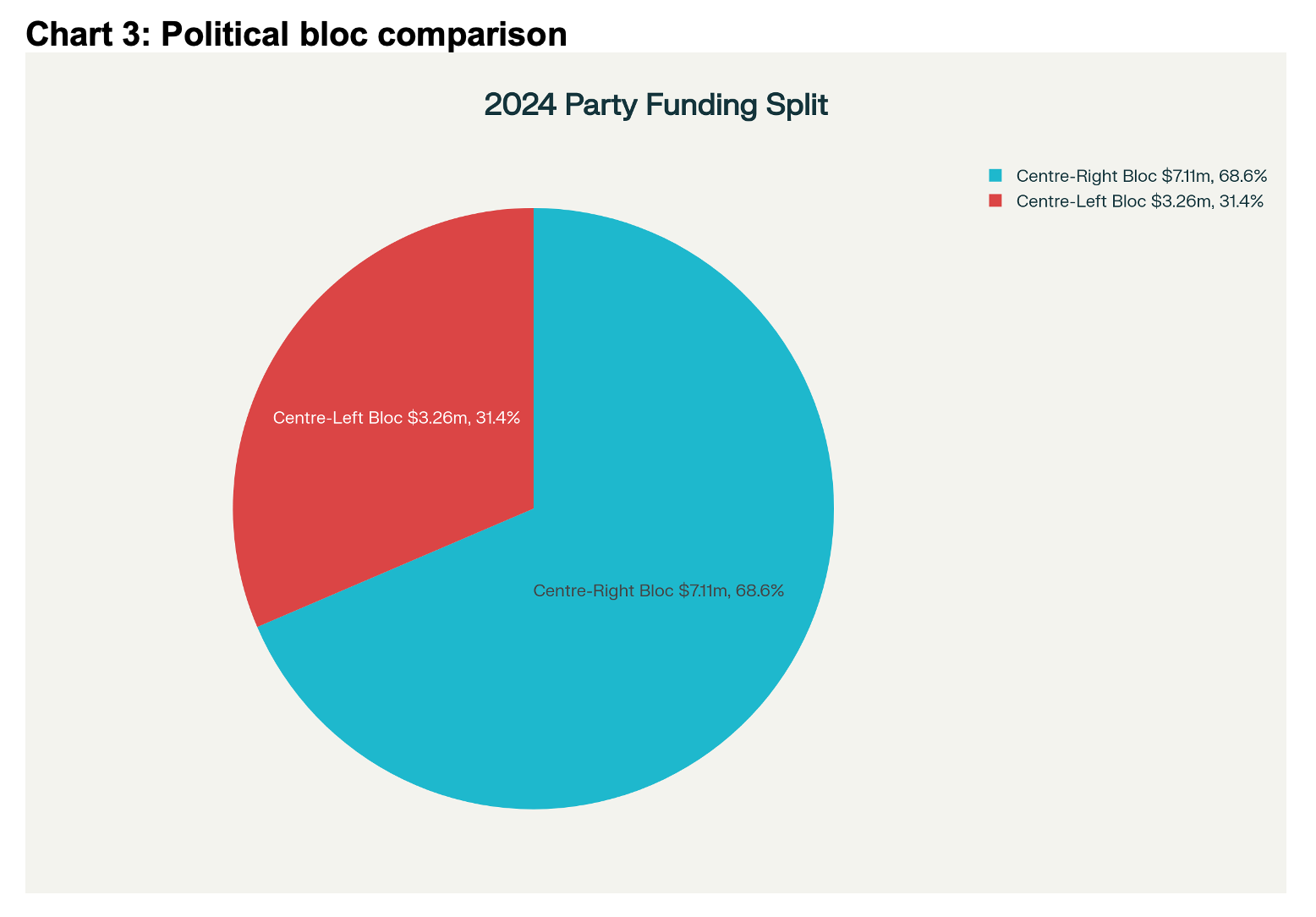
Beyond the raw numbers, the 2024 data reveals a stark bifurcation in how New Zealand’s political blocs are financed. The centre-right side of politics (National, Act and NZ First) collected $7.1 million, while the centre-left bloc (Labour, Greens, Te Pāti Māori) has raised $3.3 million. Therefore, in 2024 the centre-right’s haul was roughly double that of the centre-left.
This is not simply a matter of one side raising more money than the other; it reflects two fundamentally different models of political engagement and financial support, with profound implications for whose interests are represented in the halls of power.
2.3 The Coalition parties: A System reliant on chequebook politics
The funding model of the three governing centre-right parties (National, Act, and New Zealand First) is overwhelmingly characterised by a reliance on large donations from a narrow base of corporate entities and high-net-worth individuals. This is a transactional, business-oriented model where financial support is heavily concentrated among those with significant commercial interests.
The evidence for this is clear. All eleven of the year’s largest donations (those over $50,000) went to the parties of the Coalition Government, totalling over $1.1 million from this elite group alone. An analysis of donations since 2021 confirms this pattern, showing that contributions from the property and finance sectors flow almost exclusively to National, Act, and NZ First.
National’s donor list is approximately 60% corporate, with leading contributions from construction, development, and real estate firms. Act’s donors are primarily high-net-worth individuals from business, property, and agribusiness backgrounds. NZ First attracts significant funding from the primary and extractive industries, including mining, forestry, and transport. This is a system funded by capital.
There is also an emerging donor bloc of diaspora business networks, that the National Party in particular is utilising. National’s funding model is diversifying beyond its traditional base, to include New Zealand’s Chinese and Indian business communities, especially in terms of property, retail, manufacturing, and consulting. See the section on National Party donors later for more data on this.
2.4 The Opposition parties: A System reliant on participation and ideology
In stark contrast, the funding model of the Labour and Green parties is characterised by a broader base of smaller individual donations, supplemented by a significant and transparent system of internal tithing from their elected Members of Parliament. This is a participatory model, more reliant on mass membership and ideological alignment than on large transitions from vested interests.
MP donations to these parties are considerable. Last year, tithed donations from MPs comprised 15.6% of Labour’s total declared contributions and 18.9% of the Greens’ total (see section 2.5 below).
The donor lists of Labour and the Greens are dominated by individuals, including former politicians, academics, philanthropists, and environmental activists, rather than large corporations. This is underscored by the near-total absence of significant business donations to the Labour Party since 2021, a dramatic shift from previous eras when Labour was more successful in fundraising from businesses (Brown 2023). This is now a system funded by activists, members, and labour.
This bifurcation is more than a statistical curiosity. It suggests that the two sides of the political spectrum are responsive to fundamentally different constituencies, not just at the ballot box, but in their day-to-day financing. The Government is financially beholden to the interests of business and wealth, while the opposition is financially reliant on its members and ideological supporters. This dynamic shapes not only their policy platforms but also who gets a seat at the table when crucial decisions are made.
Of course, not all funding is neatly siloed by ideology – some wealthy individuals play all sides presumably to gain influence. For example, Wellington businessman Troy Bowker has given money to Act, NZ First, and even a Labour MP, presenting an interesting case of a donor hedging bets (Hurley 2022a; Hurley 2022b; Cook 2021).
However, more typically, when donors spread their bets, they tend to stay within one of the ideological blocs. For instance, billionaire Graeme Hart has donated $700,000 to right-wing parties over 2023 and 2024, in what looks like “strategic diversification”, spending $400,000 on National, $200,000 on Act, and $100,000 on NZ First (RNZ 2023). And as discussed later, Hart does this using both personal donations and a corporate vehicle (Rank Group).
2.5 MP tithing
Both the Green Party and Labour Party require their MPs to contribute a share of their parliamentary salary back to the party (a practice often referred to as “tithing”). Green MPs appear to tithe 10%, and Labour MPs 5% (Collins 2010; Wikipedia 2025). New Zealand First MPs other than Winston Peters and Shane Jones also appear to tithe 5%.
For Labour and the Greens, last year these tithed donations comprised 15.6% and 18.9% of their annual contributions – that’s $253,923 for Labour, and $300,261 for the Greens.
NZ First received donations from a number of its MPs in way that suggests some form of tithing might be used. Over $42,000 was received from five of the caucus, ranging from about $6,300 to $10,300. For most MP donors, the amounts were received in the form of regular monthly payments, which suggests a form of tithing. However, in the past, NZ First has also been known to charge its candidates for the party’s overall general election expenditures, requiring repayments after the election, regardless of electoral success.
National, Act and Te Pati Māori do not appear to tithe, although four National MPs – Shane Reti, Dana Kirkpatrick, Tim Costley and Carlos Cheung – made donations. The largest donation was Cheung’s $20,399.06. We have no visibility of MPs making contributions below the $5000 threshold.
The proportion of the tithing payments as donations for the Greens, Labour and NZ First can be seen in Chart 6, below, which breaks each party’s total donations amount into the proportion of funds that come from large ($5000+) donations, those below that figure, and tithes from MPs.


2.6 Former politicians
Beyond wealthy businesspeople there are always other figures that give generous donations – especially former MPs and other elected politicians. In 2024, Labour received $20k from former Auckland Mayor Dick Hubbard, $11k from former prime minister Helen Clark, and $17,912 from former Labour MP and Cabinet Minister Pete Hodgson (who has now donated a total of $59,736 to Labour since 2022).
National has received $50k from former National MP Jim Gerard QSO via the Canterbury Nationalist Trust. Former Deputy PM and senior Cabinet Minister Bill Birch donated $6,980.
Act received a $6,980 donation from Don Brash, who is both a former leader of that party (2011), as well as a former leader of National (2003–2006).
NZ First has received donations from lobbying firms associated with former MPs. Clayton Cosgrove’s lobbying firm Cosgrove & Associates donated $8,000 to New Zealand First (following a similar donation in the previous year). And after former New Zealand First MP Fletcher Tabuteau joined the lobbying firm Capital Government Relations Ltd, they gave $6,000 to New Zealand First (more about this in Section 3.4).
All these donations reinforce that even prominent public figures participate in donations – but in these cases on the moderate end, compared to corporate donors.
Section 3: The Donor class: Mapping the networks of influence
Last year there were 217 registered donations to the parliamentary political parties that were greater than $5000, and there were 103,721 donors whose contributions were below the $5000 threshold. The donors who gave more than $5000 therefore comprise just 0.2% of the total donors but contributed 34% of the total amount donated.
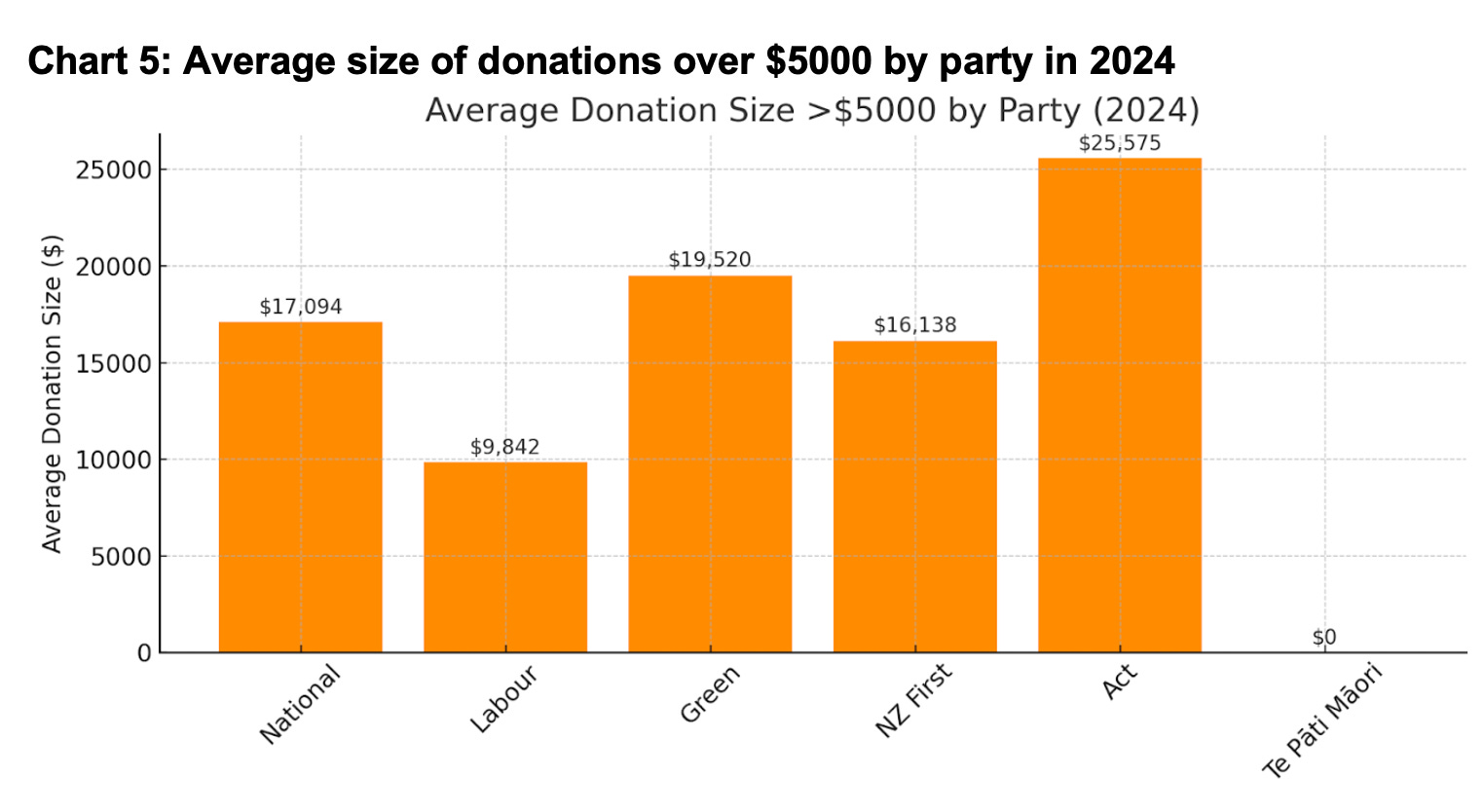
Looking specifically at the declared donations above the $5000 threshold, it is apparent that the size of these donations varied considerably between parties. As Chart 5 below shows, while the average donation above the disclosure threshold for Labour was just under $10,000, for the Act Party it was well over $25,000.
To understand the true nature of political finance in 2024, it is necessary to move beyond aggregate figures and examine the individuals and industries behind the largest donations. The data reveals not a random assortment of engaged citizens, but a highly concentrated and sectorally-aligned group of powerful interests. By classifying the donor data by industry, it becomes clear that specific parties are becoming heavily reliant on, and therefore potentially captured by, specific economic sectors. This analysis moves from how much was given, to who gave it and, most importantly, why.
3.1 The $50,000+ club: New Zealand’s political kingmakers
At the apex of the donor pyramid is a small and exclusive group whose financial contributions grant them unparalleled influence. In 2024, twelve donors contributed $50,000 or more. Their combined donations totalled $1,289,178, representing roughly 11% of all money declared across all parties.
These are not average citizens participating in the democratic process; they are New Zealand’s political kingmakers, high-net-worth individuals and their corporate vehicles whose backing can sustain a political party’s campaign. Their shared characteristics — immense personal wealth and business interests sensitive to government regulation and taxation — provide a clear context for their political alignment.
For instance, packaging magnate Graeme Hart (net worth of about $12bn) donated $50k to Act and via his company gave another $50k to NZ First; and toy entrepreneur Nicholas Mowbray gave $100k to Act (NBR 2024; RNZ 2023a). Both have business empires that benefit from low-tax, low-regulation policies. These examples show how donors appear to openly align themselves with parties who have policies that align with their financial interests.
Table A, in the Appendix, provides some basic information about the twelve donors that contributed above $50k. This provides profiles of these top donors, including their backgrounds and political ties.
3.2 Building influence: The Property, construction, and infrastructure lobby
The single most powerful and organised donor bloc in New Zealand politics is the property and construction industry. An RNZ analysis found that since 2021, individuals and entities aligned with the property sector have donated more than $2.5 million, with 97% of that funding directed to National, Act, and NZ First (Palmer 2023). The 2024 returns show this trend continuing unabated.
This sector’s financial support is directly tied to its clear policy objectives: comprehensive reform of the Resource Management Act (RMA), the creation of fast-track consenting processes to bypass council regulation, and the maintenance of favourable tax settings, most notably the absence of a capital gains tax.
Major donors from this sector in 2024 include:
Real Estate Agencies: John Bayley of Bayleys Real Estate ($38,780 to National).
Property Developers: Christopher Reeve ($53,000 to Act), Brett Russell and his Russell Property Group (combined $47,132 to National), and the Mansons family via Mansons TCLM Ltd ($15,000 to National) are all major players in land and commercial development.
Opaque Development Interests: Donations also flow through less transparent entities, such as the three “Khyber Pass Companies” controlled by developer Yuntao Cai (combined $36,338 to National) and a group of companies located at Auckland’s Princes Wharf that are linked to property magnates the Chow Brothers ($10,000 to National).
Construction Companies: In 2024, National also received significant donations from major contractors like 3Eyes Construction ($23,650.65) and key suppliers to the industry, such as Manukau Quarries ($10,000) and heavy equipment manufacturer Transport Trailers Services Limited ($6,161.66). This demonstrates a broad-based financial alignment across the entire supply chain that stands to benefit from the government’s infrastructure and “red tape reduction” agenda.
Property is a heavily regulated sector (planning laws, infrastructure funding, etc.), so developers often court whichever party holds power. In 2024, National’s donor list was flush with real estate money.
Other notable National donors included the Brady family of South Auckland – who gave $20k split between their Ardmore quarry business and personal donations – and various developers or investors who stand to benefit from a pro-building, pro-RMA-reform agenda. For instance, Auckland investor Christopher Reeve (donated $53k to Act) owns property companies and would profit from looser resource consent rules and the absence of capital gains tax.
Likewise, Christchurch builder Stonewood Homes (Chow family) have appeared in donation lists, presumably anticipating influence on urban development policies.
The Goodfellow family (through ex-National president Peter Goodfellow, $10k in 2024) have extensive business holdings and longstanding ties, ensuring they’ll have an ear in policy circles. The pattern is clear: developers and construction firms donate to National/Act expecting a government that accelerates building projects, reduces compliance costs, and opens up land. While many frame their gifts as supporting a general ideology of growth, the direct business benefit cannot be ignored.
Fletcher Building defended its $7,200 donation to National (through Fletcher Concrete), saying it was simply paying for seats at a fundraising dinner (Thomas 2024). What is not acknowledged, however, is that in essence this is paying for privileged access to politicians. The risk is that such access translates into preferential input on policy (e.g. shaping reforms to zoning, infrastructure funding, or environmental rules to suit developers).
National and Act campaigned on repealing or loosening the Resource Management Act, which would clearly reward these donors. As one analysis bluntly noted, “donors like Reeve [a property investor] could directly profit if Act in government reforms property rules… a classic case of business funding its preferred policy outcomes”. This blurring of public policy and private interest is exactly what fuels conflict-of-interest accusations.
3.3 Digging for favour: The Extractive & primary industries
The second major donor bloc comprises companies and individuals from the mining, energy, quarrying, forestry, fishing, and agricultural sectors. These industries, which rely on access to natural resources and are heavily impacted by environmental regulations, have directed their financial support overwhelmingly to the coalition parties, particularly New Zealand First, which has built its modern brand on a pro-resource extraction platform.
Key donors in 2024 include:
Mining and Quarrying: Melrose Private Capital, an investment vehicle for the owner of Taharoa Ironsands, was NZ First’s largest donor ($84,680). Other donors include sand miners McCallum Bros ($12,000 to NZ First), the Minerals West Coast Trust ($10,000 to NZ First), aggregate supplier Road Metals ($12,000 to NZ First), and Patrick Phelps, a key lobbyist for mining ($10,000 to NZ First).
Energy and Forestry: The Todd Corporation, one of New Zealand’s largest energy conglomerates, donated to National ($5,468), while the Oregon Group, a major forestry owner, gave National $17,013.
Fisheries and Agribusiness: Seafood giant Sanford Ltd donated $12,000 to NZ First. Act received significant support from agribusiness figures, including kiwifruit industry leaders Craig and Shayne Greenlees ($20,000) and large-scale farmer Ron Frew ($15,000).
These contributions align with the coalition’s agenda of repealing environmental protections, promoting mining and oil exploration, and championing provincial industries against what they term excessive “red tape.”
Several extractive industry players backed the coalition parties last year, in some cases outside of the fast-track context. NZ First received donations from the coal, oil, and minerals camp in line with its resources-focused agenda. For example, Bathurst Resources (a coal mining firm) donated to NZ First (exact amount was below disclosure threshold, but known from media) and had met with party officials regarding coal policy.
The Dynes family’s transport company (Dynes Transport, which hauls coal and forestry products) gave $20,000 to NZ First, reflecting confidence that NZ First would push for regional roading and resist tough emissions regulations on trucking. Indeed, such donors likely welcomed NZ First’s scepticism of strict climate measures and promotion of provincial industries.
On the National/Act side, oil exploration interests and climate policy opponents have also been active donors: reports indicate Mark Dunphy, a petroleum investor who advocated to restart offshore drilling, contributed to right-leaning campaigns (though not publicly disclosed in 2024, he was active in 2023).
The “National Green Steel” project proponents (the Garg family) donated to National in 2023 – a small amount ($5k) but symbolically important given their project to create a hydrogen steel plant relies on favourable government support. All these contributions underscore how natural resource companies invest in parties that will favour development over environmental restraints.
The conflict concern is that ministers may feel beholden to these donors when setting policy on mining permits, environmental standards, or climate action. Notably, Shane Jones even added sand and aggregates to a “critical minerals” list, easing rules for quarries – a direct nod to donors like McCallum and J Swap (Tibshraeny 2024; MBIE 2024).
Beyond Sanford’s fisheries donation noted earlier, other primary-sector businesses made targeted contributions. Mining, forestry and agriculture interests, for instance, quietly back NZ First and National. [In 2024 NZ First received funds from sources like Phelps & Co. (West Coast) – a forestry/logging family business (media noted a donation from [Brian Phelps], $10k, tied to NZ First’s pro-forestry stance).]
The Antipodes Aqua salmon farm (Marlborough) proponents were also linked to donations. Meanwhile, Act attracted support from wealthy farmers and agribusiness figures frustrated with environmental regulations: e.g. the Van Den Brink family (poultry farming empire) has been known to support Act’s anti-regulation platform (though specific 2024 amounts were below disclosure).
Rod Drury (tech entrepreneur) is another example: while his $100k to Act in 2022 was supportive of a party he backed, he publicly noted an “expectation that once you’re successful, you contribute to the political system” (Newshub 2022). Drury isn’t seeking government contracts, but his comment reflects how business leaders feel obliged to donate. In the primary sector’s case, donations often aim to stave off unwelcome regulation – e.g. fishing companies, trucking firms, farming co-ops all give to parties that promise to “get government out of the way.”
The conflict arises if those parties, once in power, water down regulations or enforcement in ways that specifically benefit their donors (for example, relaxing catch limits after a fishing company’s donation, or delaying emissions fees for trucking after transport operators fund the campaign). While such policy decisions can be defended on ideological grounds, the perception of payback is hard to avoid when the money trail is public.
3.4 Paying for a seat at the table: The Professional influencers
Perhaps the most explicit form of “cash for access” comes from donations made directly by professional lobbying firms and industry associations. For these entities, political donations are not a form of civic participation or philanthropic support; they are a strategic business expense, designed to build relationships, secure meetings, and ensure their clients’ interests are heard by decision-makers.
In 2024, several corporate lobbyists made declared donations:
Capital Government Relations Ltd: A prominent lobbying firm with directors from across the political spectrum, including a former NZ First MP, donated $6,000 to New Zealand First.
Cosgrove and Partners: A firm founded by a former Labour Cabinet Minister, donated $8,000 to New Zealand First.
Thompson Lewis: A public relations firm founded by a former Chief Press Secretary to Helen Clark, donated $6,000 to the Labour Party.
Massey Coates: Nicholas Albrecht is the director of corporate lobbying consultancy firm Massey Coates, and he donated $9,038.99 to National. Albrecht was previously Vector’s in-house lobbyist for 14 years (2008-2022)
Spirits New Zealand: The industry lobby group for the liquor industry donated $6,114 to National.
Orange PR Media Limited: Donated $8,732 to National. Orange PR is a marketing and event agency with offices in Auckland and Fujian, China.
These donations blur the line between democratic engagement and commercial transaction, creating a tiered system of access where those who can afford to pay a lobbying firm — and have that firm make donations on top of its fees — are granted a privileged hearing.
While these sums are modest – and possibly represent the price of access to party fundraising events with politicians – they raise eyebrows: lobbyists typically seek access through meetings and advocacy, so their direct financial contributions to a party blur the line between professional lobbying and political patronage. It could be seen as lobbyists paying to sustain relationships or goodwill with a party that ended up in government. Essentially, those who already hold influence (via connections) are also contributing money, amplifying their clout.
This trend of lobbyists donating cash underscores the report’s theme that access is increasingly monetised. Not only do businesses donate for favourable policy, but influence brokers themselves are entering the fray financially.
Construction and infrastructure contractors often rely on government spending (roading, public works), which is a dynamic that can turn donations into potential conflicts. A clear case is Road Metals Co, a Canterbury gravel and machinery supplier who donated $12,000 to NZ First. As a regular contractor for highway projects, Road Metals would benefit from NZ First’s push for big regional infrastructure builds. Its donation signals a bet that NZ First ministers will channel funding to roads and quarries or oppose policies that raise costs for heavy industry.
Similarly, engineers and lobbyists connected to transport have shown up in National’s donor rolls (e.g. names linked to roading consultancies giving in the $5k–10k range). Each such gift is relatively small, but collectively they ensure their interests are heard in the halls of power.
Section 4: Case studies in quid pro quo: How money translates into access and outcomes
The patterns of sectoral giving provide the context, but the most compelling evidence of a political system under strain emerges from specific case studies where a direct line can be drawn between a financial contribution and a favourable government action. The following cases from 2024 and 2025 demonstrate how money translates into tangible outcomes, from fast-tracked project approvals to board appointments and national honours.
Across these examples, a common theme emerges: the defence that “no rules were broken” is consistently used to justify outcomes that fail the basic test of public confidence. This gap between technical legality and perceived integrity is where public trust is lost.
4.1 Case Study: A “Pay-to-Play” system? The Fast-Track Approvals Act
In December 2024, the coalition government passed the Fast-track Approvals Act, a key part of its coalition agreement. The Act creates a “one-stop-shop” for projects of national or regional significance, allowing them to bypass normal consenting processes under the RMA and other environmental legislation. [Crucially, a panel of ministers — including those for Infrastructure, Transport, and Regional Development — holds the power to refer projects into this streamlined process.]
An analysis of the 2024 donation returns reveals a disturbing pattern: a significant number of companies and individuals who successfully had their projects included on the fast-track list were also major donors to the political parties whose ministers were making the decisions. In total, donors linked to fast-tracked projects gave approximately $121,680 to New Zealand First and $58,897 to National during 2024 (Hancock 2025a). This continues a pattern identified by RNZ in late 2024, which found over $500,000 had been donated by entities linked to fast-track projects in the preceding years (Hancock 2024).
National and NZ First attracted donations from several businesspeople whose projects benefited from fast-track approvals. One striking case: developer Brett Russell donated $35k to National just 10 days after his large housing project (Beachlands South) was accepted into the fast-track programme (Hancock 2025a). Naturally, the public might speculate whether the donation was coincidental to the decision, made in appreciation of the decision, or even an expected contingent reciprocation.
Similarly, McCallum Bros, who made a $12,000 donation to NZ First, received fast-track approval for 8 million cubic meter sand mining from Bream Bay despite significant opposition from local Māori. The company has 120+ years of operations but made its first-ever political donation to NZ First in 2024, coinciding with seeking fast-track approval for their most controversial project. See Table B in the Appendix, for a full list of donations from successful fast-track projects.
The defence from the ministers involved is that donations to a political party do not constitute a personal conflict of interest. However, this position was tested by the Auditor-General in a June 2025 review of the fast-track process (Office of the Auditor-General 2025).
While the Auditor-General found the formal system for managing conflicts was “sound,” the report issued a significant warning about the gap between rules and public perception. The report stated: “Further thought could be given to the risks associated with making decisions that tangibly benefit a party donor and how these are perceived... This could include considering whether the Cabinet Manual should provide more guidance about political donations and conflicts of interest” (Office of the Auditor-General 2025).
This nuanced finding, far from an exoneration, validates the core concern: the current rules are insufficient to manage the perception of quid pro quo, which can be as damaging to public trust as overt corruption.
The issue of fast-track donations will become more problematic in the 2026 election year: the Minister of Infrastructure (who is also oversees the fast-track approvals) is Chris Bishop, and he’s also the Chair of the National Party’s election campaign committee. As Chair he will have all the information about donations to the campaign. The fact that he will be in full knowledge of who is donating, while also acting as the gate keeper to the fast-track processes will become a bigger conflict of interest.
4.2 Case study: A “Perfect storm” of influence: The Dynes-KiwiRail affair
No single case in 2024 better illustrates the multi-faceted confluence of money, policy, and appointments than the relationship between Dynes Transport, the New Zealand First party, and the state-owned rail operator, KiwiRail. In an RNZ article on this affair, I was quoted describing the sequence of events as a “perfect storm” that erodes public trust in the political system (Hancock 2025a).
The timeline is stark:
1. The Loan: In May 2025, a joint venture involving Dynes Transport, the Southern Link Logistics Park, received an $8 million regional infrastructure loan from Crown Regional Holdings (Hancock 2025a). This entity is the successor to the Provincial Growth Fund, and New Zealand First MP Shane Jones is a shareholding minister. Jones defended the decision, stating that five ministers were involved and that party donations were not considered a conflict of interest.
2. The Appointment: On 2 July 2025, New Zealand First leader and Minister for Rail, Winston Peters, announced the appointment of Scott O’Donnell, a director of Dynes Transport and executive director of the H.W. Richardson Group, to the board of KiwiRail (Peters 2025).
3. The Donation: On 18 July 2024, Dynes Transport Tapanui, a major South Island trucking company, donated $20,000 to the New Zealand First party.
This case demonstrates a trifecta of influence: a party donation is followed by a favourable ministerial funding decision and a high-profile board appointment, all involving the same company and the same political party.
The Conflict of interest problem
The O’Donnell appointment was problematic from the outset, and has become increasingly so. O’Donnell is a director of Dynes Transport Tapanui and an executive director of the H.W. Richardson Group (HWR), one of New Zealand’s largest privately-owned transport conglomerates, which owns 46 companies and employs around 2,000 people (Hancock 2025b). Many of these companies operate in sectors that directly compete with or supply services to KiwiRail.
Documents released under the Official Information Act reveal that even KiwiRail’s newly-appointed chair, Sue Tindal, expressed unease about O’Donnell’s appointment before it was confirmed. In correspondence with Treasury officials, Tindal questioned the extent of O’Donnell’s business interests and suggested they could prove a test of his loyalties. As one email between Treasury officials summarised: “Her initial impression is that Scott has financial and beneficial interests in HWR which would significantly conflict with KiwiRail... There are also questions around where his loyalties would lie in many different types of decisions that would overlap between HWR and KiwiRail” (Hancock 2025b).
Notably, O’Donnell initially provided Treasury with a list of only four companies where conflicts might exist. However, Tindal checked publicly available information in the Companies Office register and hand-drew an “interests diagram” that identified 11 companies with potential conflicts – nearly three times what O’Donnell had disclosed (Hancock 2025b). The final conflict of interest management plan covers 10 companies.
To manage these extensive conflicts, Treasury responded with a seven-part conflict-management regime involving information barriers, agenda vetting, mandatory declarations, recusals, board-directed exclusions, and ongoing reporting to shareholding ministers (Hancock 2025b).
Impacts on board efficiency
The consequences of this elaborate conflict management regime became apparent in December 2025, when Chair Tindal was questioned during a parliamentary scrutiny week hearing. Asked by Act’s Simon Court whether the conflict management arrangements had impacted the board’s capability and efficiency, Tindal confirmed: “It does have an effect is the answer to that” (James 2025).
Tindal revealed that O’Donnell had already been required to recuse himself from “a number of items on the board agenda”, and added that regular reporting to shareholding ministers – due in early 2026 – would make “quite evident” the extent of time that director has to be recused. More pointedly, she noted that O’Donnell “needed to consider whether [he] can discharge [his] duties as required in accordance with the Companies Act” – a remarkable statement that raises fundamental questions about whether the appointment should have proceeded at all (James 2025).
When approached by RNZ, KiwiRail declined to disclose how many board meeting agenda items O’Donnell had missed due to his conflicts, stating that this information was being compiled for the reporting to shareholding ministers (James 2025).
A “Mickey Mouse” arrangement
While Treasury’s conflict management plan may satisfy the formal requirements of public sector governance, it is substantively inadequate. In response to the original RNZ reporting, I described the situation as a “Mickey Mouse” arrangement, noting: “It’s incredible. There are lots of logistical experts that are well-qualified to be appointed to the KiwiRail board. It’s bizarre that they’ve gone with one that is also a competitor to KiwiRail” (Hancock 2025b).
The core problem is that Minister Peters’ geographical recusal plan, whereby O’Donnell recuses himself from KiwiRail activities “primarily south of Oamaru” (Peters 2025), fails to address the strategic, national-level conflicts at the heart of KiwiRail’s operations. Critical decisions affecting rail freight, track access pricing, capital allocation, and KiwiRail’s relationship with major transport competitors are made at the board level in Wellington. A regional recusal is a cosmetic fix for a pervasive conflict.
While the Cabinet Manual allows for mitigation in some circumstances, it is clear that where a conflict is “significant and pervasive”, the appropriate remedies are divestment of the interest or resignation from the conflicting position. Yet in this case, O’Donnell was permitted to remain a director of Dynes Transport and H.W. Richardson Group while joining the KiwiRail board, creating an ongoing situation of dual fiduciary duty that cannot be adequately managed through procedural measures.
Systemic concerns
The Dynes-KiwiRail affair is, at its heart, a case study in the intersection of three systemic integrity issues: the influence of political donations on government decision-making; the inadequacy of current conflict of interest management regimes; and the risks of political patronage in public sector appointments.
The entire sequence creates an unavoidable perception that the $20,000 donation bought privileged access and favourable consideration across multiple government portfolios controlled by New Zealand First. This perception is precisely what the Auditor-General warned about in his June 2025 report on the Fast Track Approvals process, where he noted that ‘further thought could be given to the risks associated with making decisions that tangibly benefit a party donor’ (OAG 2025).
This case highlights the urgent need for reform: cooling-off periods between donations and eligibility for government funding or appointments; clearer Cabinet Manual guidance on party donations as potential conflicts; and more rigorous vetting of appointees’ commercial interests before, not after, appointments are announced.
It should also be noted that the $20,000 Dynes donation to NZ First is part of a wider pattern of support from the transport and primary industries sector, which also includes other 2024 donors such as Road Metals ($12,000) and Finland Holdings ($8,000).
4.3 Case study: Cash for honours? – Devaluing New Zealand’s highest accolades
The perception that New Zealand’s highest national honours can be bought is not new. In a 2014 speech in Parliament, then-opposition MP Chris Hipkins listed several prominent National Party donors who had received knighthoods or other honours, directly accusing the government of a “cash-for-honours” system:
“Look, for example, at the number of National Party donors who have been given honours under this Government. Tony Astle — 60 grand to the National Party was enough to make him an Officer of the New Zealand Order of Merit. Chris Parkin gave $66,000 to the National Party, and that made him a Companion of the New Zealand Order of Merit. Sir Graeme Douglas — twenty-five grand gave him an insignia of the Knight Companion of the New Zealand Order of Merit. Sir William Gallagher — $42,000 got him a knighthood. Lady Diana Isaac — $20,000 made her an Officer of the New Zealand Order of Merit. [Interruption] Oh, there is old “Maestro”, Jonathan Coleman, piping up at the perfect time, of course, because we know that Garth Barfoot gave him $5,000 for his campaign and he got made a Member of the New Zealand Order of Merit in exchange for that.” (Hansard 2014)
The events of 2025 suggest this issue remains a bipartisan concern. The close proximity of very large political donations to the receipt of knighthoods has once again brought the integrity of the honours process into question.
In 2025 these are the two donors who were knighted:
Sir Brendan Lindsay: The founder of Sistema Plastics, Sir Brendan donated a total of $453,392 to the three coalition parties (National, Act, and NZ First) across 2022, 2023 and 2024 (including a 2024 donation to National of $138,392.78). He does not appear to have made any declarable political donations prior to 2023. In the June 2025 King’s Birthday Honours, he was made a Knight Companion of the New Zealand Order of Merit for “services to business and philanthropy”. No media coverage of his knighthood mentioned his political giving.
Sir Ted Manson: A major Auckland property developer, Sir Ted’s family firm (Mansons TCLM) donated $15,000 to National in 2024, following a $70,000 donation from his son in 2023. Also, on September 26, 2024, Prime Minister Christopher Luxon’s official diary records a meeting described as “COFFEE: Ted Manson”. Then in the 2025 New Year’s Honours, Ted Manson was made a Knight Companion of the New Zealand Order of Merit for “services to business, philanthropy, and the community”. The sequence of a large donation and a personal meeting with the Prime Minister, followed by a prestigious national honour, creates an undeniable perception that the honour was linked to the financial support and the access it granted.
Richard Balcombe-Langridge MNZM donated $10,277.80 to the National Party in 2024, and received a King’s Birthday Honour for services to business in 2025.
This pattern mirrors the United Kingdom’s infamous “Cash-for-Honours” scandal, where large, undeclared loans to the Labour party were linked to nominations for peerages (BBC News 2007). In that case, while no criminal charges were ultimately laid, the scandal did immense damage to public trust and the credibility of the honours system.
The issue is not whether the recipients are worthy philanthropists, but whether the system is perceived to be one where a very large donation is a prerequisite for consideration. This perception devalues the honour for all recipients and corrodes the principle of merit-based public recognition.
Lindsay and Manson aren’t the only donors on the list who have received honours – they are only the latest to be made knights. Longtime National donor Sir Graeme Harrison (of ANZCO Foods) gave over $100k in recent years and sits on the National Party’s board, exemplifying how major donors often receive establishment recognition. Labour also received $20k from retired food-industry entrepreneur Dick Hubbard ONZM. And Act received $10,000 from Sir Peter Vela and $21k from Dame Jenny Gibbs (bringing her total donations to Act to $741,989 to Act since 2014). See Appendix 2 for more on all these donors. More research on the relationship between royal honours and donations is required.
4.4 Case study: Regulatory U-turns in natural health
Beyond fast-track projects, donors have successfully opposed unwanted government regulation. A salient example is the natural health products lobby. Nutricom Australasia (a supplements company whose owner was a key figure in the Natural Health Alliance) donated $14,200 to NZ First in 2024. The party then campaigned against the Therapeutic Products Act 2023 – a law that would tightly regulate natural health products.
After the election, NZ First negotiated to include the repeal of the Act in their coalition agreement with the National Party. Shortly after coming to power the Government repealed the Act and by December 2024 had had entirely revoked the Therapeutic Products regime (National–NZ First Coalition Agreement 2023; New Zealand Parliament 2024). This pleased the supplements industry which considered the law overreaching.
Internal government briefings confirm NZ First Associate Health Minister Casey Costello met with Natural Health Alliance representatives (including Nutricom’s owner) early in 2024 to discuss scrapping the “overregulated” system (RNZ 2024). This is a textbook case where a donor’s desired policy outcome (no stringent regulation on their products) was achieved soon after their contribution – a coincidence that can’t be ignored.
4.5 Case study: Carbon farming, the ETS, and climate policy
One of the most conspicuous examples of donor interests intersecting with government policy comes from the burgeoning carbon farming industry. In 2024, a cluster of donations tied to a single carbon credit company demonstrated how “green” business interests seek to shape climate policy. The donor in question, NZ Carbon Farming (via entities linked to its director Matthew Walsh), made substantial contributions to the National Party.
This occurred just as the incoming government was gearing up to review New Zealand’s Emissions Trading Scheme (ETS) – a move with huge financial stakes for anyone in the carbon credit game. The confluence of timing, money, and policy here suggests a sophisticated attempt to influence the rules of the carbon market through political donations. This case study shows that it’s not only traditional industries like property or transport looking for political favour – even players in the climate change economy now use their financial resources to ensure their interests are heard.
Key Donor: A coordinated cluster of companies controlled by Matthew Walsh – principally NZ Carbon Farming Ltd and two associated firms (Tonic 42 Ltd and Mjtk Ltd) – donated a combined $52,482 to the National Party in 2024. These three donations, each below $25k but together exceeding $50k, were all lodged via the same accountancy firm’s address, indicating a deliberate, structured giving strategy.
NZ Carbon Farming is one of New Zealand’s largest carbon offset companies, specialising in planting forests (often pinus radiata) to earn carbon credits under the ETS. By splitting the contribution across multiple entities, the scale of his contribution is less easy to identify, and also signalled that this was a business-backed effort, with a professional veneer (using an accountancy hub) rather than a single individual’s whim.
Vested Interest: NZ Carbon Farming’s entire business model is predicated on ETS settings and climate regulation. The company’s profitability depends on the market price of carbon credits and the rules around what kind of forestry qualifies for credits. At the time of the donation, the new National-led government had announced a major review of the ETS and was expressing scepticism toward policies perceived as punitive on industry.
A key debate in climate policy was whether to restrict exotic tree plantations in favour of native forests for carbon offsets – a policy shift that would directly impact NZ Carbon Farming’s operations. The company thus had a multi-million dollar stake in how the government might tweak carbon credit rules, international carbon trading, and related climate measures. By funding National, NZ Carbon Farming and its associates were effectively investing in influence: ensuring they have the ear of policymakers as these critical decisions are made.
Policy Link/Outcome: The donations from Walsh’s cluster can be read as a strategic down payment on favourable policy. In government, National and its coalition partners indeed took a markedly industry-friendly approach to climate issues. They ordered an ETS review, signalled a pause or dilution of some climate regulations, and framed climate policy in terms of “pragmatism” and economic balance – positions very much aligned with large-scale carbon offset sellers who prefer flexible, high-volume credit markets.
While it’s impossible to draw a direct line from NZ Carbon Farming’s $52k to any single decision, the alignment of interests is undeniable. The company gained access and goodwill with the ruling party, and in turn the government’s early moves (such as reconsidering the ban on exotic forests in the ETS, and slowing the rise of carbon prices) benefited big carbon credit owners.
This case illustrates a modern form of green lobbying: far from being anti-environmental, a donor can be deeply involved in the climate economy yet still seek to influence rules for profit. It underscores that even climate policy – an area one might hope is driven solely by science and the public good – is subject to the same political finance pressures as any other big-money sector.
4.6 Case study: The Construction ecosystem and the infrastructure agenda
The influence of money in politics often extends beyond obvious players to an entire ecosystem of aligned interests. Nowhere is this more evident than in the construction and infrastructure domain under the National-led Government in 2024–25. Previous case studies highlighted property developers as key donors, but a closer look reveals that donations flowed from every part of the construction supply chain.
Major contractors, materials suppliers, and industrial manufacturers opened their wallets for the political parties championing a big infrastructure build-out. These contributions were essentially sector-wide bets on a friendly government: National’s campaign promises of new highways, streamlined consents, and public works meant a potential boom for everyone in the building business. This case study shows how a whole industry network can mobilise financially to tilt the policy environment in its favour, and how that investment can pay off through government agendas that cater to their economic interests.
Key Donors from the Construction Supply Chain: In addition to donations from property developers, National’s 2024 return featured significant contributions from:
· Major construction contractors – e.g. 3EYES Construction Ltd gave $23,650. 3EYES is a large Auckland-based builder involved in commercial and high-end residential projects (including notable hotel and resort developments). Its donation brought a frontline contractor into National’s donor cadre, not just the property owners.
· Core materials and logistics suppliers – e.g. Manukau Quarries LP donated $10,000. This company supplies the aggregate and raw materials fundamental to roading and construction, indicating the quarrying sector’s stake in National’s infrastructure push. (Tellingly, Manukau Quarries’ owners made an identical personal donation on the same day, doubling their support and hinting at an orchestrated effort.) Another example is Transport Trailers Ltd, a manufacturer of heavy transport equipment, which donated about $6,160. Such firms usually stay out of politics, so their donations signal that they clearly anticipated big growth under a National government’s building spree.
Vested Interest: All these contributors share a direct financial interest in a pro-construction policy environment. National campaigned on an expansive infrastructure agenda – including new highways (the “Roads of National Significance”), rapid transit projects, and loosening of Resource Management Act constraints on development.
For construction contractors like 3EYES, this means more government contracts to bid on and a steady pipeline of projects. For quarries and materials suppliers, more roads and buildings mean higher demand for gravel, cement, steel, and other inputs. For equipment makers and trucking firms, it means more machinery to sell or lease and more goods to haul. In short, every link in the construction chain stood to benefit financially from National’s policy platform of “building back” infrastructure.
Their donations can thus be seen as a collective stakeholder investment in a future governed by parties sympathetic to construction growth. It’s a form of industry-wide lobbying, with money as the lever: by donating to National (and NZ First), the construction ecosystem helped ensure that their preferred projects and deregulations stayed high on the political agenda.
Policy Link/Outcome: The payoff for these donors is apparent in the early actions of the government. One flagship policy, the Fast-Track Approvals Act, was designed to accelerate consenting for exactly the kinds of large projects these companies work on. This law essentially removes red tape for big developments, directly benefiting both developers and the contractors who build the projects. In fact, as noted elsewhere, some fast-tracked projects were linked to donors – reinforcing perceptions of a quid pro quo.
Moreover, the government’s commitment to spend billions on new transport infrastructure translates into concrete opportunities for these donors: tenders for construction firms, supply contracts for materials providers, and so on. While formal procurement processes prevent outright favouritism, the political climate now strongly favours construction expansion, which is exactly what this donor bloc wanted.
Their financial support helps secure them a seat at the table – through access to ministers, invitations to advisory groups, or informal influence in policy development. This case is thus about sector influence writ large. It wasn’t just one company seeking a single favour; it was an entire network of industry players collectively backing the politicians who would champion their sector.
The result is a government unabashedly focused on infrastructure building, to the applause of those positioned to profit. The risk, of course, is that public policy may become overly aligned with the construction industry’s interests – potentially at the expense of rigorous environmental oversight, prudent budgeting, or alternative investments (like maintenance or social infrastructure). In summary, the construction ecosystem’s donations vividly demonstrate how money can unite an industry and shape a policy agenda, highlighting the importance of transparency and vigilance to ensure that the public interest isn’t subsumed by a well-funded private interest.
4.7 Case study: The Loopholes – How the law facilitates obscurity
Even with the new transparency rules, the 2024 returns demonstrate how sophisticated donors can use legal loopholes to obscure the full scale and source of their contributions. These are not theoretical weaknesses; they are actively exploited techniques.
4.71 Donation splitting
In 2020 rogue National MP Jami-Lee Ross alleged that the National Party accepted large donations that were split across multiple “sham donors” to remain below the disclosure limits (RNZ 2020). In general, this practice involves breaking a single large donation into multiple smaller tranches, often through different but related entities, to make the total contribution appear smaller or, under the old rules, to stay below the disclosure threshold entirely.
The rules changed in 2023, with the threshold for donation declaration reduced from $15,000 to $5000. It’s not clear that all donors were aware of this change, with some donations appearing to be made as if they were configured to avoid breaching the $15,000 threshold.
Here are the four most overt examples from last year:
Billionaire Graeme Hart donated $50,000 to Act personally, while his 100%-owned company, Rank Group Ltd, separately donated $50,000 to New Zealand First. In the public returns, there is nothing to link these two substantial donations from the same ultimate source.
Three companies controlled by property developer Yuntao Cai — Precise FTD GP Limited, Precise Homes Ltd, and North Harbor Development Limited — donated a combined $36,338 to the National Party. The donations were made as three separate payments, all of which would have been below the old $15,000 disclosure threshold.
The Brady family of Ardmore split their support into a personal donation by Donnabella & Daniel Brady ($10,000) and another $10,000 via their company (Mahuraki/Ardmore Quarries LP). Individually, each $10k wasn’t remarkable, but together the couple effectively gave $20k to National while appearing as separate entries. This allowed them to double their impact without triggering higher scrutiny, since each portion on its own was relatively modest.
Three firms directed by Matthew Walsh have been able to make coordinated donations totalling over $52,000 to the National Party, via professional firm Baker Tilly Staples Rodway Auckland Limited. This is an evolution in political financing. This pattern demonstrates a move towards professionally managed political giving, where donations are treated as a formal component of a corporate or investment strategy, administered by accounting firms to create a layer of professional distance and administrative efficiency.
Section 5: National Party donations

5.1 Summary
As the lead governing party, National amassed nearly $4.9 million in declared donations – by far the largest war chest of any party. This money came overwhelmingly from wealthy individuals and corporations, cementing National’s reliance on big-ticket donors.
Property developers, construction firms, agribusiness magnates, and financial services executives dominate the donor list, reflecting National’s deep ties to corporate New Zealand. A significant pattern is apparent: the sectors that bankrolled National’s election campaign are the very sectors poised to benefit from its policy agenda. While this support energised National’s return to power, it also raises clear influence risks, as many donations came from entities with a direct stake in government decisions.
Moreover, several integrity flags emerge in National’s fundraising, including sophisticated donation-splitting techniques, opaque trust contributions, large in-kind donations, and even an auditor’s warning that not all funds may have been fully accounted for (BDO 2025). In short, National’s donor profile illustrates both the clout of concentrated private money in our politics and the potential vulnerabilities that come with it.
5.2 Sectoral and geographic clusters of donations
Big donors and sectoral patterns: National’s financial backing reads as a who’s who of the business elite. Longtime party patrons feature prominently. For example, the late John Wares (former Nelson branch chair) and his wife Irina gave a combined $346,000 to National, making them the party’s largest benefactors. Real estate baron Garth Barfoot (director of Barfoot & Thompson) continued his decade and half-long support with major contributions (over $270,000 donated since 2010).
National also drew on a new generation of mega-donors such as billionaire Nicholas Mowbray, co-founder of Zuru, who along with his family poured $400,000+ into National/Act coffers over 2022–2023. The pattern is clear: National’s top donors are predominantly high-net-worth businessmen, often with interests in property, finance or primary industries, who can write five- or six-figure cheques.
Beyond individual tycoons, entire industry blocs underpin National’s fundraising. The property and construction sector stands out as National’s financial backbone. Property developers and investors large and small – from Auckland moguls to regional builders – pepper the donor roll. In many cases their giving aligned with National’s pro-development platform. For example, Russell Property Group director Brett Russell donated $35,000 personally (with another $12,000 via his company) shortly after his 2,700-home Beachlands housing project was approved for fast-track consenting.
Likewise, National received major contributions from the wider construction ecosystem, not just developers. A leading contractor, 3EYES Construction Ltd, gave $23,650, while raw materials supplier Manukau Quarries LP chipped in $10,000 (matched by an equal sum from its owners on the same day), and heavy equipment manufacturer Transport Trailers Ltd added over $6,000.
These donors span the supply chain (builders, quarry operators, engineering firms) all backing a party promising a multi-billion-dollar infrastructure program. It suggests a broad coalition of construction interests investing in a government that has promised to “build roads of national significance” and streamline development approvals.
Indeed, Case Study 4.6 (above) illustrates how this sector’s donations and National’s policy agenda align. In total, companies and individuals linked to projects in the new government’s fast-track consenting regime contributed over $180,000 to National and its partner NZ First last year (Hancock 2025a). Such temporal proximity between donations and policy outcomes (e.g. expedited consents) heightens the risk – or at least the perception – of a quid pro quo.
National’s donor base extends into other key sectors of the economy as well. The agribusiness and primary industries were significant contributors, consistent with National’s rural support. Prominent farming enterprises and food processors appear among mid-tier donors (e.g. Woodhaven Gardens with $5k, WoolWorks NZ $7.8k), alongside agricultural suppliers and transport firms that rely on rural growth. These donors have a vested interest in policies on water use, environmental regulation, and regional development – areas where National’s approach is seen as more industry-friendly.
Similarly, National drew donations from the manufacturing and tech sector, such as Tiger Brokers (NZ) Ltd which gave $49,665. Tiger is a fintech brokerage, and its near-$50k contribution suggests an expectation of influence over financial market regulations, fintech innovation policy, and taxation settings affecting investors.
Another notable donor, David John Ryan (the managing director of Aalto Paints), contributed $23,629, bringing a rare domestic manufacturing voice into National’s funding mix. His interests are likely to lie in trade policy, industrial training, and procurement rules that could affect local manufacturers. The picture that emerges is a broad coalition of business interests rallying around National – from real estate to finance to farming – each arguably “investing” in a favourable policy environment for their industry.
5.3 The Rise of diaspora donor networks
One striking development last year was the rise of diaspora business networks as a component of National’s funding. The party attracted numerous mid-sized donations (often $5k–$15k) from New Zealanders of Chinese and Indian heritage, indicating organised support from migrant entrepreneur communities. For example, Ranjay Sikka (Slumberzone bedding and property ventures) gave $12,354, Wenbin Yao (property investor) about $11k, and Divay Shrivastava (IT/health consultant) $11k.
Collectively, dozens of donors from these communities contributed significant funds. This trend reflects a strategic alignment: National’s platform of tougher law-and-order, pro-business immigration settings, and trade-friendly foreign policy resonated strongly with many migrant business owners. Their donations can be seen as a rational bet on a party promising stability and growth, and they underscore how National has broadened its financial base beyond the traditional Pākehā business elite. In essence, a new constituency of diaspora capital has joined the old money in backing National, adding a multicultural dimension to the party’s corporate fundraising machine.
5.4 Risks of influence (quid pro quo)
Influence risks and integrity flags: Given National’s donor profile, concerns naturally arise about policy capture and ethical boundaries. Many of National’s biggest donors are not just passive supporters but interested parties with direct stakes in government decisions. The Fast-Track consents case is the clearest example: donors like Brett Russell stood to benefit immediately from National-led policy, and indeed saw their projects accelerated (Hancock 2025a).
Similarly, the carbon farming case (Case Study 4.5) reveals how a cluster of donations from NZ Carbon Farming (via three Matthew Walsh-controlled companies) totaling over $52,000 was timed as the new government signalled an overhaul of Emissions Trading Scheme rules. NZ Carbon Farming’s business model (planting forests to earn carbon credits) is acutely sensitive to ETS policy settings. The sizeable donation by Walsh’s group, split across multiple entities, can be seen as a bid to ensure the company’s voice is heard in pending climate policy reforms.
National’s early rhetoric on “pragmatic” climate policy (focusing on economic growth over punitive emissions costs) certainly aligns with this donor’s interests. While no illegality is implied, the optics of such contributions are problematic: they create an expectation that access and influence can be purchased on matters of public policy. National’s reliance on big-money backers thus poses a standing risk of conflicts of interest, where decisions might be – or appear to be – shaped by who writes the cheques.
Beyond specific policies, systemic integrity issues emerge in National’s 2024 return. An obvious red flag is the presence of donation-splitting and obscured donor identities. For instance, the Matthew Walsh cluster mentioned above was carefully structured: three corporate donations (of $20k, $17k, $8.5k) all came from the same address (an accountancy firm) and ultimately from the same source. By parcelling out over $50k through different entities, this donor stayed under certain per-donor reporting radars while still exerting outsized influence.
Likewise, National received a $50,000 contribution from the Canterbury Nationalist Trust, an entity linked to former MP Jim Gerard. Only insider knowledge connected Gerard to the trust. Without a full list of trustees and beneficiaries, the ultimate source of this $50,000 remains partially obscured.
These examples show how trusts and corporate vehicles can obscure the true source of political funds – a loophole that National’s donors have not hesitated to exploit. Another example in the wider coalition was billionaire Graeme Hart, who last year donated $50k to Act personally while his 100%-owned company gave $50k to NZ First, effectively halving the visibility of his support. Such practices undermine transparency: the public may see “two $50k donations” instead of recognising one $100k influencer. The Integrity Gap widens when the wealthy can so easily conceal their full political spending.
National also accepted donations last year from a property developer who had previously been fined $123,000 in 2019 for breaches of the Overseas Investment Act. Yuntao Cai, an Auckland developer had bought a Birkenhead property for development while technically classified as “overseas persons,” violating the rules (Overseas Investment Office 2019; RNZ 2019). And in 2024 Cai donated $6,988 to National via his company Precise Homes Ltd. This raises an integrity concern: National accepted money from an individual who previously flouted NZ’s investment laws. While the donation is legal, it “looks bad” from an optics perspective as it exemplifies how a person penalised for trying to circumvent NZ law is now funding a major party.
5.5 Non-monetary contributions
National’s 2024 disclosures also highlight the role of non-cash donations as an underappreciated influence channel. The party’s official return shows it received roughly $193,000 worth of “Non-monetary Party Donations” (i.e. goods and services provided for free). This included pro bono professional services, discounted advertising, venue hire, and other in-kind support that saved the party significant money. In fact, these in-kind contributions made up nearly 4% of National’s total donations by value.
While perfectly legal and disclosed in aggregate, they present an integrity challenge: such contributions often fly under the radar and can create subtle debts of gratitude. A law firm quietly providing free legal counsel or a PR agency managing a campaign at no charge might gain privileged access and influence within the party in ways the public cannot easily trace. National’s campaign, for example, benefited from almost $200k of services it didn’t have to pay for, freeing up cash for other uses. The specific donors of these services are listed among monetary donors, but their in-kind nature means the real currency of influence may be expertise and insider access, not just dollars.
5.6 Compliance issues
Arguably the most consequential integrity flag in National’s finances comes from official scrutiny. The party’s own auditor, BDO, issued a Qualified Opinion on National’s 2024 donation return, casting doubt on the completeness of the reported figures (BDO 2025). In plain terms, the auditor could not verify that National’s public return included all donations the party actually received.
Specifically, BDO noted an inability to obtain evidence for all cash donations and for non-monetary contributions, and highlighted the lack of centralised oversight of funds raised by local electorate committees (BDO 2025). In other words, money raised out in the electorates or through informal means might not have made it into the official totals. However, this qualification can be seen as procedural in nature and applies to all parties’ returns.
More generally, National’s funding in 2024 epitomises both the opportunities and dangers of big-money politics: a broad base of affluent supporters empowered the party’s victory, yet the nature of that support – concentrated, transactional, and partly opaque – underscores why robust transparency and oversight are essential.
To see a comprehensive list of all donors who contributed more than $5,000 to the New Zealand National Party in the 2024 calendar year, see Table 13 in the Appendix.
Section 6: NZ First donations
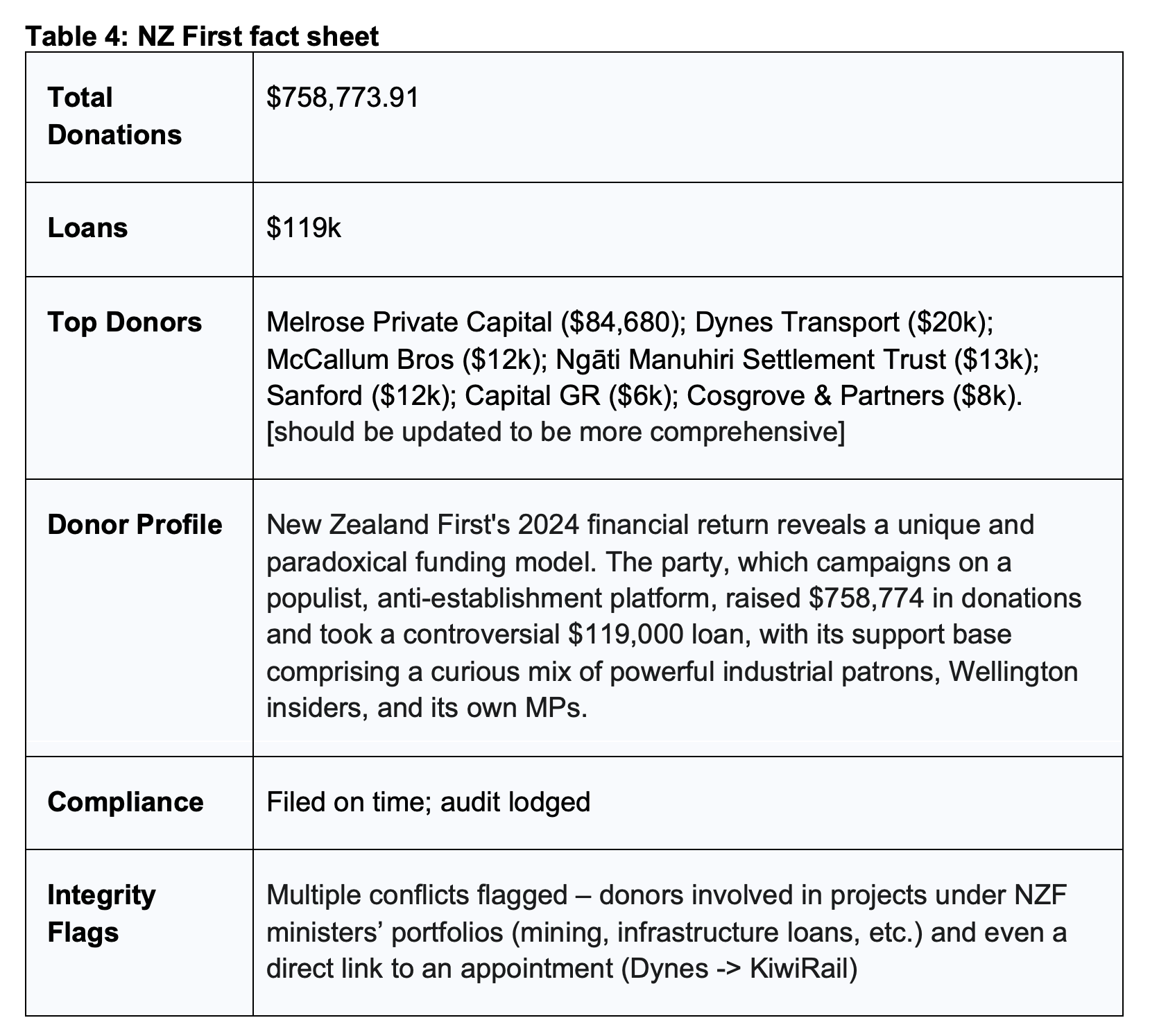
6.1 Summary
New Zealand First’s 2024 donations profile is markedly different from its larger allies, carving out a unique niche in the political finance landscape. The party declared a modest $338,907 from large donors (>$5k) in 2024, supplemented by an even larger stream of small donations under $5k totaling about $419,867.
This dual source of funds – big cheques from a few industry backers and grassroots cash from many supporters – gives NZ First a hybrid funding model unlike any other party. On one hand, NZ First leans on a handful of patrons from specific sectors (forestry, mining, racing, etc.) who have clear stakes in the party’s policy influence. On the other hand, it rallies a populist base of ordinary citizens who chip in smaller amounts, aligning with the party’s anti-establishment image.
These parallel tracks of funding mirror NZ First’s political brand: it champions the “common Kiwi” while quietly being bankrolled by certain business interests. The data suggests NZ First’s policy agenda – a mix of pro-industry regional development and nationalist populism – closely reflects the interests of those writing its biggest cheques. However, NZ First’s fundraising also rings alarm bells for integrity.
The party’s past financial scandal (the NZ First Foundation) looms large, and some of the same weaknesses that enabled that affair are evident in 2024: (Serious Fraud Office 2020; Vance 2020). In essence, NZ First’s funding in 2024 is a story of populist cash and patronage clashing – with the party walking a tightrope between grass-roots legitimacy and old-fashioned political money debt.
6.2 Sectoral and geographic clusters of donations
Donor patterns and sectoral influences: NZ First received far fewer big donations than National or Act, but its handful of major backers are revealing. The party’s top disclosed donor was Melrose Private Capital Ltd, which gave $84,680 (in two tranches). Melrose is the investment vehicle of Wayne and Rosemary Coffey, Wellington investors with interests in forestry and mining (Companies Office 2024).
Notably, Wayne Coffey is a former forestry lobbyist and owner of the Taharoa iron-sands mining project – a project that in late 2024 was added to the government’s fast-track consenting list (RNZ 2024; Stuff 2024; RNZ 2024). This donation, coinciding with Coffey seeking approvals for a major mine, exemplifies the potential conflicts in NZ First’s financing. It was significant enough that Shane Jones (NZ First’s Regional Development Minister) formally recused himself from the Taharoa decision because of Coffey’s donation and lobbying (Hancock 2024; RNZ 2024).
Another influential donor was South Island trucking firm Dynes Transport, which gave $20,000. In mid-2025, it emerged that Dynes received an $8 million government loan from a regional fund overseen by Shane Jones, and furthermore, a Dynes director was appointed to the board of KiwiRail by Winston Peters (Hancock 2025b). The Dynes-KiwiRail affair (detailed in Case Study 4.2) is perhaps the clearest instance in this report of a donation linked temporally to favorable outcomes – raising serious questions about quid pro quo dynamics.
Other notable corporate donors to NZ First include Finland Holdings Ltd (giving $8,000) – the company of Darrell Russell, a Waikato farm machinery dealer, reflecting support from the agribusiness sector (Companies Office 2024). Antipodes Timber NZ Ltd contributed $9,500; based in Tauranga, this wood exporter’s donation aligns with NZ First’s advocacy for forestry and wood processing (a priority for Shane Jones as Forestry Minister).
Even the fishing industry made an appearance: seafood giant Sanford Ltd donated $12,000, perhaps appreciative of NZ First’s regional development loans (Sanford received a Provincial Growth Fund loan in 2020) and the party’s historic championing of fishing interests (Provincial Growth Fund 2020; Stuff 2020).
Additionally, racing industry figures – long entwined with NZ First – were in the wings; for example, renowned horse breeder Sir Peter Vela donated $65,000 to NZ First (and $50k to Act) in 2023, continuing the Vela family’s legacy as benefactors during Winston Peters’ tenure in racing and fishing portfolios.
Across these examples, a pattern emerges: NZ First’s big donors map closely to its policy niches. Sectors like mining, forestry, and racing, which NZ First openly promotes and defends in government, are the very ones financing the party. This raises a compelling question of cause-and-effect: do these industries donate because NZ First advocates for them, or is NZ First so vocal on their behalf because of the donations? Either way, the appearance of policy for sale is hard to ignore.
Unusually, a large portion of NZ First’s funding in 2024 actually came from inside the tent. The party’s own MPs and candidates were significant donors – a dynamic not seen to the same degree in other parties. Five NZ First Members of Parliament made declarable donations to their party, collectively exceeding $42,000. Among them, new list MP Casey Costello gave $10,275, Tanya Unkovich $9,706, Jenny Marcroft $8,798, Andy Foster $7,306, and Jamie Arbuckle $6,306. These contributions effectively required MPs to hand over a chunk of their salary or campaign funds back to the party – an informal tithing system.
It underscores NZ First’s dependence on its representatives to bankroll the machine (perhaps necessitated by a smaller donor pool). It’s worth noting the backgrounds: Costello, for instance, was formerly involved in an anti-co-governance lobby group; Foster was a high-profile recruit (ex-Wellington Mayor) famously aided by Winston Peters in a past election; Arbuckle is a longtime local politician (RNZ 2022; Stuff 2022). Their willingness to part with thousands for the cause signals strong loyalty, but it also blurs lines – these are not outside donations so much as internal transfers, raising questions about whether public funding (MP salaries) indirectly props up the party.
Furthermore, NZ First’s 2024 return shows it received a substantial internal loan of $119,000 from board member Dorothy “Dot” Jones (who is the wife of Shane Jones). Dot Jones’ loan, declared alongside donations, was critical in keeping the party solvent through the year. This kind of insider financing echoes the party’s earlier scandal (where tens of thousands were routed through the secretive NZ First Foundation). While now done transparently on the books, relying on a Minister’s spouse for funds is hardly best practice – it speaks to both financial strain and a potential avoidance of public fundraising scrutiny.
In sum, NZ First’s funding model is paradoxical: it touts itself as a people-powered party (and indeed over half its donation money came from small donors in 2024), yet it remains reliant on a few wealthy patrons and even its own leaders to pay the bills. This mix of populism and patronage is central to understanding NZ First’s place in the tale of two funding systems.
6.3 Risks of influence (quid pro quo)
Influence risks and integrity flags: With NZ First back in government (holding the balance of power), the influence wielded by its donors warrants close examination. As outlined, several donations in 2024 were followed by outcomes that benefit those very donors, creating at least the perception of undue influence. The fast-tracking of Wayne Coffey’s mining project after his $84k donation, and the public appointments and loans flowing to Dynes Transport after its $20k donation, are cases in point.
NZ First ministers have considerable discretion in areas like regional grants, transport funding, and industry regulation – areas where many donors operate. This heightens the conflict of interest risk. Even if decisions were made on merit, the timing and targeting of donations mean the public is justified in asking: Is NZ First trading policy or favours for money?
The party’s history (e.g. the 2008 donations scandal, the 2019 Foundation affair) has long fueled cynicism on this front. The 2024 patterns – donations from lobbyists, industry insiders, and quid-pro-quo suspicions – unfortunately rhyme with that history. For a party positioning itself as a watchdog against corruption, these funding choices are ironically undermining trust.
Other integrity issues revolve around where NZ First’s money comes from. The party has often portrayed itself as anti-elite, yet we see evidence of elite support behind the scenes. For instance, NZ First received quiet backing from multi-millionaires like Sir Peter Vela in the lead-up to 2024, and from business coalitions such as forestry interests that coordinated donations. The heavy concentration of donations from sectors that also lobby the government (mining, racing, trucking) creates a risk that policy could be influenced by the loudest cheque-books rather than the public interest.
Moreover, NZ First’s reliance on loans from insiders (Dot Jones) and donations from its own MPs blurs accountability – the party might feel beholden to its benefactors even when those benefactors are within its own leadership. This closed-loop funding diminishes the transparency benefit of public disclosure: outsiders see relatively modest sums donated, but behind that may sit a larger support system of friendly loans and enforced tithes that never get the same scrutiny.
In conclusion, NZ First’s 2024 donations profile is a study in contrasts. It has a genuine grassroots element – more than half of its donation income came from small donors, far outstripping what much larger parties like National gathered from sub-$5k contributions. This speaks to a base of loyal supporters giving $20 or $100 at a time, which is healthy in a democracy. Yet at the same time, NZ First leans on big-money patrons whose interests are anything but grassroots.
The convergence of those patrons’ windfalls and NZ First’s policy actions (or ministerial decisions) is where serious integrity risks arise. And compounding it all, the official audit alarm suggests we may still not have the full story of who funds NZ First. For a party often holding the kingmaker role in New Zealand politics, that opacity is troubling. Ensuring that NZ First – and all parties – are fully transparent and not beholden to private interests remains a critical challenge moving forward.
Section 7: Act Party donations
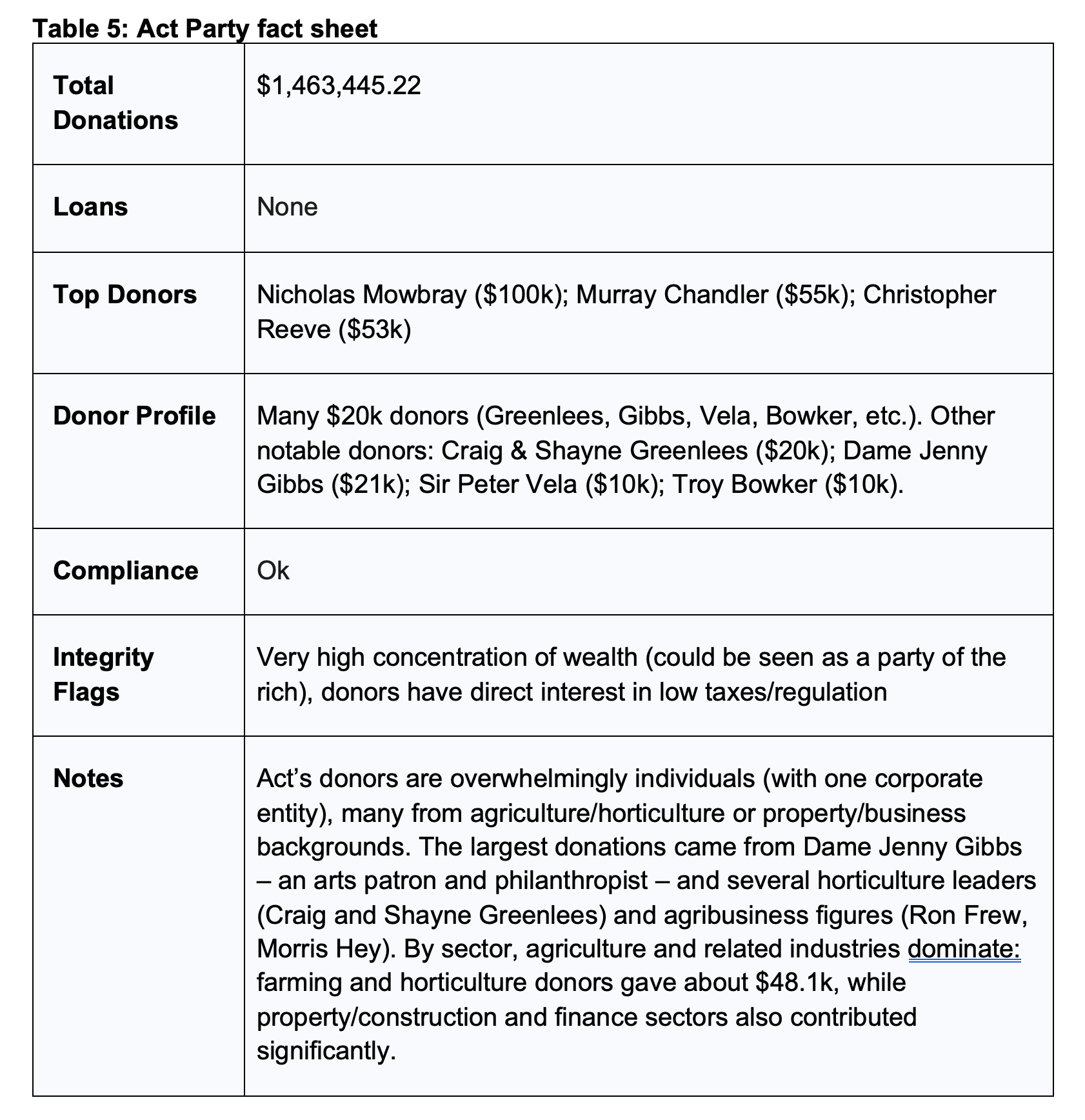
7.1 Summary
The Act Party’s 2024 annual return shows total declared donations of $1,463,445.22, placing it just behind the Greens and well ahead of smaller parties. With the disclosure threshold now lowered to $5,000, Act named 23 donors who each gave over $5k, contributing roughly $588,000 (about 40% of Act’s funds). This means the majority (60%) of Act’s funding came from donors below the $5k threshold – indicating a broader base of small and mid-level contributors than the party’s “big donor” image might suggest.
Nevertheless, the high-dollar donors include some of New Zealand’s wealthiest individuals and industry magnates, many aligned with Act’s pro-market, low-regulation platform. Notably, billionaire Nicholas Mowbray (co-founder of Zuru toys) gave $100,000 – the largest single donation to Act.
The party declared no loans in 2024, in contrast to New Zealand First’s controversial $119k loan from a Minister’s partner. Below we detail Act’s major donors, analyse the sectoral and geographic patterns of support, assess potential influence risks, and compare Act’s donor profile to other parties.
7.2 Sectoral and geographic patterns of support
Act’s donor list reveals clear sectoral clustering: money flows predominantly from industries that stand to gain from deregulatory, market-oriented policies. Property developers and investors feature heavily – from Auckland real estate figures (e.g. Buildcorp and associated individuals) to wealthy landlords in traditional National strongholds like Remuera and Parnell.
The agribusiness sector is another pillar of Act’s support: large-scale farmers and horticulturists (dairy magnate Ron Frew, kiwifruit growers Craig and Shayne Greenlees, aquaculture pioneer Peter Bull) have backed Act, reflecting discontent with environmental regulations and a desire for pro-farming policies.
High-net-worth investors and financiers are also prominent (e.g. Nicholas Mowbray in manufacturing, Graeme Hart in packaging and forestry, Peter Huljich in finance), aligning with Act’s low-tax, pro-investment platform. Additionally, a notable corporate donor – Pavlovich Coachlines – suggests even mid-sized companies in transport see Act as an ally against costly regulation.
Geographically, Auckland’s elite suburbs dominate Act’s donor map. Many top contributors reside in affluent areas of Auckland (Coatesville, Glendowie, Remuera, Parnell, Mission Bay) – mirroring Act’s appeal among wealthy urbanites and business circles. For instance, multiple donors on Riddell Road in Glendowie (Hart and neighbour Peter Mataga) gave to Act, hinting at local networks of influence. Auckland’s North Shore and central city (where many listed companies and entrepreneurs are based) are well represented. Outside the metropolis, rural and provincial wealth also shows up: donors from Waikato, Bay of Plenty, Taranaki, and Golden Bay – all regions with strong farming, mining, or business interests – contributed to Act. This includes Bay of Plenty horticulturalists (Greenlees), Taranaki retirees (Morris Hey, possibly linked to the oil/gas economy), and a Golden Bay mining prospector (Walker).
Such clustering suggests Act’s message resonated where people felt burdened by regulation: in farming heartlands and business hubs. Notably absent are donors from the public or non-profit sectors – nearly all identified supporters have private-sector commercial backgrounds.
Patterns over recent years reinforce these sectoral trends. A Radio NZ analysis (of 2021–2023 donations) found that the property industry directed 32% of its political donations to Act – the second-highest share after National (Palmer 2023). Similarly, high proportions of donations from agriculture and forestry sectors have flowed to Act since 2021 (Palmer 2023). The 2024 data continues this trajectory: Act has cemented itself as a top recipient of business money, especially from those sectors lobbying for looser regulations (construction, real estate development, farming, mining).
Regionally, Act’s growth from 2020 to 2023 saw it pick up support in rural North Island areas and wealthy Auckland districts – areas now reflected in its donor base. In short, Act’s funding footprint mirrors its political strategy: cater to capital-rich constituencies disaffected with “red tape” and government intervention, while also energising a nationwide base of ideologically driven small donors.
7.3 Influence risks and Quid Pro Quo dynamics
The alignment between Act’s donor industries and its policy agenda raises integrity red flags about potential quid pro quo dynamics. Many large donations coincided with or preceded policy promises that would directly benefit those donors’ interests. For example, the dairy and farming donors (Frew and others) gave money as Act vocally opposed agricultural emissions pricing and freshwater regulations – a convergence that suggests these donors might expect (or at least hope) that Act will weaken environmental rules in return.
Indeed, if Act in government pushes to exempt agriculture from climate policies or rolls back conservation measures on farming, it could be seen as a “payback” to its agribusiness backers, whether or not any explicit deal was made. Similarly, property sector donors (Lindsay, Buildcorp, Benjamin, etc.) stand to gain from Act’s pledge to scrap or radically reform the Resource Management Act (RMA) and fast-track development approvals. Were Act ministers to implement aggressive deregulatory changes in urban planning, those donors could reap windfall profits – blurring the line between policy made for public good and policy made for donors’ private gain.
A number of cases suggest a pattern that, while legal, raise some red flags. Donor Daniel Walker’s contributions ($8k) aimed to support Act’s stance against bans on mining – if Act helps reopen mining on conservation land, Walker directly benefits. Peter Bull, the mussel farming entrepreneur, has battled bureaucratic hurdles; his donation underscores industry pressure to ease marine consent processes, which Act indeed advocates. These instances exemplify transactional expectations: donors investing in a party that champions their narrow interests. Even when motivations are partly ideological, the appearances of quid pro quo are potent. As our Democracy Project analysis notes, the question arises: are policies like gutting environmental regulations pursued for the public good, or because Act “owes” its farmer and miner backers a favour?
The “hedging” behaviour of certain elite donors also poses a risk to integrity. Wealthy donor Troy Bowker not only gave to Act but also to its political rival NZ First (and even previously to a Labour minister) – a strategy seemingly designed to buy access across the spectrum regardless of ideology. In 2023, Bowker simultaneously donated to Act and NZ First on the same day, signalling an expectation of influence with whichever party held power. This kind of cross-party largesse undermines public trust: it suggests that for some financiers, donations are a means to secure business advantage or influence, not a reflection of genuine political support.
Such donors might later call in favours, expecting friendly treatment no matter which partner in the coalition they approach. Act’s challenge will be to convince the public that contributions from extremely wealthy figures do not translate into undue influence – for instance, that Nick Mowbray’s $100k doesn’t give him veto power over social policy (Mowbray has fiercely opposed welfare programs). Any significant policy decisions that align too neatly with a major donor’s known interests will attract scrutiny. The appearance of preferential access is itself damaging, even absent explicit corruption.
The concentration of donations among a small elite exacerbates these risks. Nationally, only 0.2% of donors (217 donations) accounted for one-third of all money in 2024, and Act is emblematic of that skew. Its “$50k Club” donors – those giving five- and six-figure sums – expect their voices to be heard. Act’s heavy reliance on a handful of ultra-wealthy backers creates a perception that policy could be “captured” by those few voices, even as the party also touts broad small-donor support.
Transparency is the key mitigant here: by publicly documenting all donations and donor backgrounds, any future policy moves that unduly favour a supporter can be flagged by media and watchdogs. The Democracy Project will be watching, for example, if urban development rules are relaxed – will Buildcorp or the Lindsays benefit directly? If public transport contracts or privatisation debates arise – will Pavlovich Coachlines’ contribution cast a shadow on Act’s stance?
These scenarios underscore why robust disclosure and oversight are essential. In summary, Act’s donor profile in 2024 heightens the risk of perceived quid pro quo, where large donations at least appear to buy goodwill and access. Act now bears the responsibility to govern in a way that proves it is not “for sale”, resisting any pressure to tailor decisions to please its funders. The coming term will be an important test of whether the party can navigate this minefield of influence while maintaining public confidence.
7.4 Compliance and transparency: Audit findings & irregularities
From a formal compliance standpoint, Act’s 2024 return appears fully in order. The party filed its annual donations report by the due date (23 April 2025), and because its total donations exceeded $50,000, an independent audit was required and duly provided. Act’s accounts were audited with an unqualified opinion – in other words, the auditor found no material issues, indicating the return complied with the law and reporting standards. There is no suggestion that any of Act’s donations were illegal or improperly declared.
Notably, Act reported “Nil” for any donations via intermediaries or associated entities over $5k, suggesting the party did not use foundation trusts or nominee structures to funnel contributions (practices that in the past have raised transparency concerns elsewhere).
One minor quirk in Act’s filed return was a duplicated entry in the donor list – the numbering of disclosed donors jumps from #21 to #23, apparently due to the same donor (Peter Bull) being listed twice in error. This seems to be a clerical or formatting issue rather than an actual additional donor. Aside from that, the return was clear and detailed. Act also provided the required summary of smaller donations: the aggregated totals of contributions in the $1,500–$5,000 band and under $1,500. These summaries help illustrate Act’s extensive small-donor base, although individual names in those categories remain confidential by law.
Section 8: Labour Party donations
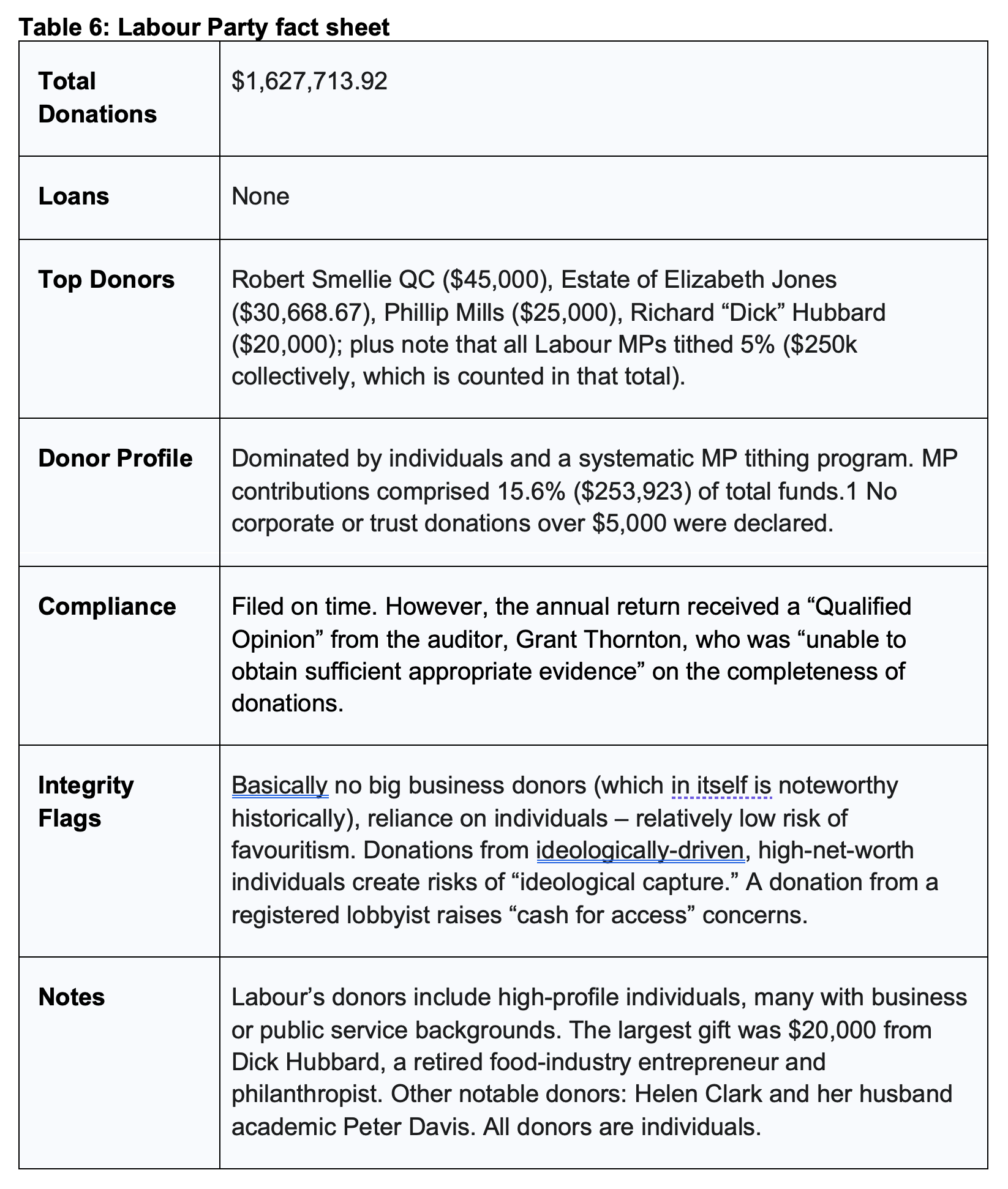
8.1 Overview
The Labour Party declared approximately $1.63 million in donations for the 2024 calendar year. This was a post-election year total (down from about $4.77 million in 2023) and amounted to roughly one-third of the funds raised by the National Party in 2024. In line with the new disclosure rules, any donor contributing over $5,000 during 2024 was identified in Labour’s return. These itemised donations over $5,000 accounted for about 27.8% of Labour’s funds ($452,767), while the remaining 72.2% ($1.17 million) came from smaller contributions below the $5,000 threshold. In fact, tens of thousands of small donations – on the order of about 50,000 individual contributions of $1,500 or less – collectively made up the bulk of Labour’s financing.
Only 19 mid-sized donations (between $1,500 and $5,000 each) were reported, totaling just $55,000. This breakdown underscores Labour’s heavy reliance on a broad base of small donors, in stark contrast to the large-sum donations dominating the incumbent governing parties’ finances (detailed later in this report). Notably, no corporate entities, industry groups, or unions contributed amounts above the disclosure threshold to Labour in 2024 – every disclosed donor was an individual.
8.2 Who funds Labour?
Donor Types and Major Contributors: Labour’s fundraising model in 2024 was overwhelmingly “people-powered,” drawing from individual supporters and the party’s own members and representatives. A striking feature is the role of Labour’s MPs themselves. Over 30 of Labour’s sitting MPs (and a few recent former MPs) appeared as donors in the 2024 return. Together these MPs’ contributions – often made via automatic “tithing” of their salaries – amounted to roughly 15.6% of Labour’s total donations. Labour requires its MPs to contribute around 5% of their taxpayer-funded salary back to the party, a practice rooted in solidarity tradition (NZ Herald 2020; Stuff 2017).
Most Labour MPs each gave between approximately $6,800 and $9,500 over the year, typically through regular fortnightly or monthly deductions. For example, then-Leader Chris Hipkins was the single largest MP donor at a bit over $12,000 contributed in 2024. Many senior MPs (and even some defeated ex-MPs) likewise donated in the $7,000–$10,000 range, underscoring an internal financing mechanism that provides the party a steady stream of funds from its own elected officials.
This widespread MP giving reflects internal support rather than outside influence – essentially the party “taxing” itself to sustain its operations. By comparison, National and Act did not enforce systematic tithing (only a handful of their MPs donated sums above $5k). Labour’s heavy internal funding is a distinguishing factor of its donor profile in 2024.
Beyond the caucus, Labour’s major external donors were a small cadre of private individuals – many with long-standing personal or ideological ties to the party. All told, 46 donors gave amounts above $5,000 to Labour in 2024, and aside from the MPs, the remainder were ex-politicians, professionals, or dedicated supporters.
The largest single donor was retired High Court judge Hon. Robert Smellie, who contributed $45,000 during the year. Smellie has been one of Labour’s most generous backers in recent years; his 2024 donation, while significant, was motivated by principle rather than any business interest – he has publicly stated that his support for Labour stems from personal conviction. He explained this in 2017 to the NZ Herald: “Labour is Christianity in action... I am a practising Anglican and as such I see socialism as being far closer to the Gospel than free enterprise” (NZ Herald 2017; Stuff 2017).
Another major gift came via the estate of Elizabeth Jones, who had been a lifelong Labour supporter until her death at 94, which bequeathed $30,669 to the party. This posthumous donation – the largest lumpsum contribution in Labour’s return – reflects a form of loyalty that literally extended beyond the grave (bequests of this kind are not uncommon; Labour’s all-time biggest donation was in fact a large bequest a decade ago).
Prominent businesspeople with progressive leanings also feature among Labour’s top donors. Fitness entrepreneur Phillip Mills gave $25,000 to Labour in 2024. Mills, the wealthy founder of Les Mills International gymnasium empire, is a known climate-action advocate who has also funded environmental causes; his donations to Labour (and the Green Party) can be seen as an investment in parties he believes will advance strong climate policies.
Similarly, breakfast cereal magnate Richard “Dick” Hubbard – a philanthropist and former Auckland City mayor – donated $20,000. Hubbard has long supported centre-left causes, and in the 2023 election year he was even more generous (donating about $100,000 to Labour).
Other high-profile names on Labour’s 2024 donor list include former Prime Minister Helen Clark (who gave $11,020) and her husband, public health academic Prof Peter Davis ($11,160). Their contributions were part of a broader effort by Labour “alumni” to rally support: Clark publicly urged supporters to “pitch in” during the party’s 2023 campaign, and personally matched others’ donations with her own (NZ Herald 2023; Stuff 2023). Indeed, party elders and insiders featured strongly – Pete Hodgson, a Cabinet Minister in the 2000s, donated roughly $17,912, continuing his lifelong association with Labour, and Helen Pollock, a renowned artist and long-time Labour advocate, contributed $12,360 as a show of support.
Importantly, no companies or corporate trusts were among Labour’s disclosed donors; even traditional Labour-affiliated unions did not appear with any large direct donations in 2024 (if unions did assist, it was below the $5k disclosure threshold). In short, Labour’s funding came entirely from individuals – primarily its own officeholders, veteran party figures, and ideologically aligned private citizens.
8.3 Sectoral and geographic patterns
The 2024 Labour donor mix exhibits some clear demographic and regional clusters. The geography skewed towards urban strongholds – particularly Auckland, New Zealand’s largest city. In fact, four of the six largest donations came from Auckland-based individuals. These include Smellie (Auckland), the Jones estate (Auckland), Mills (Auckland), and Helen Pollock (Auckland), reflecting the concentration of wealth and supportive networks in the metropolis.
Other notable contributions came from donors in Wellington and Dunedin (e.g. former ministers and activists based there), but fewer from the rural provinces. One donor of note lives overseas: Labour received about $8,000 from Warrick Cleine, a New Zealander based in Vietnam who is a Labour Party member and corporate adviser. (Cleine’s involvement points to an expatriate support network – he has been an influential donor in prior years as well, and his role as an international business figure demonstrates how diaspora donors can still bolster the party from afar.)
The sectoral profile of Labour’s donors is markedly different from that of the right-leaning parties. Many of Labour’s significant private donors in 2024 come from public service, academic, or philanthropic backgrounds. For instance, Smellie (judiciary), Clark and Hodgson (government/public sector), Peter Davis (academia), and Helen Pollock (arts) all have careers rooted in public or civic service.
Even the business donors, like Mills and Hubbard, are known for their socially conscious or progressive stances – Mills in environmental advocacy, Hubbard in philanthropy and local governance. We also see representation from the NGO and community sector: for example, Rachel Underwood (who gave $5.5k) is a prominent figure in the nonprofit realm, a former president of the National Council of Women and a health sector advocate.
The Labour donor base in 2024 skews older as well – several top contributors are retirees or in late career (e.g. a 94-year-old benefactor via the estate, a judge in his late 70s, long-retired politicians, etc.). This suggests many are long-term Labour loyalists who have accumulated wealth over their lifetimes and now channel it into the cause.
Absent from the list, notably, are the kinds of corporate and industry lobby donors that feature prominently in National/Act’s funding. No large property developers, financiers, or energy magnates wrote checks to Labour this year. Instead, the pattern is ideologically motivated individuals and Labour insiders sustaining the party’s finances.
This pattern aligns with Labour’s positioning as a mass-membership party: its financial lifeblood comes from many modest contributions by ordinary supporters (augmented by the enforced generosity of its MPs), rather than a few big cheques from commerce.
Geographically, it’s also telling that nearly all major donations came from New Zealand residents – Labour did not receive significant foreign-sourced donations, and it reported $0 in overseas contributions over $50 (complying with the tightened ban on foreign money). The Auckland concentration of big donors is perhaps unsurprising (as Auckland is home to many wealthy Kiwis), but it also reflects the fact that Labour’s core wealthy supporters tend to be urban liberals rather than rural businessmen.
The absence of South Island corporate money (Christchurch, etc.) is another contrast with National’s donor map. In summary, Labour’s donor community in 2024 can be characterised as older, city-based, public-sector or progressive-business aligned, and personally invested in Labour’s values.
8.4 Major donor profiles and motivations
The motivations of Labour’s key donors appear, for the most part, to be aligned with principle or personal affinity rather than self-interest. Unlike scenarios where businesses donate expecting policy favours, Labour’s top benefactors in 2024 largely have ideological or party-loyalty reasons for giving:
Hon. Robert Smellie QC (Retired Judge) – Smellie’s substantial $45k support is widely seen as values-driven. A former High Court judge with no commercial ventures at stake, Smellie has described his political giving as an outgrowth of his moral and religious principles, at one point remarking that “social justice is at the heart of Christianity” and that this drew him to back Labour. Originally from a traditionally conservative background, he “converted” to Labour in his retirement, citing its alignment with his ethical worldview. His donations in past years (over $550k given to Labour since 2016) have not corresponded to any personal gain – rather, he seems to act as a patron of the party, believing in its mission. The fact that his 2024 contribution was lower than what he gave in election years (he gave six-figure sums in 2017 and 2019) suggests his giving is timed to when the party most needs it (e.g. campaigns), not to any specific quid pro quo.
Phillip Mills (Clean-Energy Entrepreneur; Gym owner) – Mills’ $25k donation fits a pattern of advocacy philanthropy. As an outspoken climate change activist and co-founder of a green business lobby, Mills supports Labour (and the Greens) because of their environmental policies (NZ Herald 2019; Sustainable Business Council 2020). He has lobbied governments for stronger climate action and has publicly aligned with parties promising such action. His financial contributions can be interpreted as an attempt to bolster those political forces that will advance a clean-energy agenda in line with his beliefs (and arguably, the long-term interests of his industry as it pivots to sustainability). While Mills surely has an interest in climate policy outcomes, the scale of his donations is modest relative to his personal wealth (net worth in the hundreds of millions), indicating ideological commitment more than expectation of direct payoff (NBR Rich List 2024). It’s worth noting that Mills spread his support, giving equally to Labour and the Greens, suggesting a general intent to support the broader progressive camp rather than to buy influence within one party.
Dick Hubbard (Businessman-turned-Philanthropist) – Hubbard’s $20k gift in 2024 (and larger sum the previous year) reflects civic-minded support. As a former mayor and socially conscious entrepreneur, Hubbard has long championed community and social causes (Auckland Council 2006; NZ Herald 2006). His contributions to Labour align with his public advocacy for policies like corporate social responsibility and poverty reduction. There is little to indicate Hubbard seeks any personal benefit; his cereal company was sold years ago, and his role now is more as a benefactor in civic life. His donations likely stem from a desire to see progressive governance (indeed he literally held political office on a centre-left platform as Auckland’s mayor). Hubbard’s profile exemplifies the “idealist capitalist” – a wealthy individual who donates out of a belief in Labour’s platform of social equity.
Helen Clark & Peter Davis (Labour Alumni) – The motivations here are straightforward: loyalty and legacy. Clark, as a former Labour Prime Minister, has a vested interest in her party’s vitality and principles. Her $11k donation, and her public fundraising appeals, were aimed at energising the base and demonstrating leadership by example. There is no suggestion of quid pro quo (she is long out of domestic politics and, if anything, her influence is as an elder statesperson lending credibility). For Clark and her husband Prof Davis, donating is a way to “give back” to the movement that they led and to encourage a new generation of support. They, along with other retired party grandees like Hodgson (who oversaw major public projects post-politics), seem motivated by a mix of sentiment and the desire to see Labour ideals carried forward.
Others
Donors like artist Helen Pollock likely contribute from a mix of personal relationship and values – Pollock, a renowned artist and long-time Labour advocate, has been involved in charitable and commemorative projects, aligning with Labour’s emphasis on community and culture.
Warrick Cleine, the expatriate KPMG executive, is interesting in that as a business figure he could have channelled funds to multiple parties, yet he consistently donates to Labour (including supporting a West Coast Labour MP’s local campaign). Cleine’s motivation appears to be both ideological (loyalty to the Labour Party from afar) and perhaps to maintain connections with a future Labour government (as someone active in international trade networks, he may value having rapport with Labour leaders, though there’s no evidence of him seeking any government contract or role).
Rachel Underwood’s donations reflect her lifelong activism in public health and women’s rights – she is precisely the sort of donor who gives to advance causes rather than for herself.
In summary, the major Labour donors of 2024 are mostly cause-driven or loyalty-driven. They are investing in a political outcome (keeping Labour competitive and advocating for its policy agenda) rather than expecting concrete personal rewards. This stands in contrast to some of the large donors on the right who, as documented elsewhere, often have direct economic interests in policy decisions. That said, even principled donors can exert influence in subtler ways – by virtue of their access and longstanding relationships, figures like Clark or Mills certainly have the ear of Labour’s leadership. The party may naturally be receptive to the policy perspectives of such donors (for instance, Mills’ emphasis on climate initiatives). The key distinction, however, is that these donors’ interests generally align with Labour’s stated values, so any influence tends to reinforce the party’s program (e.g. pushing for greener policy or stronger social support) rather than divert it.
8.5 Risks of influence or Quid Pro Quo
Given the profile above, the risk of corrupt influence over Labour via donations in 2024 appears relatively low. There is scant evidence of any donor attempting a “buying of policy” – no unfamiliar corporate high-rollers suddenly bankrolling the party, no single-industry lobbying groups funneling cash with implicit expectations.
Most large contributions came from within Labour’s own ecosystem (MPs, ex-MPs, party stalwarts) or from known sympathisers whose policy goals largely overlap with Labour’s platform. This greatly limits the likelihood of quid pro quo arrangements; one cannot “sell” influence to oneself, after all, and MPs donating to their own party are obviously not trying to bribe their colleagues.
As observers have noted, the disclosed 2024 Labour donations “skew toward supportive gestures by known Labour affiliates and ideological supporters rather than attempts by unfamiliar actors to buy influence.” Indeed, in contrast to the opposition parties, there were no donations to Labour large enough to raise suspicions of policy-purchasing – not a single donation exceeded $50,000, and the largest chunk (the Jones bequest) came from a deceased person incapable of asking any favours. This all suggests that the integrity risk within Labour’s 2024 funding is more about perception and subtle access than direct corruption.
However, some nuances deserve a critical look. First, even values-driven donors can create perceived influence. For instance, Phillip Mills’ active lobbying on climate issues, coupled with his financial support, could lead to the perception (especially by opponents or media) that Labour might give him preferential access or heed his recommendations disproportionately. If Labour were in government, one might worry that Mills could, say, secure meetings or influence over climate policy by virtue of being a major donor. Similar points could be raised about any businessperson donor – e.g. if any company associated with a donor (like Hubbard’s former company or a donor’s consultancy firm) were to benefit from a government contract or favourable regulation, it could create reputational risk for Labour.
In 2024, since Labour was in opposition, the quid pro quo risk was largely hypothetical (they weren’t in power to dispense favours), but it’s something to monitor looking ahead. Notably, one of the 2024 donors did have government links in the past: Pete Hodgson chaired a major hospital rebuild under the last Labour government, and donors of his ilk often end up on boards or advisory groups (Stuff 2018; NZ Herald 2018). The risk is one of favouritism – that well-connected donors might be first in line for appointments or influence if Labour regains power. While there is no evidence of wrongdoing, maintaining public trust requires that Labour demonstrate such decisions (appointments, contracts, etc.) are merit-based and not a “thank you” for donations.
The report’s broader analysis of donation-linked conflicts (e.g. the case studies of knighthoods and contracts following big gifts, discussed elsewhere) mainly implicate the current government parties, not Labour. But Labour is not immune historically – e.g. the mid-2010s Donghua Liu scandal showed a past instance where a businessman’s donations to Labour coincided with personal immigration issues (NZ Herald 2014; Stuff 2014). Thus, Labour must remain vigilant that even seemingly benign donations do not create avenues for influence.
8.6 Compliance and transparency
From a regulatory compliance standpoint, the Labour Party’s 2024 return appears thorough and in line with Electoral Act requirements. The party filed its annual donation return on time (by 30 April 2025) and included a full independent audit report as mandated. The audited financial statements showed no loans and no non-monetary donations declared for the year, simplifying the compliance picture (Labour didn’t engage in any loans, nor did it report receiving in-kind contributions like free services above the $1,500 limit).
Importantly, Labour reported zero anonymous donations above $1,500 and zero overseas donations above $50, indicating that any such contributions were either non-existent or promptly handled according to the law (e.g. by forwarding amounts over the limit to the Electoral Commission). The return itemised all donations over $5,000 (46 entries) and also provided the required aggregate data on smaller donations in the $1,500–$5,000 band and sub-$1,500 band.
The party’s auditor (Grant Thornton New Zealand) issued a qualified audit opinion on the return, but this qualification was procedural in nature and applied to all parties’ returns: it noted that, aside from online donations, the auditors could not verify the completeness of all cash donations because of inherent limits in controls (essentially, auditors cannot guarantee every last $10 donation was recorded). This same qualification appeared in other parties’ audits and does not imply any specific wrongdoing by Labour (Grant Thornton 2025).
There were no adverse findings specific to Labour – no evidence of undisclosed donors or misreported amounts came to light. In short, Labour’s disclosure met the letter of the law, and the party has shown commitment to transparency under the new regime. In fact, Labour’s then-general secretary had to oversee the intricate task of aggregating all those thousands of small donations to ensure if any single donor exceeded $5,000 in total, they were named in Part A. The data suggests this was done correctly – e.g. multiple monthly donations by the same MP were aggregated into one entry for that MP.
There is no indication of dodgy practices like donation splitting to evade disclosure (something that has plagued other parties historically). One minor note is that Labour declared $0 in “non-monetary” donations, whereas some parties (e.g. National and Greens) did declare non-monetary support. This could mean Labour either didn’t receive any significant freebies or pro bono services in 2024, or it treated them as below the threshold. If true, it highlights a relatively straightforward fundraising operation (relying on money, not donated services). It could also reflect scrupulousness in valuation – Labour may have avoided the ambiguity of in-kind gifts by insisting on monetary support instead. In any case, no transparency issues were noted with Labour’s return.
The Electoral Commission has not reported any warnings or breaches against Labour for 2024 (contrast with minor compliance issues it flagged for a couple of other parties over late reporting of large donations, which did not involve Labour). All indications are that Labour’s finances for the year were professionally managed and fully disclosed. This stands in positive contrast to, say, Te Pāti Māori, which in prior years had repeated filing violations. Labour’s internal processes – likely strengthened after past donation controversies – seem to have kept the party on the right side of the rules in 2024. For the public, this level of disclosure (down to $5k donors and even aggregate data on smaller sums) provides a reassuring picture of who funds Labour. The audit and transparency compliance thus bolster Labour’s credibility; however, it also shines a light on the stark differences between how Labour is funded versus its rivals, raising deeper questions about the system’s fairness.
In conclusion, Labour’s 2024 donations profile – dominated by Auckland retirees, progressive entrepreneurs, party stalwarts, and MPs chipping in from their pay – is almost a nostalgic throwback to an era of politics funded by communities and committed believers. It stands in sharp relief against the backdrop of opposition parties awash in corporate dollars. This section’s critical analysis affirms that while Labour’s approach carries fewer immediate corruption risks, it is operating at a structural disadvantage in an arms race fueled by big money.
Section 9: Green Party donations
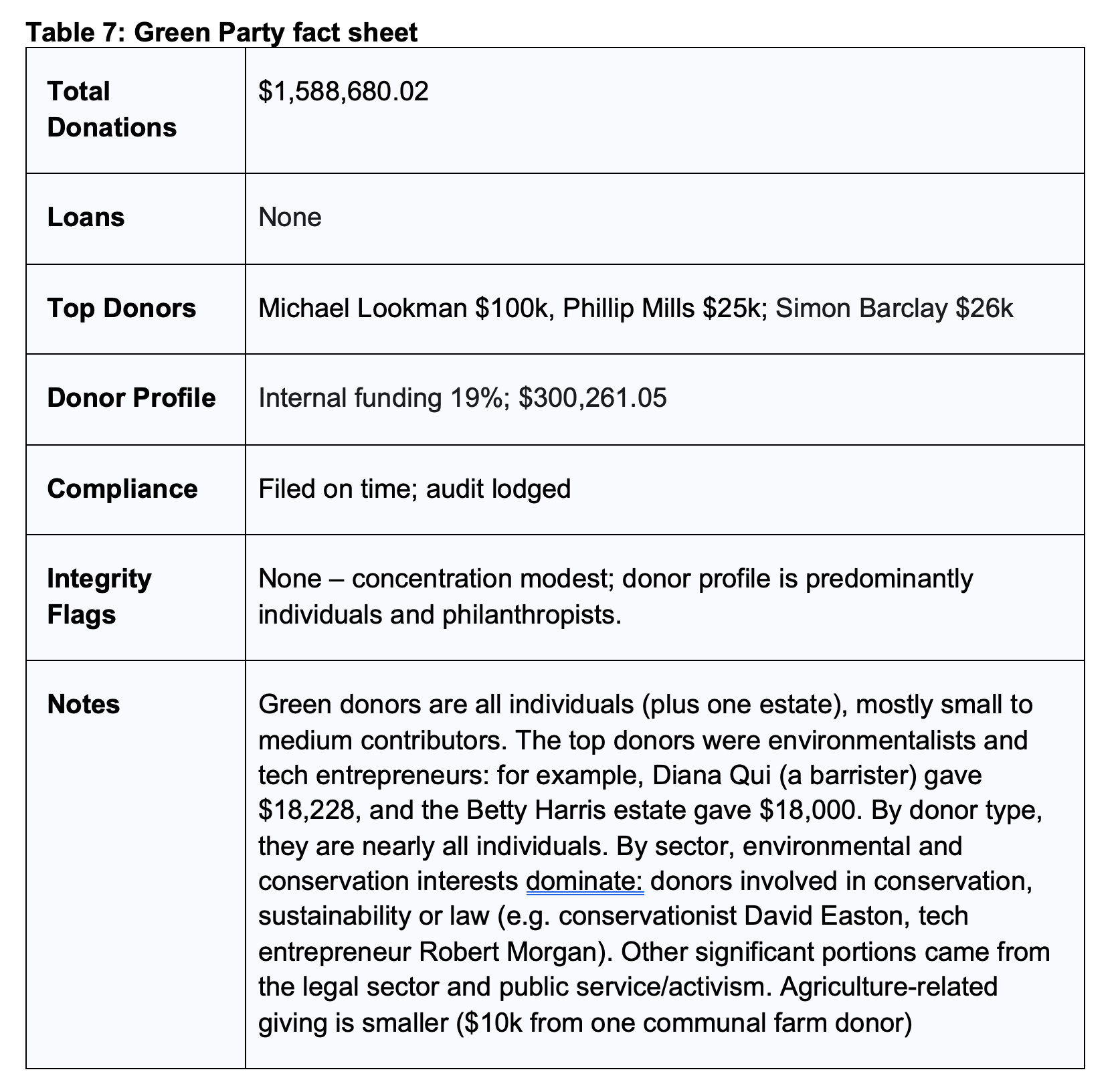
9.1 Summary of 2024 donations and key donor patterns
In 2024 the Green Party declared $1.59 million in total donations – a sharp drop from $3.31 million in the 2023 election year. Only a very small number of donors gave over $5,000 in 2024, reflecting the off-election year lull. Crucially, nearly all donations above $5k came from within the party itself.
Green Members of Parliament contributed a large share of funds via the party’s customary tithing rule – MPs donate roughly 10% of their salary back to the party (Green Party of Aotearoa New Zealand 2023; RNZ 2020). In practice most Green MPs gave close to $20,000 each in 2024, and the co-leaders contributed around $30,000 apiece.
Aside from these internal contributions, the only major external donor was Michael Lookman, a Nelson-based investor who gave $100,000. No corporations or industry groups appear among the Green Party’s large 2024 donations – a notable contrast to some other parties.
These patterns underscore the Greens’ reliance on grassroots and internal funding. After the 2023 campaign, big-ticket outside donations largely dried up. (In 2023 the Greens had attracted several large gifts from wealthy sympathisers – e.g. film-makers James & Suzy Cameron’s $50k, fitness entrepreneur Phillip Mills’ $50k, eco-business Weft Knitting’s $100k – but none of these repeated in 2024.) Thus, the 2024 donor profile was dominated by ideologically aligned individuals rather than corporate donors. Donors over $5k tended to share the Green kaupapa (principles) – for example, philanthropic environmentalists or the party’s own officeholders – with no sign of big-business lobbying via donations.
Geographically these donors were diverse (spanning Nelson to Auckland and beyond), and their giving appears motivated by support for the Greens’ climate justice and social equity mission rather than pursuit of personal influence. Notably, with the Greens out of government after 2023, risks of policy capture by donors were low; contributions seemed aimed instead at sustaining the party’s advocacy work in opposition.
Key observations include: heavy reliance on MP “tithes” and grassroots small donations, a post-election plunge in large outside donations, and a continued theme of donors emerging from activist, academic, or philanthropic circles rather than profit-driven industries. The one sizable external gift (Lookman’s) alongside the routine MP contributions suggest a donor base very closely aligned with Green Party values (climate action, conservation, social justice). No major corporate or lobbying interests appear in 2024, which reduces traditional conflict-of-interest concerns – though it also means the Greens depend on a small core of committed givers and their own MPs for financial support.
9.2 Donors over $5,000 in 2024 – Profiles and background
Despite the lowered disclosure threshold in 2023 (now any donor over $5,000 must be named in annual returns), the Green Party’s list of 2024 donors above $5k was extremely short. Below we profile every donor who gave more than $5,000 to the Greens in 2024, including their background, any political ties, motivations for donating, and potential integrity risks.
Major external donor
Michael Lookman – $100,000 (Nelson) – Investor & Environmental Philanthropist. Michael Lookman is a low-profile investor and philanthropist known for substantial support of environmental causes. He and his partner co-founded the T-Gear Charitable Trust, establishing a conservation endowment for Forest & Bird (NZ’s leading environmental NGO). Lookman built his wealth through investments (he was an early private investor in a peer-to-peer lending company) and has channeled funds into green enterprises (Forest & Bird 2020; Charities Services 2024).
Political ties: Lookman’s involvement in politics is purely as a donor; he holds no party office and isn’t a public activist. In 2023 he also donated $100k to the Greens, making headlines as one of their largest contributors (NZ Herald 2023). Unlike some wealthy donors who hedge bets across parties, Lookman has given exclusively to the Green Party, signaling genuine alignment with Green policy goals (especially on climate and conservation).
Motivation: Ideological commitment to environmental protection seems to drive his giving. Through T-Gear Trust he’s funded biodiversity preservation for future generations, a mission mirroring core Green values. His 2024 donation – given in a non-election year – likely aimed to bolster the party he sees as best advancing climate action, helping the Greens maintain operations and prepare for future campaigns.
Potential influence: As a six-figure donor two years running, Lookman stands out; the party will certainly appreciate his support. However, there’s no indication that his money buys him any policy sway – he stays out of lobbying and holds no advisory role. His low-profile, hands-off approach suggests he’s seeking impact through philanthropy, not personal gain. The risk of quid pro quo is minimal given that his interests (environmental protection) are already core Green priorities, and he hasn’t sought anything like contracts or favours. The main ethical question is simply one of dependency: the Greens’ heavy reliance on a single benefactor (alongside its MPs) could pose resilience issues if that donor’s support ever waned, though it doesn’t present a classic conflict of interest.
9.3 Internal donors: Green Party MPs (“Tithing” contributions)
Every Green Member of Parliament is required by party rules to donate a portion of their salary (around 10%) back to the party. In 2024 the Greens had 15 MPs in Parliament, and almost all of them contributed well above $5,000, typically in the five-figure range. These regular MP donations – usually deducted monthly from their pay – are a longstanding Green practice to maintain grassroots funding and demonstrate that the party is “funded by people, not big business.” Below is a rundown of the Green MPs who donated >$5k in 2024, along with their roles and any relevant background.
Integrity note: Altogether, Green MP donations accounted for a significant portion of funds raised in 2024 (likely on the order of a few hundred thousand dollars). Under the new transparency rules, all these MP contributions were publicly disclosed in the party’s return, making the scale of this practice clear. For example, in the 2023 return Green MPs’ levies totalled about $264,000, and 2024’s figure would be of a similar magnitude.
The co-leaders’ large contributions even triggered immediate disclosure requirements during 2023 (for exceeding the $20,000 threshold) – a somewhat ironic situation where politicians had to declare the “donation” they made to their own party. This practice, unique in its extent to the Greens (though other parties also see MPs donate smaller amounts), underscores the party’s internal financial self-reliance.
There is virtually no risk of undue influence or quid-pro-quo in MPs donating to their own party, aside from the general principle that money (even one’s own) can reinforce one’s standing. In the Greens, however, influence is derived from position and public mandate – these donations are seen as routine contributions, “part of the job,” rather than transactions buying power.
9.4 Sectoral and geographic trends in Green donations > $5k
Who funds the Greens? In 2024, donors above $5,000 were almost exclusively individuals tied to the Green movement – either as current officeholders (MPs) or as ideological philanthropists – rather than businesses or lobbying groups. This is in stark contrast to the donor profiles of some other parties (where corporate entities, industry lobbyists, or wealth-driven trusts feature prominently). Below we analyze the sectors and regions associated with the Greens’ sizable donors.
Donor type & sectors
The Green Party’s major 2024 donors fall into two main categories: elected officials (political sector) and a private philanthropist. Fully 93% of donors >$5k were Green MPs (15 MPs, of whom 13–14 gave above the threshold), accounting for roughly 15–20% of the party’s total income. The sole external donor (Lookman) is best described as a sustainable finance investor/philanthropist, not a corporate interest seeking profit.
Not a single corporation, trade association, or for-profit business contributed over $5,000 to the Greens in 2024. In other words, the party’s big funding came from people, not companies. Even compared to Labour – which in 2024 also had mostly individual donors – the Greens had zero union or corporate large donations.
The one non-MP donor, Lookman, channels money to environmental causes similarly to a philanthropic foundation. This implies that funds above $5k came largely from those with public interest or community-oriented careers (plus one private investor who donates out of environmental passion), rather than from sectors like corporate law, banking, real estate development, or energy industries.
The absence of industry-linked donors in 2024 suggests no particular economic sector “bought into” the Green Party via big donations that year. By contrast, in 2023 when the Greens were in government, they did see donations from a property developer, a manufacturing company (sustainable textiles), and wealthy entrepreneurs – indicating that electoral success can attract broader financial interest. But in 2024, back in opposition, the donor base narrowed to true believers and insiders. This could point to a principled purity in Green funding (only those aligned give money), but also a potential vulnerability: the party lacks support from the business sector, which might limit resources but also insulates it from certain conflicts.
Concentrations by industry
Because nearly all 2024 donors were individuals, one way to interpret “industry” influence is by looking at those individuals’ fields of work or advocacy. In that sense, environmental advocacy and social activism were well-represented (many Green MPs and supporters come from NGO or activist backgrounds). Academia and public sector experience were also common (e.g. Dr. Xu-Nan’s scholarly career, Wade-Brown’s local government service, Genter’s urban planning work).
Philanthropy/Investment is a minor category (Lookman alone). Notably no traditional corporate industries (e.g. finance, real estate, agriculture, energy companies) show up among donors above $5k. For example, contrast National’s 2024 donor list, which is rife with property developers, agribusiness owners, and corporate directors – the Greens had none of those. Even Labour’s donor list in 2024, while mostly individuals, included a few businesspeople with progressive leanings; the Greens’ one wealthy outside donor is essentially a social investor. One can say the sectoral profile of Green big donors skews toward “civil society” and public service, with little to no corporate sector presence. This likely reflects the Greens’ appeal to values-driven supporters and the lack of appeal (or deliberate distance) to big-business patrons.
Geographic distribution
Donors over $5k to the Greens in 2024 were geographically diverse, covering most regions of New Zealand. This mirrors the nationwide spread of the Green voter base and caucus. [The table below summarises the regional clusters of these donors.\
Auckland and Wellington unsurprisingly account for the largest numbers of donors, since many Green MPs (and supporters) are based in those major cities. Auckland alone had five donors over $5k (including co-leader Swarbrick and several list MPs). Wellington had three (including co-leader Davidson, who although list MP for Auckland often works from Wellington, plus Genter and Wade-Brown).
Christchurch/Canterbury contributed two new MPs-turned-donors. And importantly, smaller centers each had representation: one donor each in Northland, Manawatū, Otago, and Nelson. In fact, every broad region of the country – Northland, Auckland, central North Island, Wellington region, Canterbury, Otago, and the upper South Island – had at least one significant Green donor in 2024. This dispersion reflects how the Green Party’s support (and caucus) spans urban and regional New Zealand. It’s not heavily dominated by, say, Auckland millionaires or Wellington bureaucratic circles; instead, its donors mirror the geographic breadth of its movement (from a farmer-activist in Northland to a community organiser in Dunedin).
Urban vs Rural: Most of the over-$5k donors are urban-based (Greens have more MPs in cities), but their work often engages rural or regional issues (e.g. Hūhana Lyndon’s iwi leadership in Northland, Scott Willis’ climate projects in Otago). The one large external donor, Lookman, resides in Nelson, a provincial city – interestingly not Auckland or Wellington. This shows Green benefactors need not come from the metropolitan elite; they can emerge from smaller communities known for environmental consciousness (Nelson has a reputation in NZ for green-minded residents).
In sum, Green Party large donations in 2024 were widely geographically distributed, matching the party’s broad national presence. There was no single region monopolising big donations – unlike, for example, National’s donors which tend to concentrate in Auckland’s wealthy suburbs. For the Greens, Auckland did contribute the plurality of major donors (owing to population and MP count), but significant gifts also came from the South Island and the lower North Island. This reduces the risk of the party being seen as beholden to interests of one region; their funding base over $5k is as eclectic in locale as it is in background.
9.5 Risks of donor influence (Quid Pro Quo or conflicts of interest)
From an integrity perspective, the Green Party’s 2024 funding model carries relatively low risk of quid pro quo or undue influence, especially compared to other parties. There are several reasons for this.
Minimal reliance on corporate/industry money
In 2024 the Greens had no big corporate donors to potentially seek favours. The lack of business-sector donations >$5k means there were no obvious vested commercial interests “investing” in the Greens that year. This greatly reduces classic conflict-of-interest scenarios (where a company’s donation might be viewed as buying access or policy influence).
For example, contrast NZ First’s 2024 funding – which included an $84k donation from a mining company likely hoping to sway the party’s stance on mining regulation – the Greens received nothing comparable from any company involved in, say, resource extraction or development. In fact, when the Greens did get a property developer’s donation in 2023 (Mark Todd’s $20k), it immediately raised questions about whether the donor’s urban development interests aligned with Green housing policy (Stuff 2023).
Todd’s case was somewhat reassuring (he donated due to shared progressive views on urban planning, and he gave even more to Labour), but it illustrates the point: such potential conflicts were absent in 2024. The single external donor, Michael Lookman, has no evident business before the government – he’s not seeking contracts, permits, or regulatory changes for personal gain. His interests (environmental preservation) are public-interest goals the Greens already pursue. Thus the typical quid pro quo risk – donor funds a party to get favorable treatment – is very low in the Greens’ 2024 scenario.
One law firm did make a significant and interesting donation in 2024. Te Aro Law Ltd contributed $35,121 in non-monetary donations (pro bono legal work) to the Greens, presumably assisting with the Tana case – an unusual example of a law firm effectively subsidising a party’s internal legal costs.
Ideological and internal donors
The donors over $5k were almost all ideologically aligned individuals or party insiders. Green MPs donating to their own party obviously isn’t a corrupting influence; they cannot bribe themselves, and their donations are more a symbol of commitment than an attempt to alter policy (indeed, they’re donating because they support the policies the party stands for).
If anything, one might cynically quip that MPs who give a lot might expect greater say in party affairs – but in practice, influence in the Green Party comes from one’s role and member support, not from donating money (all Green MPs are required to donate similarly). The external ideologically-motivated donor (Lookman) likewise is giving because the party already represents his values, not to change or buy those values.
This dynamic – donors give because they agree with the party’s direction, rather than parties changing direction to suit donors – is a healthier one for integrity. It suggests little risk of policy being “bent” to appease 2024 donors, since those donors mostly want the Greens to continue exactly what they’re doing (e.g. push for climate action, social justice, etc.).
Small donor base dominance
It’s important to note that the vast majority of Green Party funding (roughly 80% in 2024) actually came from donations below $5,000 – i.e. small donors, membership contributions, grassroots fundraising. The big-donor share was relatively minor (on the order of $300k out of $1.59m) compared to some other parties. This broad base dilutes the influence of any single donor. Even Michael Lookman’s $100k, while huge for one person, constituted only 6% of the party’s total income.
For comparison, in 2023 some other parties had single donors contributing 10–20% of their war chests. The Greens’ reliance on many small contributions and MP tithes inherently limits the leverage of any one wealthy donor. Influence in proportion to donation is just not a big factor when no donor exceeds 6% and the rest are in the 1% range each. This mitigates quid pro quo risk – it’s hard for a donor to demand a policy concession in exchange for, say, 1/20th of the party’s funds, especially if that donor is philosophically on the same page anyway.
Quid pro quo in opposition
Another contextual factor: the Greens spent 2024 in opposition (having left government at the 2023 election). Donors seeking direct policy favors or contracts typically target those in power. Since the Greens had no ministers or government largesse to offer in 2024, any donor expecting a quid pro quo would be barking up the wrong tree. Donors like Lookman gave despite the Greens being out of government – implying their motive was sustaining the party long-term, not immediate influence. This reduces short-term corruption risk. (One could argue there’s future influence-seeking – e.g. donating now to stay in good graces if the Greens return to power later – but there’s scant evidence of such calculation here.
Lookman and similar benefactors appear genuinely values-driven, not transactional.) In contrast, when the Greens were in government (2020–2023), they saw a few more donations from persons in regulated industries (e.g. the developer, the Camerons in film industry). Those could pose appearance questions, but notably even those donors had overlapping values (James Cameron is a noted environmentalist, etc.).
Remaining risks – Dependency and agenda narrowing
While classic corruption risks are low, there are two softer integrity considerations: dependency on a few sources and potential agenda influence. The Greens’ heavy dependence on MPs’ tithes and one large donor means the party’s finances are somewhat fragile. If, for example, those MPs decided to end the tithe practice or if Mr Lookman decided not to donate in future, the party could face a funding shortfall.
This isn’t a corruption risk per se, but it is a vulnerability – one donor dropping out (or one election where the Greens lose MPs) and the funding collapses by a large chunk. From an integrity standpoint, dependency on a single donor can become risky if that donor ever does seek influence; the party might feel pressure to accommodate a benefactor to keep money flowing. Right now, Lookman is not exerting pressure as far as known, but if hypothetically the Greens had a future wealthy donor with an agenda, being so reliant on a handful of big gifts could create temptation to cater to them.
A related subtle risk is agenda-setting influence: when virtually all large donors are passionate environmentalists (or all are from one faction of the party), the funds might disproportionately support certain issue campaigns over others. For instance, if the bulk of big donations (internal and external) are from climate-focused individuals, the party might – even unconsciously – prioritise climate change work because that’s where money is assured.
Meanwhile, areas like say disability rights or economic justice, which don’t attract big donations, might get fewer resources. In the Greens’ case, their donors’ values largely align with the party’s breadth of issues (many MPs’ donations support social programs as much as environmental ones), so this effect is limited. But it’s worth the party being mindful that money can still shape emphasis: e.g. Hugh Douglas of Weft (a 2023 donor) explicitly said he donated to support climate initiatives – such intent could lead the party to focus on those initiatives to validate donor support. In 2024, with donors mostly being the MPs themselves, the agenda influence basically equals the existing democratic influence of those MPs (they will push their pet issues whether or not they donate). Thus no distortion.
In summary, the Greens’ 2024 donations present low risk of quid pro quo. Donations were transparently disclosed, came from aligned sources, and conferred no obvious private benefits. The party’s structure of internal funding mitigates external influence but does create a narrow donor base. The Greens will want to ensure that as they attract more large donations (as happened in 2023), they maintain vigilance. The flip side of “no big-business donors” is that when one or two wealthy friends do come along, they stand out – and the party must ensure even well-meaning benefactors don’t gain outsized say. So far, 2024 shows a model of fundraising that largely avoids the classic money-in-politics pitfalls. The Greens are not immune to the “hydraulic” nature of money in politics, but in 2024 they exemplified a relatively grassroots-driven funding approach, arguably mitigating many systemic risks of donor influence.
9.6 Compliance and transparency issues in 2024
The Green Party’s 2024 Annual Return of party donations (filed with the Electoral Commission in April 2025) did raise a few compliance points, although these appear to be general issues rather than specific violations. An independent auditor’s report on the return delivered a qualified opinion – meaning the auditors could not give full assurance that everything was 100% complete (Green Party Auditor’s Report 2025). The basis for this qualified opinion highlights a few inherent limitations and minor red flags. However, this qualification can be seen as procedural in nature and applies to all parties’ returns.
In summary, the Green Party’s 2024 donation model is distinct in its low concentration of external big donors and its reliance on aligned, internal support. Unlike National or Act, the Greens did not have a coterie of business magnates pouring money in – thus they avoided the high-conflict donations (e.g. developers, mining interests) that those parties received.
Unlike NZ First, the Greens did not resort to loans or flirt with loopholes; their funding was straightforward and transparent. And even compared to their closer ideological neighbour Labour, the Greens were somewhat unique: Labour in 2024 also depended on individuals and MPs, but Labour’s donor pool was larger and included a few more high-profile names (retired judge, former PM, etc.), whereas the Greens’ pool was tiny and ultra-focused on party insiders and one environmental philanthropist.
Greens’ model mitigates many systemic risks of pay-for-play influence – no one is buying policy shifts with these donations. However, it also means the Greens are financially more vulnerable (fewer deep pockets to call on) and at times in 2023 they did accept large donations from wealthy individuals (which edges them toward the territory of other parties, albeit from donors with shared values). If one zooms out: The Greens have to an extent avoided “big money” compromises by cultivating a fundraising base of members and ethically driven benefactors. This stands in contrast to National/Act which rely on a small number of large donors (concentrated funding, higher capture risk), and to NZ First which has a pattern of quid pro quo-suspect donations. Labour sits in between but in 2024 skewed towards a Green-like model out of necessity.
Importantly, the Greens also actively advocate for donation reform (such as lowering caps and increasing transparency), and their practices (like not using anonymous donation channels and happily disclosing even their MPs’ contributions) give them a degree of credibility on that issue. By contrast, parties like National and NZ First have been known to exploit legal gaps (e.g. splitting donations across entities or using the anonymity provisions). This comparative perspective could be highlighted in the report to show how the structure of political funding differs and what risks each structure entails. The Green Party’s approach in 2024 largely mitigates the classic corruption risks (no obvious donor-driven policy deviations), whereas other parties provide case studies in how large private donations can raise red flags (e.g. policy alignment with donor interests in NZF, Act, National cases).
Section 10: Te Pāti Māori donations
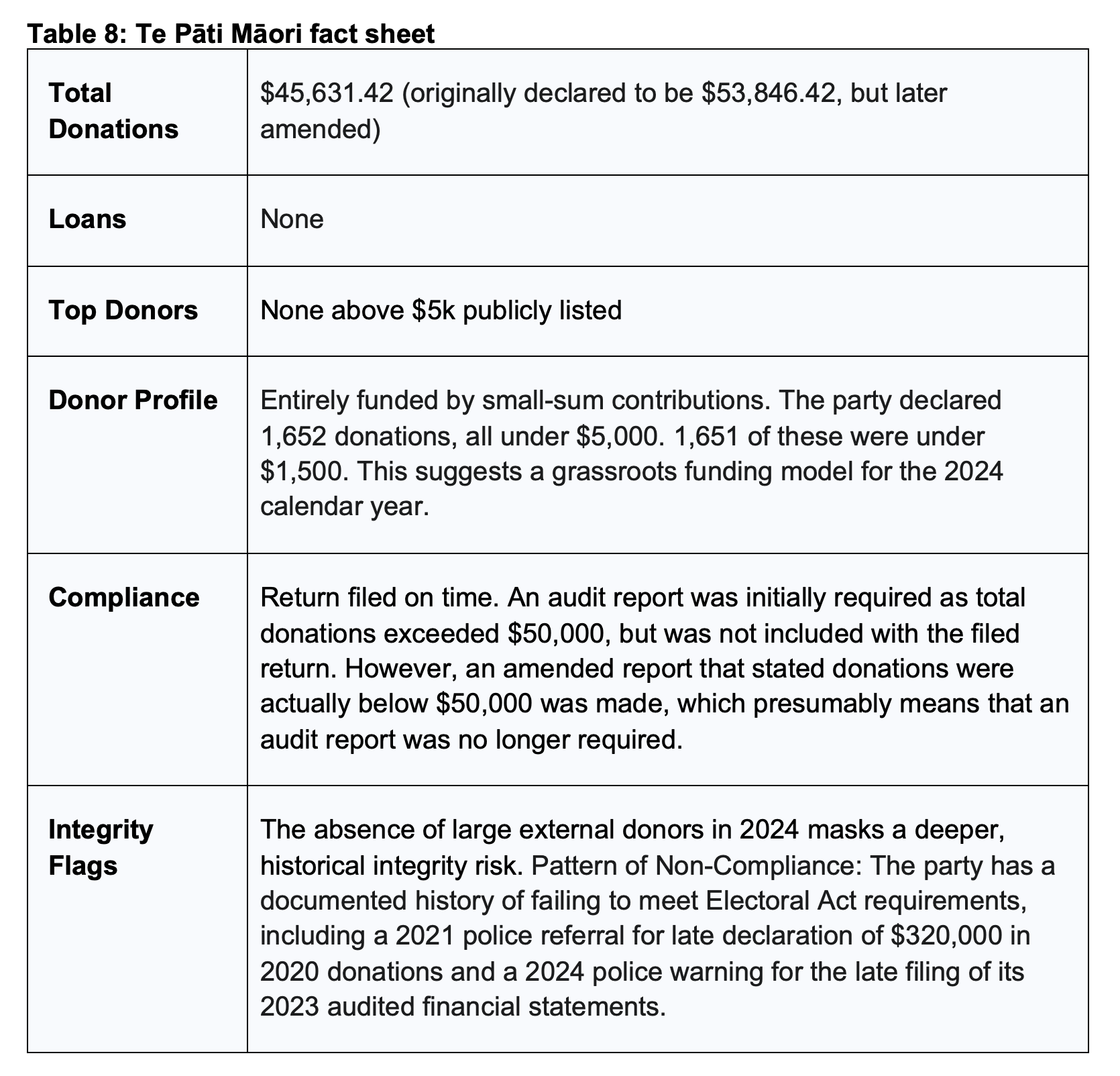
10.1 Summary
Te Pāti Māori’s financial footprint in 2024 was by far the smallest of any parliamentary party. The party’s total declared donations for the year were only on the order of tens of thousands – initially reported as roughly $54,000 and later amended to about $45,631. This is a minuscule sum next to the millions raised by larger parties, reflecting Te Pāti Māori’s modest donor base and resource constraints. No individual donation exceeded the $5,000 disclosure threshold in 2024, meaning not a single named donor appears on the public record for that year. Instead, all contributions were small donations aggregated from grassroots supporters, with zero party loans taken. In short, Te Pāti Māori relies on a trickle of small-dollar support rather than big-ticket benefactors, an approach that keeps the party free from large-donor influence but also leaves it operating on a shoestring budget.
This limited funding has real consequences for how the party functions. Te Pāti Māori cannot mount expensive nationwide campaigns or large-scale advertising blitzes comparable to those of well-funded parties. Instead, it must punch above its weight through non-monetary means. The party’s influence is often attributed to the high profile of its leaders and the resonance of its kaupapa (cause) rather than financial clout.
Lacking big donors or corporate sponsors, Te Pāti Māori has leaned on grassroots organising, media visibility, and bold advocacy to make an impact. This “low-budget, high-mana” model has enabled the party to champion Māori rights, aspirations, and tino rangatiratanga with outsized visibility relative to its tiny war chest. However, the flip side is that its finances remain precarious.
The 2024 non-election year total of about $50k is drastically lower even than what Te Pāti Māori raised in election years (e.g. $160k in 2023). This underscores a heavy dependence on election-cycle fundraising spikes and highlights that in off-years the party must survive on very lean income. Overall, Te Pāti Māori’s 2024 fundraising profile is characterised by extreme scarcity of funds, complete absence of large donors, and a consequent reliance on community support and improvisation to sustain its activities.
10.2 Sectoral and geographic clusters of donations
Unlike the major parties, Te Pāti Māori has no obvious sectoral or corporate donor base in its 2024 returns. The party received virtually no money from corporate entities, industry groups, or wealthy business magnates during the year. In stark contrast to the National/Act/NZ First bloc (fuelled by property developers, investors, agribusiness, etc.) and even to Labour/Greens (supported by unions, NGOs, and philanthropic individuals), Te Pāti Māori’s funding came almost entirely from individuals giving modest amounts.
These donors are likely rank-and-file supporters – ordinary whānau, community members, and small-scale donors motivated by the party’s kaupapa – rather than representatives of any particular industry. The near-total absence of large business or interest-group donations sets Te Pāti Māori apart as the only parliamentary party essentially funded by its grassroots alone. This reflects the party’s outsider status and kaupapa-driven appeal: its financial support is community-oriented and kaupapa-centric, not transactional or sector-based.
Geographically, donations to Te Pāti Māori in 2024 appear to be dispersed and locally driven. With no big contributions from any one region, the party’s funds likely trickled in from Māori communities across multiple rohe (areas) instead of a single geographic cluster of wealthy backers. For instance, some support presumably came from areas where the party has electorates or strong influence (such as Waiariki, Te Tai Hauāuru, Tāmaki Makaurau, etc.), though each local stream was small.
One notable regional anchor in prior years has been West Auckland: in 2023 the party president John Tamihere (based in Auckland) personally donated $50,000, and his Te Whānau o Waipareira Trust (West Auckland) has historically provided substantial backing, often in-kind (RNZ 2024; Stuff 2024). However, in 2024 no equivalent major infusion from Auckland or any other single region occurred – the West Auckland funding pipeline, for example, did not materialise as a declared donation that year. This left the 2024 donations spread thinly.
Essentially, Te Pāti Māori’s fundraising network is fragmented across many small givers rather than concentrated in a wealthy enclave. In practical terms, the party’s “donor base” is simply its voter base: grassroot Māori supporters and allies scattered nationwide, giving what they can at marae fundraisers, community events, or via online appeals. There were no significant iwi corporate donations or major urban business donors on record in 2024. The strength of this model lies in its broad community legitimacy – funding coming from the people the party represents – but the weakness is obvious: a lack of deep pockets anywhere. Te Pāti Māori remains financially isolated from the high-wealth donor circuits that other parties tap into, which limits its capacity but also insulates it from certain sectoral pressures.
10.3 Risks of influence (Quid Pro Quo)
Given its 2024 donor profile, Te Pāti Māori faces minimal traditional “quid pro quo” risk, at least in the sense of big donors expecting policy favors. With no single donor contributing above $5k, there is no evidence of any wealthy benefactor pulling strings behind the scenes in 2024. The usual concern in political finance – that large contributors might receive favorable treatment, contracts, or policy changes in return – is largely moot for Te Pāti Māori in this period, simply because there were no such contributors.
In fact, 2024’s small-donor financing reinforces the party’s independence from corporate influence: it would be hard to argue that any government decisions or policy positions were “bought” by donors when the party didn’t collect significant sums from any outside interest. If anything, Te Pāti Māori’s policy agenda in 2024 (focused on Māori rights, anti-poverty measures, and challenging the political status quo) aligns with the collective interests of its supporter communities rather than any one patron’s agenda. This stands in stark relief to the quid-pro-quo red flags observed with other parties’ big donors in 2024. Essentially, there were no “corporate strings” attached to Te Pāti Māori’s funding in 2024, which is a positive sign for integrity.
However, this lack of big-donor influence in 2024 comes with two important caveats. First, the party’s financial fragility makes it highly vulnerable to influence if a large donor were to emerge. Because the baseline funding is so low, a single wealthy individual writing, say, a $20,000 check in the future would suddenly account for a huge portion of Te Pāti Māori’s money. Such a donor could potentially wield outsize influence or expect special access simply by virtue of being the main financier. The risk is that any future large donation would loom proportionately very large for Te Pāti Māori, creating a dependency or implicit quid pro quo where none existed before.
In other words, the threshold for undue influence is much lower – a donation that might be routine for National or Labour could potentially result in enormous goodwill or sway in Te Pāti Māori due to its shoestring budget. This hypothetical risk is not just theoretical: in 2023, President John Tamihere’s $50k contribution made up nearly one-third of the party’s funds, concentrating financial power in a single insider and demonstrating how one person’s support could dominate the party’s finances. That example underscores how reliance on one benefactor (even an internal one) can raise concerns about disproportionate influence. While Tamihere’s donation was presumably altruistic and aligned with the party’s mission, it still illustrates how the party could become overly dependent on a single revenue source, potentially skewing priorities toward that source’s interests (or simply empowering that individual’s voice within the party).
The second caveat involves non-traditional influence risks stemming from the party’s unique funding avenues. Notably, the party’s close relationship with the charitable Waipareira Trust (of which Tamihere is CEO) has been a source of controversy. In previous campaigns, Waipareira and its subsidiaries provided substantial support to Te Pāti Māori – from funding campaign events to in-kind services like mass texting urging votes. These contributions had to be reframed as “loans” and triggered regulatory scrutiny since charities are barred from partisan spending (RNZ 2024; NZ Herald 2024; Charities Services 2024).
10.4 Compliance issues
Where Te Pāti Māori has truly struggled is compliance and financial administration. The party’s 2024 return may have been small and simple, but even so it was accompanied by significant filing issues that raise red flags about governance. Te Pāti Māori has developed a track record of late, incomplete, and non-compliant filings with the Electoral Commission in recent years, undermining transparency. In fact, 2024 continued this pattern. Although the party did submit its 2024 annual donations return by the 30 April 2025 deadline, that return had to be amended after filing due to errors – the initially reported total was revised downward by over $8,000 in the amended return.
This discrepancy echoed a similar problem from the previous year: for 2023, the donations total in the party’s financial statements turned out to be $5,792.58 less than what the party had reported in its official donations return, an inconsistency discovered during reconciliation. Such errors suggest poor internal record-keeping or oversight, where even the small amounts involved are not being tracked accurately. While the dollar figures might seem minor, any mismatch in reported numbers is a serious integrity concern – it indicates that the party’s financial reports cannot be taken at face value without verification.
More worrying were Te Pāti Māori’s failures to meet the auditing requirements introduced by the Electoral Amendment Act 2022. Because the party exceeded the $50,000 donations threshold in 2023, it was required to file audited financial statements for that year. It did not do so on time. The party missed the July 2024 deadline for submitting its 2023 audited financial statements, eventually filing an incomplete statement in December 2024 that lacked the auditor’s report and even proper signatures (RNZ 2024).
The Electoral Commission referred this breach to the police, resulting in a formal police warning issued in December 2024 (NZ Herald 2024; RNZ 2024). This is a remarkable and troubling outcome – to be formally warned by police is a rare escalation for party finance infractions. Yet, despite this warning, Te Pāti Māori again failed to file its next set of financial statements on time in 2025 (for the 2024 year). So, for two years running the party did not fully comply with financial reporting law – a repeat offense that raises doubts about either the party’s capacity or its commitment to transparency.
Eventually the party filed a return that declared the receipt of $53,846 in donations. This total amount exceeded the $50k threshold for requiring an auditor’s report, but the party failed to produce this. However, later an amended declaration was filed, stating that donations were only $45,631, but the party included an auditor’s report regardless.
Te Pāti Māori’s co-leaders have distanced themselves by calling it an internal administrative matter, but that does little to reassure observers (RNZ 2024; Stuff 2024). These compliance lapses stand in stark contrast to the larger parties, which, despite handling far greater sums of money, have more robust processes and have largely met their filing obligations. Even smaller parties with similar resource constraints managed to file on time. The repeated audit delays and missing information from Te Pāti Māori signal a systemic weakness in the party’s financial governance.
Moreover, the entangled relationship with the Waipareira Trust has introduced additional compliance concerns beyond electoral law. As noted, Charities Services (the charities regulator) was so alarmed by Waipareira’s political financing of Te Pāti Māori that in late 2024 it moved to deregister the Trust for breaching the rule against funding partisan activity (Charities Services 2024; NZ Herald 2024). This extraordinary step – essentially threatening the charity’s tax-exempt status – underscores how serious the compliance issues have become when viewed holistically.
It’s not just the Electoral Commission flagging late paperwork; it’s also another regulator finding fundamental breaches of law in how money flowed to support the party. While Tamihere and party officials insisted they “always comply to the letter of the law” (in his words), the evidence suggests otherwise: audits missing, returns amended, donation records inaccurate, and charitable funds commingled with political campaigning (RNZ 2024; NZ Herald 2024). For an organisation preaching integrity, these failures are damaging.
In summary, Te Pāti Māori’s integrity risks in 2024 stem less from who funds it and more from how it manages and reports those funds. The party’s tiny donations pool meant traditional corruption via big money was a non-issue, but at the same time basic compliance obligations were frequently unmet, indicating either a lack of administrative capacity, a disregard for rules, or both. These administrative shortcomings expose the party to legal penalties and erode public trust – the very outcome one would hope a party focused on elevating Māori voices would avoid.
If Te Pāti Māori is to maintain moral authority on issues of political integrity, it will need to significantly improve its financial stewardship and transparency, so that it can meet the same standards it calls others to. The “integrity flags” for Te Pāti Māori are thus mostly about internal practices: late audits, opaque or inconsistent financial records, and the blurring of lines with supportive organisations. Addressing these issues is critical, because integrity is not just about avoiding quid pro quo influence; it’s also about demonstrating competence and honesty in abiding by the rules that govern political finance.
Section 11: The Trust deficit: Public perception vs The “Clean” reputation
The final sections of this report deal with explaining what all of the above means in practice, and what might be done to fix it. Section 11 deals with the problems of the public’s trust in the current regime of existing political donations regime, and then Section 12 puts forward some potential reforms.
There is a dangerous and growing disconnect between how New Zealand’s political system is perceived by international indexes and how it is viewed by its own citizens. While officials and politicians often point to high global rankings as proof of our system’s integrity, the New Zealand public is increasingly convinced that the game is rigged. This “Integrity Gap” — the chasm between our external reputation and our internal reality — is the most significant threat to the health of our democracy.
11.1 The Voice of the public: Widespread distrust
A wealth of public opinion data shows that New Zealanders are deeply cynical about the role of money in their political system. This is not a fringe view held by a small minority; it is a mainstream sentiment that cuts across the political spectrum:
· A 2023 survey found 45% of New Zealanders believe the government is run by a “few big interests” (NZES 2023).
· The same study found 43% believe donors exert “undue influence” on politicians, with only 18% disagreeing. This belief is held not only by left-leaning voters but is also prevalent among a significant number of National and Act voters (NZES 2023).
· Polling conducted by Victoria University of Wellington found that nearly three-quarters of New Zealanders (between 71% and 75%) distrust the current system of political party funding (Vowles et al. 2023).
· A 2024 Ipsos survey revealed that 65% of New Zealanders believe the economy is “rigged to advantage the wealthy and powerful” (Ipsos 2024).
Crucially, this widespread concern is matched by strong public support for reform. Majorities of New Zealanders support capping donation amounts and banning donations from corporations and unions. This support for change is bipartisan, with significant numbers of centre-right voters also favouring tighter regulations (Vowles et al. 2023; NZES 2023). The public’s message is clear: they see a problem, and they want it fixed.
11.2 Official scrutiny: When auditors raise a flag
In 2024, the auditors of New Zealand’s major parties delivered some blunt assessments that should concern anyone worried about transparency. Most notably, the auditors for National, Labour, and New Zealand First each issued “qualified” opinions on the parties’ financial returns (BDO 2025; Grant Thornton 2025; Lennie & Associates 2025).
A qualified opinion is essentially an auditor’s way of saying, “We cannot give a clean bill of health.” It means the auditors encountered one or more material issues that prevented them from confirming the accounts were complete or correct. In this context, the qualifications all stemmed from the same fundamental problem: the system of recording political donations in New Zealand can not guarantee that all donations are properly recorded. In plainer language, the auditors are warning that the totals we see in the political donation returns may not tell the full story of money flowing into the parties.
For the National Party, auditor BDO noted an inability to obtain “sufficient appropriate evidence” that all donation income was included, particularly cash donations and in-kind contributions. BDO’s report highlighted that National’s head office lacks oversight of fundraising done by its many local electorate committees (BDO 2025). Donations gathered at the grassroots (through branch events, raffles, local wealthy supporters, etc.) might not all filter up into the central accounts. Similarly, non-monetary donations – goods or services given to the party – are hard to comprehensively track. The result was a formal qualification: BDO stated that, except for these unspecified missing pieces, National’s return was accurate.
National declared $4.89 million raised in 2024, but the auditor explicitly warns that the true figure could be higher (BDO 2025). In effect, the integrity of National’s disclosure is in doubt, which bolsters the report’s argument that even with improved transparency laws, enforcement and verification remain weak. It’s worth noting this is not the first time such concerns have arisen – historically, party treasurers have struggled to monitor all electorate-level finances. What’s new is that, under the spotlight of the post-2022 disclosure rules, auditors are now openly flagging the issue.
New Zealand First’s audit also gave a qualified opinion, citing four distinct problems (Lennie & Associates 2025). These included the same issues as National – incomplete donation records at electorate level and incomplete accounting of in-kind gifts – but went further to highlight potential gaps in recording transactions between candidates and the party, and weak controls on verifying donor residency.
The latter is particularly relevant given NZ First’s past controversy with its Foundation: there’s a known risk of using third-party entities or non-resident donors to funnel money. The auditor essentially is saying that NZ First’s internal controls haven’t fully recovered from past lapses – there remains room to hide or misreport donations via side channels. For example, if a wealthy supporter gave money to an individual NZ First candidate or a local branch, and that money was later transferred to the central party, it’s unclear if all such movements would be caught and declared.
Likewise, if a donor’s residency status was in question (important because overseas donors above $50 must be disclosed), the party might not have the systems to detect it. These are exactly the kind of integrity vulnerabilities that allowed the NZ First Foundation to operate in a grey zone, and here we have an auditor effectively warning “it could happen again.”
The fact that this comes from an external, independent professional gives the concern some weight – it’s no longer just critics or journalists suggesting NZ First’s finances are murky, it’s the party’s own auditor sounding an alarm bell. For the public, this should be a big red flag: when a party in government cannot assure that all its donations are above board, the risk of corruption or hidden influence is not a theoretical worry but a real possibility.
The Labour Party, too, received a qualified audit opinion in 2024 (from Grant Thornton) on similar grounds (Grant Thornton 2025). Despite Labour’s much smaller haul of large donations, the auditor noted that aside from donations through the party’s online portal, there were “limited controls” to ensure all other donations were recorded. In practice, Labour also has local electorate committees and fundraising initiatives that might bypass central scrutiny. So Labour was not immune to the structural issue affecting National and NZ First. The common thread is clear: decentralised party structures = incomplete oversight. Every major party that relies on chapters or branches to collect money ended up with an auditor effectively saying, “we can’t be sure these accounts are complete.”
So, what are the implications of these audit findings for transparency and public trust? First, they offer a vindication of public cynicism. This report opens by noting a gap between New Zealand’s clean reputation and the public’s mistrust. Here we have hard evidence from audits that such mistrust isn’t unfounded. Even under newly strengthened disclosure laws, the official records are not entirely reliable. The auditors’ warnings substantiate the idea that money in politics is still finding shadowy cracks to flow through.
Second, the fact that two of the governing parties (National and NZ First) and the main opposition party (Labour) all failed to get clean audits in 2024 points to a systemic weakness. This undermines confidence because the public cannot be sure if, for example, a given policy decision might be influenced by a donation that never saw daylight on the register.
Additionally, these audit findings hearken back to previous scandals – they are a reminder that the lessons of those incidents haven’t been fully learned. The NZ First Foundation scandal involved donations being routed in a way that bypassed disclosure; the auditor now says NZ First’s 2024 processes still left that possibility open. National and Labour have historically had issues with trust and foundation structures too, e.g. National’s hidden “advisory bodies” funded by donors, Labour’s 2017 campaign cash scandal (NZ Herald 2017; Stuff 2017; Hager 2006). The auditors are effectively saying: we as professionals can’t guarantee it’s not happening again in some form. This should galvanise calls for stronger oversight – perhaps giving the Electoral Commission more audit powers, standardising how parties must account for branch fundraising, or even considering public funding to reduce reliance on private money.
In summary, when the auditors raise flags, it’s time for the public and regulators to listen. The 2024 party returns may have been the most transparent ever on paper, but if independent audits say “not everything is accounted for,” then NZ democracy still has a transparency problem.
Cleaning this up might require both legislative fixes (tightening donation rules further, improving audit requirements) and internal party reform (centralising donation collection or improving record-keeping). At the very least, these qualified opinions shatter any complacency: they prove that even in the post-reform era, the integrity gap in party finances is real and documented. This convergence of evidence – from investigative case studies to auditors’ reports – strengthens the report’s overall call for urgent reforms to rebuild trust in how politics is funded.
11.3 Deconstructing the “Clean” reputation
The primary shield used to deflect these domestic concerns is New Zealand’s consistently high ranking on Transparency International’s Corruption Perceptions Index (CPI), where it currently sits among the top five least corrupt countries in the world (Transparency International 2024). However, a critical examination of the CPI reveals that this reliance is misplaced and creates a dangerous sense of complacency.
As critiques from the Democracy Project and myself have pointed out, the CPI has significant limitations:
1. It Measures Perceptions, Not Reality: The CPI is based on surveys of business executives and country experts about their perception of public sector corruption. It does not measure actual instances of corruption (Transparency International 2024).
2. It Focuses on Bribery, Not Influence: The index is designed to detect overt corruption like bribery and embezzlement. It is poorly equipped to measure the more sophisticated forms of “legal corruption” prevalent in developed democracies, such as policy capture through political donations, opaque lobbying, and “revolving door” appointments (Heywood & Rose 2014; Mulgan 2012).
3. Reputation Lags Reality: A country’s high score can persist for years based on historical reputation, even as its domestic integrity standards decline (Heywood & Rose 2014). The steady stream of donation scandals in New Zealand over the past decade has yet to be fully reflected in the perceptions of international businesspeople.
In essence, New Zealand’s high CPI score allows politicians to dismiss legitimate domestic concerns by pointing to an international metric that is measuring the wrong thing. The Integrity Gap persists because the official measures of integrity are not capturing the forms of influence-peddling that citizens see and experience. The purpose of this report is to bridge that gap by demonstrating that the public’s concerns are not unfounded paranoia, but are a rational response to the empirical evidence of the 2024 donation patterns.
Section 12: A Blueprint for integrity: Recommendations for reform
The findings of this report demonstrate that New Zealand’s political financing system is no longer fit for purpose. The current rules are inadequate to prevent the reality, and the equally corrosive perception, that policy and favour can be bought. The goal of reform should not be to end political donations, which are a legitimate form of expression, but to restore balance, mitigate the risk of undue influence, and rebuild public trust in the democratic process.
The following recommendations provide a comprehensive blueprint for reform. They are grounded in the evidence presented in this report and are designed to bring New Zealand’s regulations into line with international best practice.
12.1 Reforming donation rules: Capping influence and increasing transparency
The most direct way to reduce the power of big money is to limit its flow and make what remains fully transparent.
Recommendation 1: Implement an annual cap on donations
An annual cap on the total amount any single person or entity can donate to a political party could be introduced. A cap of $15,000 per year, as recommended in the Victoria University report “Money for Something,” would strike a balance between allowing meaningful support and preventing any single donor from achieving outsized influence.
Recommendation 2: Restrict donations to enrolled voters
New Zealand could follow the lead of countries like Canada and ban donations from corporate entities, trade unions, and other organisations (Elections Canada 2024). Limiting the right to donate to individual, enrolled voters reinforces the democratic principle of “one person, one vote” and has strong public support (NZES 2023; Vowles et al. 2023).
Recommendation 3: Lower the public disclosure threshold
The threshold for public disclosure of a donor’s identity could be lowered from the current $5,000 to $1,500. This would increase transparency and align New Zealand with the majority of developed nations (IDEA 2024).
Recommendation 4: Introduce anti-splitting legislation
To combat the practice of donation splitting, the Electoral Act should be amended to require the aggregation of all donations from individuals and entities that are under common control (e.g., a person and their wholly-owned companies, or companies with the same majority shareholder/director). This would close the loophole clearly identified in Section 4.4 of this report.
12.2 Strengthening conflict of interest guardrails: Creating distance
Clear, enforceable rules are needed to create an unambiguous separation between financial contributions and government decisions that benefit donors.
Recommendation 5: Legislate mandatory stand-down periods
A mandatory five-year stand-down period should be legislated between an individual or their company making a significant political donation (e.g., a cumulative total exceeding $20,000) and that individual receiving a national honour (e.g., a knighthood) or being appointed to the board of a Crown entity or State-Owned Enterprise. This recommendation is a direct response to the “Cash for Honours” and Dynes/KiwiRail case studies.
Recommendation 6: Amend the Cabinet Manual on conflicts of interest
The Cabinet Manual should be updated to explicitly state that a Minister has a material conflict of interest when they are required to make a decision that confers a specific and tangible benefit to a recent, major donor to their political party. This language, drawn from the Auditor-General’s 2025 review, distinguishes between decisions that benefit an entire sector and those that single out a party benefactor for a unique advantage (Office of the Auditor-General 2025).
12.3 Enhancing transparency and accountability: Letting the sunshine In
True accountability requires greater visibility into the interactions between politicians and their financial backers.
Recommendation 7: Mandate disclosure of meetings with donors
The rules governing the public release of Ministerial diaries should be expanded to require the explicit identification of any meetings with registered lobbyists or individuals/organisations known to be political donors above the disclosure threshold (Cabinet Office 2023).
Recommendation 8: Empower enhanced auditing
The Electoral Commission or the Office of the Auditor-General should be given new powers and resources to conduct targeted audits of donation patterns below the disclosure threshold where there is reasonable suspicion of structured giving or common control, in order to detect sophisticated donation splitting schemes.
12.4 Insulating public processes: Ring-fencing key decisions
For extraordinary government processes that bypass normal checks and balances, extraordinary safeguards are required.
Recommendation 9: Prohibit donors from non-standard procurement
Individuals and companies (including their directors) who have made a declarable donation to a political party in the preceding 24 months should be prohibited from applying for, or benefiting from, minister-led, non-standard procurement or consenting processes. This would apply directly to schemes like the Fast-Track Approvals regime and discretionary funds such as Crown Regional Holdings, insulating these high-risk processes from the perception of “pay-to-play”.
To contextualise these recommendations, the following table compares New Zealand’s current (and proposed) regulatory environment with that of its closest peers. It starkly illustrates that the proposed reforms are not radical, but rather a necessary step to catch up with established international norms of democratic integrity.
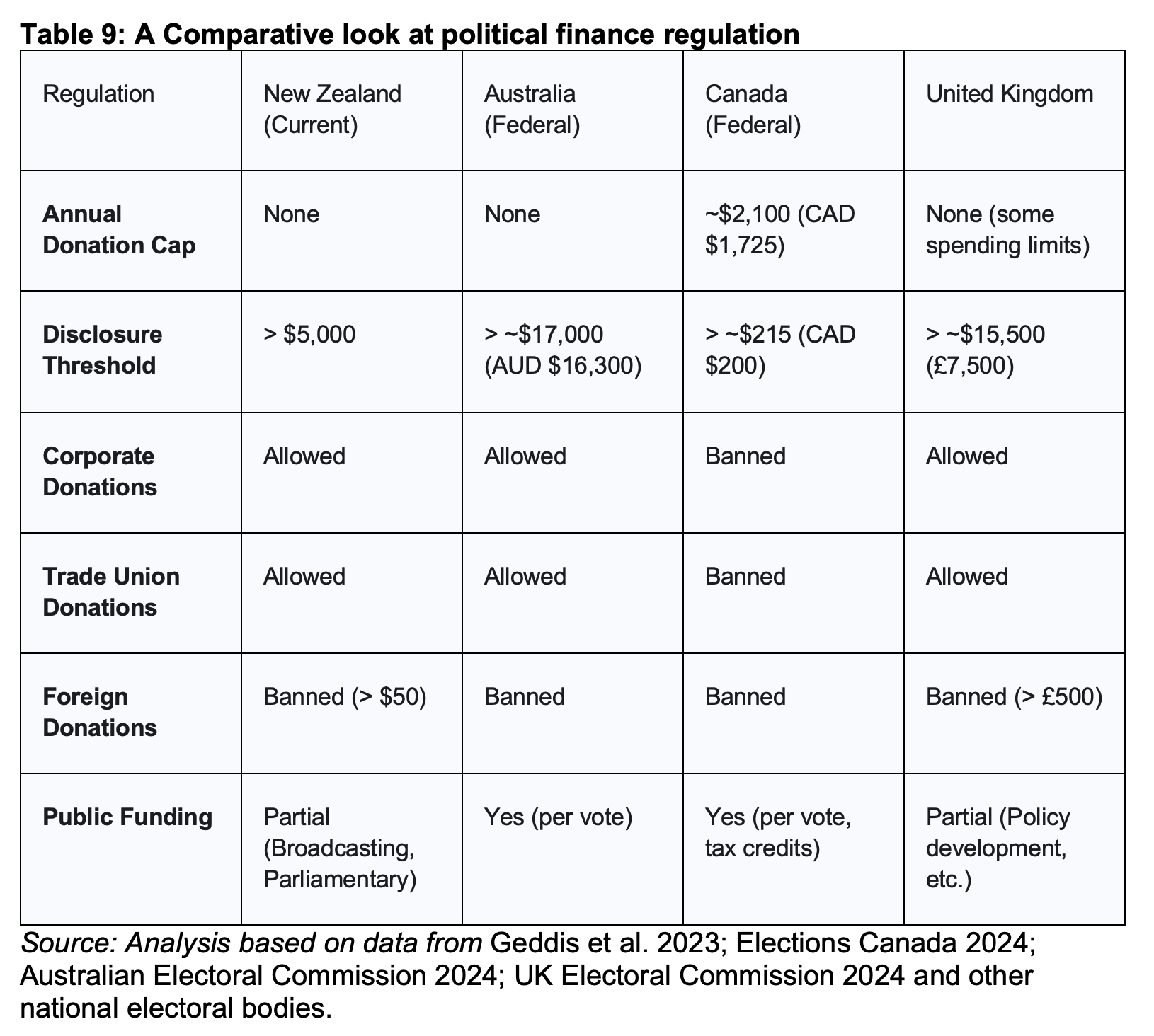
Section 13: Conclusion: Restoring the balance
The 2024 donation returns, illuminated by new transparency laws, have laid bare the mechanics of influence in modern New Zealand politics. The evidence presented in this report is not of a system plagued by isolated incidents of poor judgment, but of a political culture where the transactional exchange of money for access and favourable outcomes has become normalised. The democratic principle of “one person, one vote” is being systematically challenged by the financial power of “one dollar, one say.”
A few dozen wealthy donors now supply a hugely disproportionate share of the money that fuels our political parties. Their cheques coincide with fast-track consents for their development projects, eight-figure Crown loans for their businesses, seats on the boards of state-owned enterprises, and — at the very top end — knighthoods. The lines between governance and favour-seeking, between public interest and private benefit, have become dangerously blurred.
While every step may be technically lawful, the cumulative effect of this pattern is a catastrophic erosion of public confidence. When citizens believe the game is rigged, they disengage from the democratic process, and the social contract that underpins a cohesive society begins to fray. The “Integrity Gap” between New Zealand’s pristine international reputation and the deep cynicism of its own people is a direct result of this reality.
The way forward is clear. The reforms proposed in this report — donation caps, a ban on corporate giving, mandatory stand-down periods, and radical transparency — are not an attack on business or success. They are essential measures to restore the arm’s-length principle that is the bedrock of trustworthy government. They seek to ensure that decisions are made, and are seen to be made, on their merits, without fear or favour.
New Zealand still ranks among the world’s most trusted nations, but rankings will not save us if our own people conclude that their voices are drowned out by the sound of writing cheques. This is not a partisan issue; it is a question of democratic hygiene. The reforms proposed here are not a luxury to be debated in perpetuity; they are the necessary price of preserving the political integrity that has long been this country’s most valuable, and most fragile, asset.
Appendices
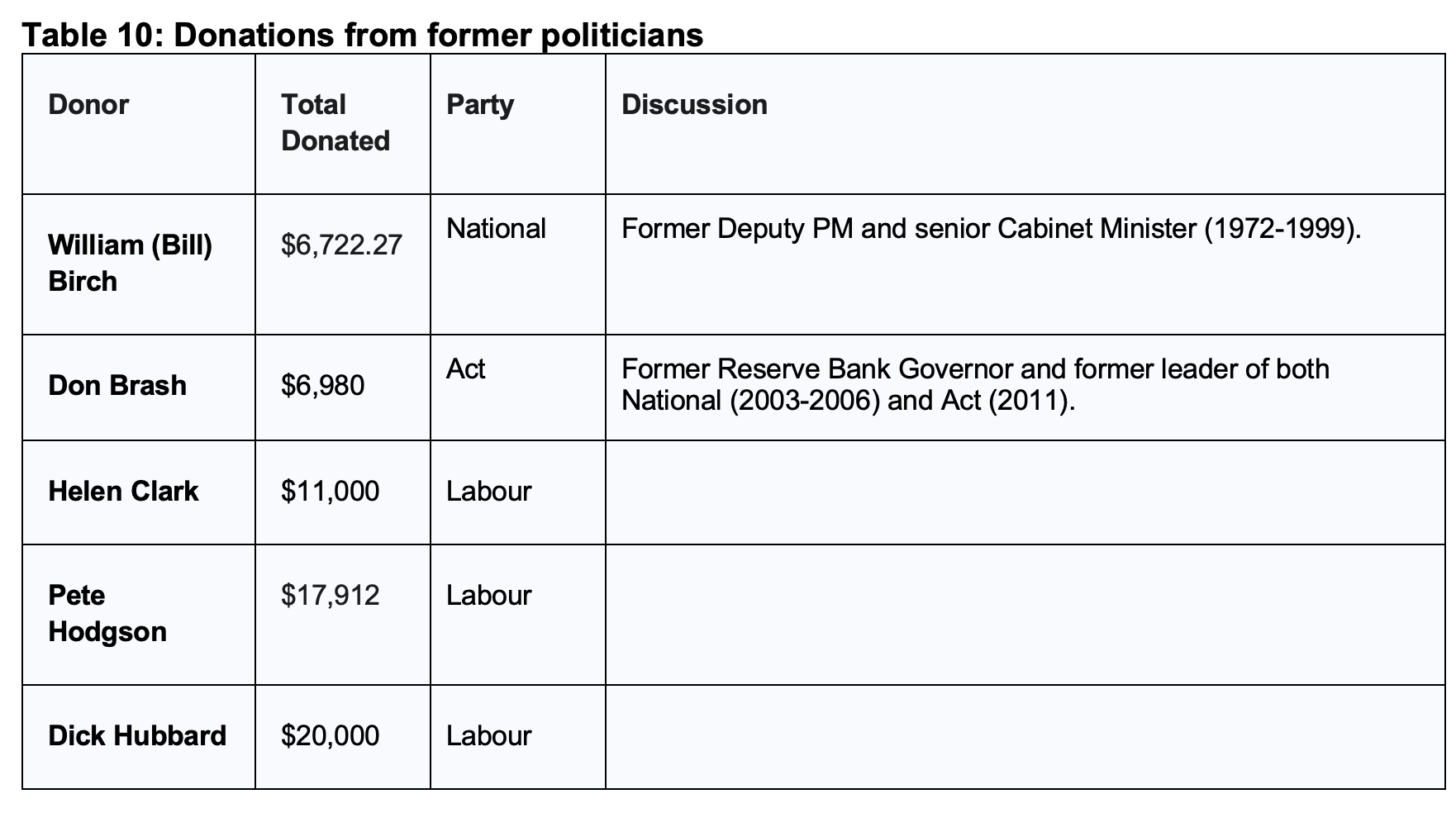
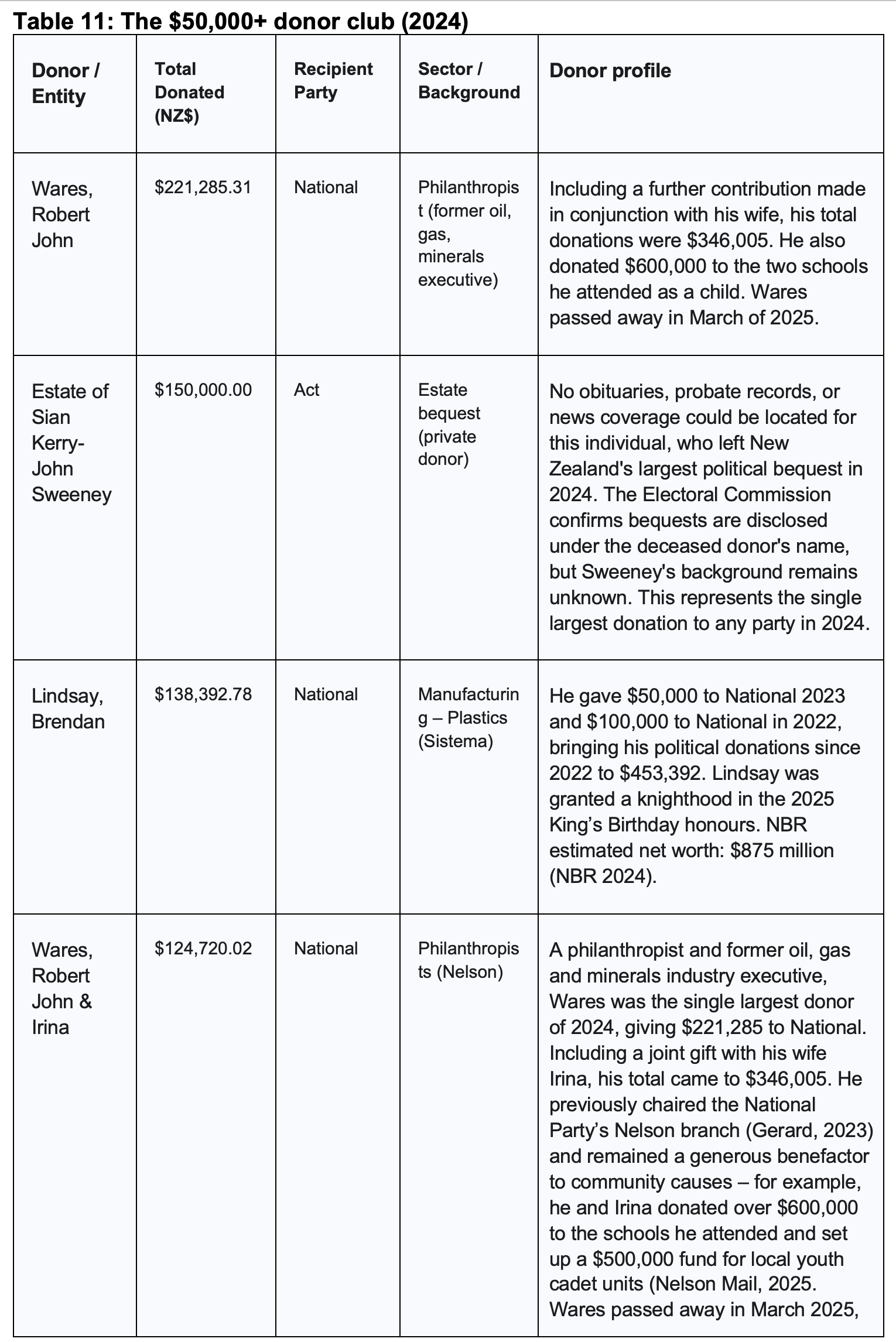
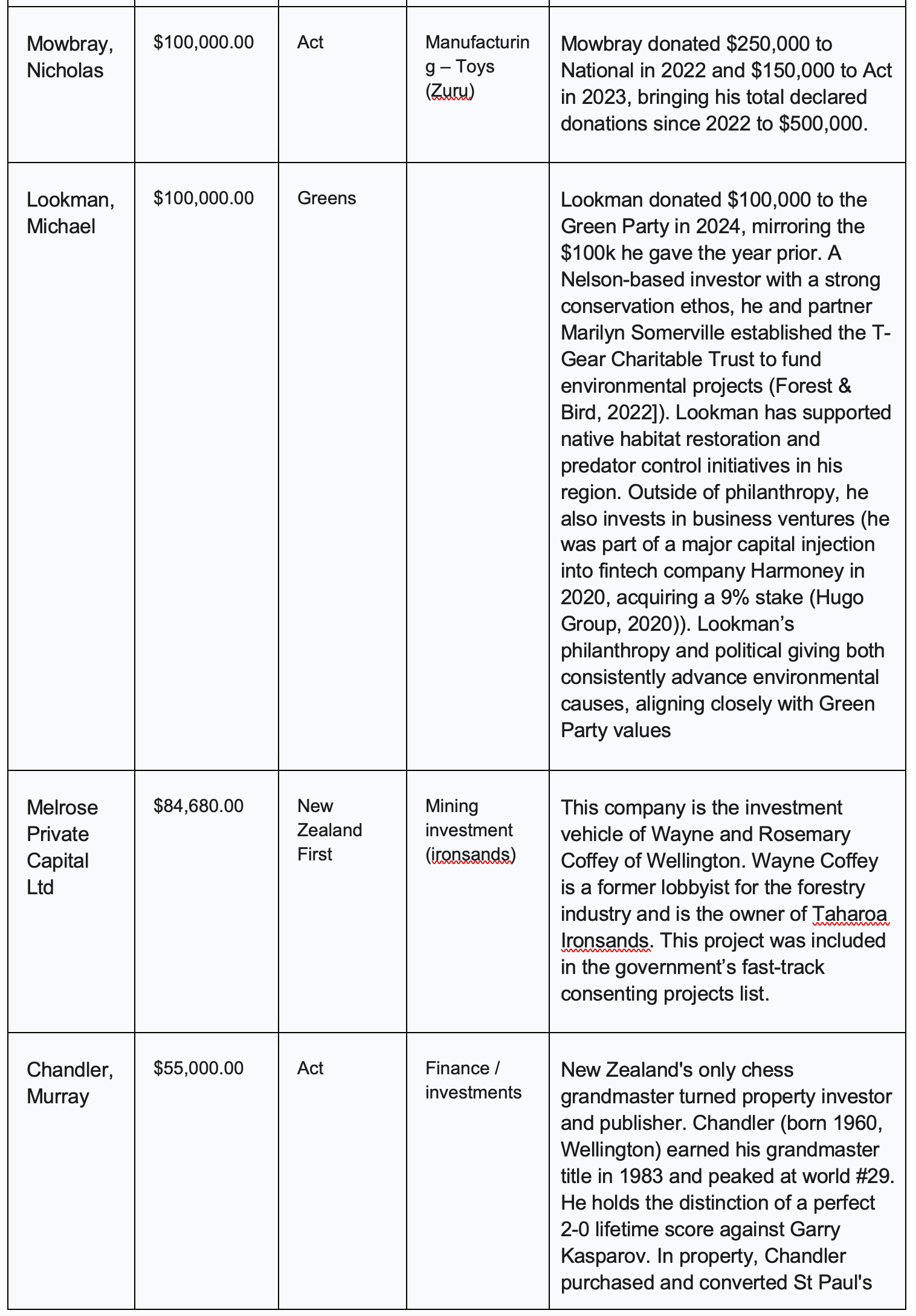
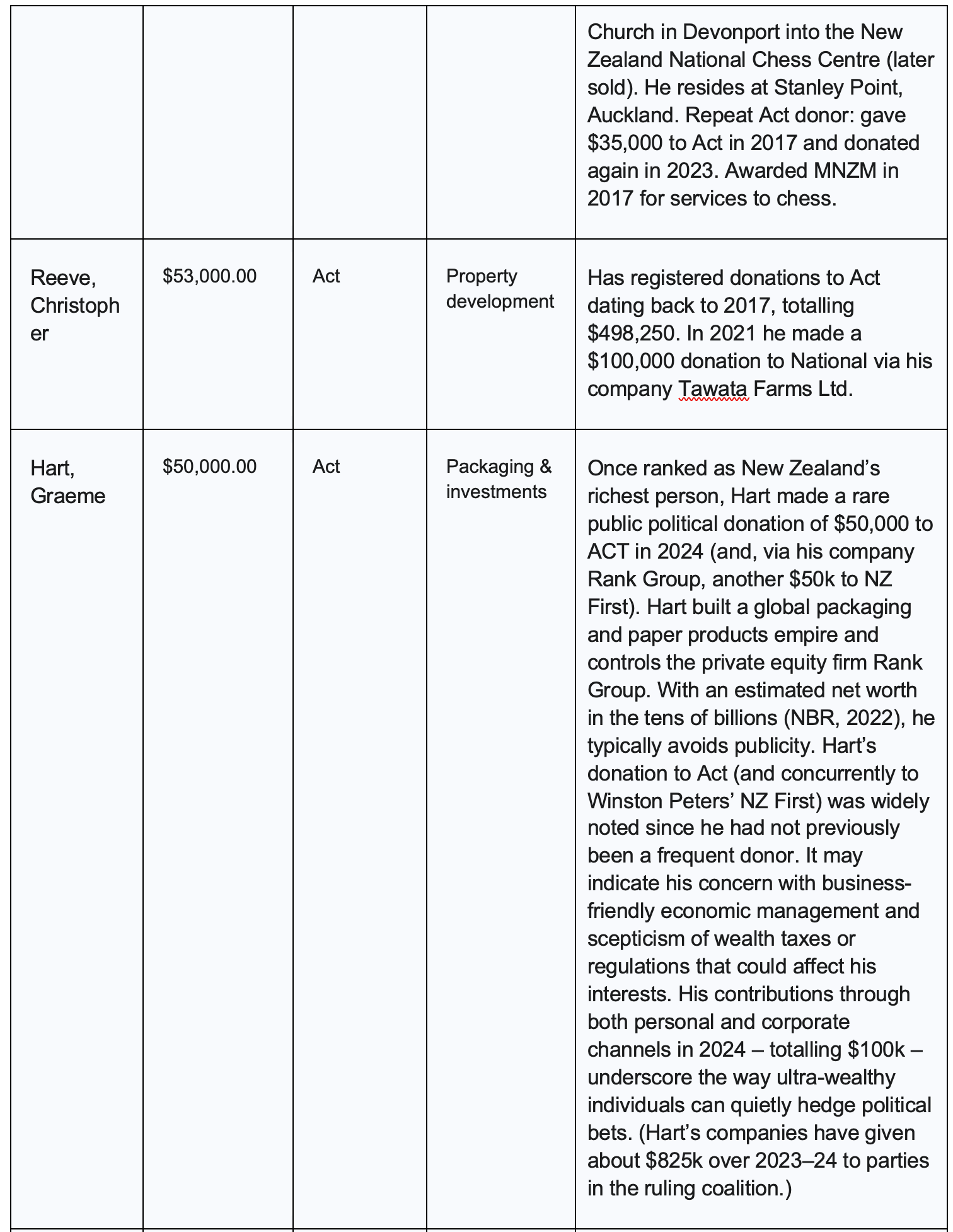
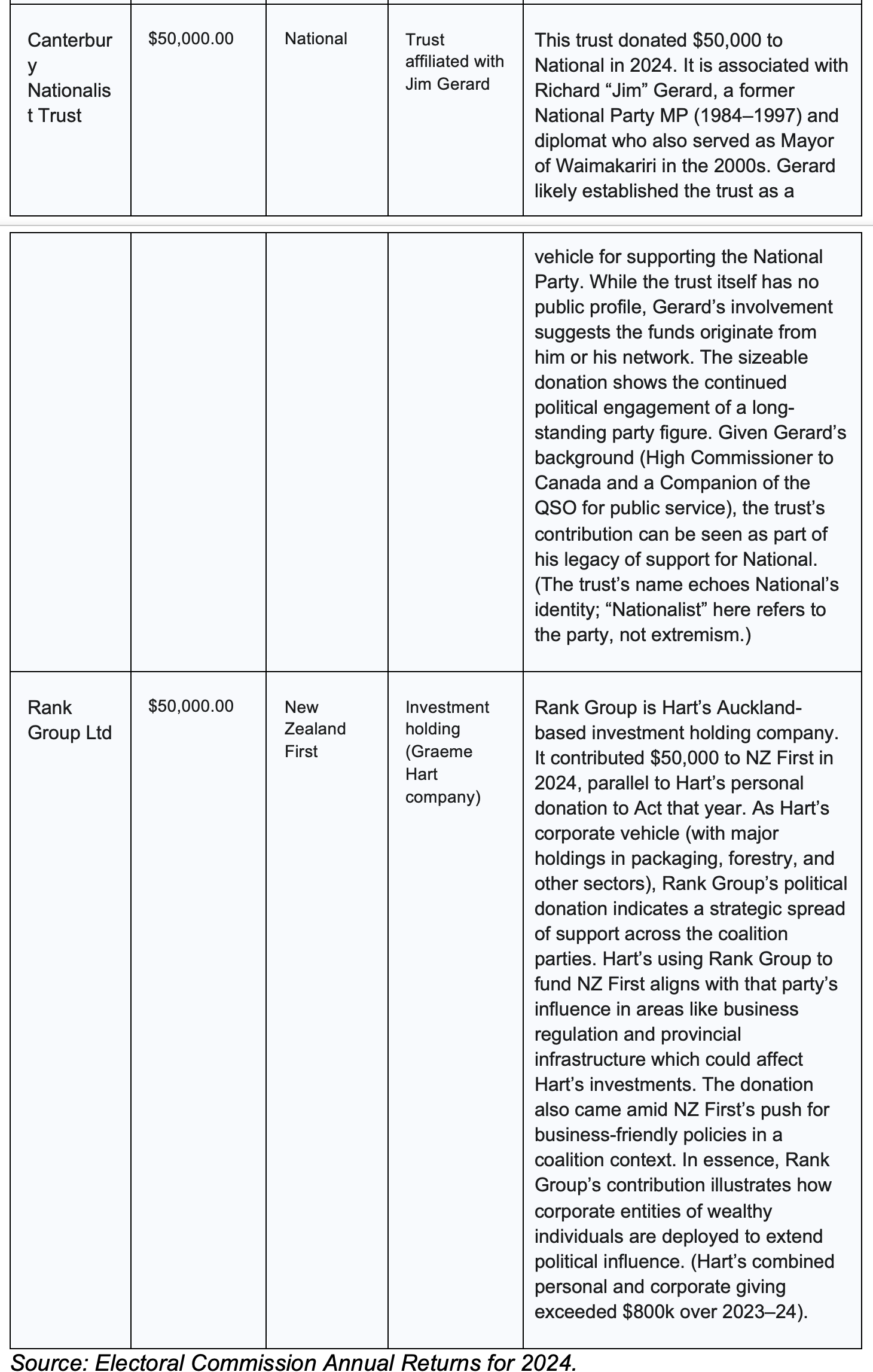
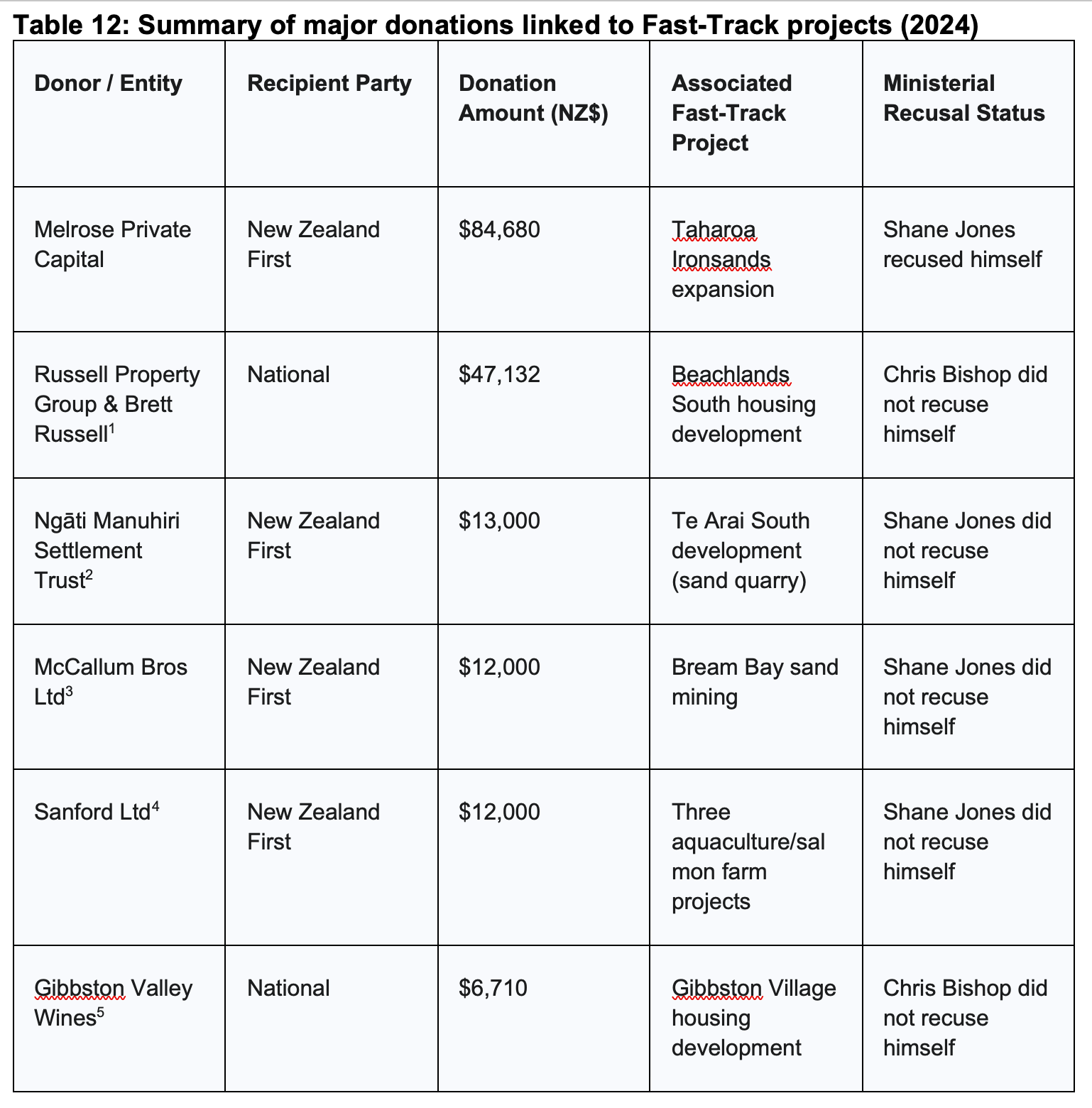
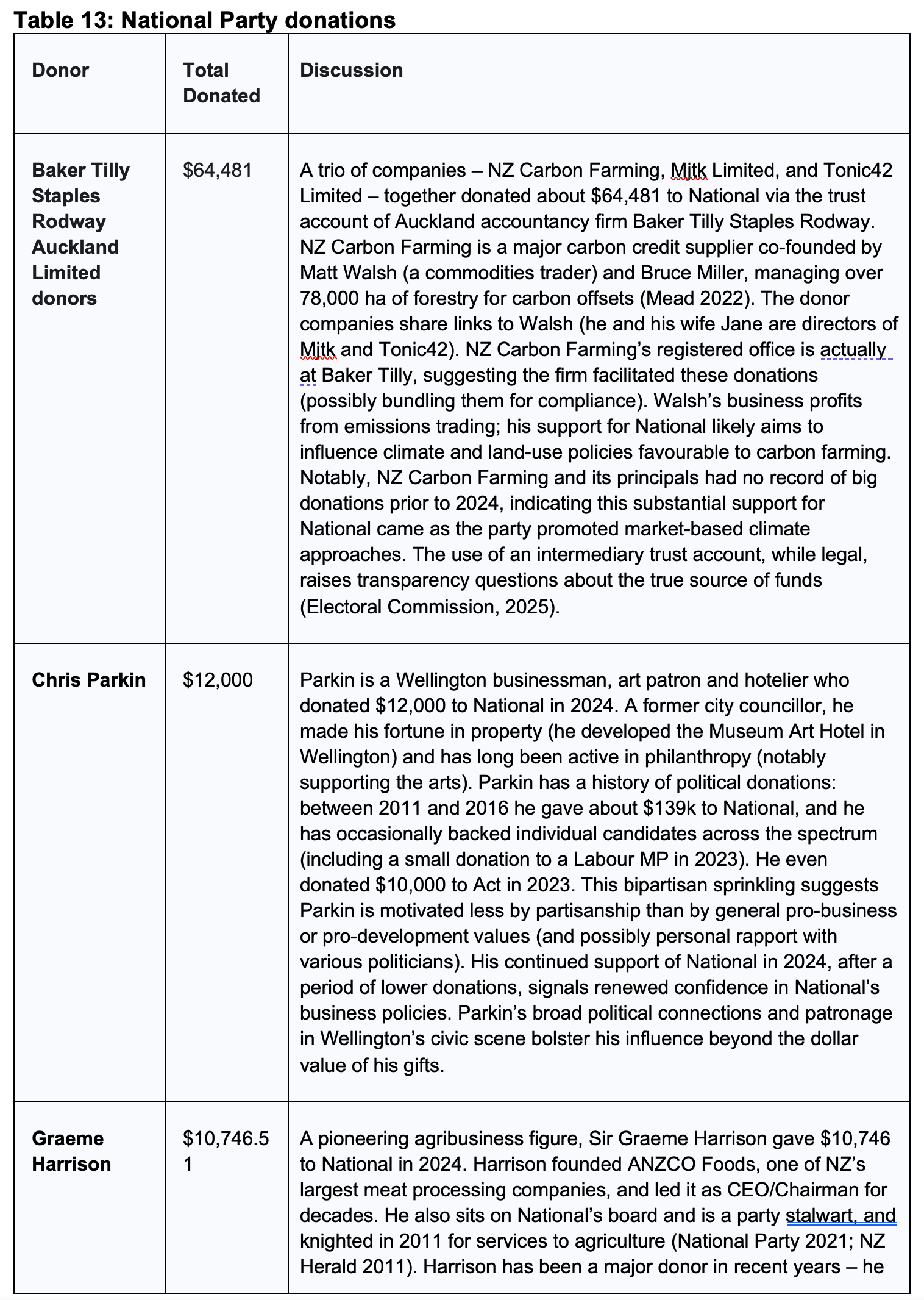
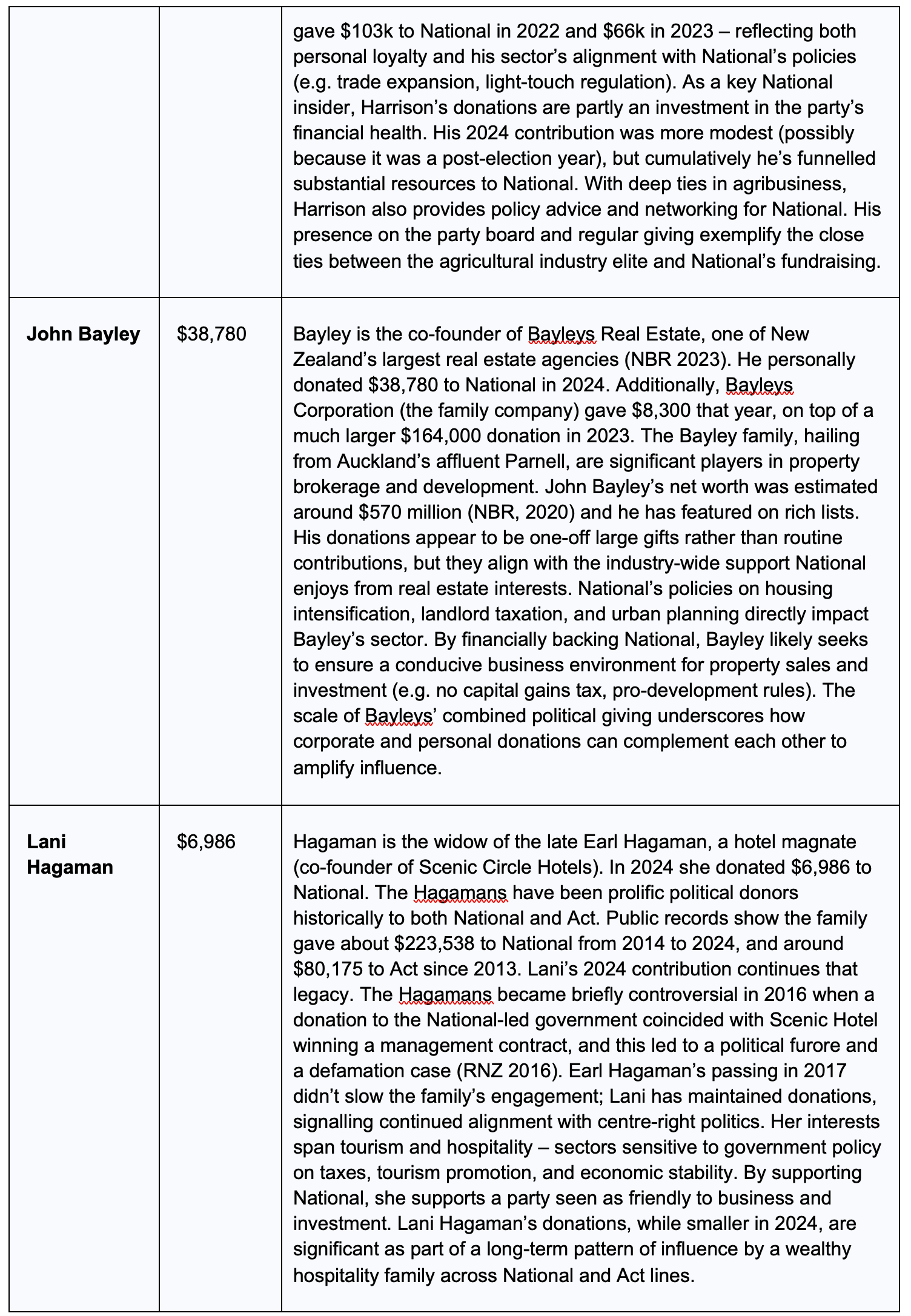
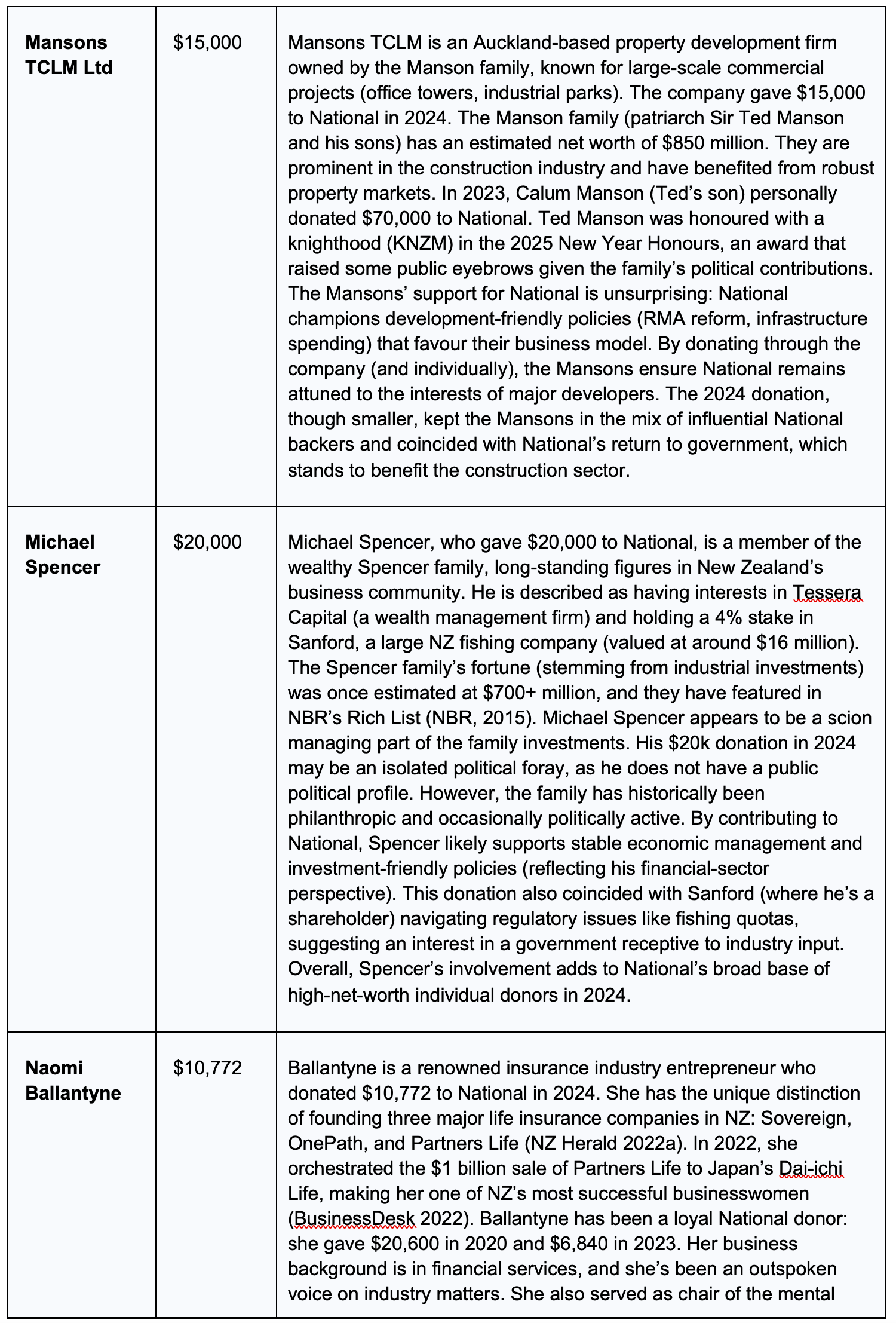
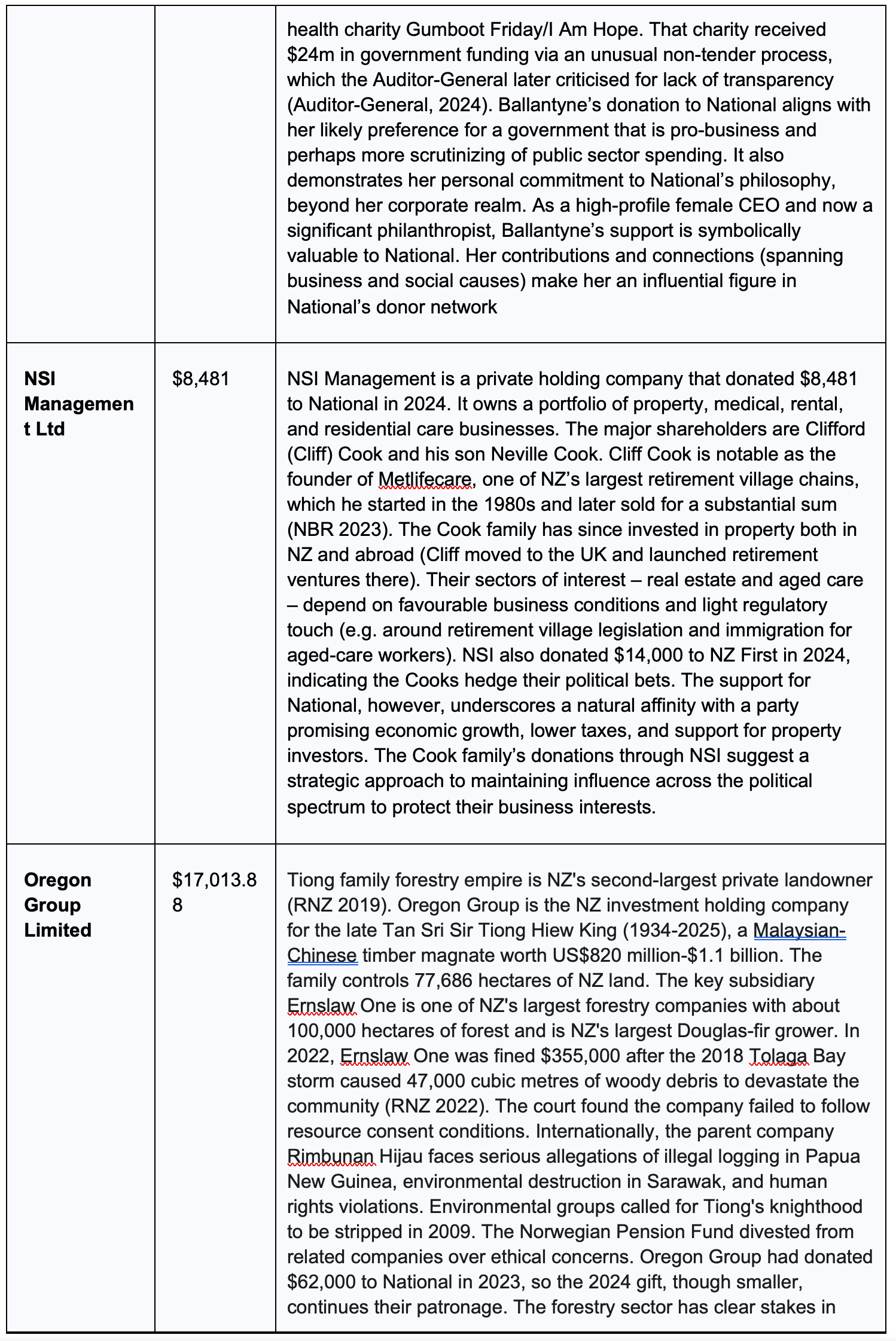

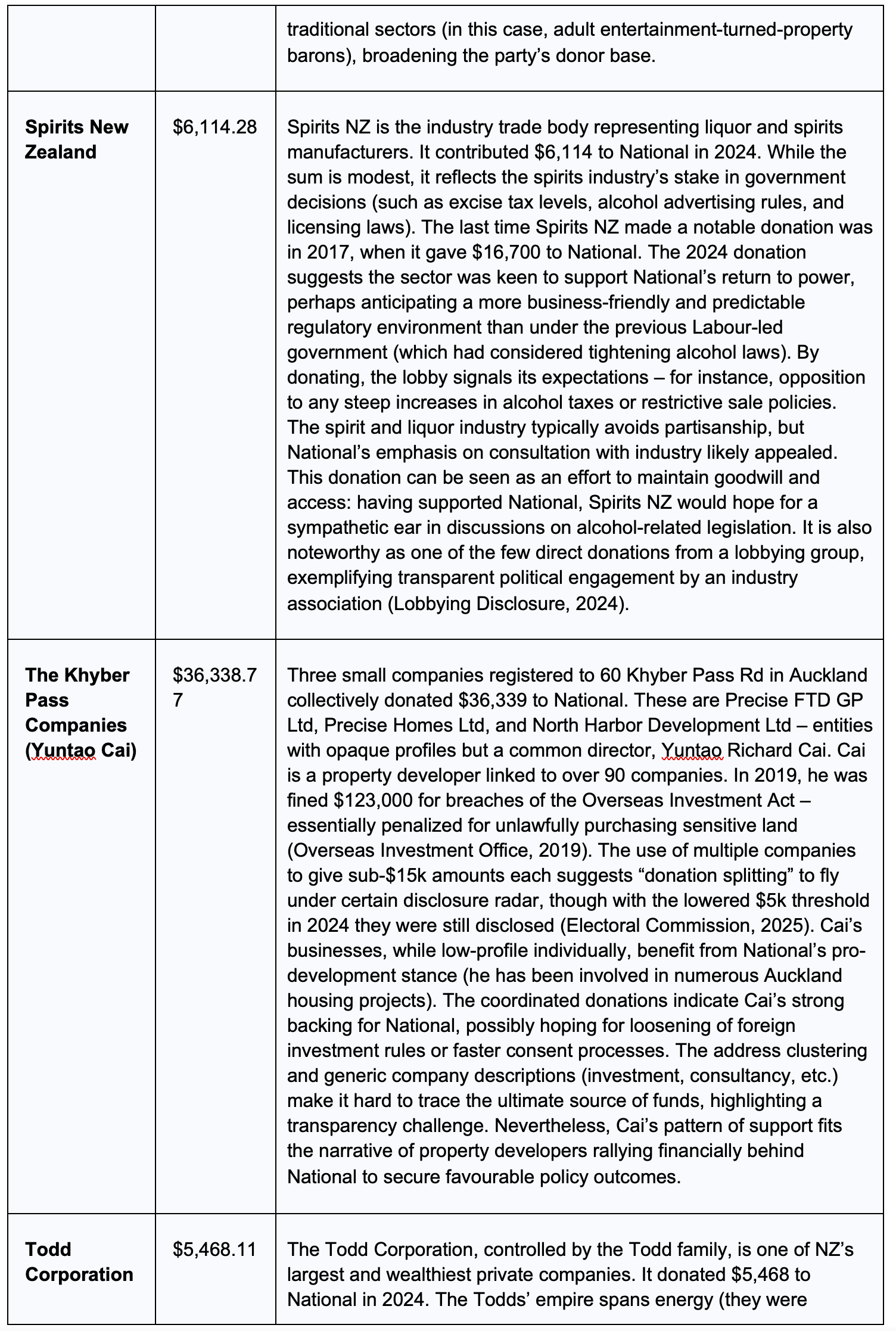
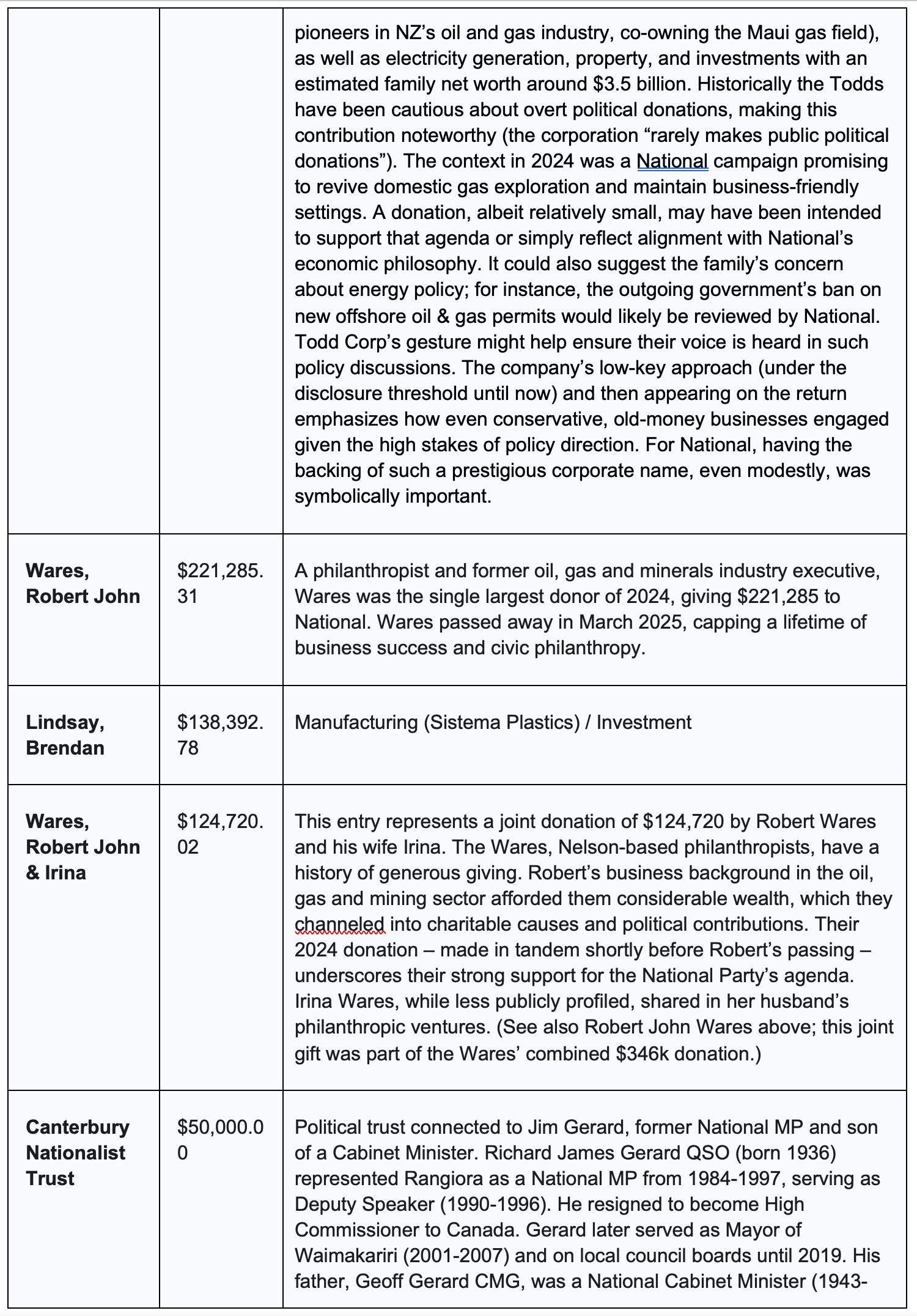
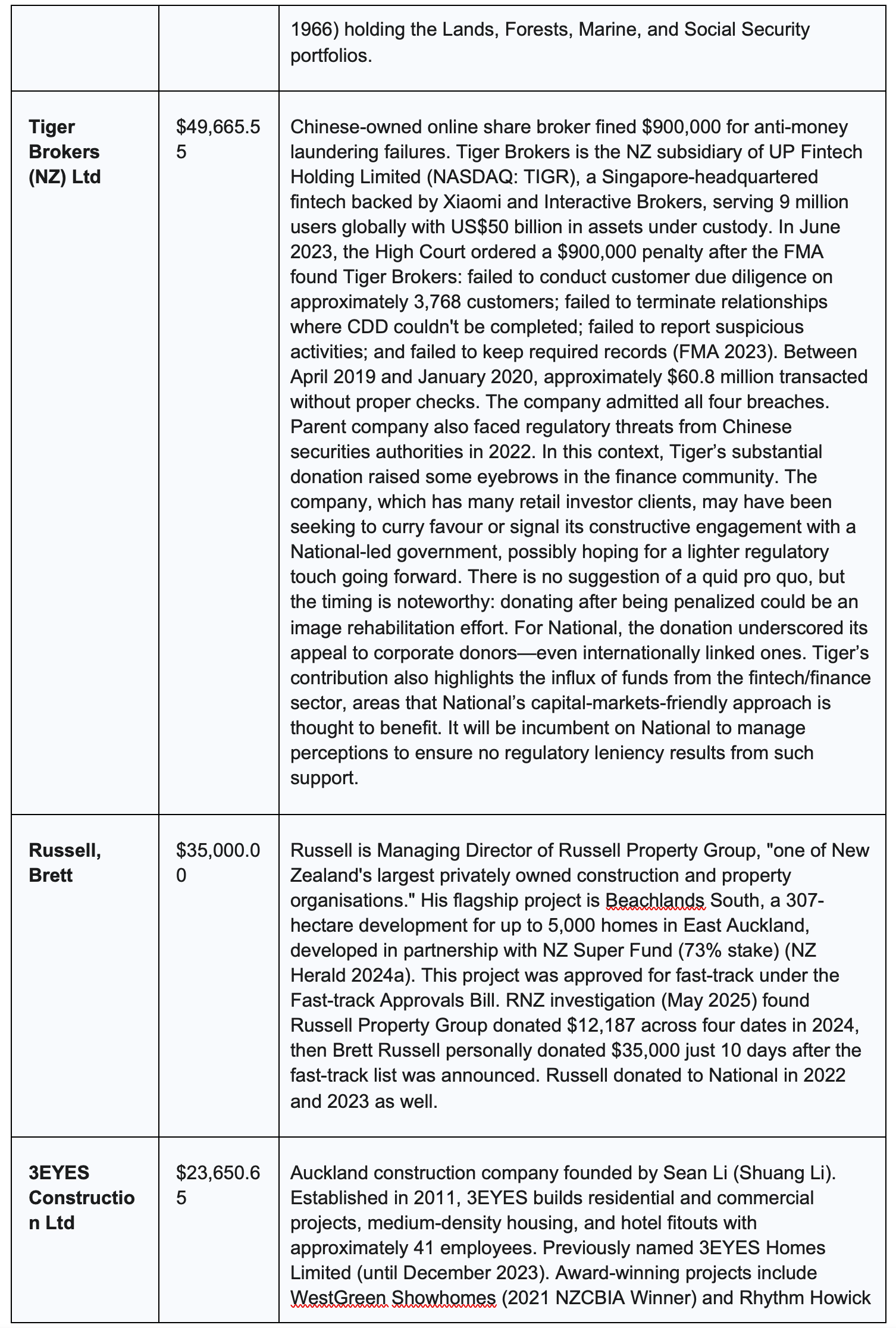
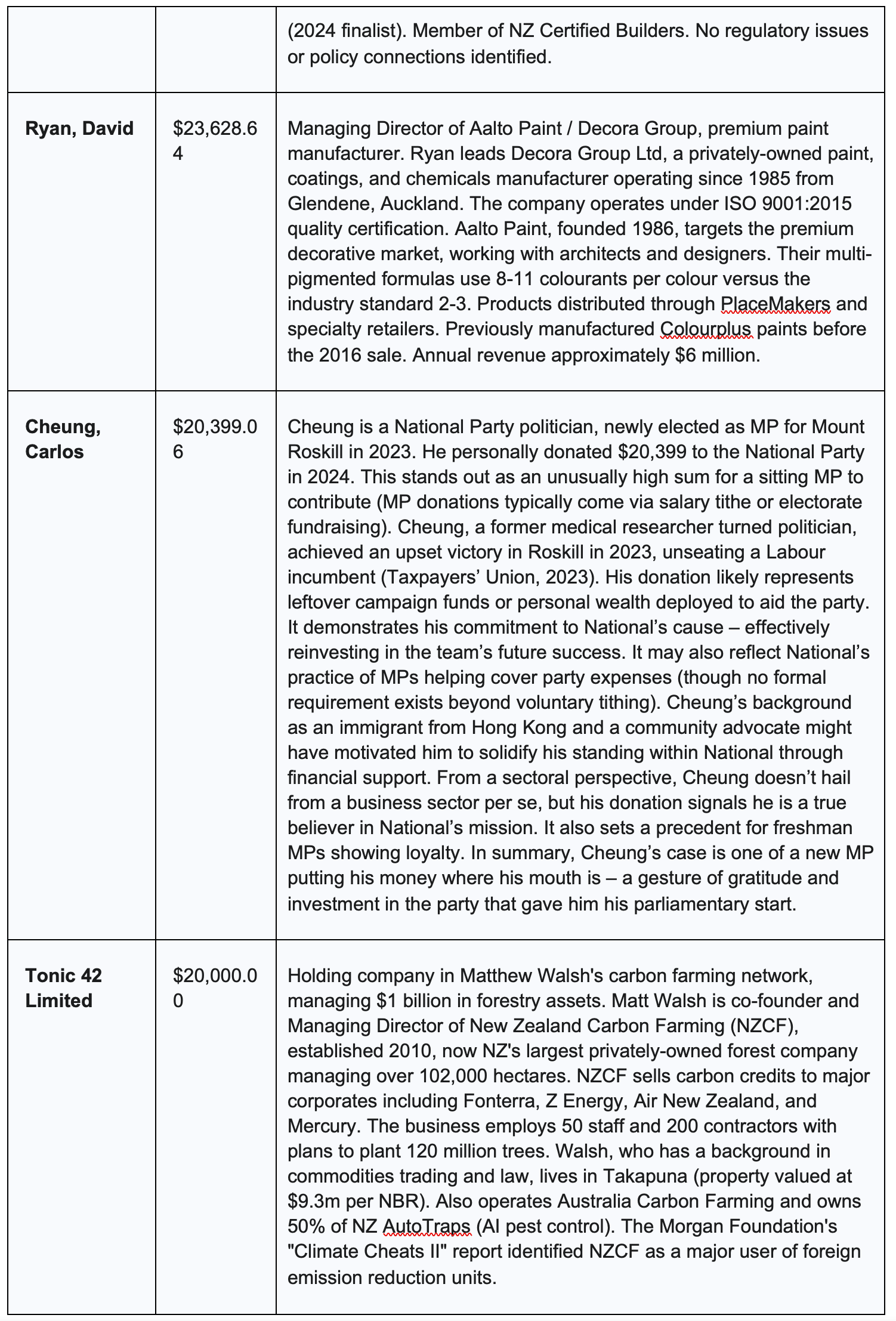
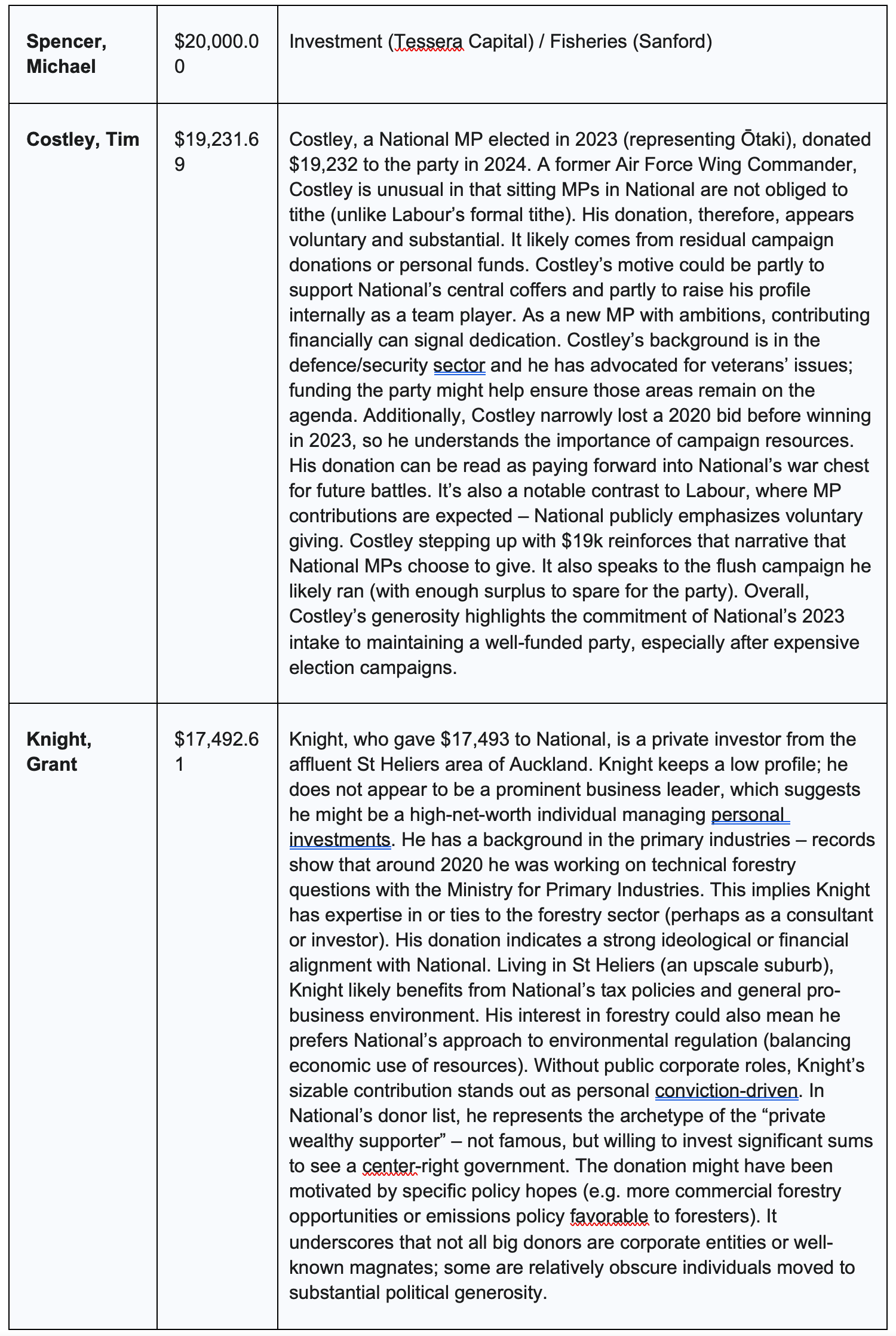
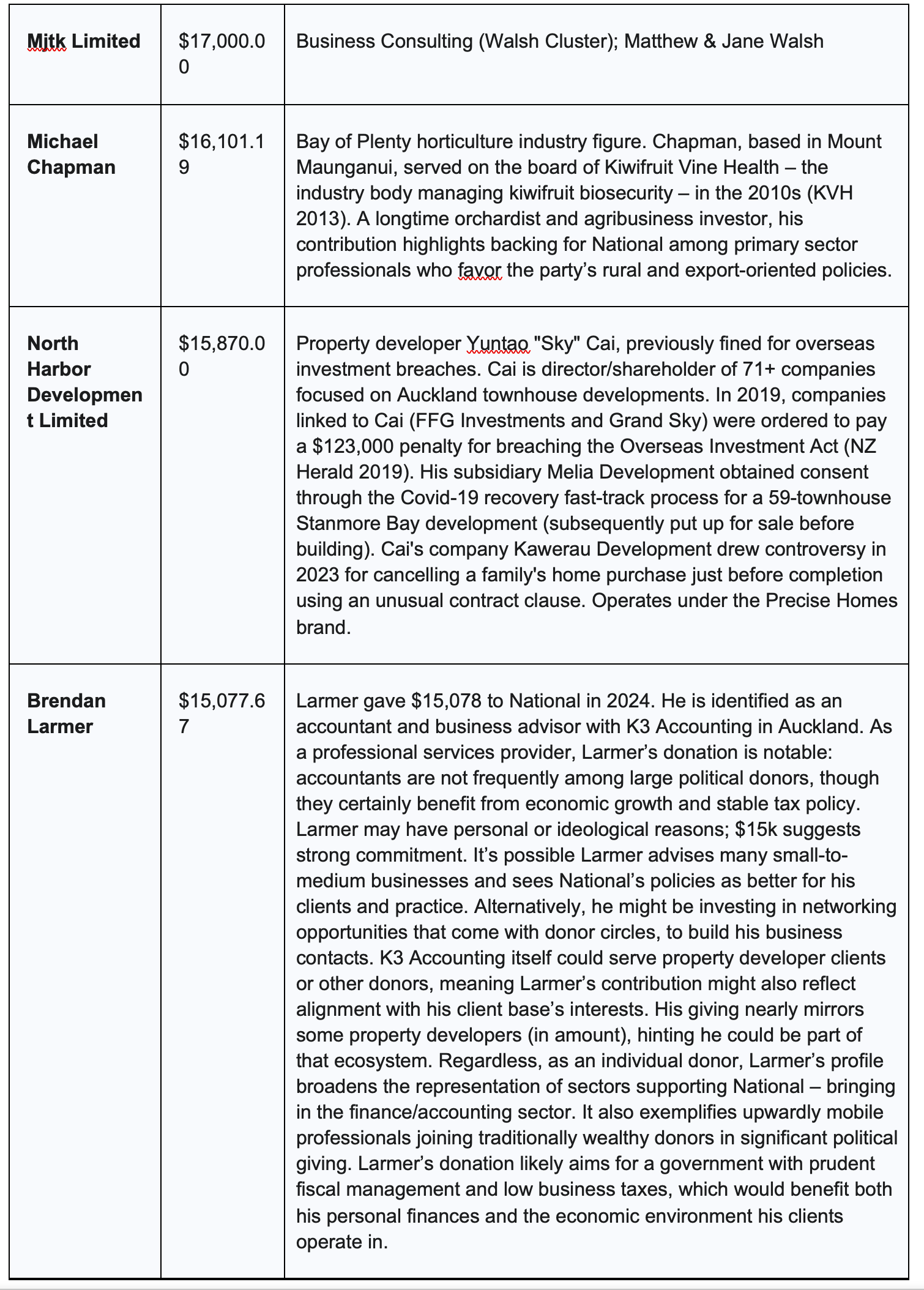
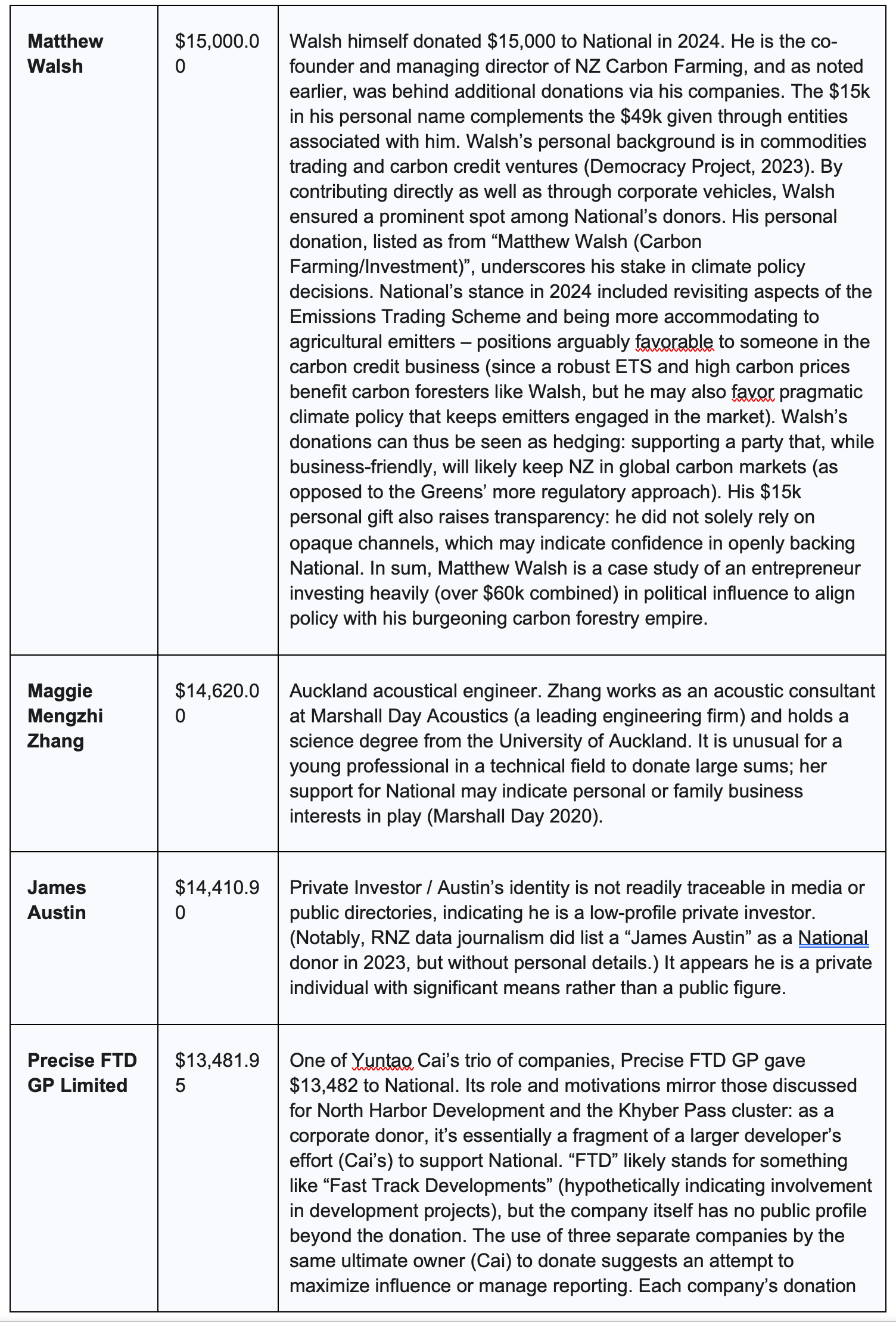
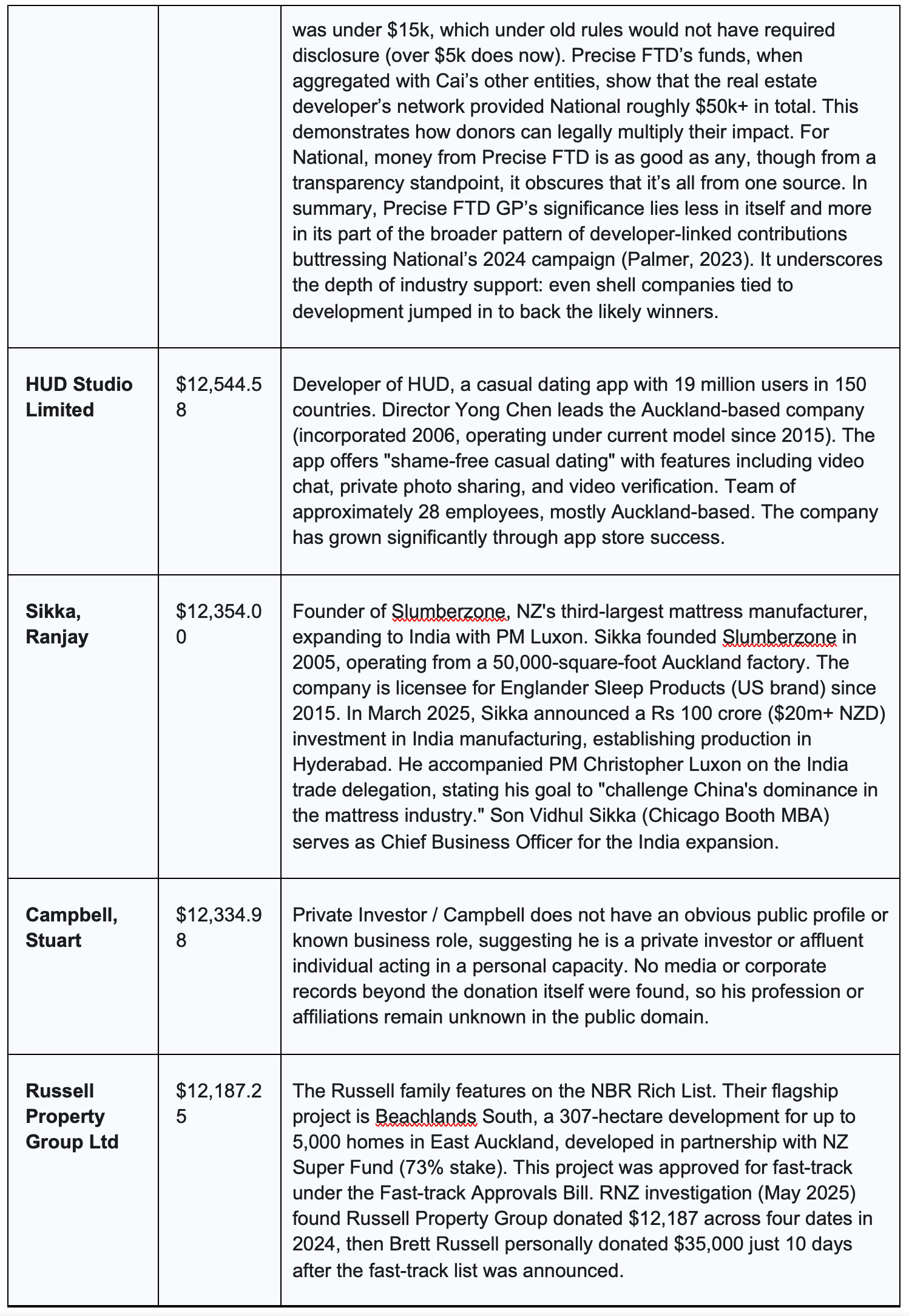

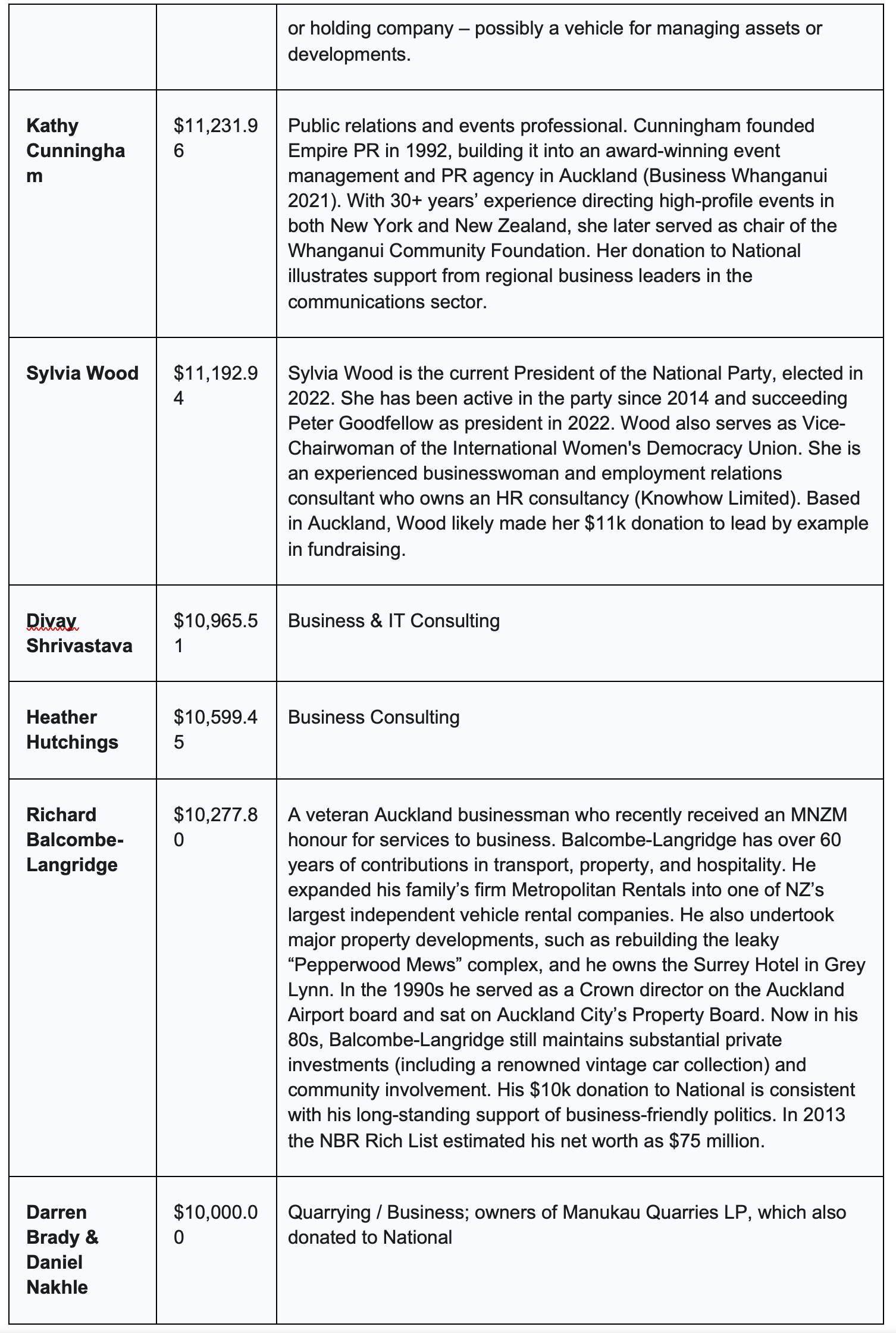
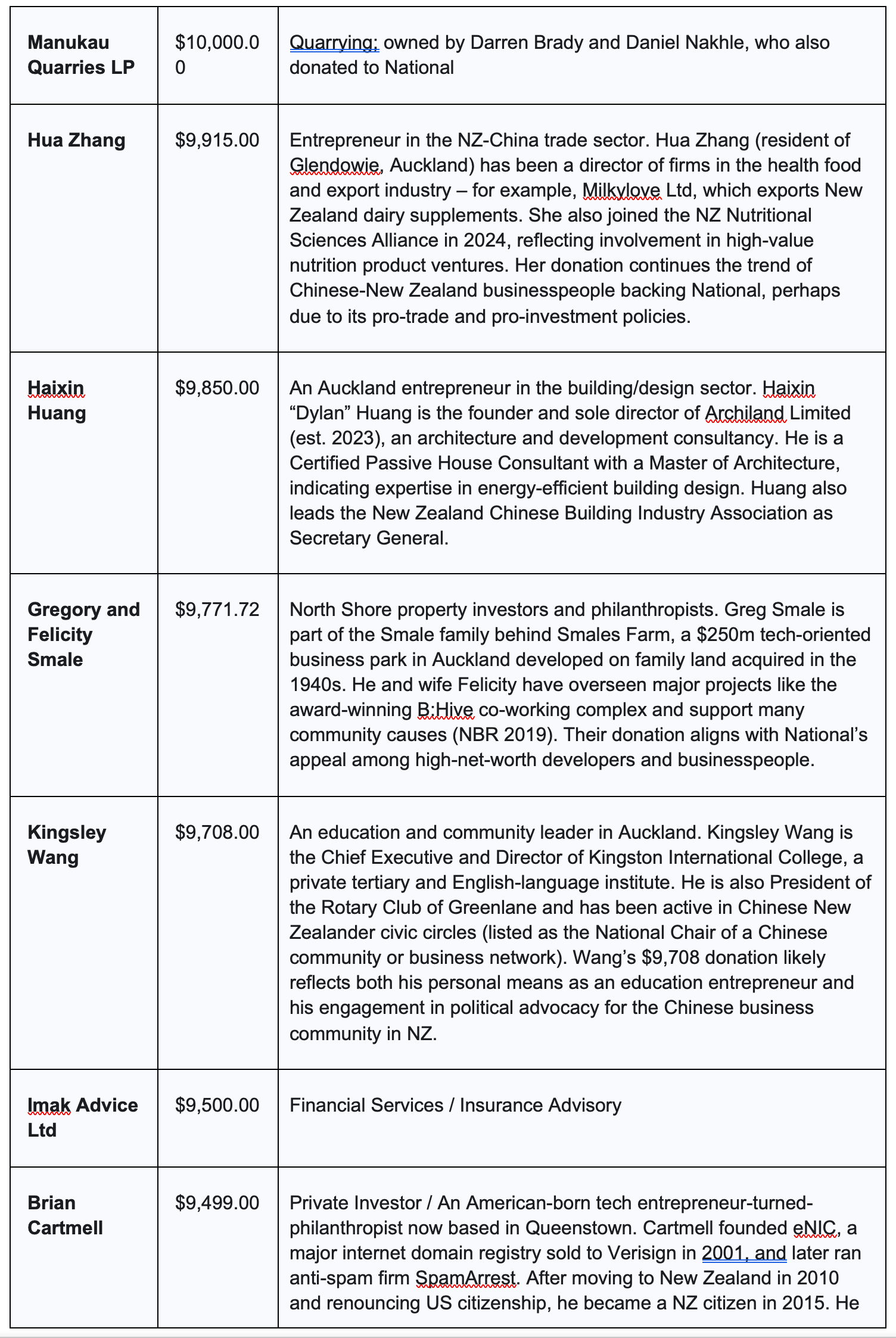
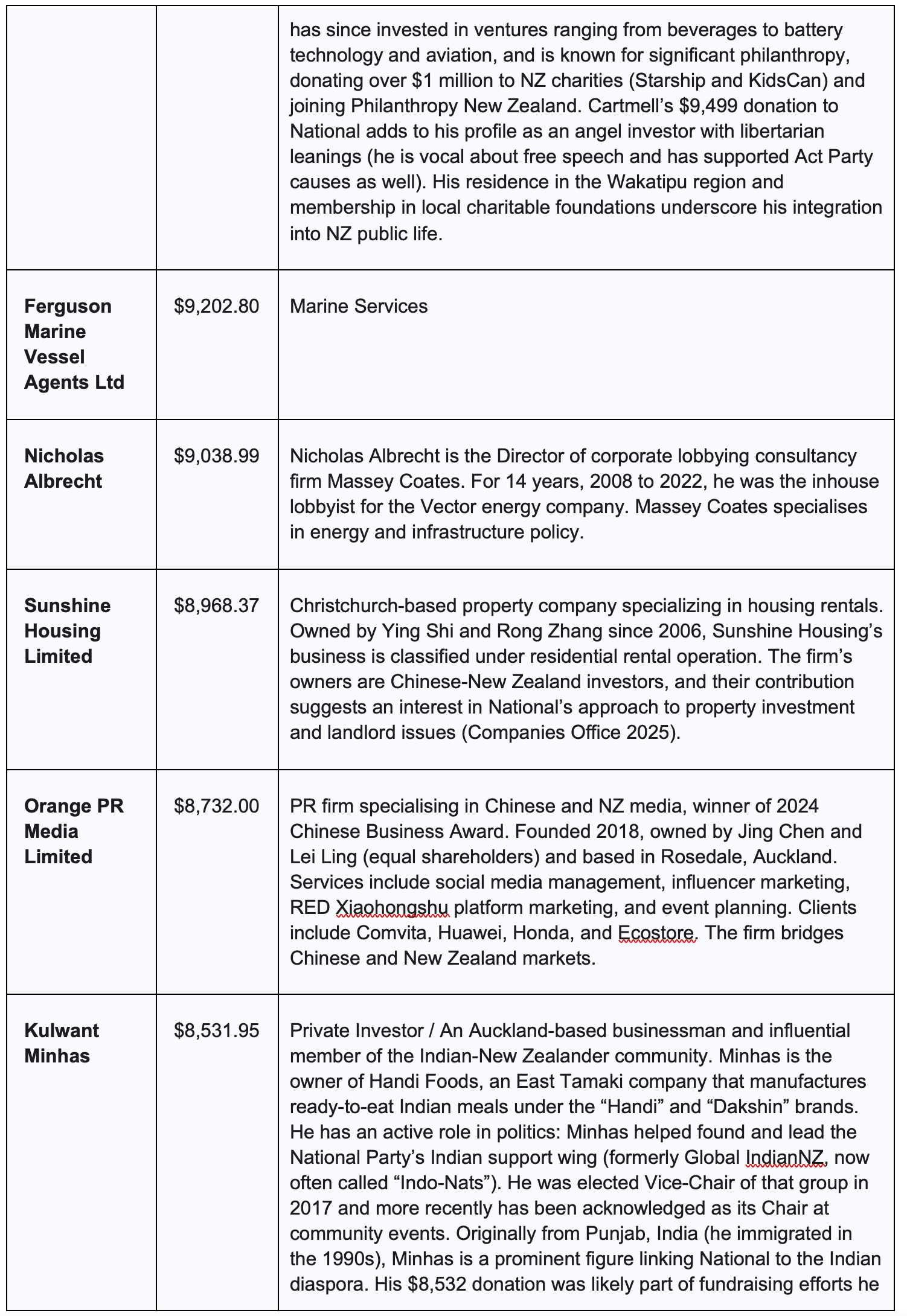

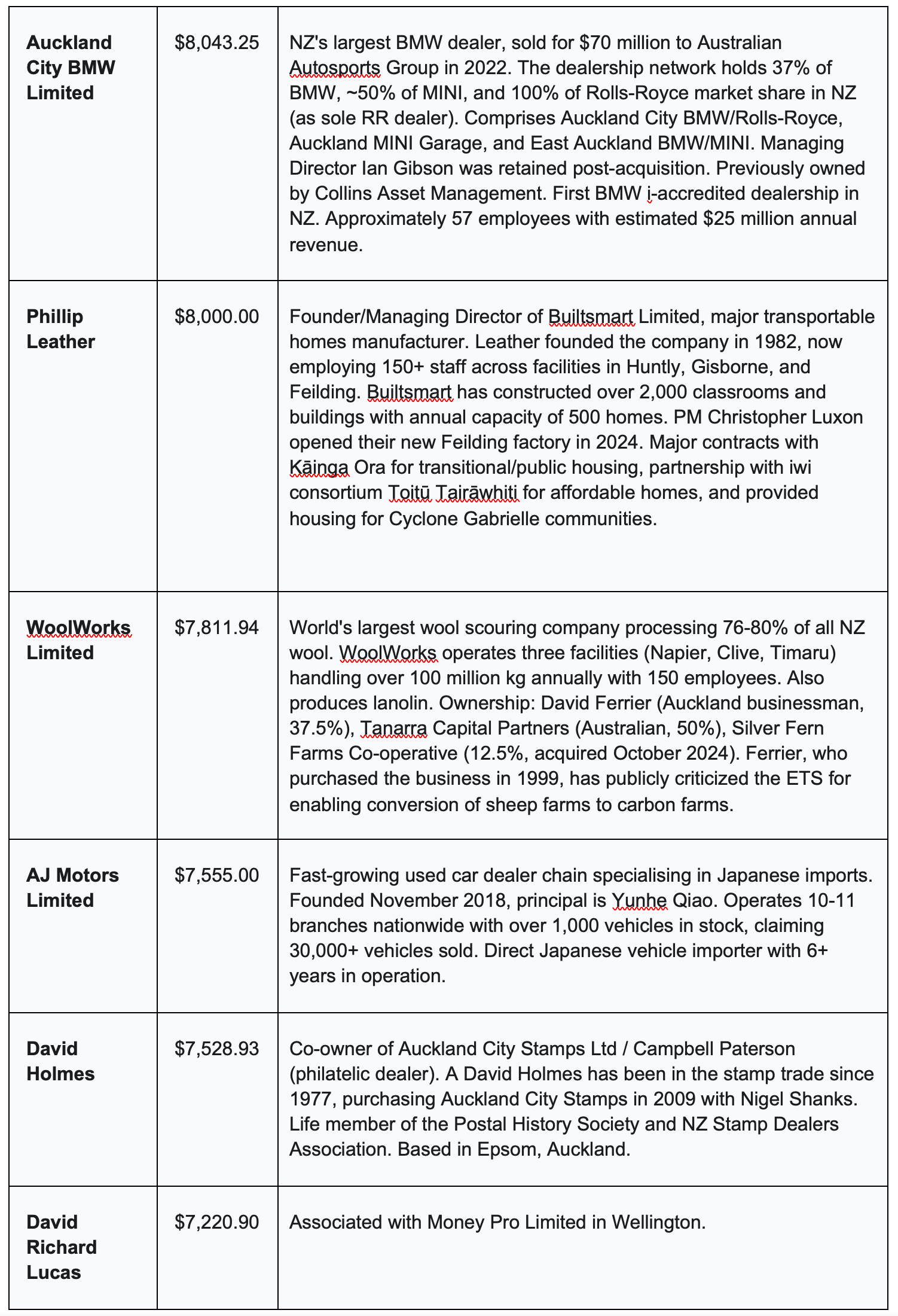
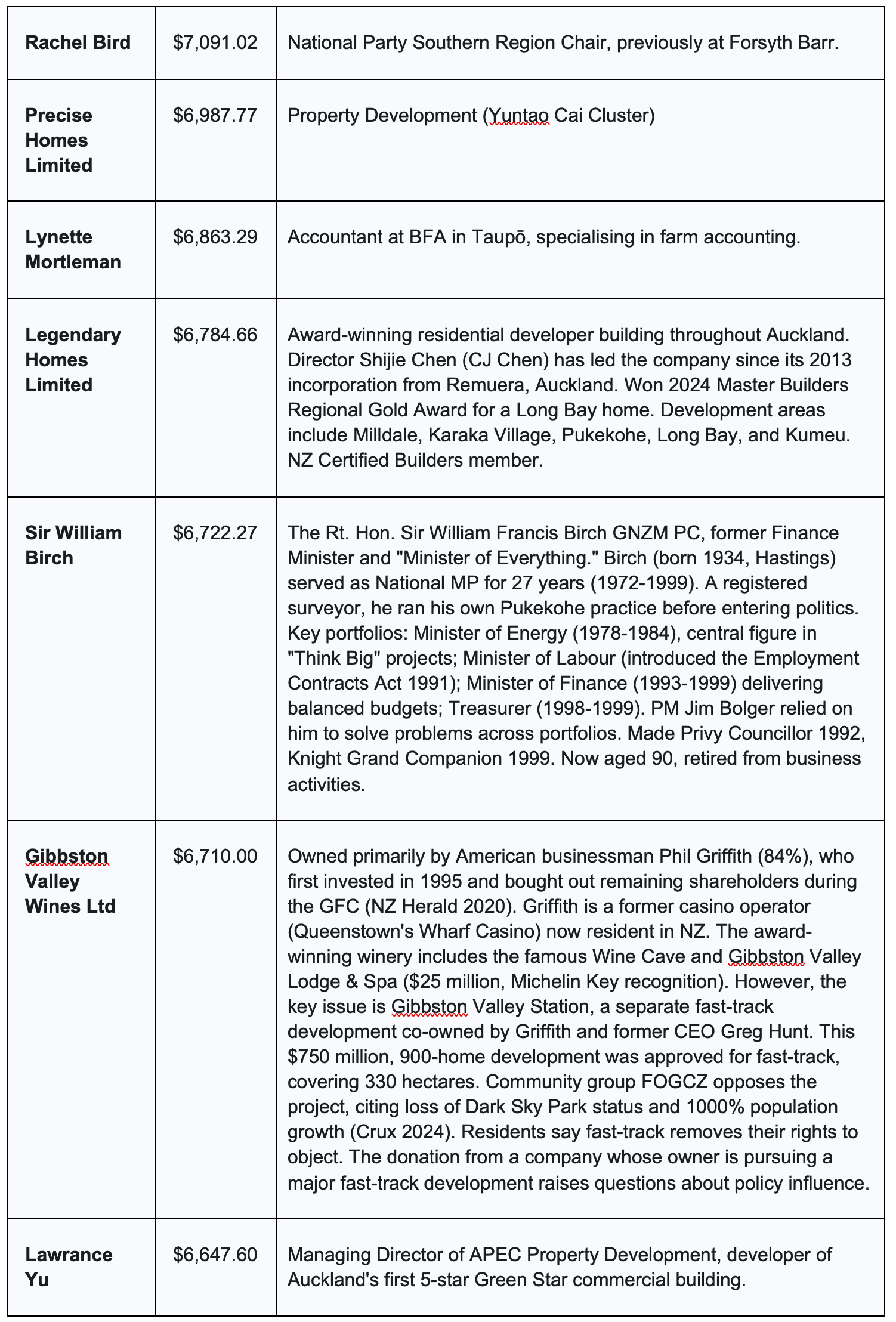
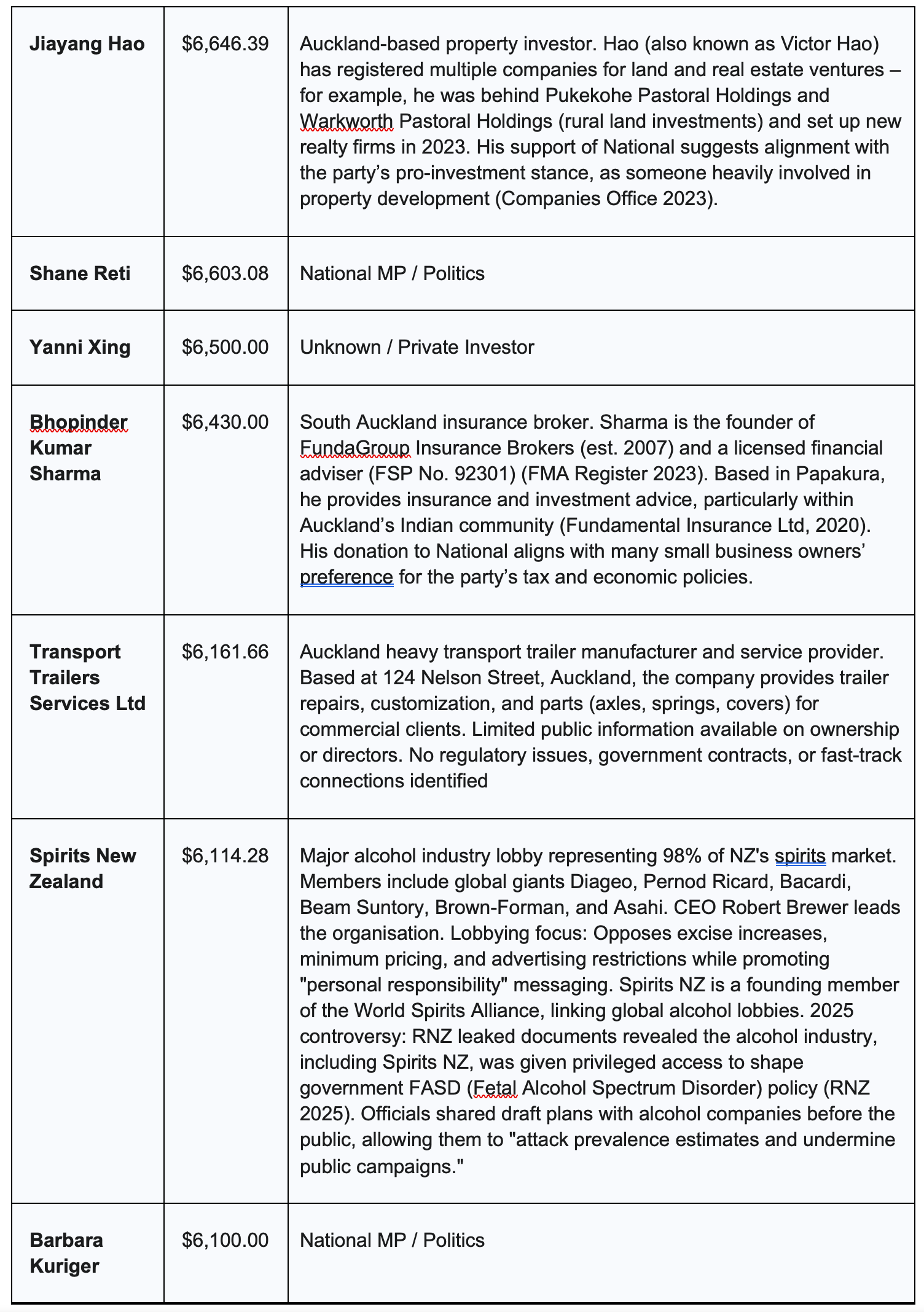

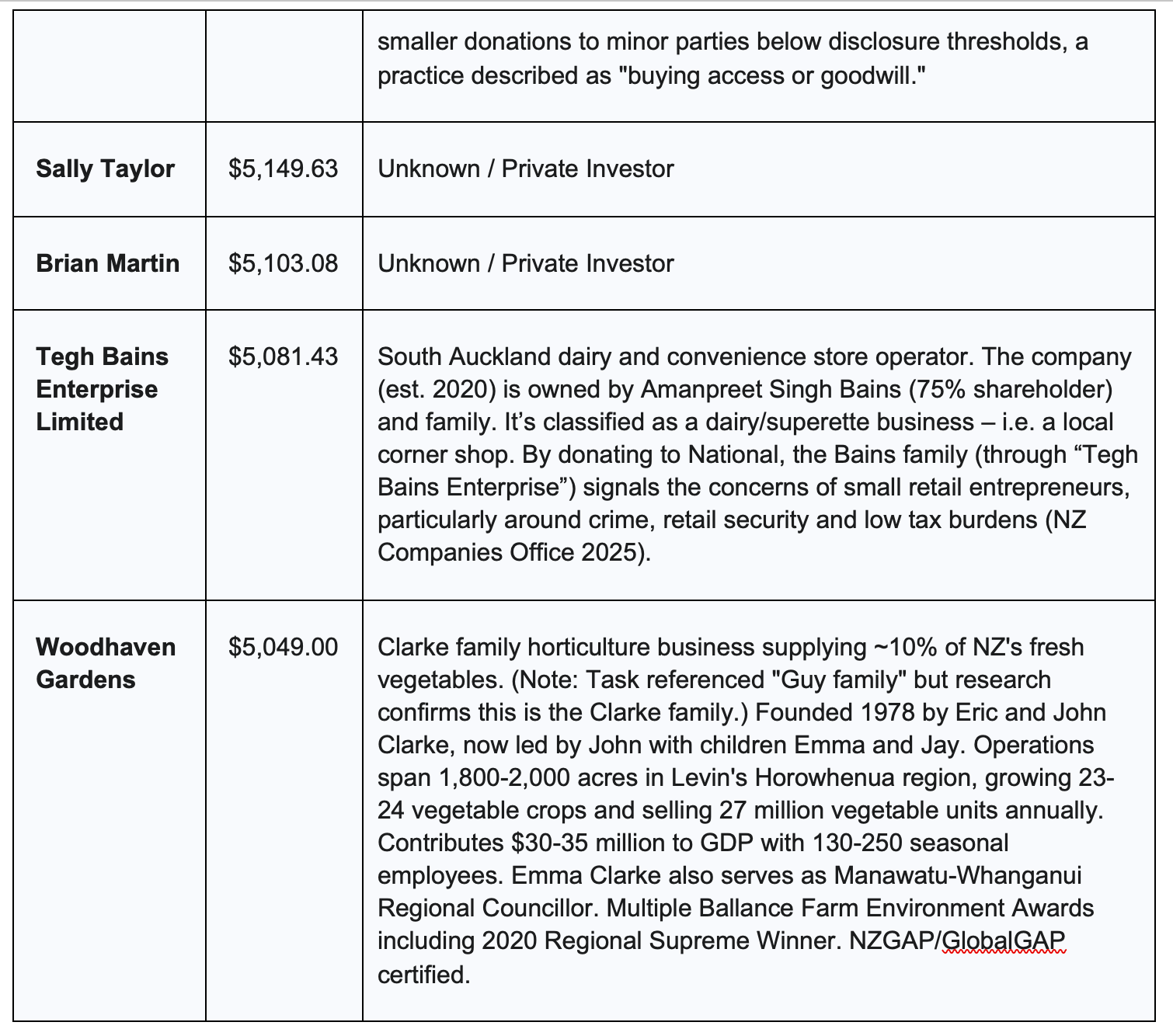
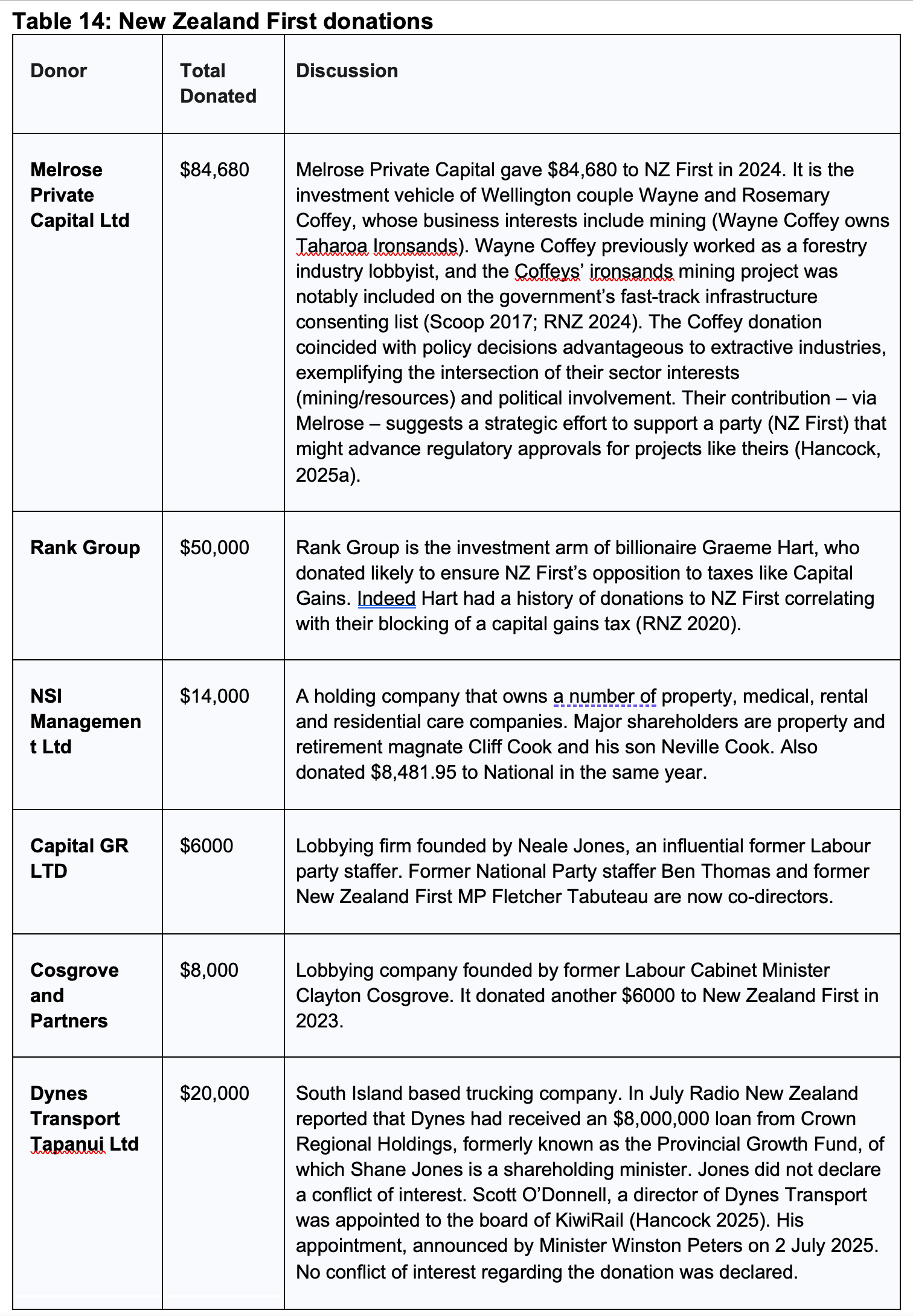
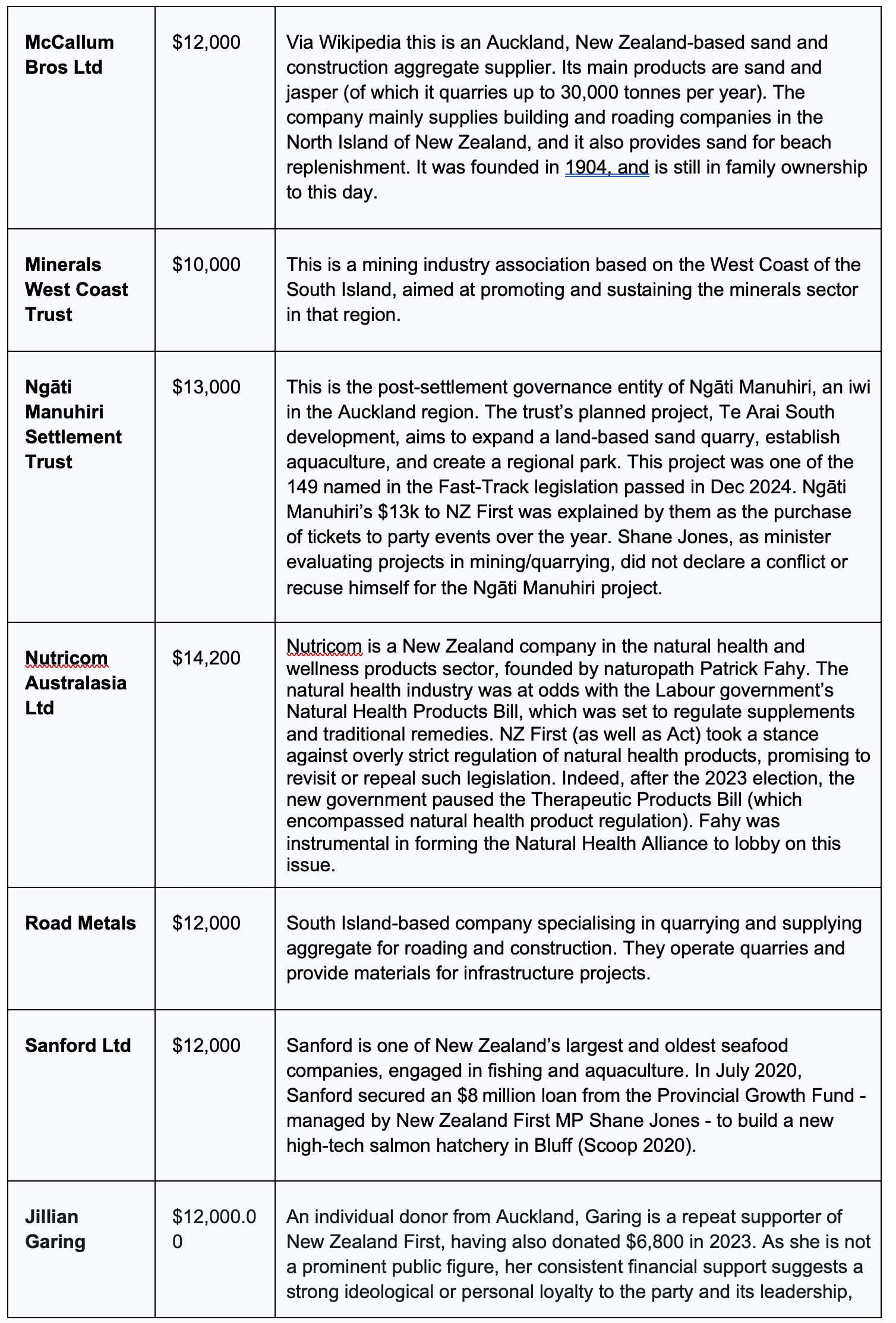
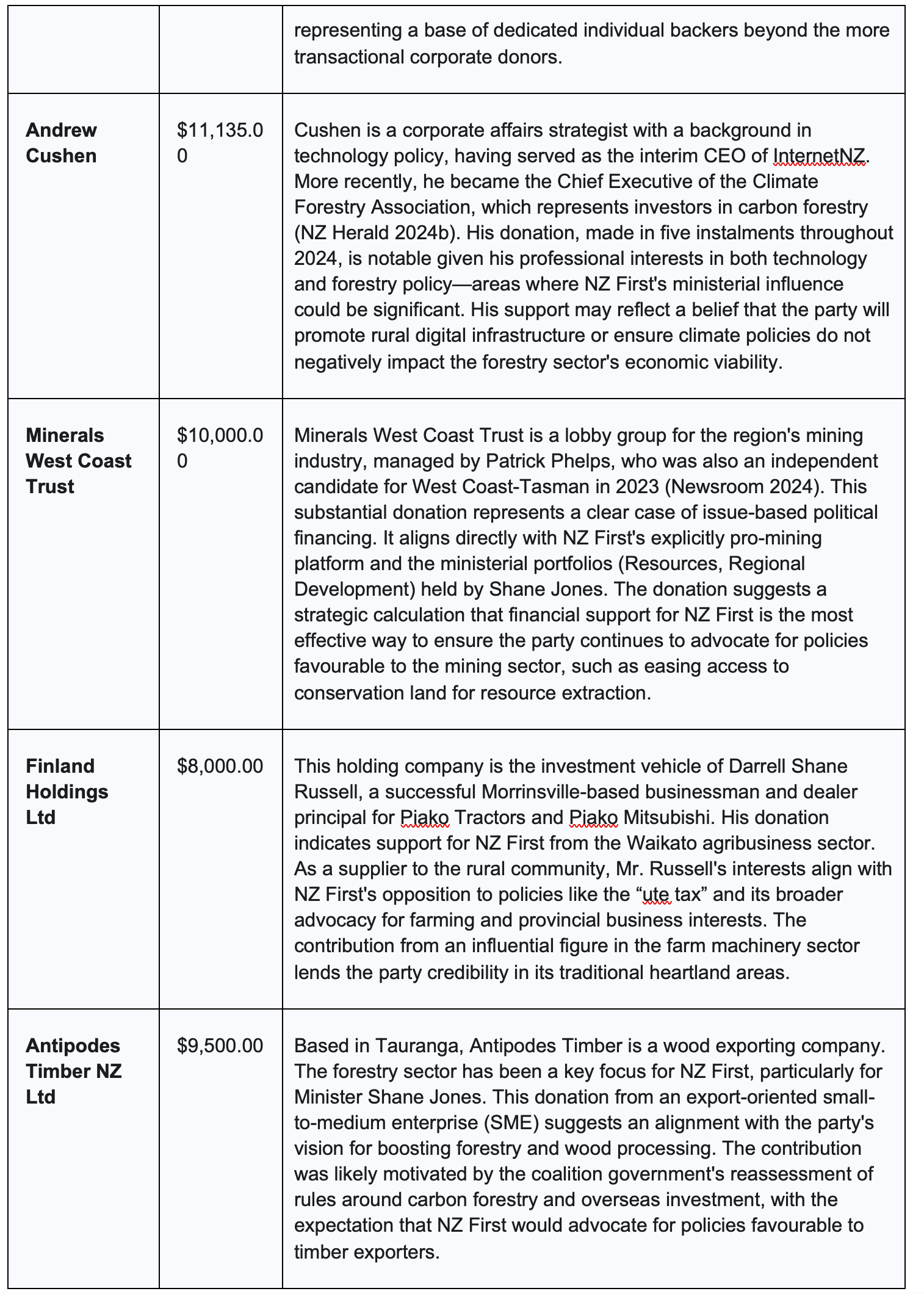

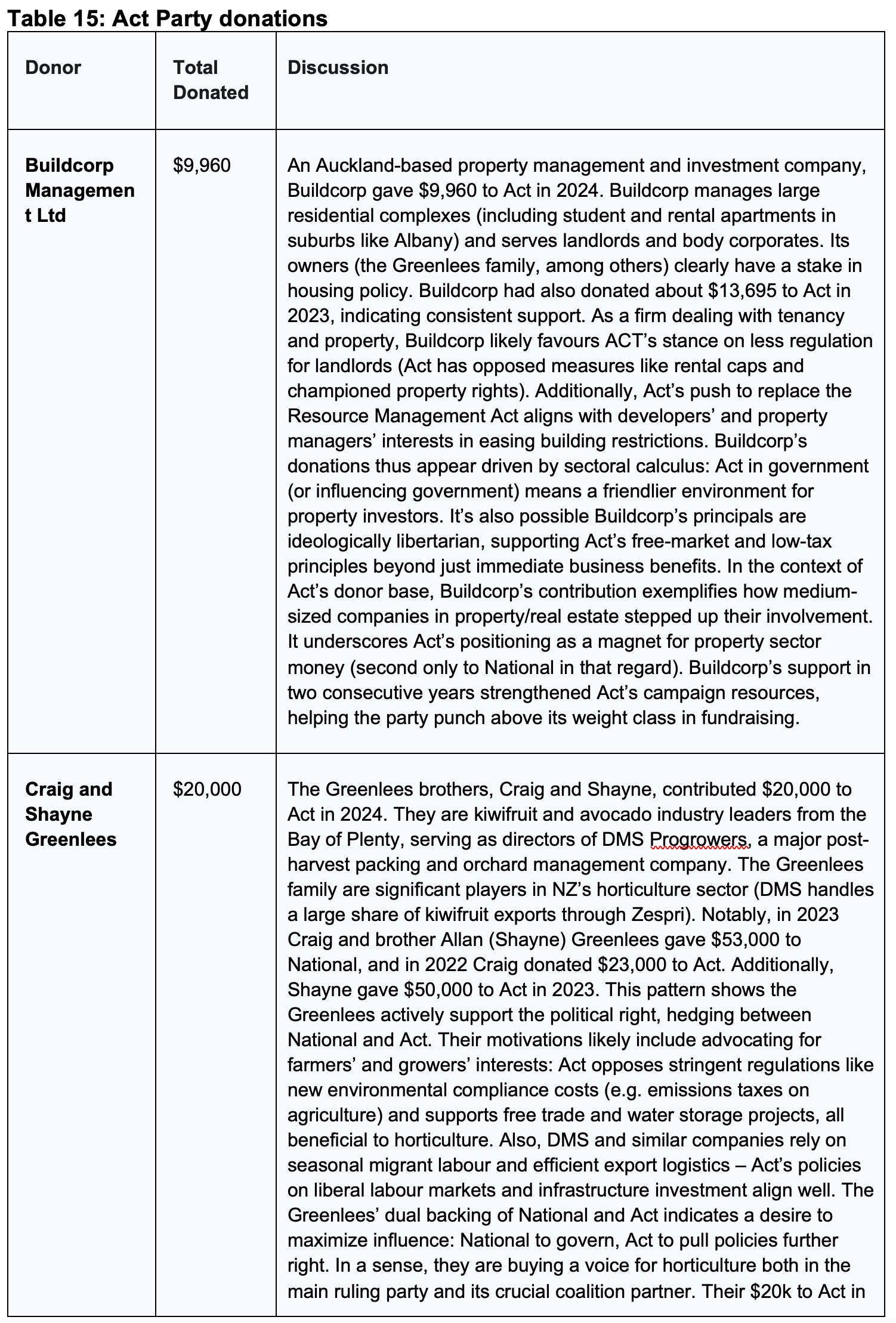

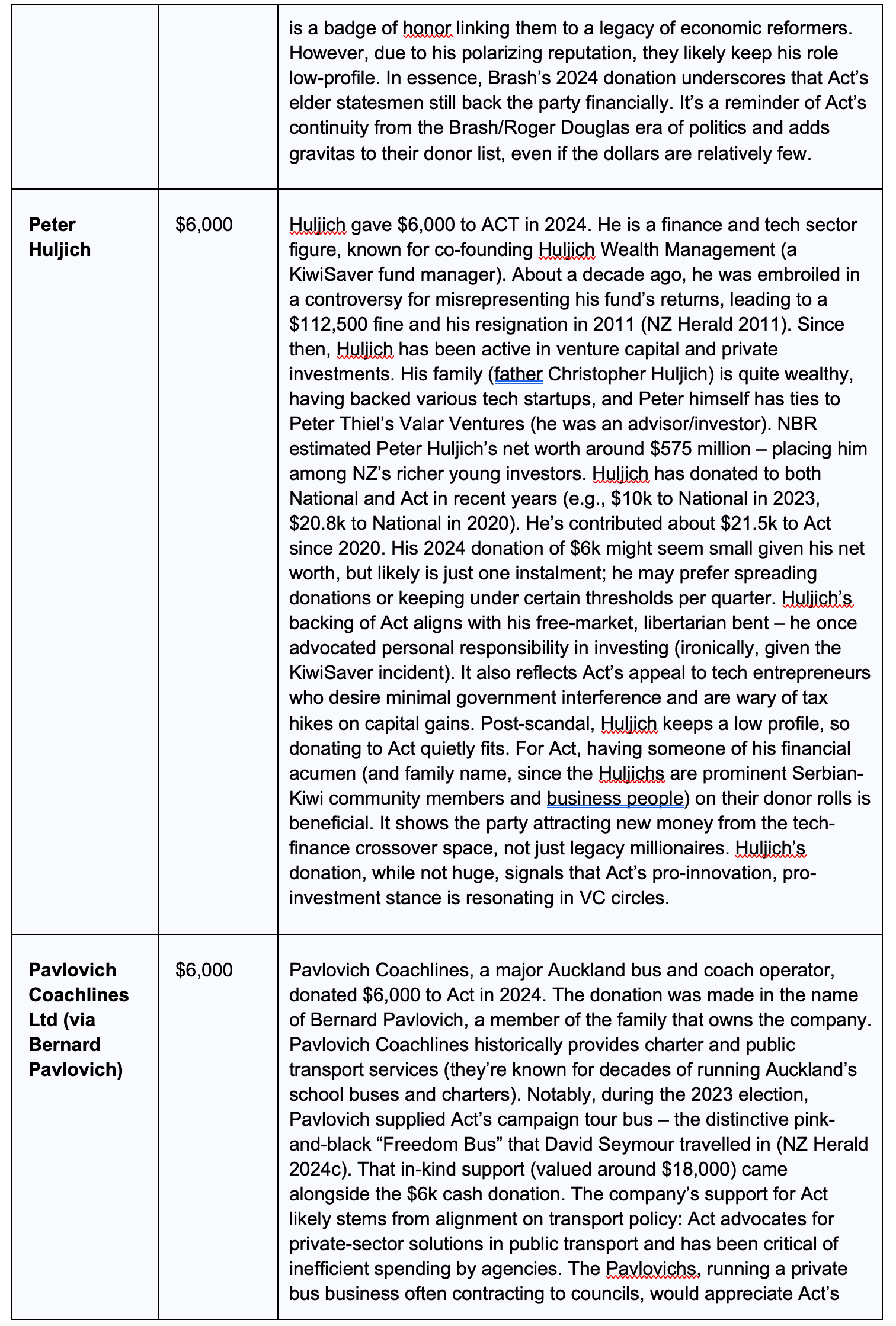
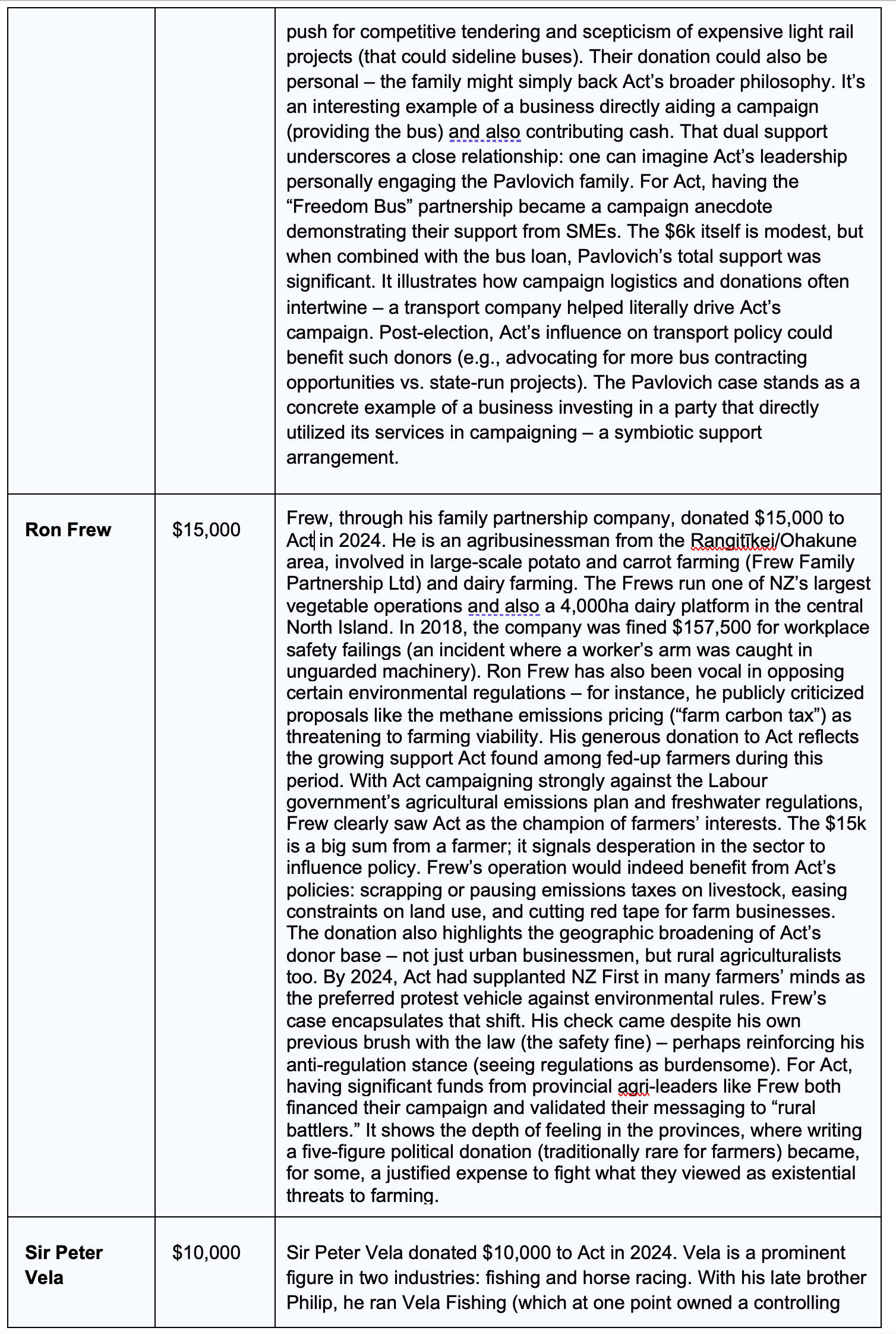
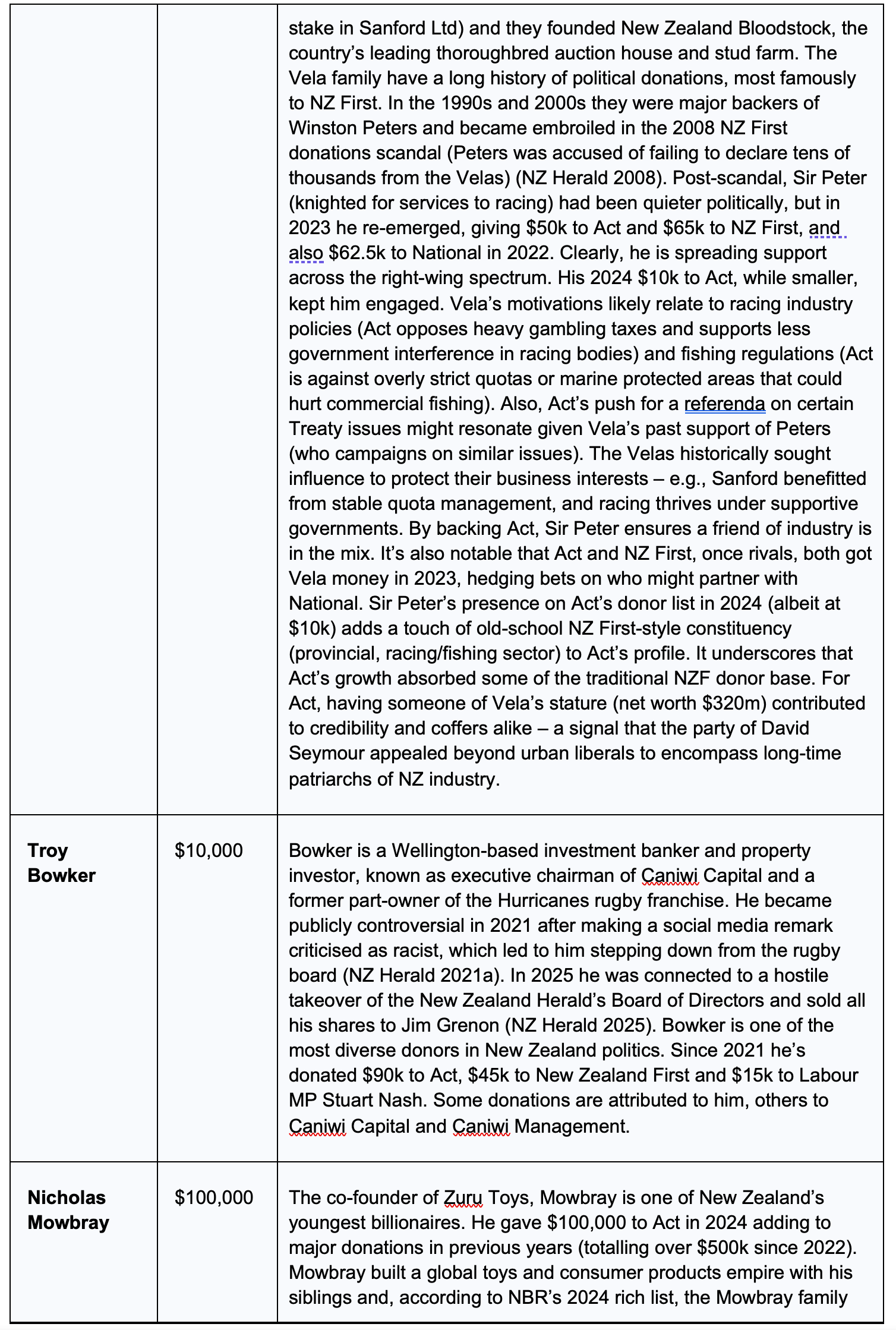
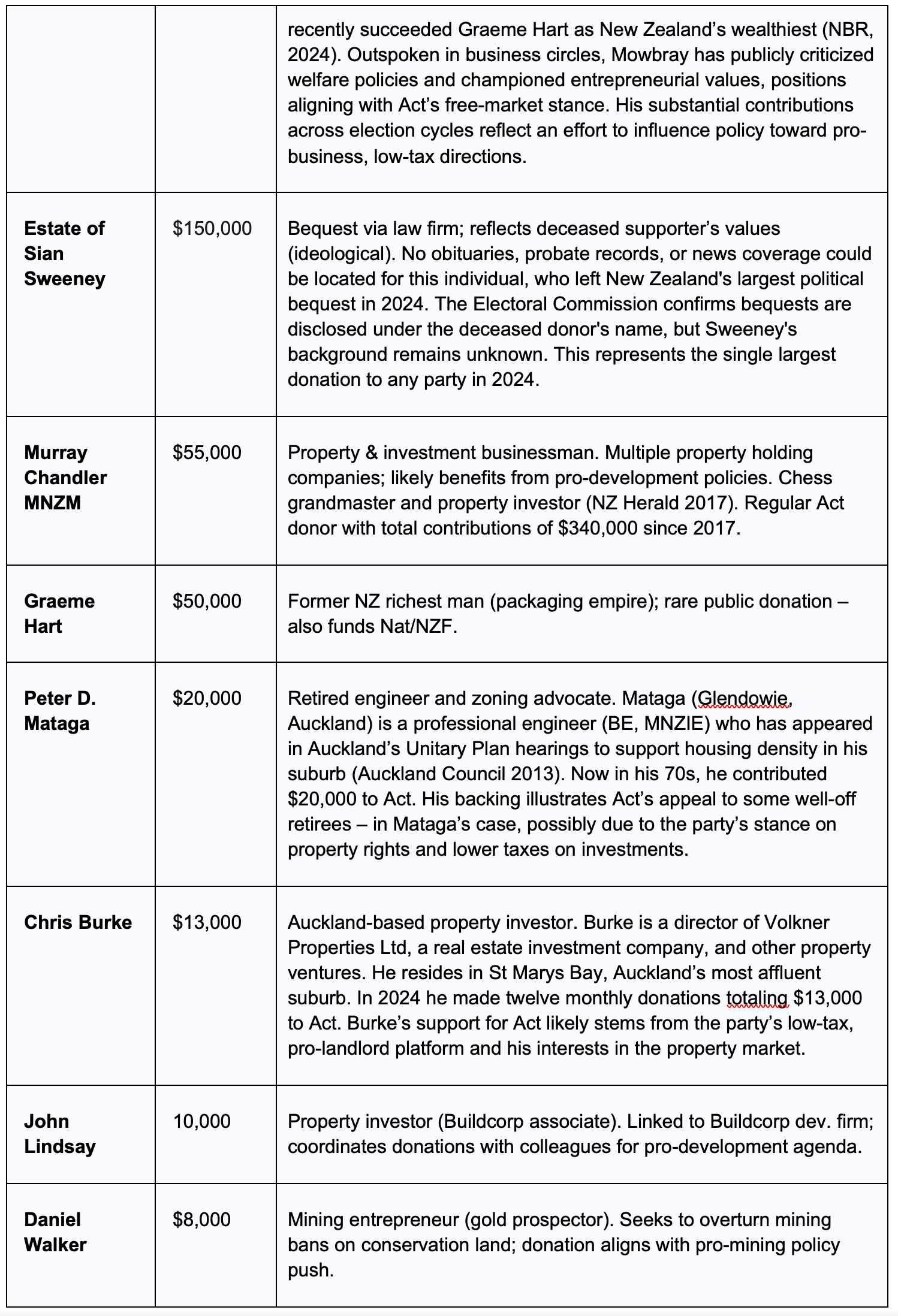
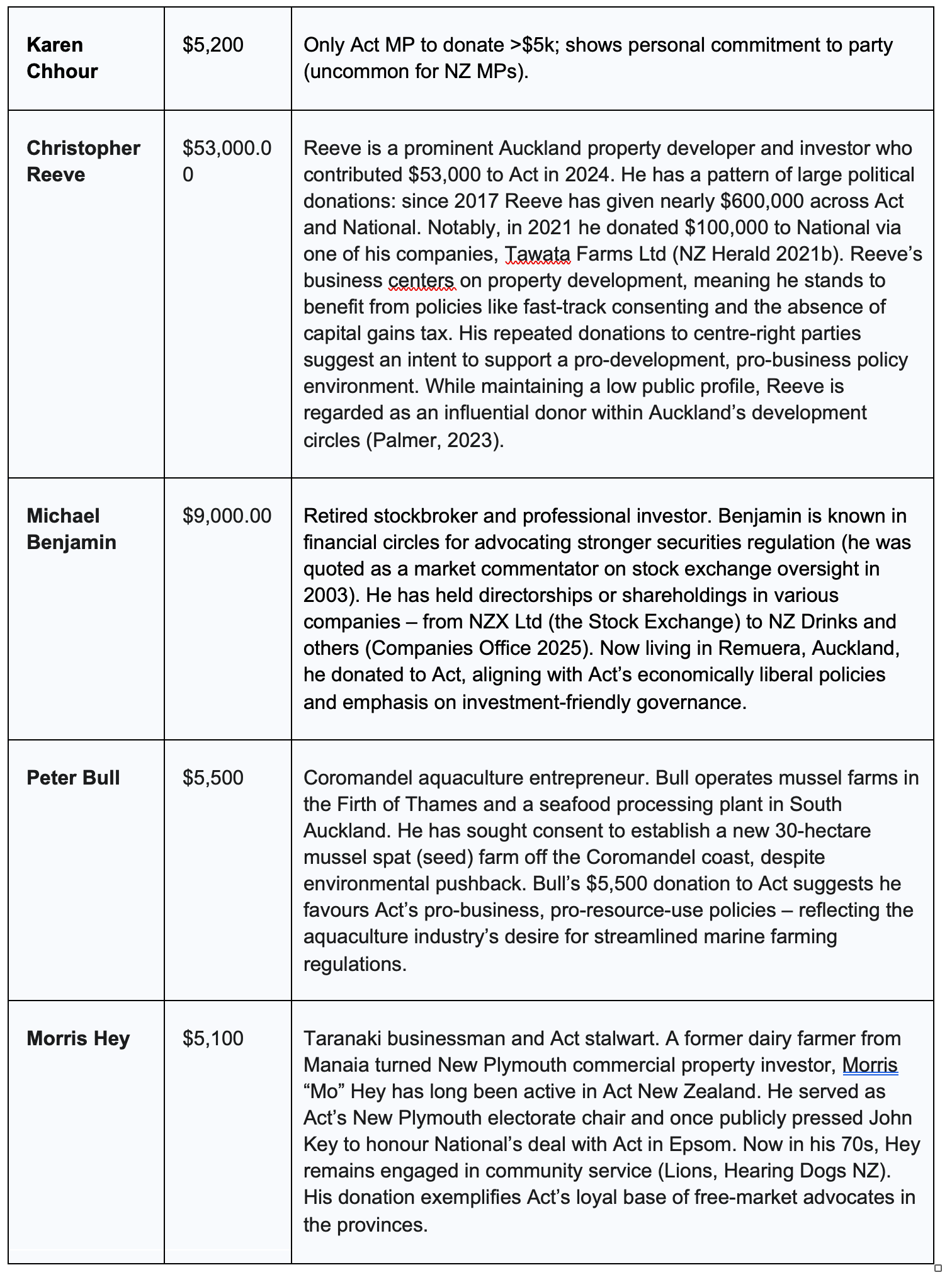
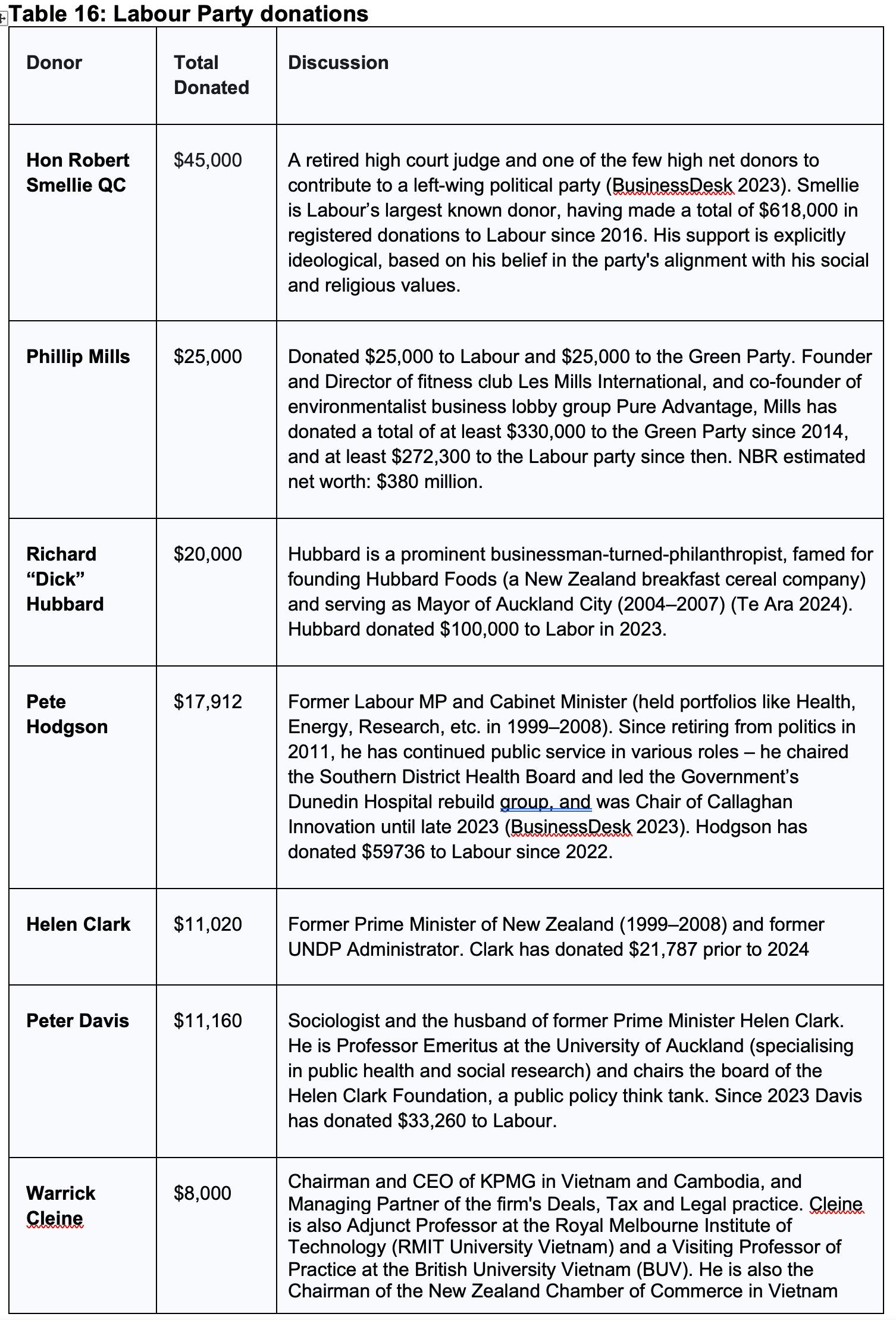

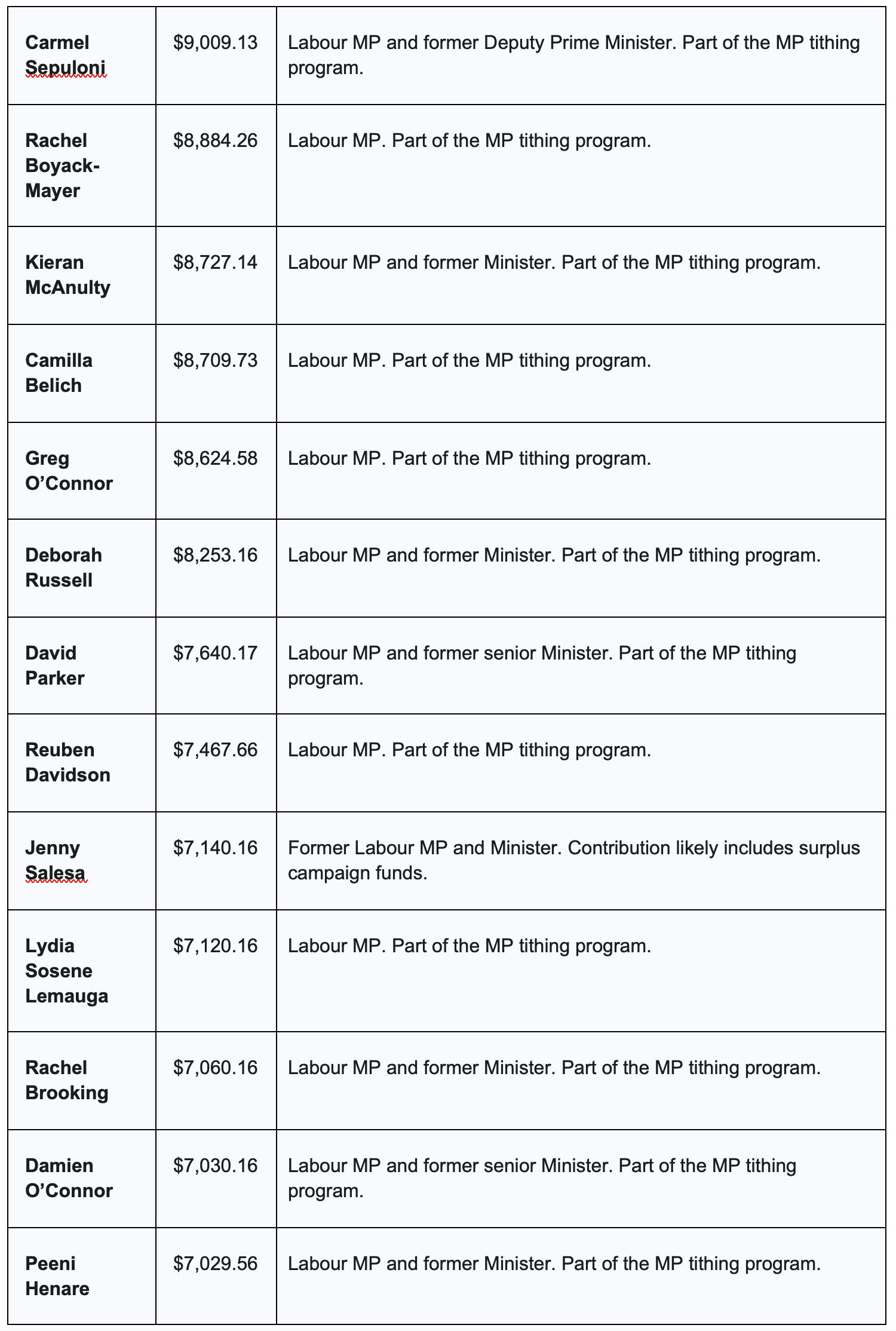
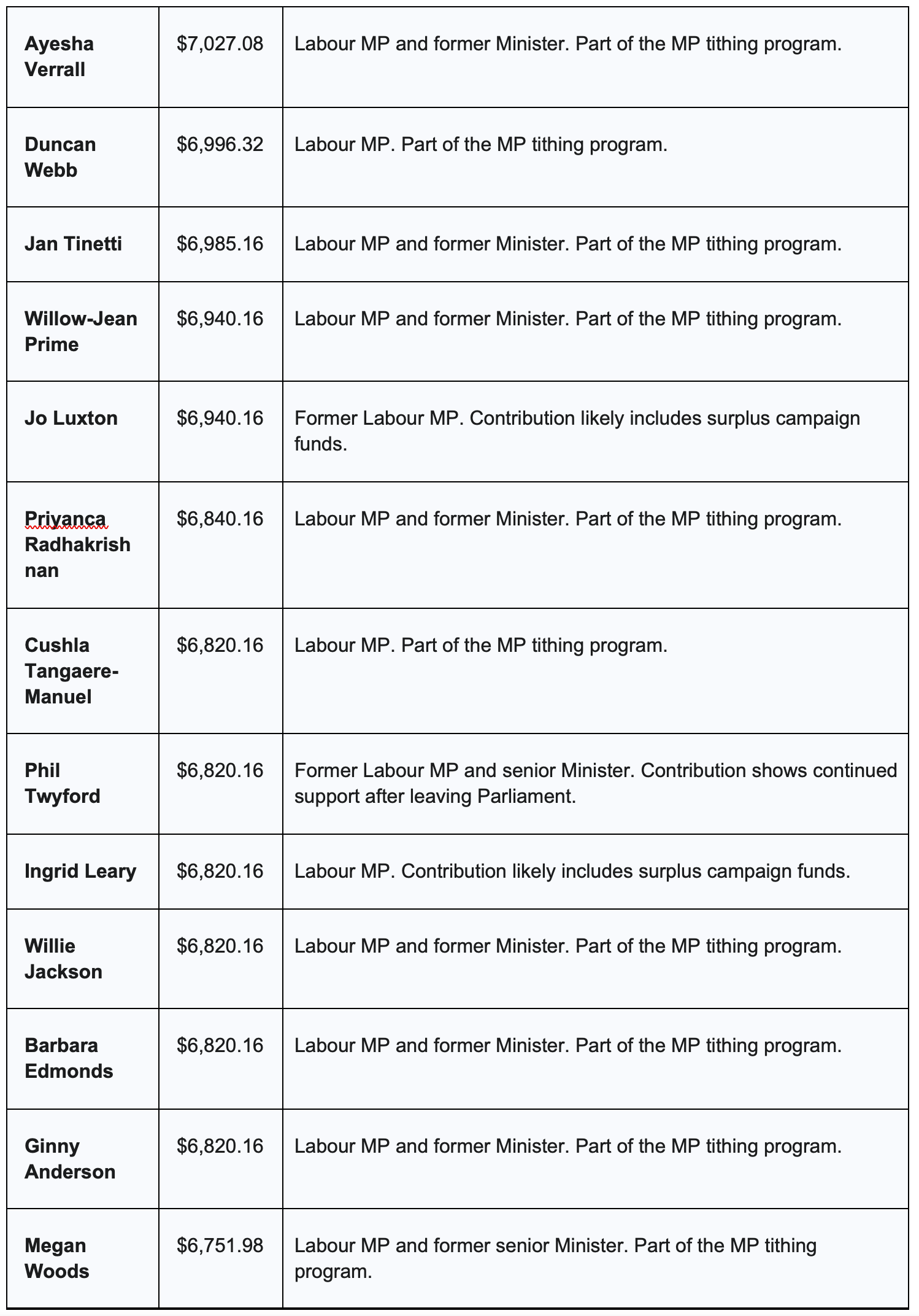
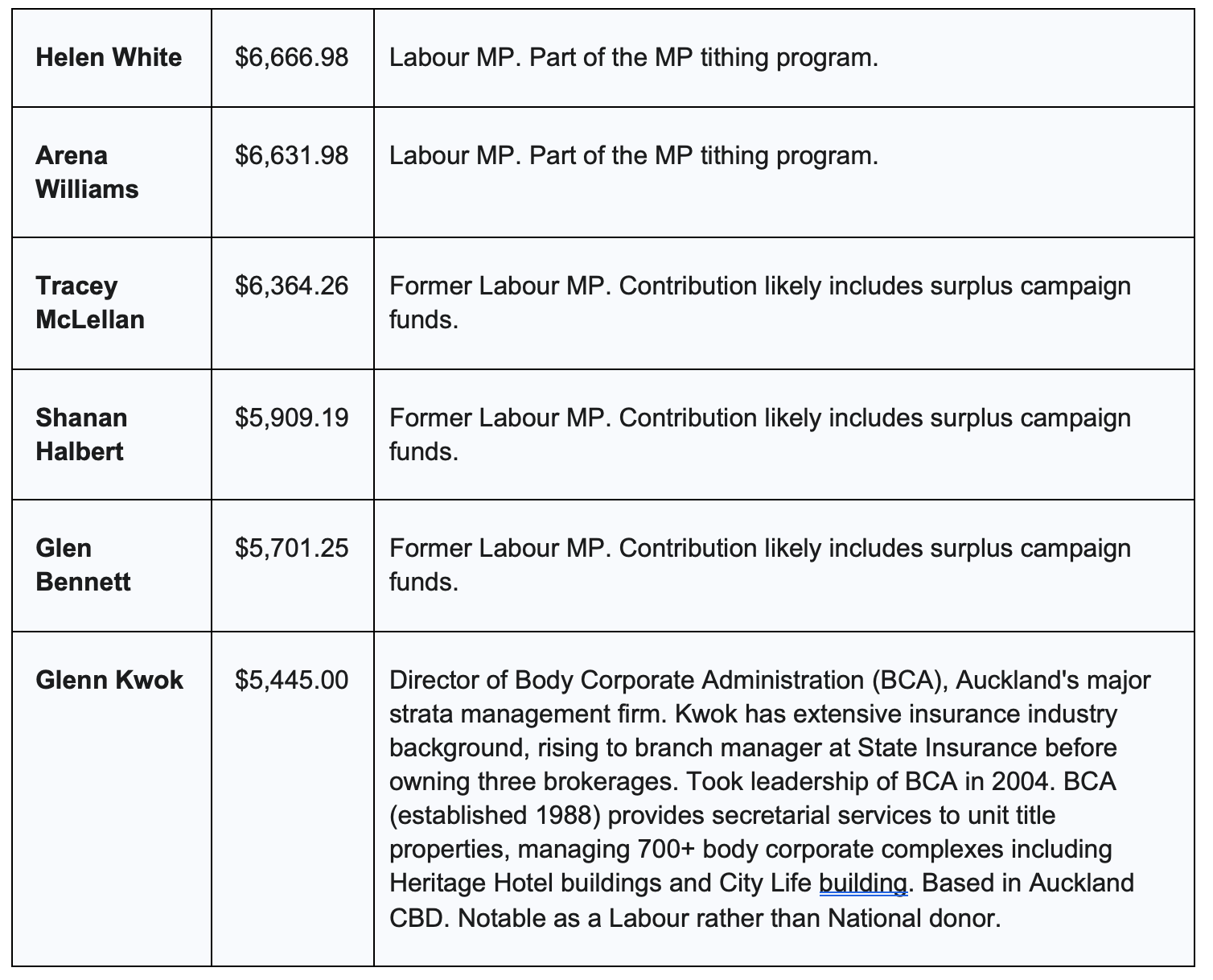
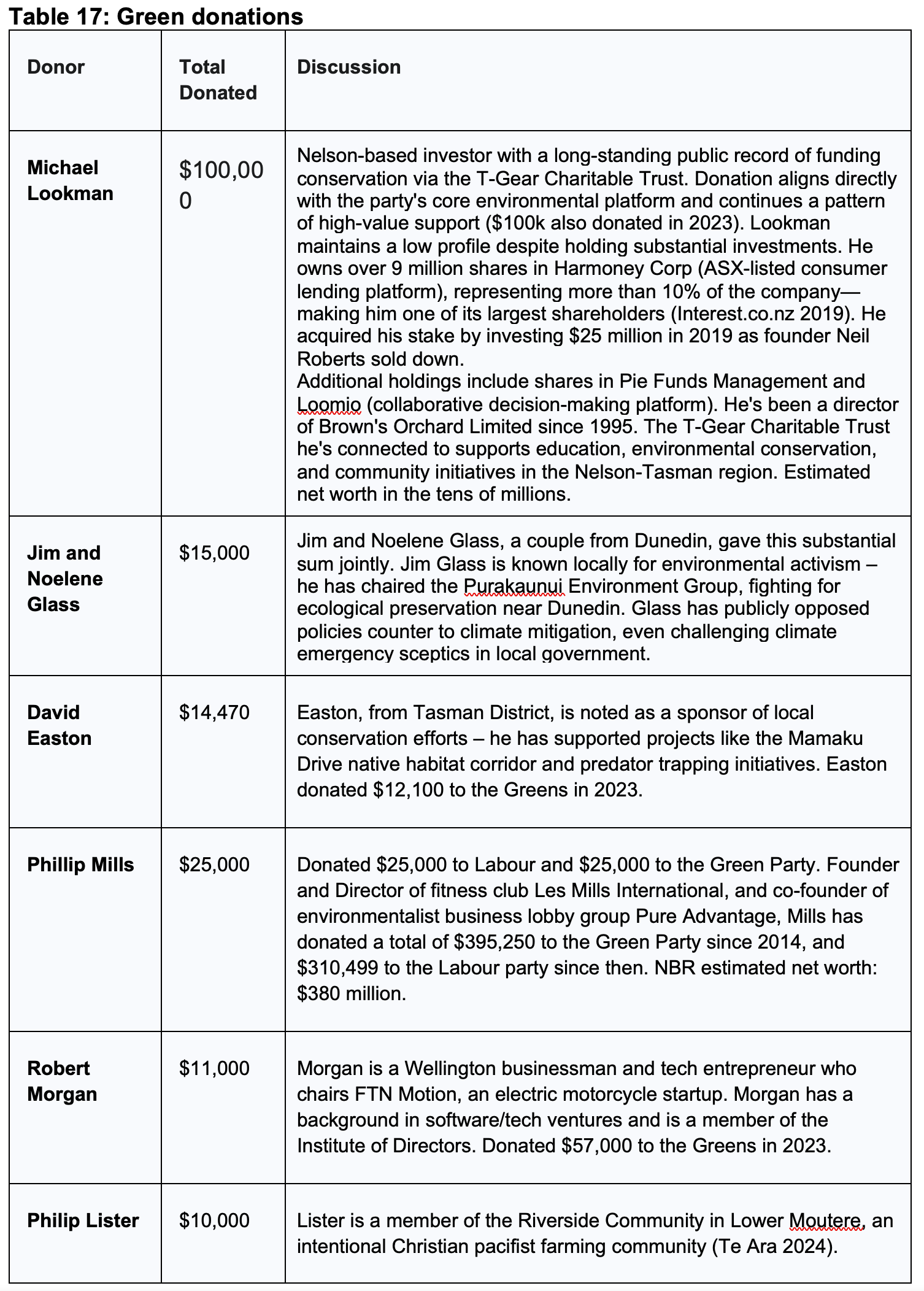
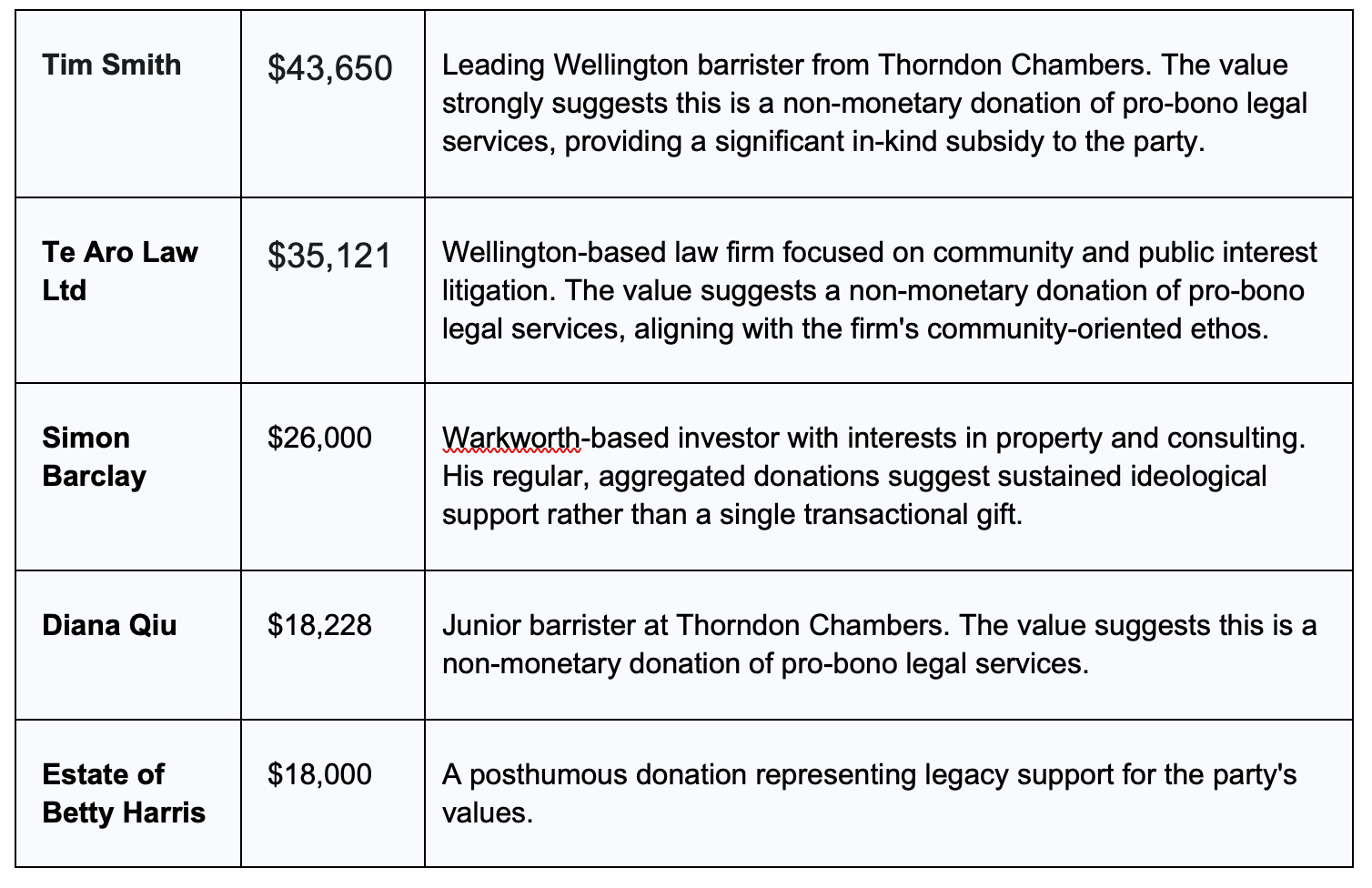
Bibliography
Act Party 2023, ‘Act Policy Platform 2023’, Act New Zealand, viewed December 2025, <https://www.act.org.nz/policies>.
Act Party Auditor’s Report 2025, ‘Independent Auditor’s Report: Act New Zealand Annual Return 2024’, Electoral Commission, Wellington.
Auckland Council 2006, ‘Mayor Dick Hubbard’, Auckland Council Archives, Auckland.
Australian Electoral Commission 2024, ‘Political donations and disclosure’, Australian Electoral Commission, Canberra, viewed December 2025, <https://www.aec.gov.au/Parties_and_Representatives/Party_Disclosure/>.
BBC News 2007, ‘Cash-for-honours: Timeline’, BBC News, 20 July, viewed December 2025, <https://news.bbc.co.uk/2/hi/uk_news/politics/4819482.stm>.
BBC News 2023, ‘Boris Johnson: Partygate report concludes he deliberately misled MPs’, BBC News, 15 June, viewed December 2025, <https://www.bbc.com/news/uk-politics-65905774>.
BDO 2025, ‘Independent Auditor’s Report: New Zealand National Party Annual Return 2024’, BDO Wellington, Electoral Commission, Wellington.
Brown, A 2023, ‘No significant donations to the Labour Party from businesses in over two years’, RNZ, 13 September, viewed December 2025, <https://www.rnz.co.nz/news/election-2023/497947/no-significant-donations-to-the-labour-party-from-businesses-in-over-two-years>.
Bruggeman, L & Barr, L 2025, ‘Trump administration poised to accept “palace in the sky” as a gift for Trump from Qatar: Sources’, ABC News, 11 May, viewed December 2025, <https://abcnews.go.com/Politics/trump-administration-poised-accept-palace-sky-gift-trump/story?id=121680511>.
BusinessDesk 2022, ‘Partners Life sold to Dai-ichi in $1b deal’, BusinessDesk, 28 February.
BusinessDesk 2023, ‘The former judge who is one of Labour’s biggest donors’, BusinessDesk, 17 May.
Cabinet Office 2023, Cabinet Manual 2023, Department of the Prime Minister and Cabinet, Wellington, <https://www.dpmc.govt.nz/our-programmes/cabinet-office/cabinet-manual>.
Charities Services 2024, ‘Notice of intention to deregister Te Whānau o Waipareira Trust’, Charities Services New Zealand, Wellington, viewed December 2025, <https://www.charities.govt.nz/>.
Charities Services 2024, ‘T-Gear Charitable Trust’, Charities Services New Zealand, Wellington, viewed December 2025, <https://www.charities.govt.nz/>.
Collins, S 2010, ‘Salary tithe puts Greens top of big donations list’, New Zealand Herald, 3 May, viewed December 2025, <https://www.nzherald.co.nz/nz/salary-tithe-puts-greens-top-of-big-donations-list/J5HFAIBN7LZJSYL6A6GTQSUCUU/>.
Companies Office 2024, ‘Companies Register’, New Zealand Companies Office, Wellington, viewed December 2025, <https://companies-register.companiesoffice.govt.nz/>.
Cook, A 2021, ‘Prime Minister Jacinda Ardern took a donation from Troy Bowker in 2017’, New Zealand Herald, 16 August, viewed December 2025, <https://www.nzherald.co.nz/nz/prime-minister-jacinda-ardern-took-a-donation-from-troy-bowker-in-2017/ISZ44Z7DUZL7GKL2KBHNL7PYTQ/>.
Cook, F 2025, ‘New KiwiRail director Scott O’Donnell linked to NZ First donation, Government loan’, New Zealand Herald, 9 July, viewed December 2025, <https://www.nzherald.co.nz/nz/politics/new-kiwirail-director-scott-odonnell-linked-to-nz-first-donation-government-loan/>.
Crown Regional Holdings 2024, ‘About Crown Regional Holdings’, New Zealand Government, Wellington, viewed December 2025.
Crux 2024, ‘Gibbston Village opposition mounts: “This was snuck in”’, Crux, October.
DPMC 2025, ‘King’s Birthday and New Year Honours Lists 2025’, Department of the Prime Minister and Cabinet, Wellington, viewed December 2025, <https://www.dpmc.govt.nz/our-programmes/new-zealand-royal-honours>.
Edwards, B 2025, ‘Fletcher Building’, Democracy Project, 23 April, viewed December 2025, <https://www.democracyproject.org.nz/p/fletcher-building>.
Elections Canada 2024, ‘Political financing handbook for electoral district associations’, Elections Canada, Ottawa, viewed December 2025, <https://www.elections.ca/content.aspx?section=pol&dir=lim&document=index&lang=e>.
Electoral Amendment Act 2022 (NZ), <https://www.legislation.govt.nz/act/public/2022/0080/latest/whole.html>.
Electoral Commission 2022, ‘New electoral finance rules’, Electoral Commission, Wellington, viewed December 2025, <https://elections.nz/media-and-news/2022/new-electoral-finance-rules/>.
Electoral Commission 2023, ‘Party donations and loans 2022’, Electoral Commission, Wellington, viewed December 2025, <https://elections.nz/democracy-in-nz/political-parties-in-new-zealand/party-donations-and-loans-by-year/>.
Electoral Commission 2024, ‘Party donations and loans 2023’, Electoral Commission, Wellington, viewed December 2025, <https://elections.nz/democracy-in-nz/political-parties-in-new-zealand/party-donations-and-loans-by-year/>.
Electoral Commission 2025, ‘Party donations and loans 2024’, Electoral Commission, Wellington, viewed December 2025, <https://elections.nz/democracy-in-nz/political-parties-in-new-zealand/party-donations-and-loans-by-year/>.
Ensor, J 2025, ‘National tops 2024 list of party donations: Shane Jones’ partner lends $119k to NZ First’, New Zealand Herald, 5 May, viewed December 2025, <https://www.nzherald.co.nz/nz/politics/national-tops-2024-list-of-party-donations-shane-jones-partner-lends-119k-to-nz-first/6WZDDBXK55HBHEW2HLANOCZOBE/>.
Fast-track Approvals Act 2024 (NZ), <https://www.legislation.govt.nz/act/public/2024/0089/latest/whole.html>.
FIDE 2024, ‘Murray Chandler player profile’, World Chess Federation, viewed December 2025, <https://ratings.fide.com/>.
FMA 2023, ‘Tiger Brokers to pay $900,000 penalty for multiple AML/CFT Act breaches’, Financial Markets Authority, Wellington, 14 June.
Forest & Bird 2020, ‘Conservation endowment established’, Royal Forest and Bird Protection Society, Wellington, viewed December 2025, <https://www.forestandbird.org.nz/>.
Geddis, A, Charters, C, Geiringer, C & Palmer, M 2023, ‘Money for Something: A report on the funding of political parties in New Zealand’, Victoria University of Wellington, Wellington.
Grant Thornton 2025, ‘Independent Auditor’s Report: New Zealand Labour Party Annual Return 2024’, Electoral Commission, Wellington.
Green Party Auditor’s Report 2025, ‘Independent Auditor’s Report: Green Party of Aotearoa New Zealand Annual Return 2024’, Electoral Commission, Wellington.
Green Party of Aotearoa New Zealand 2023, ‘Party Constitution and Rules’, Green Party, Wellington, viewed December 2025, <https://www.greens.org.nz/>.
Hager, N 2006, The Hollow Men: A Study in the Politics of Deception, Craig Potton Publishing, Nelson.
Hancock, F 2024, ‘$500,000 in political donations associated with fast track projects’, RNZ, 9 October, viewed December 2025, <https://www.rnz.co.nz/news/in-depth/530312/500-000-in-political-donations-associated-with-fast-track-projects>.
Hancock, F 2025a, ‘Ministers continue to make decisions on fast-track projects after parties take donations linked to applicants’, RNZ, 11 May, viewed December 2025, <https://www.rnz.co.nz/news/in-depth/560641/ministers-continue-to-make-decisions-on-fast-track-projects-after-parties-take-donations-linked-to-applicants>.
Hancock, F 2025b, ‘New KiwiRail director Scott O’Donnell linked to NZ First donation, government loan’, RNZ, 8 July, viewed December 2025, <https://www.rnz.co.nz/news/in-depth/566354/new-kiwirail-director-scott-o-donnell-linked-to-nz-first-donation-government-loan>.
Hansard 2014, ‘Parliamentary Debates’, New Zealand Parliament, Wellington, 19 March.
Heywood, PM & Rose, J 2014, ‘Close but no Cigar: the measurement of corruption’, Journal of Public Policy, vol. 34, no. 3, pp. 507-529.
House of Commons Privileges Committee 2023, Matter referred on 21 April 2022 (conduct of Rt Hon Boris Johnson): Final Report, UK Parliament, London, viewed December 2025, <https://publications.parliament.uk/pa/cm5803/cmselect/cmprivi/564/report.html>.
Hurley, D 2022a, ‘Controversial businessman Troy Bowker makes $35,000 Act donation’, New Zealand Herald, 25 January, viewed December 2025, <https://www.nzherald.co.nz/nz/controversial-businessman-troy-bowker-makes-35000-act-donation/UWOA5743C2CXEEAMQC2JH6XZ2Y/>.
Hurley, D 2022b, ‘Controversial businessman Troy Bowker makes $35,000 NZ First donation, Winston Peters says Bowker a “friend”’, New Zealand Herald, 8 February, viewed December 2025, <https://www.nzherald.co.nz/nz/controversial-businessman-troy-bowker-makes-35000-nz-first-donation-winston-peters-says-bowker-a-friend/52CD4PQDUW2RERM62ZIVZMANL4/>.
IDEA 2024, ‘Political Finance Database’, International Institute for Democracy and Electoral Assistance, Stockholm, viewed December 2025, <https://www.idea.int/data-tools/data/political-finance-database>.
Interest.co.nz 2019, ‘Harmoney raises $25 million’, Interest.co.nz.
Ipsos 2024, ‘Global Trends Survey: New Zealand’, Ipsos, viewed December 2025, <https://www.ipsos.com/en/ipsos-global-trends>.
James, N. 2025. ‘KiwiRail director’s conflicts of interest management affecting efficiency, board chair says’, RNZ, 10 December.
Krewel, M & Vowles, J 2024, ‘The best government money can buy? How New Zealanders feel about political party funding’, The Conversation, 24 October, viewed December 2025, <https://theconversation.com/the-best-government-money-can-buy-how-new-zealanders-feel-about-political-party-funding-241881>.
Lennie & Associates 2025, ‘Independent Auditor’s Report: New Zealand First Party Annual Return 2024’, Electoral Commission, Wellington.
Mead, T 2022, ‘You Have Now Entered Carbon Country’, North & South Magazine, 14 May.
MBIE 2024, Draft Critical Minerals List, Ministry of Business, Innovation and Employment, Wellington, September.
Ministry for the Environment 2024, ‘Emissions Trading Scheme review’, Ministry for the Environment, Wellington, viewed December 2025, <https://environment.govt.nz/what-government-is-doing/areas-of-work/climate-change/>.
Mulgan, R 2012, ‘Aristotle on Legality and Corruption’, in M Barcham, B Hindess & P Larmour (eds), Corruption: Expanding the Focus, ANU Press, Canberra, pp. 25-36.
National Council of Women NZ 2020, ‘Past Presidents’, National Council of Women of New Zealand, Wellington, viewed December 2025, <https://www.ncwnz.org.nz/>.
National Party 2021, ‘Sir Graeme Harrison joins National Party board’, Scoop, September.
National Party 2023, ‘National’s Plan for New Zealand’, New Zealand National Party, Wellington, viewed December 2025, <https://www.national.org.nz/>.
National-NZ First Coalition Agreement 2023, ‘Coalition Agreement between New Zealand National Party and New Zealand First Party’, New Zealand Government, Wellington, 24 November.
NBR 2023, ‘NBR Rich List 2023’, National Business Review.
NBR 2024, ‘NBR Rich List 2024’, National Business Review.
NBR 2024, ‘The NBR List 2024: Mowbray Family Succeed Graeme Hart As New Zealand’s Richest’, National Business Review, 9 June, viewed December 2025, <https://www.nbr.co.nz/business/the-nbr-list-2024-mowbray-family-succeed-graeme-hart-as-new-zealands-richest/>.
Nelson Mail 2025, ‘Obituary: Robert John Wares’, Nelson Mail, March, viewed December 2025.
New Zealand Parliament 2024, ‘Members of Parliament’, New Zealand Parliament, Wellington, viewed December 2025, <https://www.parliament.nz/en/mps-and-electorates/members-of-parliament/>.
Newshub 2022, ‘David Seymour defends Xero founder Rod Drury after National Maori Authority chair Matthew Tukaki calls for product boycott over ACT donation’, Newshub, 25 March, viewed December 2025, <https://www.newshub.co.nz/home/politics/2022/03/david-seymour-defends-xero-founder-rod-drury-after-national-m-ori-authority-chair-matthew-tukaki-calls-for-product-boycott-over-act-donation.html>.
Newsroom 2021, ‘Revealed: New Zealand’s worst climate polluters’, Newsroom, 8 November.
Newsroom 2023, ‘Blue rinse across Auckland’, Newsroom, October.
Newsroom 2024, ‘Big coal company bought West Coast election campaign’, Newsroom, 23 February.
NPR 2025, ‘What to know about Trump cryptocurrency meme coins’, NPR, 20 January, viewed December 2025, <https://www.npr.org/2025/01/20/nx-s1-5268759/donald-trump-melania-cryptocurrency-meme-coins>.
NZ First 2023, ‘New Zealand First Policy Platform 2023’, New Zealand First Party, Wellington, viewed December 2025, <https://www.nzfirst.org.nz/>.
NZ Herald 2008, ‘Vela brothers paid $150,000 to Peters’, NZ Herald, 22 August.
NZ Herald 2011, ‘Huljich fined $112,500 over KiwiSaver returns’, NZ Herald, December.
NZ Herald 2016, ‘Sistema sold to US company Newell for $660m’, NZ Herald, 14 March.
NZ Herald 2017, ‘Chequemate: Act Party’s $35,000 chess grandmaster donation’, NZ Herald, May.
NZ Herald 2019, ‘Property developers fined $123k for breaking overseas investment rules’, NZ Herald.
NZ Herald 2020, ‘Golf/housing resort planned for Gibbston Valley, Queenstown - John Key buying in’, NZ Herald, December.
NZ Herald 2021a, ‘Trevor Mallard to boycott Hurricanes over Troy Bowker’s Māori race comments’, NZ Herald, August.
NZ Herald 2021b, ‘Wealthy political donor speaks on why his money has gone to National instead of Act’, NZ Herald, August.
NZ Herald 2022a, ‘Billion-dollar sale: What the future holds for Naomi Ballantyne’, NZ Herald, March.
NZ Herald 2022b, ‘National Party president Peter Goodfellow to stand down’, NZ Herald, July.
NZ Herald 2022c, ‘StonewoodKey Capital: John and Max Key join Chows for new $100 million funder’, NZ Herald, February.
NZ Herald 2024a, ‘NZ Super Fund, Brett Russell: Rezoning for 5000-residence Beachlands scheme approved’, NZ Herald, April.
NZ Herald 2024b, ‘Forestry group slams ETS reform as “vandalism”’, NZ Herald.
NZ Herald 2024c, ‘Election donations: National Party raises $10.4 million for election’, NZ Herald, May.
NZ Herald 2025, ‘Media Insider: Outspoken NZME shareholder sells out of media company’, NZ Herald.
NZES 2023, ‘New Zealand Election Study 2023’, Victoria University of Wellington, Wellington, viewed December 2025, <https://www.nzes.org/>.
NZTA 2024, ‘Roads of National Significance’, New Zealand Transport Agency, Wellington, viewed December 2025, <https://www.nzta.govt.nz/>.
Office of the Auditor-General 2025, Inquiry into how conflicts of interest were managed in the development and passage of the Fast-track Approvals Bill, Office of the Auditor-General, Wellington, 24 June, viewed December 2025, <https://oag.parliament.nz/2025/fast-track-conflicts>.
Overseas Investment Office 2019, ‘Enforcement actions’, Land Information New Zealand, Wellington, viewed December 2025, <https://www.linz.govt.nz/overseas-investment>.
Palmer, R 2023, ‘Property industry tops political donations’, RNZ, 1 October, viewed December 2025, <https://www.rnz.co.nz/news/national/499176/property-industry-tops-political-donations>.
Patterson, J 2024, ‘Why New Zealand political donations have more than tripled’, RNZ, 29 July, viewed December 2025, <https://www.rnz.co.nz/news/in-depth/523415/why-new-zealand-political-donations-have-more-than-tripled>.
PBS NewsHour 2025, ‘Trump family’s cryptocurrency ties raise concerns as administration loosens regulations’, PBS NewsHour, November, viewed December 2025, <https://www.pbs.org/newshour/show/trump-familys-cryptocurrency-ties-raise-concerns-as-administration-loosens-regulations>.
Pearse, A 2023, ‘Ex-NZ First MP Fletcher Tabuteau joins lobbying firm Capital ahead of new government forming’, New Zealand Herald, 8 November, viewed December 2025, <https://www.nzherald.co.nz/nz/politics/ex-nz-first-mp-fletcher-tabuteau-joins-lobbying-firm-capital-ahead-of-new-government-forming/T5ZAJOUEXRF6VEJDOGRNLBE4ZU/>.
Peters, W. 2025. ‘New director bolsters freight expertise on KiwiRail board’, Press release, 2 July, beehive.govt.nz.
Privileges Committee 2008, ‘Question of privilege concerning New Zealand First donations’, New Zealand Parliament, Wellington.
Provincial Growth Fund 2020, ‘Provincial Growth Fund investments’, Ministry of Business, Innovation and Employment, Wellington, viewed December 2025, <https://www.growregions.govt.nz/>.
RNZ 2016, ‘Contract not linked to donation - Scenic Hotel’, RNZ, April.
RNZ 2017, ‘Hey big political spender’, RNZ, September.
RNZ 2019, ‘NZ’s top 50 private landowners revealed’, RNZ, October.
RNZ 2020, ‘Wealthy and powerful: NZ First Foundation donors revealed’, RNZ, February.
RNZ 2020, ‘National Party donations case: Jami-Lee Ross named as suppressions lifted’, RNZ, 19 February, viewed December 2025, <https://www.rnz.co.nz/news/political/409878/national-party-donations-case-jami-lee-ross-named-as-suppressions-lifted>.
RNZ 2022, ‘Andy Foster joins NZ First’, RNZ, viewed December 2025, <https://www.rnz.co.nz/>.
RNZ 2023, ‘Billionaire Graeme Hart’s $700k in donations to right wing parties’, RNZ, 18 September, viewed December 2025, <https://www.rnz.co.nz/news/political/498251/billionaire-graeme-hart-s-700k-in-donations-to-right-wing-parties>.
RNZ 2022, ‘Forestry firm Ernslaw told to pay $355,000 over failure that led to massive flood damage’, RNZ, December.
RNZ 2024, ‘Ministers continue to make decisions on fast-track projects after parties take donations linked to applicants’, RNZ, 11 May.
RNZ 2024, ‘Te Pati Maori faces police warning over late financial statements’, RNZ, December, viewed December 2025, <https://www.rnz.co.nz/>.
RNZ 2024, ‘Waipareira Trust faces deregistration over political support’, RNZ, December, viewed December 2025, <https://www.rnz.co.nz/>.
RNZ 2025, ‘Alcohol industry given privileged access to shape FASD policy’, RNZ.
Scoop 2017, ‘BlueScope sweetens Taharoa ironsands mine sale’, Scoop, April.
Scoop 2020, ‘Sanford proud to announce funding secured for new salmon hatchery in Southland’, Scoop, July.
Serious Fraud Office 2020, ‘NZ First Foundation investigation’, Serious Fraud Office, Wellington.
Sustainable Business Council 2020, ‘Climate Leaders Coalition’, Sustainable Business Council NZ, Auckland, viewed December 2025, <https://www.sbc.org.nz/>.
Te Ara 2024, ‘Dick Hubbard’, Te Ara - The Encyclopedia of New Zealand.
Thomas, D 2024, ‘Election donations: National Party raises $10.4 million for election’, New Zealand Herald, 3 May, viewed December 2025, <https://www.nzherald.co.nz/nz/politics/election-donations-national-party-raises-massive-104-million-haul-in-donations-for-election/6MD4DITFKVG63BGS5RK5HMDJHQ/>.
Tibshraeny, J 2024a, ‘Political donations: people power no match for big business’, Newsroom, 6 May, viewed December 2025, <https://newsroom.co.nz/2024/05/06/political-donations-people-power-no-match-for-big-business/>.
Tibshraeny, J 2024b, ‘Red tape earns quarrying spot on Jones’ critical minerals list’, Newsroom, 17 September, viewed December 2025, <https://newsroom.co.nz/2024/09/17/red-tape-earns-quarrying-spot-on-jones-critical-minerals-list/>.
Tibshraeny, J 2025, ‘From Hotchin to Atlas: a cautionary tale for corporates mulling a political donation’, Newsroom, 6 May, viewed December 2025, <https://newsroom.co.nz/2025/05/06/from-hotchin-to-atlas-a-cautionary-tale-for-corporates-mulling-a-political-donation/>.
Todd Corporation 2021, ‘Board of Directors’, Todd Corporation, Wellington, <https://toddcorporation.com/our-people/board-of-directors/>.
Transparency International 2024, ‘Corruption Perceptions Index 2024’, Transparency International, Berlin, viewed December 2025, <https://www.transparency.org/en/cpi/2024>.
Transparency International New Zealand 2025, ‘New Zealand slides again in 2024 Corruption Perceptions Index’, TINZ, February, viewed December 2025, <https://www.transparency.org.nz/blog/new-zealand-slides-again-in-corruption-perceptions-index>.
UK Electoral Commission 2024, ‘Political party and election finance’, UK Electoral Commission, London, viewed December 2025, <https://www.electoralcommission.org.uk/parties-campaigns-referendums>.
Vance, A 2020, ‘NZ First Foundation: How it worked and what went wrong’, Stuff, viewed December 2025, <https://www.stuff.co.nz/national/politics/119611048/nz-first-foundation-how-it-worked-and-what-went-wrong>.
Vowles, J, Krewel, M & Geddis, A 2023, ‘Political finance attitudes in New Zealand’, Victoria University of Wellington, Wellington.
Wikipedia 2025, ‘Political funding in New Zealand’, Wikipedia, viewed December 2025, <https://en.wikipedia.org/wiki/Political_funding_in_New_Zealand>
Yaffe-Bellany, D 2025, ‘New Report Exposes the Trump Family’s Multi-Billion-Dollar Crypto Empire’, House Judiciary Committee Democrats, 25 November, viewed December 2025, <https://democrats-judiciary.house.gov/media-center/press-releases/new-report-exposes-the-trump-family-s-multi-billion-dollar-crypto-empire-fueled-by-self-dealing-and-corrupt-foreign-interests>