

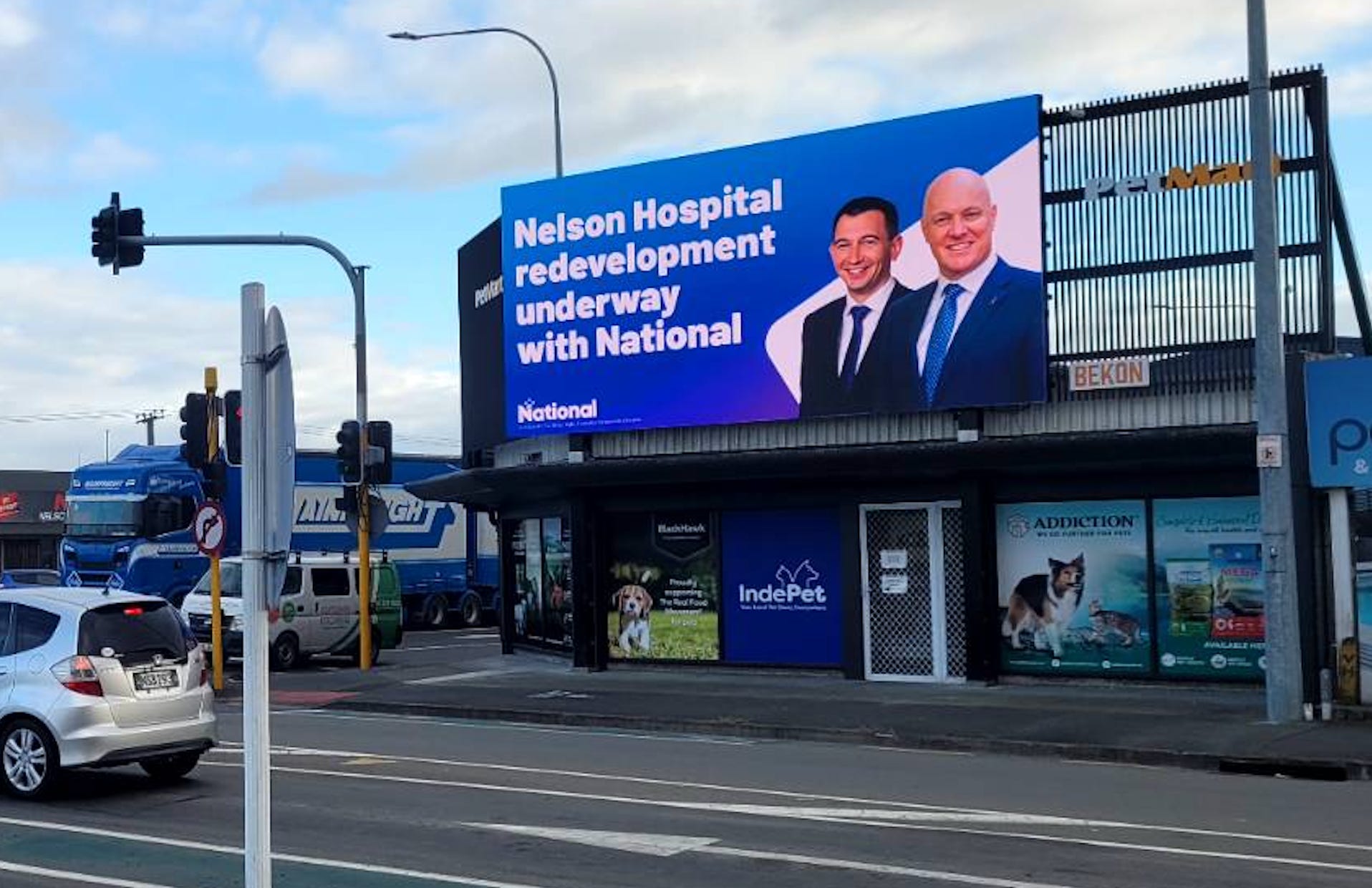
How much taxpayer funding will politicians spend this year on election advertising? It will be many, many millions of dollars, but we won’t know much about it, because the rules have been written to help MPs electioneer with parliamentary funding, without transparency.
You would have already seen plenty of billboards and election ads for the various parties. National MPs have recently been carrying out a blitz of billboards and online ads, but what is often unclear is that the taxpayer is paying for them. See, for example, the billboard above in Nelson recently, featuring Simeon Brown and Chris Luxon, and the message: “Nelson Hospital redevelopment underway with National”.
Or if you’re reading the news online, you might have seen the article yesterday on the Stuff website that looked for all the world like regular journalism but was actually paid content from the National Party.
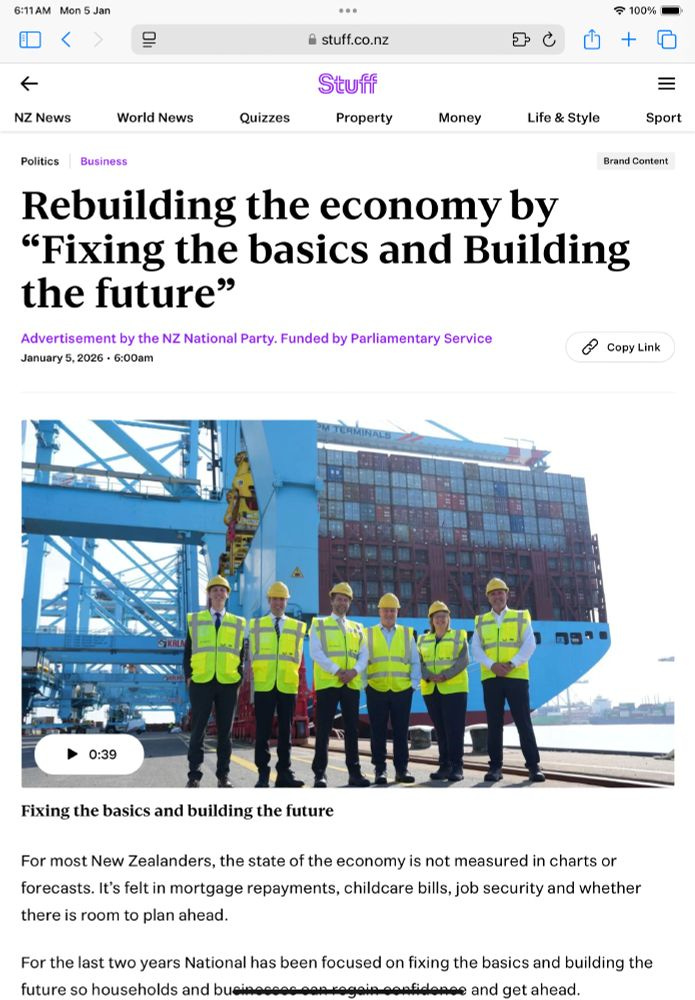
These election articles and billboards are paid for out of large budgets that MPs have at Parliament. In theory, the budgets are to help MPs carry out their Parliamentary duties and to communicate with the public about policy issues. In practice, they are a slush fund for electioneering ads. All political parties in Parliament use them for this.
Parliamentary budgets as slush funds for electioneering
The scale of taxpayer funding for political parties is staggering. Vote Parliamentary Service allocates approximately $134 million over three years for “Party and Member Support” funding. These funds are distributed roughly in proportion to party size, meaning a large party like Labour or National might receive $15 to 20 million or more annually in support.
What can this money be spent on? The rules, set out in the Speaker’s Directions and the Members of Parliament (Remuneration and Services) Act, explicitly forbid using parliamentary funds for electioneering. The principle seems clear enough: “Funding and services provided under these directions must only be used for parliamentary purposes… [which] does not include electioneering.” Taxpayer money can fund MPs to do their jobs as legislators and representatives, but not to run their re-election campaigns.
That’s the theory, anyway. The reality is rather different.
The definition of “electioneering” has a specific meaning in this context. Under the Parliamentary Service Act, electioneering includes any communication that explicitly seeks support for votes or donations, or encourages joining a party. It also includes any election advertisement published during the official regulated period before an election, usually the three months before polling day. During that formal campaign period, parliamentary funding cannot be used for advertising that promotes a party or candidate.
Outside the regulated period, however, the line becomes remarkably blurry. The rules allow publicly funded communications as long as they don’t explicitly say “vote for us” or something similar. Parties have seized on this loophole, pouring public funds into ads touting their policies or attacking opponents well ahead of writ day. As long as the content stops short of an outright “please re-elect us” message, they argue it’s “parliamentary” communication rather than electioneering.
This is why opposition parties can run taxpayer-funded billboards lambasting the government’s tax policy mid-term. It’s why governing parties can mail pamphlets highlighting budget accomplishments, all under the rubric of informing the public of MPs’ work. Technically, such material is not election advertising if published before the regulated campaign window and if it avoids phrases like “Vote Green.”
Practically, of course, it serves exactly the same purpose: boosting a party’s public profile and support.
As political scientist Claire Robinson put it last July, MPs have turned the non-election period into a publicly funded “free-for-all of 24/7 campaigning.” The only real check on this behaviour is the Speaker, who oversees Parliamentary Service spending, and ultimately the court of public opinion. Enforcement is lax unless a flagrant breach occurs.
The Problems of a state slush fund for electioneering
Even if parties’ use of parliamentary funds for advertising stays within legal boundaries, it raises serious ethical questions. The core of the criticism is that it amounts to taxpayer-funded electioneering by stealth. Parties are leveraging public money, provided to support their democratic duties, to give themselves an extra campaigning advantage that new or outside challengers cannot match.
Consider the unfair incumbency advantage this creates. Parliamentary funding is only available to parties already in Parliament, effectively entrenching the incumbents’ position. Established parties can saturate the public with positive messaging through billboards, online ads, and mailers in the pre-election period without touching their campaign budgets. A new party or independent candidate outside Parliament has no such benefit.
This skews the playing field considerably. As I’ve noted before, “new parties face big barriers to getting into Parliament,” and lack of access to these state resources is one such barrier. Every other new party in recent decades, including the Greens, Alliance, New Zealand First, United Future, Progressives, Mana, and the Māori Party, has been launched by at least one existing MP. Other new parties struggle to compete with the millions of dollars of state-funded resources at the disposal of parliamentarians.
Election paid content on news media sites
National’s election article on the Stuff website has led to some complaints that it is not ethical. One person, Rob Dickinson, says he has complained about the National article to the Advertising Standards Authority on the basis that “it is not clear it is an advert and not a news article”.
On social media there have been complaints about the National Party paid articles on the Stuff site. For example, the Listener’s media commentator Russell Brown posted online his criticism of what he called a “fake lead story,” arguing that “not only giving up the lead spot of your Business section, but running it with the same style as real editorial is horrible.” Brown said that more information was required: “The interesting thing — and hard to know because the Parliamentary Service is not subject to the OIA — is whether the lead position and use of editorial style were a specific request in the commercial deal. Because I think that would reflect poorly on everyone involved.”
In the case of the National Party’s sponsored articles on Stuff, the media company did include a small “Brand Content” label and an explanatory blurb. This likely satisfies the bare minimum standard, meaning the content was technically identifiable as advertising. However, some argue the labelling was too inconspicuous, risking that readers would mistake the piece for an objective news story.
The Media Council’s position is that if a sponsored item looks like a news article, it “should, at least, be held to the same standards as news content” in terms of accuracy and fairness. Even paid political content shouldn’t be allowed to deceive or spread false claims just because it’s an ad.
When political advertising is formatted to resemble news articles, it confuses readers about what is independent journalism versus paid content. It undermines trust in media institutions. It allows parties to bypass journalistic scrutiny and editorial standards. And it contributes to the broader misinformation environment.
This is a bipartisan problem
The examples of taxpayer-funded electioneering in this column might suggest this is a critique of the National Party. I have used these images because it is currently National that is undertaking a significant election campaign with taxpayer funds. However, all the parties will be doing the same this year, to different degrees.
The pledge card controversy of 2005 showed Labour exploiting these advantages, which then National leader Don Brash said was “corrupt”. Yet National appears to be doing the same now.
It’s also worth looking back at the last election year. At the start of 2023, the incumbent Labour Party – flush with the largest caucus in Parliament at the time – went on what the Opposition called a taxpayer-funded “advertising spree”. National Party campaign director Jo de Joux publicly claimed that Labour was using a “huge taxpayer-funded war chest” on a blitz of ads before the regulated campaign period. National’s analysis found that in January–June 2023 alone Labour spent about $260,000 of parliamentary budget on Facebook and Instagram ads, with over $160,000 in just two months leading up to winter.
More scrutiny required
Outside the regulated election period, parties face little real accountability for how they use their taxpayer-funded advertising allowance. One could invoke a simple ethical test: “Would a reasonable taxpayer be comfortable knowing their taxes paid for this ad?” In the case of a neutral electorate newsletter, perhaps yes. In the case of a thinly veiled attack ad or self-congratulatory billboard, likely not. By that measure, much of the current parliamentary-funded advertising fails the test.
All major parties have engaged in this arms race, so any solution or reform needs cross-party agreement. Since turkeys rarely vote for an early Christmas, public pressure is key. The Speaker or Parliament could tighten the definitions even further. An independent watchdog like the Auditor-General or Electoral Commission could get jurisdiction to review parliamentary advertising for partisan content in real-time.
At the very least, a bright light of transparency should be shone on this spending. If parties had to publish reports of exactly what they spend parliamentary funds on, including advertising, mailers, and social media, they might be more restrained for fear of public backlash.
Until the rules are properly reformed, expect more of the same. We’ll keep seeing billboards touting government achievements, online ads disguised as news articles, and glossy pamphlets paid for from the public purse. And we’ll keep being told it’s all perfectly legitimate “communication with constituents”.
----
The above “Democracy Briefing” on parliamentary-funded election ads is an abridged version of a “Democracy Deep Dive” – which you can read here:
Dr Bryce Edwards
Director of the Democracy Project
Further examples of recent parliamentary-funded advertisements:
