

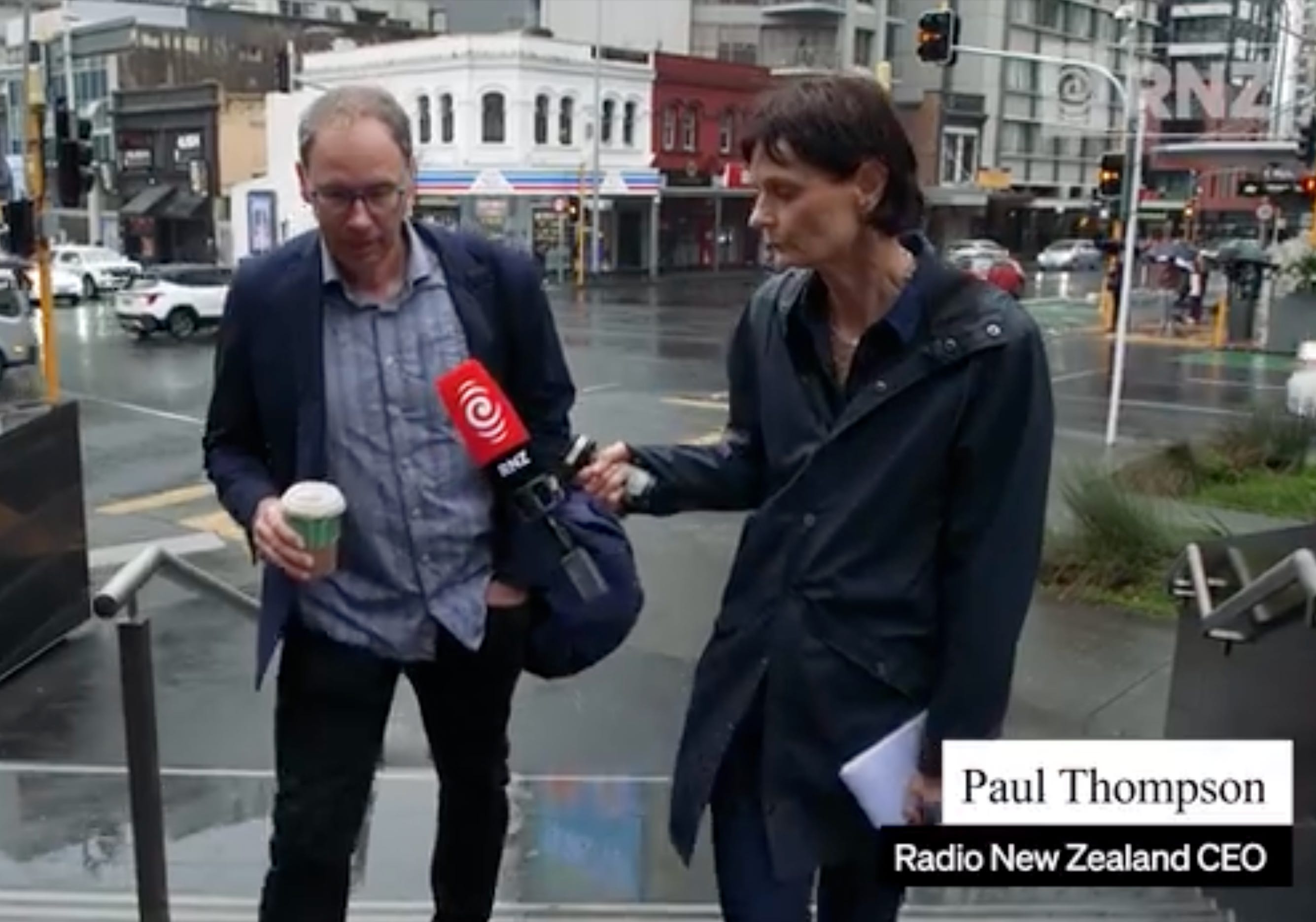
RNZ’s own journalists are pressing their bosses for answers. On Tuesday, Checkpoint host Lisa Owen doorstepped her chief executive, Paul Thompson, as he arrived at work. When he said he had taken responsibility and had “a job to do”, she asked: “Why are you the right person to do that? Why don’t you leave now? People are losing their jobs because you didn’t see what was coming.” He replied that the job cuts were “about our underlying funding position”, before conceding: “We thought we were addressing that. We weren’t.”
RNZ’s annual report, published on Monday, revealed an $11.8m deficit for the year to June, against a budgeted loss of $470,000. RNZ will cut the equivalent of 58 full-time jobs by March, about one in six, including the 25 to 30 it had already planned in August. It also admitted breaking the Crown Entities Act by setting up a $5m loan facility without ministerial approval.
It’s another case of what I’ve been calling Broken New Zealand, in which those at the top – in both the private and public sectors – let the public down through complacency, incompetence and a lack of accountability, and rarely pay for it. At RNZ, the cost is being passed to the staff. In Further Analysis below, I look at what the board and ministers knew before voters went to the polls.
“Error after error after error”
“Error after error after error” is how RNZ’s chair, Brent Impey, described it to The Post. Personnel costs ran $3.2m over budget, and The Post reports that only $400,000 of that was extra redundancy pay. The other $2.8m went on pay and entitlements, in a year when funding was cut by 7%. RNZ had failed to bring its staffing costs into line with its funding. Operating costs ran $6.4m over, much of it on the Auckland office move and the sale of surplus property.
The budget also counted $2m from land sales as revenue, which the annual report concedes was a mistake. It doesn’t say why, but selling land isn’t income in the ordinary sense: under RNZ’s own accounting policies, a sale counts only as a gain or loss against the land’s book value.
No money has gone missing. RNZ spent more than it budgeted for, and budgeted for income it was never going to get. Management and directors say they relied on inaccurate internal reports. Questioning those reports was the board’s job, as RNZ’s own statement on the result admits: “The Board is accountable for governance, challenge and oversight.” “Good governance isn’t just accepting what is put in front of you,” David Farrar wrote on Kiwiblog.
“I’ve never seen anything like this, and it’s almost inexplicable,” Impey said on Checkpoint. Newsroom’s Jonathan Milne turned that around, writing that it was the incompetence behind the problems that was “entirely inexplicable, at a Crown company of this size”.
Who is paying for RNZ’s failure?
The staff are paying first, with job losses and, according to an E tū email reported by the Herald, a general hiring freeze. “Our members are fuming,” E tū’s Amy Hansen told The Post. “Taking responsibility is practical; it’s not just verbal.”
Meanwhile, as The Post revealed this week, Thompson’s salary rose 5.6% to $528,000 in the year to June 2026, on top of a $59,000 performance payment for his work in 2024/25. Staff got 1.8%, or around 3% with step increases, according to the union. E tū and the PSA now want any savings in senior executive pay identified before jobs go.
Thompson stays until 31 December, collecting about $80,000 more in pay, The Post reports. Asked on Checkpoint why those in charge kept their jobs, Impey replied: “Well, someone’s got to run the place, don’t they? What do you suggest?” RNZ has already answered that question itself. Its chief news officer, Mark Stevens, is already due to become interim chief executive on 1 January, and he was acting chief executive in October, when the CFO resigned while Thompson was overseas. Bringing that forward by six weeks wouldn’t leave RNZ without a leader.
David Seymour told Chris Lynch Media that senior figures who would normally lose their jobs over such a failure have “already been fired”. That is a generous description of accountability. The former chair and a former audit committee chair retired from the board in June, and Thompson’s departure was announced in May. None of those exits was a consequence of this scandal.
Only the CFO left after the problems surfaced, and the circumstances haven’t been fully disclosed. You could call it “accountability by calendar”: departures that were already scheduled are being counted as consequences, while some of the directors who approved the unlawful loan facility are still on the board.
RNZ joins a long list of failing institutions
The British economist Dan Davies has a name for this: an “accountability sink”, in which the connection “between a decision, its consequences and a person who has the authority is broken”. The Listener’s Danyl McLauchlan has drawn on the idea, and RNZ’s own Mediawatch has applied it to this scandal, alongside three other cases from this year, all of them more costly than RNZ’s blowout.
A Crown review of Wellington’s Moa Point sewage plant found failures by the city council, Wellington Water and the plant’s operator. The review of the Mount Maunganui landslide found six deaths “preventable” but, as Tauranga City Council put it, did not attribute blame to any individual. And MBIE’s chief executive was found by Parliament’s Privileges Committee to have deliberately misled Parliament over a failed $33m IT project, but his resignation offer was declined.
Each case is different. What they share is that the consequences for those at the top have been limited or unclear. That’s what I mean by Broken New Zealand: well-paid leaders oversee failures that hurt the public, and the reviews that follow either spread the blame so thinly that nobody carries it, or name someone who then keeps their job. Nor is it only a public-sector problem. I’ve made the same criticism of New Zealand’s corporate boardrooms, where poor governance has done its own damage to the country.
What funding cuts don’t explain
E tū and others on the left point to funding cuts. The coalition did cut RNZ’s baseline by about 7% in 2025 and a further $1.4m this year, which explains the cuts RNZ planned in August. It doesn’t explain a $3.2m overspend on staff, and RNZ was cutting from a higher base, after its baseline funding rose from $42.7m to $66.6m in 2023/24.
On the right, Seymour, who has praised RNZ’s press gallery team, draws a different lesson: this is “the kind of thing that can and does happen when people are largely spending other people’s money”. But it was the government that chose the people overseeing that spending. Paul Goldsmith appointed Impey in 2024, promising he would bring “sound financial and commercial acumen”, along with two directors who went on to serve on the audit committee, including its current chair, Gracie MacKinlay. As Seymour put it earlier this year: “We have appointed most of the people on the board and replaced and refreshed them.”
RNZ’s harsher critics will be tempted to go further. As Peter Thompson, a Victoria University media academic and spokesperson for the advocacy group Better Public Media, notes in The Conversation, Winston Peters has threatened its funding and Seymour has alleged political bias, and this budget shock plays into their hands. But the failures happened in the finance team and the boardroom, not the newsroom. RNZ was named the most trusted news brand in AUT’s Trust in News survey earlier this year, and section 13 of the Radio New Zealand Act stops ministers directing it on news and programmes, which nothing in this scandal justifies weakening.
Where accountability should start
“Accountability, not redundancy” is the slogan for the 17 November staff protests outside RNZ’s Wellington and Auckland offices, and it’s the right one. RNZ’s failure was made by its best-paid executives and its board, so the consequences should start with them, not with reporters and producers who had no part in it.
Impey says Thompson still has a job to do in his last six weeks. This isn’t very persuasive. Continuity has some value. The board can still draw on Thompson’s knowledge without leaving him in charge, and the chief executive who ran RNZ while this happened shouldn’t be the one deciding which staff pay for it. He should hand over to Stevens now, with no further discretionary bonus.
The review must examine the board as well as the executives, and publish its findings with only narrowly justified redactions. Before the cuts are final, RNZ should also publish the case for them and the alternatives, including keeping some of the land-sale money.
The next government should fix the way RNZ is governed, rather than use its managers’ failures as a pretext to weaken public broadcasting. The public is entitled to expect that accepting responsibility at RNZ will change something more than the number of people left on the payroll.
Dr Bryce Edwards
Director, Democracy Project
The above column argues that accountability at RNZ must start at the top. Ministers knew RNZ had serious financial problems before the election, but voters learned the scale only two days afterwards. The “Further Analysis” section below looks at what the board and ministers knew, what a credible review must publish, and the $51m land-sale decision facing the next Cabinet. If you value independent scrutiny like this, please consider a paid subscription.