

Henry Cooke’s frontpage article in the Post yesterday opened with a striking sentence: “There is an attempt – a very nascent one – from a very rich right-wing man to fundamentally skew the New Zealand election.” The man is Harry Mowbray, father of the siblings behind the Zuru toy company, and Cooke reports that he “has been calling around looking to get a campaign going that exploits the ‘overhang’ in MMP to get the current parties of the coalition an advantage.” Mowbray apparently believes “anywhere from 10 extra MPs to 30 is possible.”
A month ago I wrote about how both sides could game MMP – see: Democracy Briefing: How both sides could game MMP. At that stage Te Pāti Māori had built its campaign around the candidate vote, and people on the right were mostly just discussing whether National voters could do the same on a bigger scale. That talk has since turned into something closer to a campaign, and a steady stream of broadcasters and bloggers repeating one instruction: “electorate vote National, party vote Act or New Zealand First”.
None of the three coalition parties will put its name to the strategy, and National is openly hostile to it. The advocacy is coming from donors, commentators and some candidates, while the parties themselves resist the proposal. If it develops into paid campaigning, the organisers will face requirements that ordinary political commentary does not.
I’ve criticised Te Pāti Māori’s version too, but at least it is owned by a party that voters can punish on 7 November. In this case, however, a campaign organised outside the parties raises an additional question: who takes responsibility for its funding and methods?
More seats without more support
Here’s why this overhang strategy is very clever, but not very ethical.
Normally, the party vote determines each party’s total entitlement to MPs. Electorate winners fill part of that entitlement, and list MPs make up the balance. If a party wins more electorates than its party vote entitles it to, however, it keeps those electorate MPs and Parliament expands. That is an overhang.
The broader strategy promoted by individuals like Don Brash exploits that exception. National supporters would keep electing National’s local candidates while transferring party votes to Act or NZ First. If National retained enough electorates, reducing its party-vote entitlement would enlarge its overhang while the transferred votes helped elect more of its partners’ MPs.
Consider a hypothetical result in which the governing parties’ combined party votes would ordinarily produce 58 seats against the opposition’s 62. If transfers within the governing bloc generated a six-seat National overhang, the result could become 64 against 62. Parliament would grow to 126 MPs, with 64 needed for a majority. The coalition would have crossed that line without increasing its combined party vote.
Of course there is nothing inherently wrong with splitting your votes. Someone can prefer a National electorate candidate and Act’s policies. The objection is to deliberately coordinating votes to produce a Parliament less representative of the party vote, potentially allowing a bloc with less support to remain in government.
From talkback to a campaign
Anyone who listens to rightwing talkback will have heard the pitch by now. Don Brash brought the idea to wide attention in August, telling The Platform that “The right would be unstoppable.” Michael Laws, a New Zealand First candidate who also hosts a daily show on The Platform, says he has been “hammering” the case for the “overhang ruse or rort” since February. Peter Williams conceded on his Substack that the tactic was “not absolutely ethical or in the spirit of the electoral system but needs must.” Ashley Church has pushed it on his blog and on Leighton Smith’s podcast, and Act candidate Paul Henry has hinted at it on his roadshow.
Muriel Newman’s New Zealand Centre for Political Research has since published detailed advice on vote-splitting, identifying electorates where Act and NZ First supporters could help National. She argues that National party votes may produce no additional MPs, while acknowledging that a recovery in its support could change the calculation.
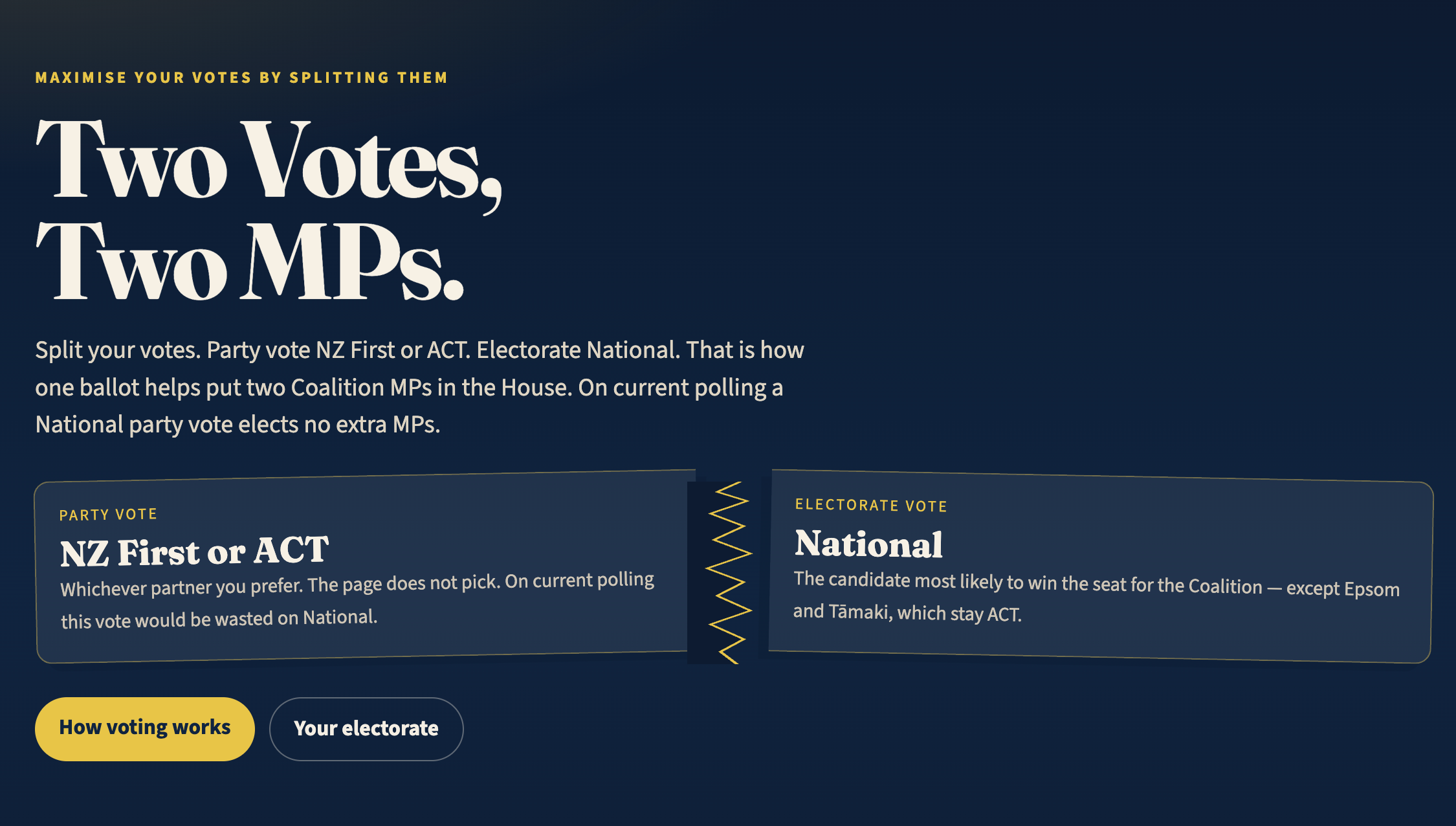
Cameron Slater has been pushing the same split at the Good Oil. A website called “Two Votes, Two MPs” already advocates an electorate vote for National, except in Epsom and Tāmaki, and a party vote for Act or NZ First. The site names Dieuwe de Boer in its authorisation statement and says it is unaffiliated with any party or third-party promoter.
And at the start of September Nick Mowbray, who has given $250,000 to National and $200,000 to Act this year, set out the strategy on X: “The objective is simple: maximise the chances of the current coalition continuing to govern.”
Much of the arithmetic comes from Oliver Hartwich of the New Zealand Initiative, whose modelling found that “If one National party vote in nine moved to a coalition partner, the Government would gain a parliamentary majority even if the opposition wins more votes in total.”
Writing about Te Pāti Māori’s tactic, Hartwich warned: “This tactical manoeuvre makes political sense, it is legal, and that is exactly the problem.” As Toby Manhire observed at the Spinoff, “All of this might be dismissed as fanciful were it not for the fact that it has been championed by a group of intelligent and influential figures on the right.” Newman and others have since treated Hartwich’s paper as a how-to guide.
The Mowbray plan
Cooke describes Harry Mowbray wanting Act and New Zealand First voters to pledge their electorate votes to National, while some National voters give their party votes to Act. Cooke is blunt about what that would mean: “Mathematically, this could give the right a large number of extra seats – without having to win over actual new voters.” It would also “make it entirely possible for a Government to be elected that had far fewer votes than the Opposition, but were simply better organised.”
This is reminiscent of the first past the post electoral era, such as in the 1978 and 1981 elections, in which the party with the most votes lost. Mowbray’s proposal could produce a comparable mismatch between votes and power.
Cooke found Mowbray “refreshingly open about his goal”, and reports that he “thinks MMP is a dog of a system for allowing such a move.” Hartwich, for his part, told the Taxpayers’ Union’s podcast that he would prefer first past the post, although he argues MMP should be repaired before voters are asked whether to keep it. I suspect some on the right wouldn’t mind much if MMP were discredited along the way.
What remains unclear is who would finance such a campaign and how much voters would learn about its spending.
The paywall now starts partway through all Democracy Project newsletters. Please take out a paid sub if you want to support this service and access the full content, including the following sections:
“The obstacle to an advertising campaign”
“The prospect of paid influencers”
“Doing what the parties can’t”
“Changing the rules”