

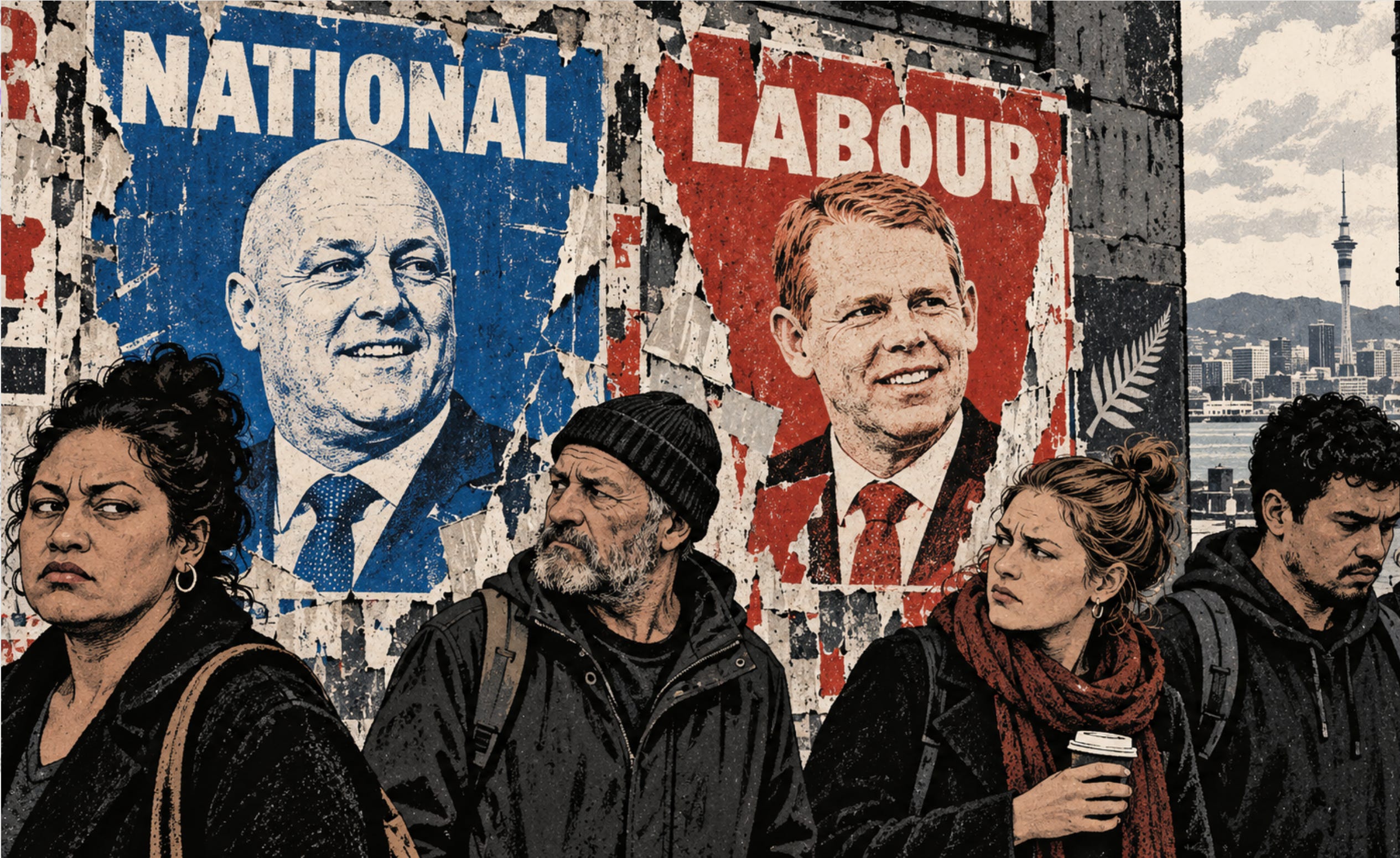
With little more than three weeks until polling day, a study from the University of Otago helps explain why so many voters are looking beyond Labour and National. Satisfaction with the state of the economy averaged 4.3 out of 10. Asked about the cost of living, 22% said they felt angry and 28% anxious. Both major parties should find this unsettling.
The Consumer Lifestyles Study, released yesterday, surveyed 1,096 adults between November 2025 and January 2026. Reporting on it, the Post’s Rob Stock explained that the “Election campaigning is playing out before the eyes of a jaded public with many feeling uncertain and miserable about their finances”.
Politicians should not assume that better messaging and a few more months of economic recovery will settle this discontent. I think many people have read their own circumstances accurately. Their discontent is a reasonable judgment about what their wages buy, what their taxes deliver, and whether politicians can improve either. It’s a rational anger, and it’s part of this year’s “populist moment” I’ve been writing about.
When getting ahead means leaving
A university degree, a full-time job and a mortgage were supposed to mean you were getting somewhere in New Zealand. The Otago study finds they no longer necessarily protect people from struggling to pay the bills.
The researchers classify 27% of respondents as “Financial Strugglers”, making this the largest of six groups. A comparable group accounted for 16.5% in the 2020 study. The current group has the second-highest shares of university graduates, mortgage holders and full-time workers. Lead researcher Leah Watkins told RNZ’s Susan Edmunds: “It’s not perhaps what we [normally] picture as those that would be financially struggling.”
Across the survey, 40% reported struggling to pay for essentials. The pressure on the middle class comes on top of deeper hardship further down the income scale. Reporting from South Auckland foodbanks, RNZ Pacific’s Johnny Blades heard from Lara Dolan of the Māngere Budgeting Services Trust: “We see a lot of people who are ‘working poor’, like teachers, builders, and health care workers coming in.”
Some 75% of respondents expect the high cost of living to persist for several years. Almost half (48%) agree that anyone who wants to get ahead needs to go overseas, up from 28% in 2020. Stock noted that 2020 was an unusual Covid year. In 2015, under John Key’s National government, 34.2% agreed. The latest figure is well above that too.
That is a bleak assessment of what staying in New Zealand offers, whether or not respondents intend to leave.
Discontent extends beyond finances. Since 2020, agreement that New Zealand is a good country to live in has fallen from 80% to 68%. The share who think it is becoming more dangerous has risen from 39% to 52%, and the share who think moral standards are declining from 51% to 63%. More also think racial problems are getting worse (56%, up from 46%) and want the courts to be tougher on lawbreakers (69%, up from 60%). And 55% think the country would be better off returning to the standards of previous generations, up from 44%.
Where dissatisfied voters are going
If the anger were simply a reflex against whoever is in power, Labour would be cruising. Instead, National and Labour sit on 28% each in the 13 October 1News-Verian poll, a combined 56%. Rob Stock made the connection in his story on the Otago study: “That fragmented picture echoes the fragmented political scene.”
Similarly, summarising the Post’s Freshwater polling recently, Matthew Hooton wrote: “Nearly 60% lack confidence in the Government to fix things, but they have no more confidence in the Opposition parties either.” Stuff’s Jenna Lynch has the best description of this I’ve come across: “The discontent is scattering.”
Lynch notes that National and Labour’s combined vote was “about 75-80%” from 2005 to 2020, fell to 65% in 2023, and is about 55% in recent polls. Her argument is that dissatisfied voters are increasingly choosing smaller parties instead of moving between Labour and National. National’s tax attacks have hurt Labour, she says, but the voters it has scared off aren’t turning to National.
Opportunity is on 8% in the 13 October poll (although the Taxpayers’ Union-Curia poll released on 8 October put it on 4.8%). In my recent briefing, I discussed Hooton’s argument that it could attract protest votes. Henry Cooke has emphasised Qiulae Wong’s reasonable manner, despite the substantial policy changes she proposes. We do not yet know how much of Opportunity’s support comes from its policies, protest votes or Wong herself.
In addition, anger about inequality may be favouring the Greens, while concerns about social decline may be helping NZ First. Both can challenge the major parties’ priorities, although both have held office and NZ First is in the current Government.
Interestingly, the 1News-Verian polling shows that economic pessimism fell from 52% in April to 25% in October, but support for National remains weak. Economic recovery may not restore the political loyalties those parties have lost.
This is the “populist moment” I’ve been writing about. Political theorist Chantal Mouffe explains that a “populist moment” is a time when established parties lose authority and discontented voters look for alternatives on both the left and the right. The major parties are struggling to convince voters that they will improve their lives, which gives other parties a chance, although voters disagree about what needs to change.
The paywall now starts partway through all Democracy Project newsletters. Please take out a paid sub if you want to support this service and access the full content, including the following sections:
“A grumpy electorate?”
“What do voters get for their taxes?”
“Who benefits from the squeeze?”
“The case for anger”
“New Zealand’s populist moment?”
