

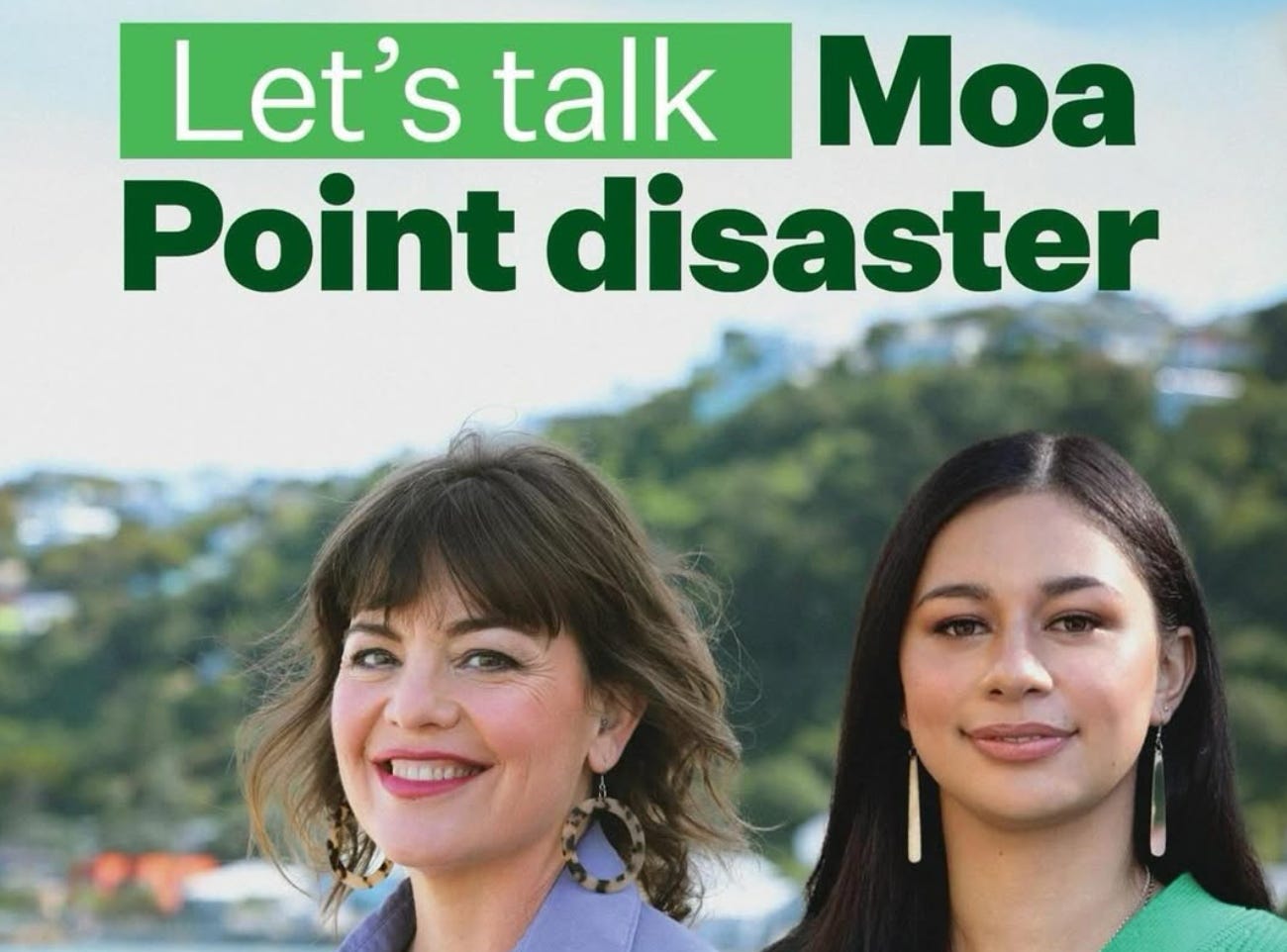
Nick Leggett’s resignation as Wellington Water chair yesterday was inevitable. After nearly a fortnight of 70 million litres of raw sewage a day pouring into the Cook Strait, somebody had to go. Leggett told The Post that “someone had to be accountable” and that “leadership carries responsibility.”
Fair enough. But Leggett’s departure should not become a convenient endpoint on the question of accountability. Because the Moa Point disaster was not caused by one man, one company, or one bad night of rain. It was caused by a political culture, sustained by councils of left and right alike for decades, in which Wellington’s elected representatives consistently failed to treat water infrastructure as the crisis it was.
The blame game over the past two weeks has been revealing for what it avoids. Wellington Water and Veolia are getting hammered, and rightly so. And ten days ago, I wrote my first column on the sewage disaster, with detailed criticism of Wellington Water and Veolia – see: Wellington’s sewage catastrophe exposes “Broken NZ”. But the politicians who were supposed to be governing these organisations and funding these assets have largely escaped scrutiny.
The Councillors who looked the other way
The most prominent political figure drawn into the sewage debate so far is Tamatha Paul, the former Green councillor and now Wellington Central MP. Peter Bassett’s widely-shared blog post accused Paul of moving a 2021 Long-Term Plan (LTP) amendment that nearly doubled the cycleway budget to $226 million while the most ambitious wastewater renewal option was passed over. Paul’s amendment, seconded by Jill Day (now Labour Party president), passed 9-5, with every Labour and Green councillor voting in favour.
Paul has pushed back, telling the media that the argument bike lane spending caused the Moa Point failure “demonstrates both financial and logical illiteracy, as well as historic ignorance.” She also told the Ryan Bridge’s morning show that “every amount of money that Wellington Water has ever asked for since 2021, they have gotten.”
She and her defenders have a point. Former councillor Sean Rush, who held the water portfolio at the time, wrote in The Post that the wastewater and cycleway votes were “financially and procedurally separate” decisions, that the rejected “Water Option 3” didn’t even focus on Moa Point, and that council officers themselves had questioned whether the more ambitious programme could actually be delivered. The 2021 LTP still committed $2.7 billion to water and separately funded the Moa Point sludge minimisation facility.
But here is where the defence falls apart. Paul’s supporters want us to believe the 2021 vote was irrelevant to Moa Point. Fine. Then the real question becomes bigger, not smaller: what were councillors actually doing about the plant that has now catastrophically failed? Because the answer, across multiple terms and multiple political alignments, is: not nearly enough.
A Culture of distraction
The real story is worse than the simplistic “bikes vs pipes” row. It wasn’t one vote in May 2021 that caused the disaster. It was a decade-long pattern in which Wellington’s elected representatives treated water infrastructure as a dull baseline obligation to be maintained at minimal political cost, while throwing themselves into visible, above-ground projects that could win votes and get photographed.
Green and Labour councillors were central to this culture, but they weren’t alone. As one commentor on the Scoop website pointed out, “Long before 2021, all through the Blumsky, Prendergast, Wade-Brown, Lester, Foster years there were low rates rises and consequent minimal investment in, and maintenance of, water assets.”
That’s true. And it matters. Wellington’s under-investment in water spans five decades, with roughly 200km of pipes laid before World War I and a $578 million infrastructure backlog identified by 2020. Audit New Zealand issued two unprecedented qualified opinions on the council’s water planning, finding the council “did not use information about the condition of water assets to direct investment” and instead forecast renewals “on age, capped by what the council considers affordable.”
Every mayor and every council that accepted those budgets shares some culpability. But what distinguished the progressive-leaning councils from roughly 2019 onwards was not just the continuation of under-investment. It was that they were spending big on other things at the same time, which made the neglect look deliberate, not just lazy.
Cycleways. The $330 million Town Hall refurbishment. The convention centre Tākina, which ratepayers fund 40% of in perpetuity. A new rubbish collection system. Te Kāinga housing. A new library. The sludge minimisation plant that ballooned from $200 million to $511 million. As one exasperated ratepayer put it on the Scoop website: “Citizens have been shouting into the void for years asking for the pipes to be prioritised.”
Were the politicians properly governing, or just outsourcing?
The mess goes way beyond one budget line. Wellington City Council owned the Moa Point plant. Wellington Water managed it. Veolia operated it. And the politicians whose job it was to govern this chain appear to have treated the arrangement as a reason not to ask hard questions, rather than a reason to ask more of them. Councillors effectively outsourced governance alongside operations, then looked the other way when the documented failures piled up.
The Moa Point plant had been non-compliant with its resource consent for almost every month since January 2024. Independent reviewers had found “understaffed plants, inexperienced operators and a lack of executive oversight.” Equipment was described as “obsolete and outdated and prone to failure.” Wellington Water’s own CEO acknowledged the organisation lacked a proper asset management system, a finance system, or even a payroll system.
Were councillors aware of this? They should have been. The Wellington Water Committee papers flagging serious concerns about Moa Point were circulated to the committee members, which included regional mayors. Mayor Andrew Little himself was on that committee. Yet Little claimed after the disaster that “there’s been nothing indicated to me in the time I’ve been mayor or even before that that this is a plant that’s at risk.” That claim is hard to square with the documented record.
The Funding defence doesn’t hold
Politicians love pointing to the “record funding” for water infrastructure. Tamatha Paul has made this case on social media. Former mayor Tory Whanau claimed in her valedictory speech that she directed 30% of the council’s budget, some $1.8 billion, towards water.
But there are good reasons to be sceptical. First, much of the big-ticket spending at Moa Point went to the sludge minimisation facility, not to maintaining or upgrading the actual sewage treatment plant that has now failed. That facility, plagued by cost blowouts and engineering defects, has seen its budget more than double from $200 million to $511 million. It addresses future waste processing, not the state of the existing plant’s pumps, outfall pipes, and electrical systems. So, when politicians and their defenders say “we were investing in Moa Point,” they are conflating two different projects.
Second, the increases in water funding that recent councils boast of were often reactive rather than proactive. They came after the 2024 summer water crisis of geyser eruptions in Wellington streets, after faecal contamination of streams and bays at levels hundreds of times the permissible limit, after Audit New Zealand qualified the council’s plans, and after sustained public pressure. Responding to emergencies after the fact is not foresight. The Council had planned to spend less money on water infrastructure until they were forced to backtrack by public pressure. Another online commentator has noted that capital expenditure on wastewater actually dropped from 23% of council capex in the 2022-23 council term to just 12% in 2025-26, despite all the rhetoric about increased investment.
Third, the argument that “we gave Wellington Water everything they asked for” should itself be a red flag, not a defence. The highly dysfunctional organisation the council was outsourcing to was spending nearly three times more than comparable councils on unplanned maintenance per kilometre of pipe. It had no asset management system. It made a $51 million budgeting error and took four months to tell the councils. If a councillor’s response to all of this was “we funded what they requested,” that tells you something about the quality of oversight, not the adequacy of funding.
The idea that councillors can simply point to Wellington Water’s budget requests and say “we gave them what they asked for” ignores the fundamental duty of elected officials to scrutinise, challenge, and oversee the organisations they control. That is what governance means. You don’t just write the cheque and look the other way. Giving Wellington Water “everything it asked for” is not governance. It is rubber-stamping.
The People who should be asked hard questions
Tamatha Paul deserves scrutiny, but she should not be a scapegoat. She was a first-term councillor in 2021 operating within a political culture that long pre-dated her. Yes, she went along with the status quo of the Wellington Water and Veolia arrangement. But the harder questions should be aimed at the more experienced politicians who sustained that culture over many years.
Former mayor Tory Whanau presided over the council from 2022 to 2025. Under her watch, the sludge plant budget doubled. Wellington Water’s contractor spending scandals emerged. The Moa Point plant failed its compliance checks month after month. Yet the council’s political energy was consumed by cycleways, by the airport shares controversy, by Tākina, and by personality-driven media coverage. Whanau was ultimately replaced by Andrew Little in a result widely interpreted as a demand to get back to basics. Whanau has been silent since the disaster.
Fleur Fitzsimons, the former Labour councillor who represented the Southern ward, which includes Moa Point, was by some accounts, one of the council’s more vocal critics of water under-investment. She warned of a crisis and called for additional investment. But she also voted for the 2021 LTP that her own party’s defenders now cite as evidence of adequate funding.
Julie Anne Genter, the Green MP for Rongotai and long the most vocal champion of cycleways in Wellington politics, called the disaster “a terrible reminder of the importance of investing in our infrastructure” and promised to “ask hard questions.” The irony was not lost on critics.
And then there are the mayors who preceded the recent progressive era. Andy Foster, Justin Lester, Celia Wade-Brown, Kerry Prendergast, Mark Blumsky. Every one of them presided over councils that kept rates artificially low by ignoring what was happening underground. The progressive-left councils inherited a mess. Their failure was not creating the problem but failing to treat it with the urgency it demanded when they had the chance.
The Real accountability deficit
What unites all of these politicians, across the political spectrum, is a pattern that should trouble anyone who cares about democratic governance. They outsourced the management of critical assets to a council-controlled organisation that was demonstrably dysfunctional. They contracted a French multinational whose failures were documented for years but whose contract was deemed “too embedded to fail.” They accepted officer advice about funding levels without interrogating whether the organisation receiving those funds was capable of spending them effectively. And when the whole system produced exactly the disaster that was predictable from the documented record, many reached for the same playbook: call for an inquiry, blame the contractor, and hope the public’s attention moves on.
Nick Leggett has resigned, with his own conflicts of interest as both Wellington Water Chair and CEO of Infrastructure New Zealand still demanding serious examination. Veolia will face investigation. Wellington Water will soon be dissolved into Tiaki Wai. But the politicians who governed this system, who set budgets, who chose priorities, who failed to hold anyone accountable for years of non-compliance, are largely walking away clean.
Eugene Doyle, a south coast resident who served on the Mayoral Three Waters Taskforce, put his finger on the deeper problem. Doyle revealed that the taskforce met behind closed doors and that members had to sign non-disclosure agreements. The council officers, he said, “wanted a report which lacked steel.” He warned that a government inquiry risks the same pattern: “Such inquiries, behind closed doors, have the benefit (to them) of taking the heat out of the moment. The report is eventually released, after the evidence has been carefully curated, and any commercially sensitive bits or inconvenient truths have been massaged into shape.”
This is the fundamental accountability gap. Wellington’s councillors and mayors did not need a catastrophe to know the system was failing. The information was there: in the audit qualifications, in the compliance reports, in the independent reviews, in the geysers erupting from the streets. What was missing was not information but political will. The political will to spend money on things voters couldn’t see, to confront a dysfunctional water entity, and to say no to popular projects when the basics were crumbling.
So, yes, councillors who are now MPs like Tamatha Paul, are right to criticise Wellington Water and Veolia. But that conveniently redirects attention from council decision-making, including Paul’s 2021 manoeuvre to direct much more money to cycleways when this would reduce the ability to fund water infrastructure, which everyone was telling councillors was in dire need of fixing.
Holding politicians to account
Tamatha Paul is currently doing a good job of asking questions about the Moa Point crisis. And tonight, she is helping convene a public meeting about the scandal. This is good. But if you were part of the governance that let the system rot, you don’t get to reinvent yourself as the critic without first accounting for your own record.
If Paul wants ‘hard questions’ asked of Wellington Water and Veolia, she should also welcome hard questions about the political leadership that owned the system while it decayed. In recent days she has cast herself as a fierce critic of the council’s outsourcing model and of the councillors who “let this occur over recent years”. The obvious question is what she did about that model when she was in a position to change it.
No doubt once Paul finds out which councillor chaired the Environment and Infrastructure committee with explicit responsibility for capital works delivery (including Wellington Water’s programmes) and three-waters, she will hold them to account. The problem, of course, is that it was Paul herself! She oversaw the committee during a period when the Moa Point plant was failing its compliance checks month after month, when the sludge plant budget was blowing out, and when Wellington Water’s dysfunction was becoming impossible to ignore. Paul was in a powerful position to demand change, to enforce performance, or to campaign against the whole model. Instead, she appears to have been one of the ones responsible for the ongoing arrangement.
Avoiding a very “Wellington outcome”
The Moa Point disaster was not caused by a single council vote in 2021. It was caused by decades of underinvestment, by Veolia’s operational failures, by Wellington Water’s dysfunctional management, by a governance structure that dispersed accountability so widely that nobody owned it.
But within that wider failure, local politicians bear a share of the blame they have never owned up to. They set the budgets. They approved the priorities. They created the governance structures.
This means that raw sewage is still pouring into the strait. Leggett’s out. An inquiry’s on the way. But unless it extends its gaze beyond Wellington Water and Veolia to the elected representatives who were supposed to be governing the system, it will be yet another exercise in diffusing blame until nobody is responsible.
That would be the most Wellington outcome of all.
Dr Bryce Edwards
Director of the Democracy Project
Further Reading: