

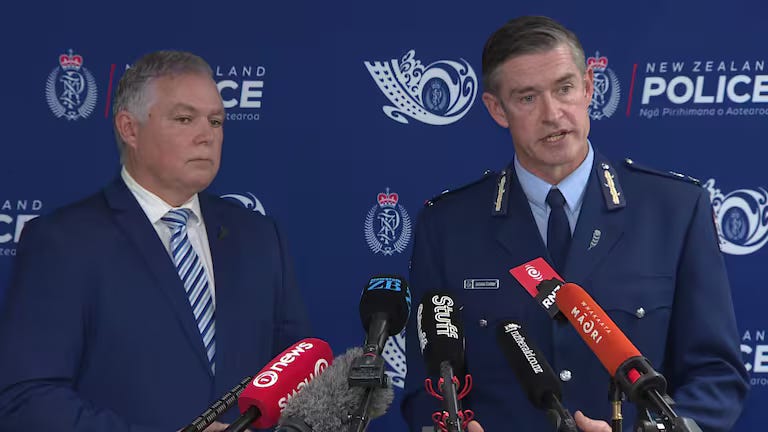
Andrew Coster’s interview on Q+A has blown the police integrity scandal wide open again. It’s now obvious the public has been left with a mess of clashing accounts, shifting explanations, and gaps that the existing investigation was never designed to resolve. If the Government wants any hope of restoring confidence in the Police, it needs to authorise an independent inquiry with proper powers.
Coster went on television insisting he’d “acted honestly” throughout the McSkimming saga, and that he’d told both Chris Hipkins and Mark Mitchell about the developing situation long before either claims to have known. He also rejected outright the allegation that his office created or authorised the protocol that funnelled McSkimming-related emails away from the Police Minister. “The first I heard of that,” he said, “was when I heard that allegation made.”
Within hours, both Mitchell and Hipkins contradicted him. Mitchell said Coster’s denial was “unfathomable”. Hipkins said he had “no recollection” of any such briefing. We are now watching the country’s former Police Commissioner and two senior politicians essentially accuse one another of misremembering, or worse. Nobody outside that inner circle can know who is right. And that, precisely, is why an inquiry is needed.
Beyond the factual disputes, all three have obvious incentives to present a self-serving version of events. Coster is fighting for his professional reputation. Hipkins and Mitchell are fighting to avoid looking negligent. When the stakes are this high for all involved, the public isn’t wrong to doubt every party equally.
A core problem is that the IPCA report — the only official investigation so far — never set out to answer the questions that matter most. It looked narrowly at how police handled early complaints about Jevon McSkimming. It did not examine whether there was an orchestrated effort to shield him. It did not attempt to reconcile the conflicting political accounts. It never set out to determine who knew what, when, or whether information was deliberately withheld from elected officials.
The IPCA itself warned as much. Its report said it was examining only “the first aspect” of the case — the handling of complaints. It made “no findings as to the truth” of the allegations, and it was never focused on whether senior figures engaged in a cover-up. Even Sir Brian Roche emphasised the absence of evidence for “conscious wrongdoing”, but that was because the investigation wasn’t asked to look for it.
Yet the evidence that has emerged is alarming. A handwritten note confirms someone instructed that complaint emails be diverted away from the Minister’s office. Mitchell says the instruction came from Coster’s office. Coster says he knew nothing about it. A fundamental democratic principle is at stake here: Ministers cannot exercise oversight if their officials are deciding which information they see or don’t see.
This is the kind of issue that, in other eras, has triggered full-scale inquiries. The parallels with the early-2000s Louise Nicholas scandal are unsettling. Dame Margaret Bazley’s inquiry back then exposed a police culture that protected its own and buried inconvenient truths. Many New Zealanders had assumed that era was behind us. The McSkimming case suggests otherwise.
Journalist Jared Savage has argued that the country needs a new commission or ministerial inquiry because “not as much progress has been made as police would like us to believe”. He’s right. The pattern looks depressingly familiar: an institution that defaults to protecting reputations, a reluctance to investigate one of its own, and a vulnerable complainant (known publicly as Ms Z) treated appallingly. Police leadership allowed her to be prosecuted under the Harmful Digital Communications Act rather than properly investigating her allegations. That does not indicate a modern, accountable police force.
What New Zealanders still don’t know is even more troubling. Did Coster brief Hipkins in 2022? Did he brief Mitchell in 2024? Who authorised the email-diversion protocol, and was it used elsewhere? Was the IPCA investigation influenced behind the scenes? If Coster is telling the truth, then the two politicians are not. If they are telling the truth, then he is not. Those aren’t small discrepancies; they cut to the heart of how democratic oversight of the Police is supposed to function.
The debate over whether this scandal amounts to “corruption” also remains unresolved. Ministers flirted with the word before retreating from it. Transparency International has tried to reframe the issue as simply a cultural problem. But ordinary people watching this saga don’t speak in euphemisms. When a powerful institution bends rules, suppresses information, or protects insiders, they call it corruption. And they’re not wrong.
Without an inquiry, we cannot know whether what happened was the work of a misguided Commissioner defending a colleague, or a wider institutional reflex to smother bad news. That is the question the public cares about. And it is exactly the question the IPCA was never structured to answer.
The scandal has already ended Coster’s public-sector career. Three senior officers face employment investigations. McSkimming has admitted grotesque offending. But these outcomes tell us nothing about whether the system that enabled the failures has been fixed — or whether it remains intact, waiting for the next crisis.
New Zealanders deserve clarity. They deserve to know whether there was a cover-up, whether their elected representatives were misled, and whether the police executive was acting in the public interest or its own.
However, Prime Minister Christopher Luxon has now ruled out having an independent inquiry on the matter. He argued yesterday that the IPCA inquiry had already found the answers, and he stated that “I can tell you what the outcome of that would be.” Rather than going over what exactly had gone wrong, Luxon wanted the focus to be on the future.
This isn’t convincing everyone. Today’s New Zealand Herald editorial argues that the Coster interview shows that “there is much more still to be learned. It also helps to justify the calls from those wanting a further investigation”. The newspaper isn’t convinced that this is a case of the politicians telling the truth and the disgraced former Commissioner being in the wrong, and they point out that Coster “has never displayed – throughout an extensive career – a tendency to, nor be caught, outright lying”.
“Something doesn’t add up” about the various accounts of what has happened, and the newspaper says “the public rightly have a lot more questions and deserve answers.” The Herald suggests that the politicians and the Police might wish that we would all move on from the scandal and questions soon, but without any real transparency this is impossible.
Stuff journalist Tova O’Brien is even more scathing about the PM ruling out a proper inquiry. She mocks his argument that he already knows what a high level inquiry would conclude: “Well, he can’t. That’s simply impossible… That’s like saying he knew the outcome of the IPCA investigation before it started.”
O’Brien also finds inconsistencies in Police Commissioner Mark Mitchell’s explanations, which provides further reasons for an inquiry: “all this murkiness in an already mucky scandal can only have any hope of being cleaned up with a further independent inquiry that looks into the roles of government ministers and MPs including Hipkins.”
In the end, the Government can announce all the new oversight mechanisms it likes and can keep telling us to focus on the future. But until there is a proper, independent reckoning with what actually happened, public confidence in the police will remain fundamentally compromised.
Dr Bryce Edwards
Director of the Democracy Project
Note: For a much more extended version of this column, check out my online “Democracy Deep Dive” version on the Democracy Project’s Substack: Democracy Deep Dive: The Coster interview deepens the case for an independent inquiry
Further Reading: