

Tomorrow’s final count could leave Chris Hipkins with a path to becoming prime minister, something few in Parliament would have predicted a fortnight ago. On 9 November David Farrar, whose company Curia polls for National, headlined a Kiwiblog post “Hipkins has almost no path to power”. This week he wrote that if the specials leave Opportunity holding the balance of power and it can’t reach an agreement with National, “Chris Hipkins would become Prime Minister.”
Hipkins would need the specials to cut the coalition’s majority over all the other parties, now three seats, by at least four, most plausibly through NZ First losing a list seat, Labour winning Wairarapa and one more result such as Hamilton East. Opportunity, which has promised to negotiate with National first, would then have to decide that those talks were going nowhere or that National’s offer wasn’t good enough. If it got that far, Opportunity would have strong reasons to choose Labour.
(In the “Further Analysis” section after this column, I look at what Labour, the Greens and Te Pāti Māori would have to agree with Opportunity, and with each other, to form a government that could last.)
The numbers before the specials
The existing coalition has 67 seats on the preliminary results, with Labour, the Greens and Te Pāti Māori on 57 and Opportunity on seven. With 66 MPs needed for a majority in a Parliament of 131, the coalition has only one more seat than it needs, even though Labour won 3,650 more party votes than National.
The estimated 400,000 special votes are unusual this year, because restrictions on late enrolment have cut domestic specials while overseas voting is up sharply. The Electoral Commission says nearly 97,000 of the specials are overseas or dictation votes. The specialist Substack The Overhang estimates that overseas votes will make up roughly a quarter of all specials, compared with 13% in 2023, and overseas voters have consistently backed the Greens and, since 2017, Opportunity far more strongly than voters on election night.
How the consensus moved
The Overhang’s modelling, as the Herald’s Thomas Coughlan reported on Saturday, gives a 58% chance that Opportunity becomes a true kingmaker, able to choose whether a National-led or a Labour-led government takes office, and only a 22% chance that the coalition keeps its majority. Screenshots of the analysis went round Parliament, Coughlan wrote, “undermining the coalition’s confidence and fuelling hope in the left bloc”.
Simulations reported by the Post’s Henry Cooke last week were less favourable to the left. Their most common outcome was the coalition scraping back with a one-seat majority (38%), while a one-seat majority for Labour and its three prospective partners came up in 25%.
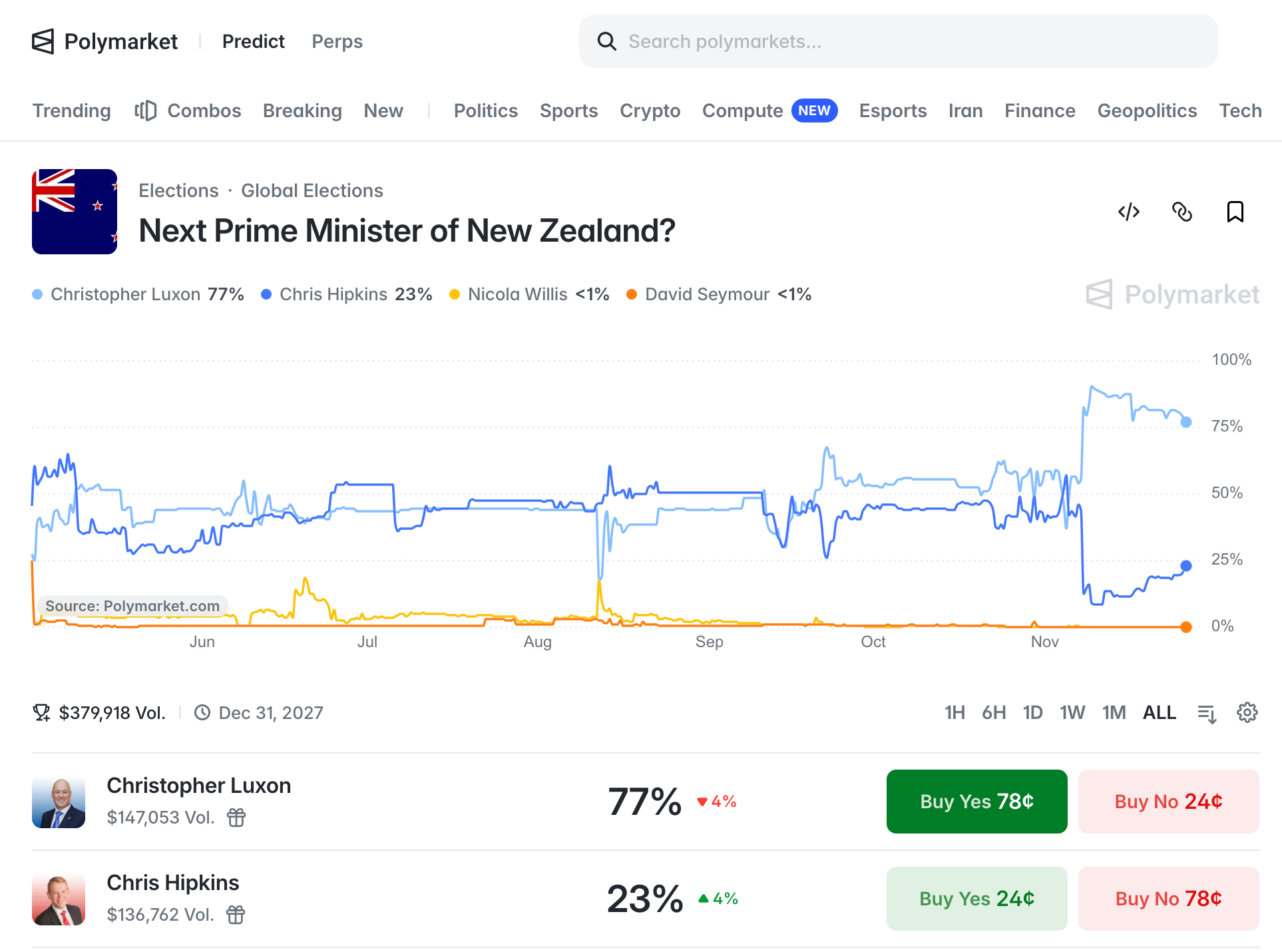
On the international prediction market Polymarket, contracts for Christopher Luxon becoming the next prime minister were priced at around 77 US cents today, compared with 23 cents for Chris Hipkins. The market has moved somewhat in Hipkins’ favour recently, with cumulative trading exceeding US$375,000.
On RNZ’s Midday Report today, Farrar said that a repeat of the 2023 special-vote pattern would leave the coalition with its majority, but if the specials follow 2017, “it’s Opportunity kingmaker, where a left government would be viable.” I have argued in Democracy Briefings, including on 11 November, that the right was much more likely to govern. The modelling of the specials and the polling of Opportunity voters since then have narrowed that gap a long way.
What to watch at 2pm
The coalition’s majority over all the other parties combined is 67 to 64. If NZ First’s last list seat goes to the Greens, Opportunity or Labour, that falls to one, because a seat moves from one side to the other. Farrar expects that to happen.
Unusually for MMP, close electorate races could change the balance, because National and Te Pāti Māori are in overhang. As 1News’ Justin Hu writes, “every electorate won or lost will add or remove a seat it has”, changing the number of seats held by the right or the left. A Labour win in Wairarapa, where Kieran McAnulty trails by 139 votes, or in Hamilton East, where Georgie Dansey trails by 456, would cost National a seat without adding one to Labour, while a National win in Mt Roskill, where Labour’s Michael Wood leads by 262, would add one to the coalition. Wairarapa is the seat Farrar is picking to flip, “based on what I have heard about specials in another seat”.
In Te Tai Tokerau, Hu points out, a Green win would hurt the left. If the Green MP Hūhana Lyndon overtakes Te Pāti Māori’s Aperahama Edwards, who leads by 436, Te Pāti Māori would drop a seat and the Greens would gain none, which would help Christopher Luxon stay in power.
If the coalition’s majority falls to zero, Parliament is “hung”, and Opportunity could decide whether National governs but couldn’t give Labour a majority, which the trade unionist and former Labour adviser David Choat calls the “one-way kingmaker” scenario. With margins this tight, judicial recounts could delay the final result beyond tomorrow.
Why Opportunity could choose Labour
Opportunity’s leader, Qiulae Wong, has said she will negotiate first with the largest party by seats, which will be National, and that if Opportunity feels those talks are “not getting anywhere”, “then we will go talk to the second largest party.” Opportunity can therefore move on without formally declaring the talks with National over, and Choat writes that “its optionality places a discipline on whichever of the two it is negotiating with”. Farrar wrote this week that it is “far from likely that National could negotiate an agreement with Opportunity that meets their five bottom lines, let alone one that NZ First and ACT would agree to.” He thinks Labour would be an easier partner because “Everything Opportunity wants is stuff Labour and Greens want to do anyway”.
A post-election Anacta poll reported by the Spinoff’s Toby Manhire on Monday found that 68% of Opportunity voters wanted the party to join the left bloc if possible, against 21% the right, and earlier Anacta polling that Nick James wrote up for the Post last week had them favouring a Labour-led government by five to one. Anacta also polls for Labour, though, and the subsamples are small.
Opportunity’s chief of staff, Iain Lees-Galloway, who is on its negotiating team, was a minister in the last Labour government. Wong told RNZ’s Morning Report before the election, “we are not here to prop up the current coalition government.” Coughlan writes that “Opportunity is a left-wing party, even if it can’t admit it”, though the party still describes itself as centrist.
The case for going right
Even if Opportunity has the choice, many on the political right assume it will opt for National because of the more comfortable majority on offer. Coughlan wrote on Saturday that the right expects Opportunity to go its way even if a one-seat left majority were possible, because such a majority would be too fragile to govern with. “That’s probably correct,” he added, “although majorities aren’t as fragile as they were in the past”. Wong has said that “a majority is a majority”, but Farrar suggests Opportunity “may show some flexibility with the interpretation of their bottom lines” for the sake of a majority of six or seven seats rather than one or two.
A left government would also rest on Te Pāti Māori, which expelled two MPs last term and whose internal turmoil could put a thin majority at risk. Nearly a third of Opportunity’s party votes, RNZ found, came from higher-income neighbourhoods that favour National. In a left government, Farrar writes, Opportunity “may not get any credit for their ‘wins’”, because Labour and the Greens want much the same things, whereas forcing National to keep the Climate Commission or the Paris Agreement would be an achievement it could clearly call its own.
A choice Opportunity may not want
The Overhang’s author asks whether Opportunity would actually prefer a hung Parliament, with its leverage but “without the burden of (and blame from) really choosing”. A genuine choice would set National’s bigger majority against the problem of NZ First, whose leader Winston Peters has described Opportunity as “pinko communists”, and whose deputy leader, Shane Jones, said in mid-November that NZ First was still ruling Opportunity out. A Labour-led government is probably still less likely than a National-led one. Whether it happens depends first on a handful of close results tomorrow afternoon, and then on how long Opportunity is willing to keep talking to National.
Dr Bryce Edwards
Director of the Democracy Project
What would Labour have to give to govern with Opportunity? The “Further Analysis” section that follows compares Opportunity’s bottom lines with what Labour, the Greens and Te Pāti Māori have promised, identifies the hard issues (tax, Te Tiriti, ministries and the rules on political money), and asks how four parties could protect a majority of one or two seats. Paid subscriptions fund this research.