

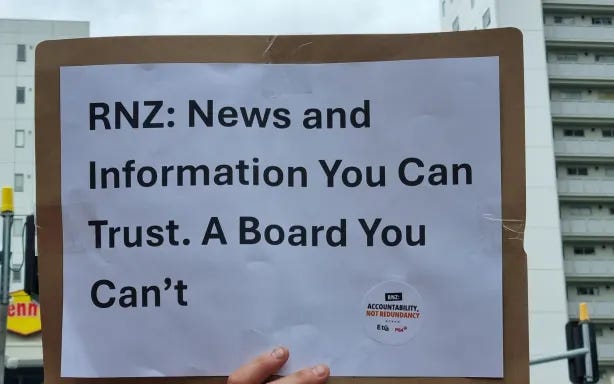
The last ones standing
RNZ has lost another senior executive. Chief people officer Sarah Neilson leaves on Friday after seven years, the Herald reports. Her team ran the Auckland office move, which came in about $1.85m over budget, and she was reported last week to have been the go-between after chief executive Paul Thompson and finance chief Hilary Parker fell out. Parker resigned in October and Thompson left six weeks early. But the board remains in place.
In today’s Democracy Briefing I argue that it is now the board’s turn. Earlier this month I argued that RNZ’s staff are paying for failures at the top. It has since become much clearer where those failures sat.
RNZ budgeted for a $470,000 loss and ended the year $11.8m in deficit, with personnel costs $3.2m over budget and operating costs $6.4m over. The Government’s funding cut was real, but RNZ knew about it when it set the budget it then missed by more than $11m.
Labour is right, up to a point
Labour’s media spokesperson, Reuben Davidson, has finally called for the board to go. Writing in The Post this afternoon, he argues: “An interim board should be appointed while a review examines how this occurred, and no decisions on cuts or redundancies should be made in the caretaker period. We should not allow a board that oversaw this crisis to push through major restructuring that could permanently weaken RNZ before a new Government has the opportunity to consider the alternatives.”
I agree with him, but Labour is treating this as a failure of National’s appointments alone, which is too convenient. The scandal has also opened a bigger fight over what RNZ is for, which I examine in the “Further Analysis” section below the paywall.
The buck stops with the board
Start with the $5m borrowing facility the board approved on 9 June. No money went missing, but the Crown Entities Act required the approval of two ministers, and nobody sought it, even though former director Jane Wrightson says she told the meeting it was needed and her warning never made the minutes. Checkpoint has reported that another director, Gracie MacKinlay, twice emailed Parker to ask the same question and was assured approval wasn’t needed. Who decided to go ahead regardless is one of the questions RNZ won’t answer. Brent Impey, now the chair, was one of the directors at that meeting, though Jim Mather chaired it.
Then there is the cash. Shane Jones, rarely a defender of RNZ, notes that its cash fell from about $23m to $8m in roughly two years, and told RNZ it is “just not credible for people of governance merit to have missed such a rapid reduction in cash”.
The Herald’s sources point the same way. One told Media Insider that on personnel costs “people were told month after month they were at $44 million when they’re at $47.6m”. Another put it more bluntly: “It goes back to a fundamental governance flaw… The audit and risk committee is very culpable here.” RNZ’s only response is that the review will establish what happened, and “We are not discussing individuals.”
Board fees rose about 22% that year, from $254,000 to $311,000, according to the annual report. RNZ attributes that to a government-wide lift in Crown board fees, and some of it reflects changes in membership. But fees are paid at the board’s discretion, and directors took the rise in the year of the blowout.
Who is investigating whom?
The board has approved draft terms of reference for an “independent review”, and this week ministers told it to “toughen it up”. The terms haven’t been published and no reviewer has been named. Even a reputable accounting firm won’t make the review independent if the board still writes its questions, controls access to its papers and decides what the public gets to read. As James Hollings, Massey University’s head of journalism, puts it, the current regime “cannot be allowed” to sack one in six staff, “and certainly not hold an inquiry into itself”.
If I were writing the terms of reference, I’d start with three questions: what financial information the board and its audit committee received and when, why the warnings about the facility were neither acted on nor minuted, and what Treasury, which met RNZ every quarter, did with what it was told. The board can’t have the final say over the scrutiny of its own conduct.
Impey was happy to give interviews when the deficit was announced, but he has gone quiet as the questions have become more specific. When The Post asked this week about the second warning, RNZ reissued his statement of 12 November, which mentions only one. When Paul Goldsmith promoted Impey to chair in May, he praised his “decisive and transparent leadership style”. Having picked him, Goldsmith can hardly go on saying, as he did on 10 November, “It’s their problem. They broke it. They need to fix it.”
The case for waiting
The strongest argument against all this comes from David Seymour, who told The Post that “before deciding on a board clear-out, or a bail-out, it would be wise to get to the bottom of how these accounting mistakes occurred.” He has a point. The board says management fed it wrong figures for months, some directors raised the alarm, and at least two, including acting CFO Richard Dellabarca, joined after the financial year ended. RNZ says it has found no evidence of fraud. A wholesale clear-out could also hand ministers another chance to install their favourites.
But nobody needs to be found guilty of anything for a board to be replaced. This government replaced Health New Zealand’s board, by then down to two members, with a commissioner in 2024 over its finances, without first holding an inquiry into each director. The inquiry here can still decide who did what. Waiting only makes sense if the people being reviewed aren’t running the review, and aren’t making irreversible decisions in the meantime.
Both parties’ plaything
This is where Labour’s story falls short. Davidson describes the board as “hand-picked” by the coalition, and that is true of today’s board, which has been entirely appointed by this government. But at the June meeting that approved the unlawful facility, three of the seven directors had first been appointed under Labour, including Mather, who had chaired the board since 2018. As Hollings puts it, “Labour and National have both used the RNZ board as a plaything”.
The current government has been unusually open about this. In May, Seymour, one of RNZ’s shareholding ministers, was reported by The Spinoff as saying: “We have appointed most of the people on the board and replaced and refreshed them.” When Wrightson objected, he said she “shouldn’t be surprised that we do that with purpose”.
Several of today’s directors have serious commercial broadcasting experience, but running a commercial media business is not the same as governing a public broadcaster that exists to do what the market won’t. If the next minister simply installs a new set of “trusted” names, we’ll be back here in a few years. The interim board should be agreed across Parliament. And if Labour is serious about better governance, it should say whether it would bring in published selection criteria, an independent shortlisting panel and cross-party agreement on the chair.
Don’t make the staff pay first
Meanwhile, staff are learning this week which roles are proposed to go, under a budget the board approved with 58 fewer of them. According to the Herald, 26 people covering 23 full-time roles are already leaving through voluntary redundancy and expiring contracts, so about 35 more roles are still to be found.
The unions say the consultation is predetermined, which acting chief executive Mark Stevens denies. The caretaker convention doesn’t forbid staffing decisions, but the Cabinet Manual asks board members of public sector agencies to “exercise special care” while a government is formed. Disputed, irreversible redundancies should wait for the inquiry.
The board should go first
RNZ’s board has lost the confidence it needs to lead the clean-up. It should make way for an interim board agreed across Parliament, Brent Impey should stand aside now, and the inquiry should be put beyond the board’s control. Some of the directors who go will have done their jobs properly, and the inquiry should say so. But RNZ’s staff are being asked to pay for this, and they are entitled to see the people at the top go first.
This is “Broken New Zealand” again, with failures at the top paid for further down. RNZ needs a new board, not another round of political musical chairs, and if Labour and National keep choosing its governors the way they always have, the next board will be no better than this one.
Dr Bryce Edwards
Director of the Democracy Project
Whoever governs RNZ through the next few months, a bigger argument has begun over what it should become. Below, I weigh the main proposals now in play: a smaller RNZ, a more commercial one, a merger or a new NZBC, and a return to public-service basics. I ask what each would cost democracy, and set out the kind of public broadcaster I think is worth defending – see: “Further Analysis: The fight over what RNZ is for”
Paid subscriptions are what keep this analysis independent.