

“Government by the Farmers, for the Farmers”. That phrase is no longer just a quip in New Zealand – it’s an apt description of how climate policy is being made.
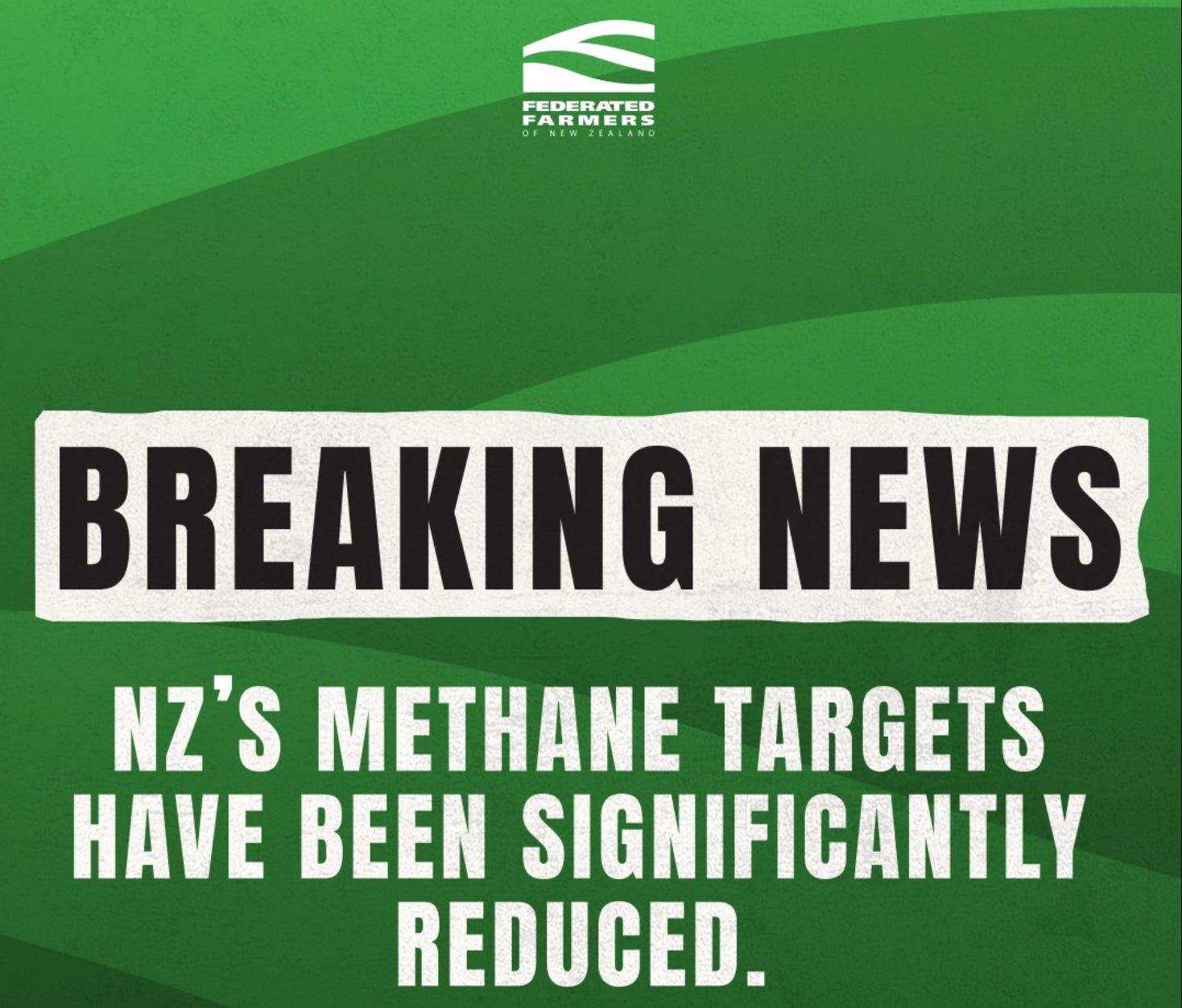
That became very apparent on Sunday, when on a sunny Waikato farm, three Government ministers unveiled a decision that slashed New Zealand’s methane emissions reduction target almost in half and shielded the agricultural sector from any carbon pricing. They announced the official biogenic methane target was being weakened to 14–24% below 2017 levels by 2050 (down from 24–47%), and farmers were promised exemption from the Emissions Trading Scheme or any similar emissions tax.
At the same time, the government magically found $400 million of public funds for R&D to help farmers reduce emissions – a generous carrot with absolutely no stick. In effect, the country’s biggest polluting industry got exactly what it wanted: no new costs, no strict regulations, and plenty of taxpayer support.
Observers were quick to note how uncannily this package mirrors the demands of powerful farming lobby groups. As Newsroom’s Marc Daalder put it, the announcement “reads almost exactly like a wish list from radical farmer advocacy group Groundswell.” The message was clear: the sector asks, and the government delivers.
This U-turn is especially jarring because the senior coalition partner – the National Party – had campaigned at the 2023 general election to introduce a price on agricultural emissions by 2030. That pledge evaporated under post-election pressure. It appears National was, according to one commentator, “rolled by NZ First and Act on the issue,” caving to its more hardline junior partners. Indeed, Act Party agriculture spokesperson Mark Cameron crowed that the softer target was just “common sense,” bragging in a press release that the Paris Agreement would be “next” on the chopping block.
The farm lobby’s triumph was so complete that Federated Farmers president Wayne Langford hailed the policy as a “huge relief,” and other industry leaders seemed in near disbelief at having their entire agenda fulfilled. In the span of a few months, New Zealand’s climate policy framework for agriculture has gone from a hard-won consensus to something that looks like it was written by the agribusiness lobby.
The Farming lobby’s wish list, delivered
To understand how we got here, we have to recognise that New Zealand’s agricultural lobby has waged a long campaign against methane regulations. And they finally found a government willing to do their bidding.
Federated Farmers, the country’s most influential farm industry group, never accepted the original 24–47% methane reduction goal “from day one”. They lobbied strenuously against it, arguing it would hobble farmers and wasn’t necessary.
Groundswell NZ, a more radical grassroots protest group formed in 2020, whipped up rural outrage by painting environmental rules as an existential threat to the “Kiwi way of life.” Beef + Lamb New Zealand and DairyNZ – representing the meat and dairy sectors – likewise pressed relentlessly to delay or dilute emissions targets and avoid any pricing of farm emissions.
For years, these groups were pushing uphill against a policy consensus that agriculture needed to do its share on climate. But with the right-leaning coalition elected in late 2023, the lobby finally hit the jackpot.
It’s not an exaggeration to say the new Government adopted the farm lobby’s pre-election wish list verbatim. Federated Farmers had published a checklist of policies it wanted, and high on that list was a “review” of the methane target (code for weakening it). Sure enough, the incoming coalition agreement specifically called for a review of the methane target, effectively preordaining a backtrack. As RNZ reported, the methane target review “was on Federated Farmers’ pre-election wishlist before being adopted by the coalition.”
Another item on the lobby’s list: no emissions taxes for farmers. The Government delivered that too, outright ruling out the very pricing mechanism that National itself had once championed. Instead, ministers parroted the industry’s own mantra: “innovation and partnership, not taxes and regulation.” The policy announcement was littered with phrases straight out of industry playbooks – “no additional warming,” “split gas approach,” “protect food production” – all slogans the farm lobby has used to justify special treatment for methane. It was as if the government’s climate policy had been ghostwritten by Groundswell and Federated Farmers.
Unsurprisingly, farm lobby leaders are ecstatic. Wayne Langford of Federated Farmers practically applauded the government for finally “listening to reason” (as they see it). Groundswell’s figures, who spent the past few years organising tractor convoys in protest of climate regulations, are claiming vindication now that their talking points have been elevated into official policy.
Big agribusiness players are likewise relieved: dairy giant Fonterra, for instance, benefits enormously from avoiding a methane emissions price that could have cost it and its suppliers dearly. Publicly, Fonterra touts its sustainability initiatives, but as the industry’s largest player, its interests were perfectly served by the outcome. The sector, of which it is the dominant member, lobbied intensely for exactly this result. The entire agricultural sector has been handed a free pass to keep emitting without paying, wrapped up with a bow.
This dramatic policy reversal raises an obvious question: how did a small set of industry groups exercise such outsized influence over national climate policy? The answer lies in a perfect storm of lobbying clout, sympathetic politicians in power, and the willing sidelining of independent expertise. What we are witnessing is a textbook case of regulatory capture – where an industry, through relentless pressure and strategic placement of its people, comes to essentially direct the policy decisions meant to regulate it.
Regulatory capture in plain sight
One of the most blatant indicators of capture is sitting right in Cabinet. Andrew Hoggard, until mid-2023, was the president of Federated Farmers – the chief lobbyist and public face of the farming industry’s resistance to methane targets.
Hoggard spent years aggressively opposing emissions pricing and tougher targets, claiming to fight for farmers’ survival. And now? He’s inside the Government, as a freshly minted Act Party MP and Associate Minister of Agriculture. In fact, Hoggard stood beside Agriculture Minister Todd McClay and Climate Change Minister Simon Watts at Sunday’s announcement, beaming at the victory he’d sought for so long.
This is the revolving door on full display: a lobbyist-turned-minister helping implement policies he used to lobby for. Act Party leader David Seymour was unabashed about it, crediting Hoggard for spending years fighting for this outcome, long before he entered Parliament. Hoggard’s job, in Seymour’s own words, is making sure the Government “listens to rural communities.” Translation: the government is now being guided from within by the very interest group it’s supposed to regulate.
The revolving door doesn’t stop with Hoggard. The new administration is packed with allies of the agricultural industry and has been extraordinarily deferential to its demands. It appears that lobbyists weren’t just knocking on the door with friendly suggestions; they were welcomed in to craft the message and the rules to their liking.
In one egregious example, Federated Farmers had prepared its public response to the methane target announcement before the government even announced it, indicating they had advance knowledge and input on the decision. This kind of cosiness and coordination goes far beyond normal consultation. It suggests the lines between the regulator and the regulated have all but vanished.
The language and framing of the policy itself further expose the depth of capture. The Government’s announcement adopted wholesale the terminology that the farm lobby has been shopping around for years. “No additional warming” – a phrase meant to argue that methane cuts beyond a certain point aren’t needed – was a concept developed and promoted by a Groundswell-affiliated group.
Sure enough, the Government made “no additional warming from 2017 levels” the lodestar of its new target. Likewise, the emphasis on a “split gas approach” (treating methane differently from carbon dioxide), the insistence on “technology and partnership, not taxes”, and the vow to “protect food production” at all costs. These are all rhetorical pillars of the industry’s campaign against climate regulations.
It’s jarring to see a government essentially serving as a mouthpiece for lobbyist talking points. As leftwing commentator Greg Presland noted (in his blogpost titled “Government by the Farmers, for the Farmers”), “this policy may as well have been written by [the farming lobby]”. And when WWF New Zealand flatly declared the outcome “regulatory capture, plain and simple,” it was hard to disagree.
In short, the biggest polluters have been allowed to write their own rules. The agricultural lobby wanted a weaker target and no emissions pricing – and that’s exactly what the Government delivered. The pattern is unmistakable: policy by and for the loudest, most deep-pocketed interest in the room, rather than for the broader public good.
Sidestepping science and the law
Perhaps the most disturbing aspect of this saga is how the Government wilfully sidelined independent science and the established law in order to justify capitulating to the farm lobby. New Zealand’s Climate Change Commission (CCC) – an independent expert body set up under the landmark Zero Carbon Act of 2019 – was specifically designed to provide non-partisan, scientific advice on emissions targets. It exists to prevent exactly the sort of political meddling we are now seeing. And the CCC’s verdict on the methane target was unequivocal: there was “no evidence to support” lowering the target.
In fact, in draft advice earlier in 2025 the Commission indicated that if anything, New Zealand should strengthen its 2050 methane goal (to closer to 35–47% cuts) to align with the global effort to limit warming to 1.5°C. The Commission’s formal advice – released in mid-2025 – urged the government to “course correct” on climate action because the world was off-track for 1.5°C. In other words, the independent experts essentially said cut methane more, not less.
The Government’s response? Ignore the Commission. The new ministers knew the CCC would never endorse gutting the target, so they simply worked around it. They established a separate hand-picked panel, the “Methane Science Review”, with a very narrow brief that was almost guaranteed to produce the answer the politicians wanted.
Internal emails later exposed (thanks to Greenpeace and OIA requests) that ministers explicitly set up this panel because they feared the Commission wouldn’t play ball with the “no additional warming” concept. So, they wrote the panel’s terms of reference to focus on that single idea, essentially asking a loaded question: Tell us that reducing methane less is fine, because of no additional warming, right? Unsurprisingly, the panel (stocked with a few select scientists) came back with a number closer to what the Government wanted.
The process was a travesty of genuine consultation. Greenpeace revealed that the Methane Science Review panel met with exactly two outside stakeholder groups while preparing its report – one was the “Methane Science Accord,” a climate-sceptical lobby outfit linked to Groundswell, and the other was an agri-tech investor group.
The panel did not consult broader environmental experts, the Parliamentary Commissioner for the Environment, or indeed anyone outside of the agriculture industry’s orbit. By design, it seems the panel was there to provide a rubber stamp on a political decision already made under industry pressure.
This is a classic case of policy-based evidence making, rather than evidence-based policy. The government had a political goal – exempt farmers from meaningful climate costs and keep the lobby happy – and when the primary source of expert advice (the CCC) didn’t support that goal, the government simply shopped for a different source of “advice” that would. They got the soundbite they wanted (“14%–24% by 2050 is sufficient for no additional warming”) and promptly presented it as if it were objective science, when in truth it was the product of a contrived, one-sided exercise.
By doing this, the Government has not only weakened climate ambition, it has undermined the integrity of New Zealand’s climate framework. The Zero Carbon Act, lauded as a bipartisan achievement, set up the Commission to depoliticise climate target-setting and ensure successive governments stay on a science-guided path. That bipartisan consensus has now been trashed.
The law still exists on paper, but its spirit has been violated. The Government cherry-picked which “science” to follow and pointedly brushed aside the inconvenient official advice.
The tail is wagging the dog. The minor coalition partners and their farmer base is pulling New Zealand off the course that had been carefully, collectively set. In doing so, the Government has sent a chilling message: when expert institutions tell us something we don’t want to hear, we’ll find someone else who tells us what we do want to hear. It’s hard to imagine a more blatant affront to evidence-based policy – or a clearer sign of regulatory capture at work.
Socialising costs, privatising profits
The upshot of these decisions is not just a weaker target on paper. It’s a massive transfer of cost and risk from private industry to the public. New Zealand runs an Emissions Trading Scheme (ETS) that requires polluters in sectors like energy, transport, and waste to pay for each tonne of greenhouse gases they emit. Agriculture, which produces about half of New Zealand’s emissions, has always been exempt from the ETS – a political carve-out that dates back years.
The whole point of finally pricing agricultural emissions (even modestly, as National once proposed by 2030) was to bring fairness and economic reality to climate policy: polluters should pay for the pollution they create. By scrapping any prospect of an ag emissions levy, the government has ensured that the nation’s biggest emitting sector will continue to pay nothing, indefinitely, while everyone else either pays more or the climate simply suffers more.
The scale of this effective subsidy is enormous. Researchers at Victoria University of Wellington have estimated that not pricing agricultural methane is equivalent to a subsidy of about $878 million every year for the farming sector, in the form of avoided costs.
No minister stood on that Waikato farm and openly admitted, “We’ve just handed out a billion-dollar annual subsidy to agriculture,” but that’s exactly what this policy is.
Ironically, Agriculture Minister Todd McClay framed the decisions as protecting farmers from economic harm – casting the Government as the saviour of rural livelihoods. But in reality, they’re not eliminating the economic harm, they’re just passing it onto others.
Climate change doesn’t magically become cheaper because you decide one sector won’t pay; it just means more of the bill will be borne by other industries, taxpayers, and future generations. Already, taxpayers are directly footing part of that bill: witness the $400 million in public funding for on-farm emissions reduction research that was announced. Instead of making the polluters invest in cutting their own emissions, the public is paying to do it for them, with no guarantee of results. It’s the classic story: privatise the profits, socialise the costs.
This new policy regime cements an unfair economic model. Consider that agriculture is about 5% of New Zealand’s GDP and provides a similarly small fraction of tax revenue – but it produces roughly 50% of our greenhouse emissions (mostly methane). Yet this sector will contribute almost nothing toward the cost of those emissions. Meanwhile, the other 95% of the economy, and ordinary citizens, will shoulder the burden through either higher costs in the ETS, higher taxes to fund climate measures, or the unchecked climate impacts themselves. So, for all the Government’s talk of “protecting food producers”, what they’ve really done is protect agribusiness profits in the short term while sacrificing the wider public interest and stability of the climate we all depend on. In the long run, that serves nobody – including farmers – but it does let the current industry leaders off the hook for now.
The Power play behind the rollback
It’s important to shine a light on the political calculus that allowed this rollback to happen, because it underscores a troubling dynamic for democratic accountability. The National Party, traditionally centre-right but generally supportive of climate action in recent years, did not campaign on gutting the methane target or abandoning an emissions price. Quite the opposite: their 2023 manifesto maintained a commitment (albeit a delayed one) to start pricing on-farm emissions by 2030. However, once National needed the Act Party and New Zealand First to form a government, climate policy became a bargaining chip. Both Act and NZ First ran hard against climate regulations, courting the farm vote with promises to dilute or repeal anything they saw as “anti-farmer.” In coalition negotiations, Act and NZ First had outsized leverage and they used it to secure a dramatic pull-back on agricultural climate policy.
Multiple reports indicate that National’s leadership was either convinced or coerced into adopting their partners’ positions. One political insider noted that National was willingly rolled by Act and NZ First on the issue – perhaps “willingly” because many in National’s rural caucus were sympathetic to begin with. In fact, earlier in 2025, there were rumblings of internal strife within National: rural MPs were pressing the party to back off tough climate measures, reflecting pressure from constituents and groups like Federated Farmers.
That internal lobbying primed the pump. Once in power with Act and NZ First, the path of least resistance for National was to give the farm lobby everything it wanted, in exchange for coalition harmony. The tail wagged the dog, and the climate policy that emerged looks far more extreme than what the larger coalition party had sold to voters.
The influence of Act in particular is evident not just in the policies but in the rhetoric. Act’s Mark Cameron gleefully proclaimed the softened target a victory and, in practically the same breath, took aim at New Zealand’s international climate commitments (hence his “Paris is next” remark).
NZ First’s Winston Peters, never a fan of climate “zealotry” as he calls it, surely also counted this outcome as a win, although he’s been a bit quieter publicly. The net effect is that a relatively small segment of the electorate – those represented by these minor parties and the loudest voices in the farm lobby – drove a decision that affects all New Zealanders and the global climate. This imbalance is alarming. Climate change policy, which demands a long-term, society-wide perspective, was effectively dictated by short-term political horse-trading and niche interest pressure.
Gone, for now, is the idea of a durable cross-party consensus on climate (which the Zero Carbon Act symbolised). Instead, we have climate policy by coalition contract – and if that contract is essentially co-written by interest groups like Federated Farmers or Groundswell, where does that leave the public interest? It’s a question New Zealanders should be asking themselves as we witness policies swing wildly with each change of government or each new partnership needed to form one. The signal to other lobby groups is clear: if you can get a foothold in power, directly or via a friendly party, you too can unravel policies that took years to build.
A Dangerous precedent for climate accountability
From an integrity standpoint, what has transpired is deeply troubling. This is beyond typical lobbying, as it veers into the territory of regulatory capture and democratic erosion. We’ve seen an industry that is a major emitter use its economic clout and political connections to capture the policy-making process, subvert independent oversight, and essentially write rules in its own favour. Who, at the end of the day, is the Government serving here? The evidence suggests it is serving the farming lobby’s interests first and foremost, not the broader New Zealand public nor the global climate commons.
Climate policy is supposed to be guided by science and the public good, with a long horizon that looks beyond the next election or the next industry fundraiser. In this case, science was relegated to a prop, used only when convenient, and the public good was sidelined in favour of short-term sectoral gain. The Climate Change Commission’s advice was swept under the rug, and with it went a measure of trust in our institutions. The Zero Carbon Act’s promise of stability and accountability was undercut, sending a message that even our most critical long-term policies are vulnerable to backroom deals.
This state of affairs is alarming. It sets a precedent that the loudest lobbyist in the room can overrule the experts, the law, and the wider public interest – especially if that lobbyist can get their representative into the halls of power. When policy becomes a mirror of a private wish list rather than a reflection of evidence and the public will, democratic integrity is at stake. This runs counter to public opinion polls which have generally shown broad support for climate action. This raises hard questions: Who does our Government really answer to, and what happened to evidence-based policy when inconvenient evidence can just be circumvented?
New Zealand’s reputation for forward-thinking climate action and fairness is in jeopardy. This methane decision is being celebrated in some quarters as a win for “commonsense” and rural New Zealand, but in truth it’s a short-sighted gambit that bets against scientific consensus and shoves costs onto the many for the benefit of a few. It’s government of the farmers, by the farmers, for the farmers – and it imperils the very future we’re leaving to our farmers’ grandchildren.
As citizens and as an integrity watchdog, we should call this what it is: a profound failure of governance and accountability. Climate change will not pause for political convenience. If our leaders continue to cater to powerful lobbies at the expense of honest policy, it’s not just our climate goals that will suffer – it’s our democracy as well.
Dr Bryce Edwards
Director of The Integrity Institute
Lobbying and Influence Register:
Further reading:
Greg Presland (The Standard): Government by the Farmers for the Farmers
Mountain Tui: Socialising losses, privatising gain - Groundswell win bigly
Dan Brunskill (Interest): Government will rely on export businesses, such as Fonterra, to push farmers to reduce emissions by paying low-methane producers higher prices
Kirsty Johnston (RNZ): Scientists fear weaker methane target signals wider retreat from climate action
Marc Daalder (Newsroom): Farmers off the hook on climate means rest of us pick up the slack
Gianina Schwanecke (RNZ): Farmers welcome government’s drop in methane targets
Glenn McConnell (Post): Government almost halves methane reduction target, farmers celebrate (paywalled)
ODT: Editorial – Methane muddling (paywalled)
James Renwick (The Conversation): A ‘lack of ambition’ over livestock emissions targets now threatens NZ’s reputation and trade
Marc Daalder (Newsroom): Climate minister admits new target may breach global 1.5C goal
Thomas Coughlan (Herald): Inside the climate debate that quietly rocked the National Party (paywalled)
Eloise Gibson (RNZ): Greenpeace accuses government climate panel of only listening to ‘vested interests’
Anneke Smith (RNZ): Coalition ‘missed opportunity’ to price methane - climate scientist
I whole heartly agree with what the Government has done. Climate Change is a con. In spite of what the MSM declare none of their, end of time predictions have come to pass. Not one of Al Gore's, or the UN's predictions have come to pass. The decitfulness of the climate change scam is exposed when you look at weather records further back than the 1960s. It was hotter in the 1930's than it is now and there were droughts in the 1880s that caused severe famine in India, China and other parts of Asia, to mention just a few things.
The very latest IPCC report has toned down the rhetoric on the climate scam. Higher levels of co2 has greened the plant up, and the levels of co2 now are still considerably lower than in the earth's past. Drawing a link between a warming atmosphere and co2 level is flawed. There is no scientific consensus on whether the two are linked. In fact warming seems to be proceeding higher levels of co2, as it has done in the last few hundred thousand years, according to the ice record.
And don't get me started on methane, an extremely small portion of atmospheric gasses.
Screaming headlines in MSM doesn't make something true.
Given the IPSS has stated
The report clearly states that a 0.3 percent reduction per year in methane is equivalent to net zero for CO2 – that is, there would be no additional warming at this level.
The report also clearly states that the current accounting method, known as GWP100 (which compares the global warming potential of emissions over a 100-year period) overstates the effect of constant methane emissions on global surface temperature by a factor of 3-4 over a 20-year horizon, while understating the effect of new (or increasing) methane emissions by a factor of 4-5 over a 20-year horizon.
As we are still advocating for a decrease, I think its all a storm in a teacup by the communist party masquerading as the greens.
My biggest concern is, how are we going to tax Vegans for adding more methane into the environment?