

Richard Prebble, the former Act leader, has asked the question hanging over the coalition talks: “Are we to have another election unless the other parties agree to phase out bottom trawling?” Winston Peters and Shane Jones could be asked the same thing: “Would NZ First walk away from coalition negotiations over its opposition to reforming bottom trawling?”
When it comes to forming a government, the Opportunity Party’s votes in Parliament will be wanted regardless of what the final count shows on 27 November. If the right bloc holds the one-seat majority it won on election night, Christopher Luxon will still want Opportunity as insurance, especially given David Seymour’s admission that the coalition “barely survived” its first term. If the special votes take that majority away, he will need Opportunity’s leader, Qiulae Wong, outright. Of Opportunity’s five bottom lines, bottom trawling is the one most likely to collide with National’s existing partners.
The fishing industry is lobbying before the special votes have even been counted. Newsroom’s Andrew Bevin reported yesterday that Seafood New Zealand is writing to every party’s leader, president and chief of staff, and its chief executive, Lisa Futschek, says it is “basically offering up our team of experts around fisheries policy”.
(In the “Further Analysis” section after this column, I look at who owns New Zealand’s bottom-trawl fishery, and at how much weight the Treaty settlement argument against a phase-out can bear when Māori views on it are so divided.)
What Opportunity wants
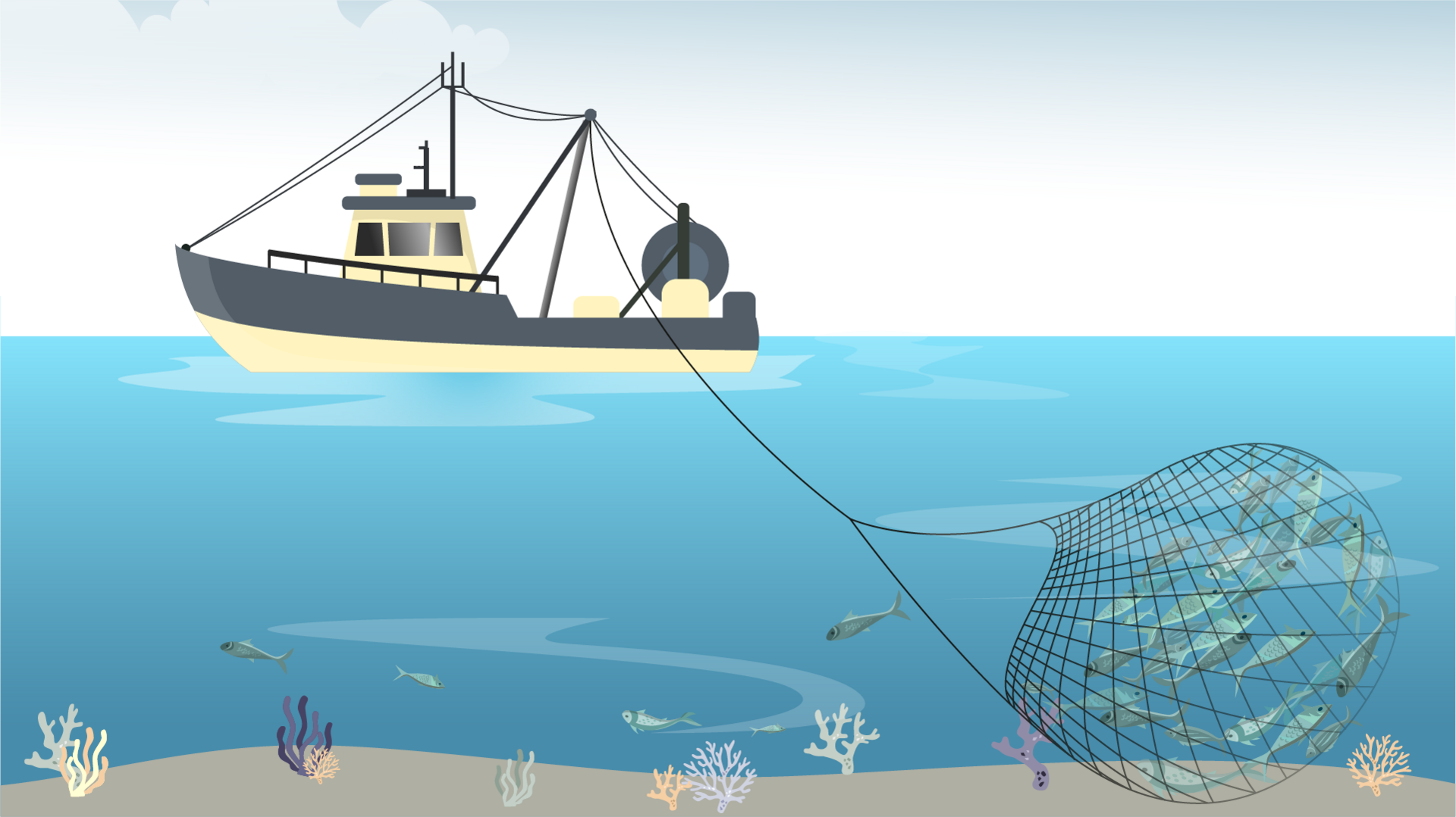
A bottom trawler drags a weighted net along or just above the sea floor to catch fish on or near it, and the gear can tear up coral and sponge beds that take centuries to recover. Fisheries New Zealand estimates that about 68% of the commercial catch by volume is taken this way, and in the Hauraki Gulf observers recorded coral in the catch on 6% of the tows they monitored between 2012 and 2022.
Opportunity’s bottom line calls for “an immediate end to bottom trawling in our most damaged inshore areas” and names the Gulf. Its oceans policy goes further, phasing trawling out of all inshore areas by 2030, off seamounts within three years and off other deep-sea features within five. Its oceans spokesperson, Kayla Kingdon-Bebb, told Q+A on Sunday that the party was “not talking about flipping a switch and ending things overnight — or even in five years”. A Horizon poll for WWF-New Zealand, which Kingdon-Bebb previously led, found in April that 55% of adults wanted bottom trawling banned entirely in the Gulf.
National’s policy goes part of the way. It promised to ban commercial fishing in the Gulf’s High Protection Areas, review the trawl corridors there and review bottom trawling on seamounts, while Labour’s manifesto promised to “Ban bottom trawling in the Hauraki Gulf Marine Park”. National has yet to promise to close any of the Gulf’s trawl corridors.
Will NZ First die in a ditch over bottom trawling?
Richard Harman predicts that Jones “will die in a ditch” on bottom trawling. Peters told the Herald, “We know far more about the fishing industry than National Party does,” though he said he would look at the details of National’s review.
History is on Harman’s side, because marine protection has repeatedly been traded away to keep a support partner happy. National’s 2023 coalition agreement with NZ First promised to “remove regulations that impede the productivity and enormous potential of the seafood sector”, Jones scrapped the Kermadec bill a few months later, and Luxon now admits that National “made trade-offs” that let ring-net fishers into protected areas of the Gulf. If Opportunity secures even the Gulf closures, it will be a rare case of a support party using its leverage against the fishing industry rather than for it.
Fishing companies have also donated regularly to NZ First and Jones. As RNZ revealed and I have documented, Talley’s-related entities gave $26,950 to the NZ First Foundation in 2017–19, and Jones declared $7,000 from two companies controlled by the West Coast fishing operator Craig Boote in 2023. Sanford gave NZ First $12,000 in 2024, as recorded in my annual audit of political donations, and this year Cando Fishing gave the party $30,000.
The industry’s case, and who is making it
Pushing back against a full ban, Luxon warned, “If 70% of our seafood is coming out of bottom trawling in New Zealand, the price of fish is going to go through the roof.” Sanford’s managing director, David Mair, was blunter, telling NBR’s Kate McVicar today: “No bottom trawling, no fish. We’ll be eating shitty fish out of Asia.” He isn’t preparing for change, he told her, because “Iwi, they’re going to come out strong and they’re going to say, ‘You can’t take away the fisheries settlement.’ So, no Government can just stop bottom trawling”. Sanford is not iwi-owned, but its boss is counting on the 1992 Treaty settlement to protect the trawl fleet.
Moana New Zealand’s chair, Dean Moana, made a weightier objection. He told BusinessDesk’s John Anthony that if a future coalition “materially undermined” settlement rights, “we would expect to use all remedies available to us”. Iwi have reason to be wary, since the High Court found last year, in a separate case about quota, that the Crown had broken the settlement. Te Pāti Māori, however, told LegaSea that it supports removing trawling from inshore waters.
Make or break
Peters has said he can’t sit at a Cabinet table with Wong, 1News reported. Without a Cabinet seat for Opportunity, the options are a confidence and supply agreement, which would bring in all five bottom lines, or abstention from the crossbenches, which would ask much less of Luxon. An Anacta poll published this afternoon by the Post’s Nick James found that half of the voters it classified as Opportunity supporters wanted a Labour-led government, 10% a National-led one and 23% neither. The survey predates the election, was done by a firm that also polls for Labour and the Post didn’t report how many Opportunity supporters answered, but on those numbers Wong has more to fear from her own voters over a cheap deal with National and NZ First than over walking away.
NZ First may well fight for the industry, and if it does, bottom trawling could decide who governs. For environmentalists, a fudge is a bigger danger than a breakdown: a promise to “begin” that turns into a review, with the industry’s experts writing the details while the trawlers carry on. Any agreement should be measured by which parts of the Gulf it closes to bottom trawling, and from what date. National offered a review before the election without needing anyone’s votes, and if that is all Wong brings back, she will have spent Opportunity’s leverage on something National was already giving away.
Dr Bryce Edwards
Director of the Democracy Project
In 2024 Seafood New Zealand asked three ministers to drop a clause that would have ruled out compensation for fishers affected by new protected areas in the Gulf, and the clause was dropped. The “Further Analysis” section that follows looks at what that left open for quota owners, who would actually bear the cost of a phase-out, and how far the 1992 Māori fisheries settlement constrains one. See: “Further Analysis: Who owns the catch, and what does the Treaty settlement protect?”
Paid subscriptions fund this research.