

Labour won 710,330 party votes and National 706,680, yet National leads in 42 electorates, which on the preliminary count gives it 42 seats to Labour’s 36. Allocated strictly by party vote, the usual 120 seats would have divided 60–60 between the coalition parties and everyone else. The overhang has turned that dead heat into a 67–64 majority for the coalition in a Parliament of 131, and the right’s campaign to enlarge it is likely to have supplied the coalition’s narrow margin.
(In the Further Analysis section after this column, I look at what would happen if New Zealand went back to the polls early under the same rules, and why Parliament should change them first.)
From a dead heat to a majority
On the Electoral Commission’s preliminary count, National’s 29.2% of the party vote entitles it to 35 seats, but all 42 of its electorate leaders keep their seats, so none of its list candidates get in. Te Pāti Māori leads in five Māori seats on 0.57% of the party vote, enough for one. The 11 overhang seats, the most under MMP, leave National, Act and NZ First on 67, one more than they need. On this count National loses Nicola Willis, Paul Goldsmith and Gerry Brownlee from Parliament, and Chris Bishop too unless he overturns an 889-vote deficit in Hutt South.
On the ballots counted so far, the coalition parties did win slightly more votes than the rest of Parliament, 1,207,431 to 1,190,375, but without the overhangs Qiulae Wong’s seven MPs would have decided whether they governed. Andrew Geddis writes in The Spinoff today that the coalition’s lead “is based purely on” National’s seven overhang seats outweighing Te Pāti Māori’s four.
The strategists claim the credit
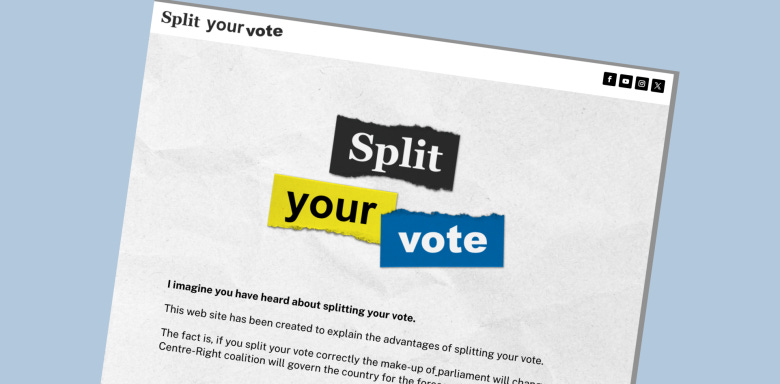
Harry Mowbray, whose Split Your Vote campaign urged right-wing voters to back National’s candidates while giving their party vote to Act or NZ First, told Stuff’s Isaac Davison that “This is 100% due to us”. According to 1News, Don Brash, who wrote Reality Check Radio’s split-vote advertisement, believes “we contributed to the centre-right victory”.
Brownlee tells Newsroom’s David Williams today that he had likened the campaigners to “kids playing with matches”. He believes the campaign had an effect, though not necessarily the one they wanted, and that deliberately engineering an overhang can “manipulate a result”.
Did the campaign make the difference?
The gap between National’s candidate and party votes grew to about 13 points, from about 5.6 last time, on Henry Cooke’s analysis for the Post. Act ran no candidate in Wairarapa or Hamilton East, yet won more than 5,000 and almost 3,000 party votes there, both marginal National seats, as Grant McLachlan notes. But in 2023 nearly six in ten Act party voters gave their electorate vote to National’s candidate anyway.
David Farrar argues that the party vote barely moved. National’s 29% matched most polls taken in August and early September, he notes, and he judges that any movement towards Act and NZ First “was extremely modest, if at all”. National’s slump came first, as Damien Grant argues in Stuff today, and the lawyer Graeme Edgeler told RNZ today he thought it quite possible the overhang arose organically, asking whether it was “just because, well, both National and Labour were very unpopular going into this election”.
But in three southern seats National held comfortably, Mike Houlahan found in the ODT today that National’s party vote fell by between 4,700 and 5,900 on a strong 2023 result, and that Act’s and NZ First’s gains made up about half of that drop. Farrar himself concludes that the campaign “succeeded in terms of having people be more tactical with their electorate votes”, and the electorates decided this election.
McLachlan calculates that if Labour had won Wairarapa, Nelson and Hamilton West, the right would have 64 of 128 seats, level with all the other parties combined. Reality Check Radio says it printed more than a million flyers. On the ordinary count National leads Wairarapa by 139 votes and Nelson by 1,210. Had it lost both, the coalition would still hold 65 of 129 seats, but one fewer list seat for Act or NZ First would then have cost it its majority. A campaign on that scale probably moved enough votes to supply that margin, even if no one can show which.
The case for proportionality
Helen Clark told AAP that “New Zealand could well be deemed by observers to have had a flawed election”, and that the outcome “is not what MMP was designed to deliver”. The objection to the rule is that a bloc can gain MPs without winning over a single voter from the other side, because a National supporter can keep their local MP and use their party vote to help elect another of Christopher Luxon’s coalition partners.
Ani O’Brien, who had a one-off paid consultancy arrangement with Harry Mowbray, rightly defends split voting in LawNews on Sunday, but acknowledges that the difference this time “is scale”. At this scale, 11 extra seats decide which bloc governs, and Te Pāti Māori’s candidate-only strategy, as I wrote in my last column, deserves the same criticism as the right’s campaign.
None of this makes a government formed on these numbers illegitimate. It would hold its seats under rules everyone knew in advance, and Brownlee says there is “no question” the result is legitimate. But legitimacy and mandate are different things. Every electorate winner has a local mandate, but on party votes alone the coalition would hold only half the seats. A coalition that owes its majority to National’s seven overhang seats rather than to more votes, after a campaign designed to enlarge that overhang, would have a much thinner mandate than its seat count suggests.
What needs to change
Both blocs will try harder to enlarge the overhang next time if the rule stays as it is, so Parliament should change it before the next election. Voters should also know who paid. They went to the polls without knowing who funded the vote-splitting campaigns, as I argued on Friday, and Clark says “There is no transparency around who funded it.” RCR’s co-founder Alia Bland says Harry Mowbray provided “approximately 2%” of the budget for its Vote Smart campaign, and the law lets promoters keep their donors private. RCR could still say how much that was in dollars, and who else paid for its million flyers.
Dr Bryce Edwards
Director of the Democracy Project
If New Zealand goes back to the polls early, why would a National supporter give the party two ticks this time? The “Further Analysis” section that follows asks what kind of mandate an overhang government would have, and argues that Parliament should fix the rule before any rerun, with Labour and National voting together – see: “Further Analysis: A snap election under these rules could be a landslide in seats”
Paid subscriptions fund this research.
