

Dear subscribers
A quick note about another format change I am trialling. From today, the Democracy Briefing column will be shorter, while remaining free to read and complete in its own right. But after the paywall, paid subscribers will receive a longer, essay-style “Further Analysis”, giving me room to explore a closely related question in greater depth.
Kind regards
Bryce
--------
Democracy Briefing: Politicians must act on the overhang campaign
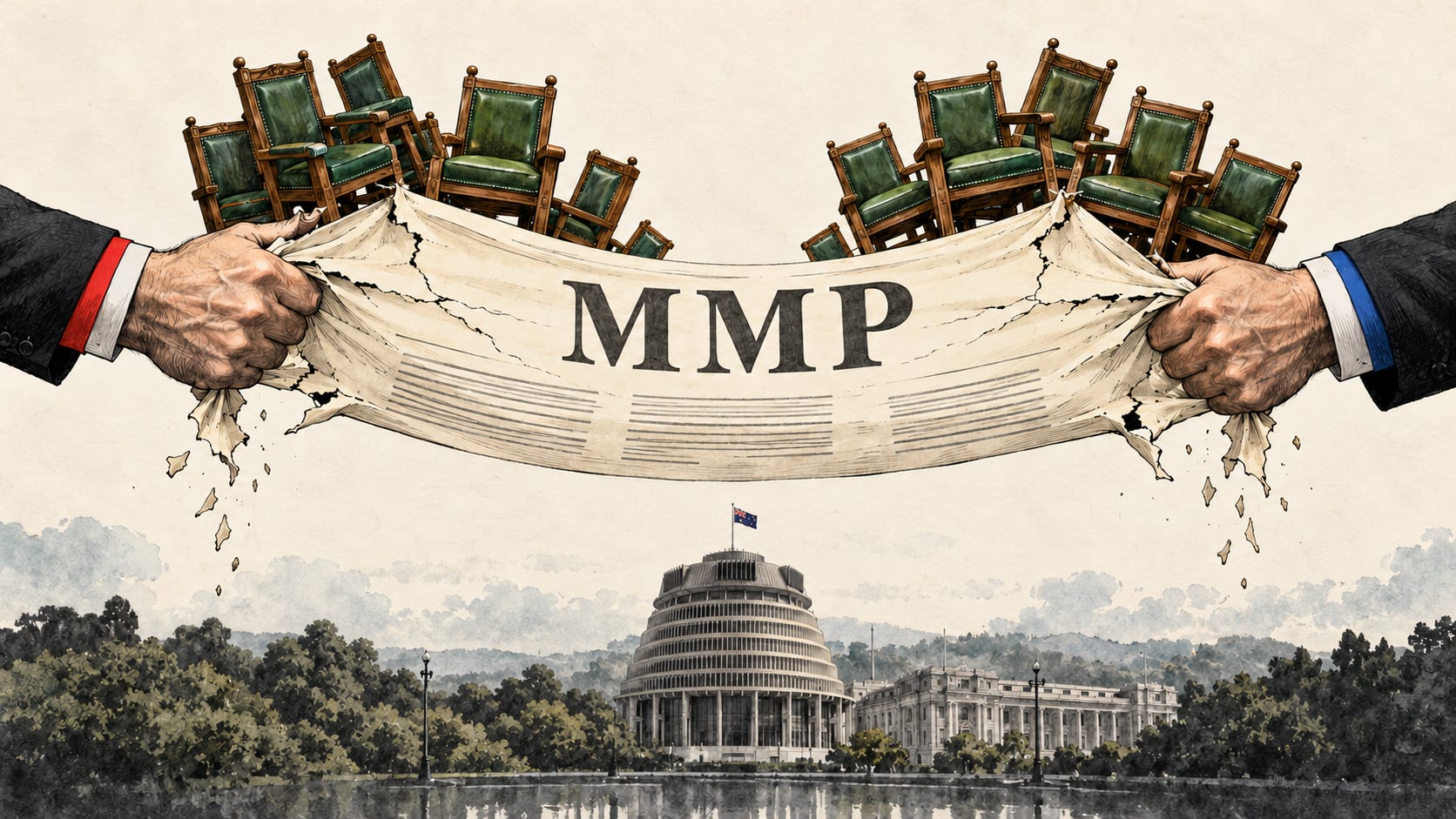
The campaign by some politicians of left and right to game the MMP electoral system is escalating. This morning, NZ First leader Winston Peters told listeners of The Platform that National’s party votes are “a total waste”. With overseas voting beginning on 21 October and advance voting on 26 October, Christopher Luxon and Chris Hipkins need to say what they would do about the campaign, and they need to say it before they find out whether the manoeuvre benefits them.
Its advocates dress up the campaign as simply asking people to “split their vote”. An editorial in The Post said Te Pāti Māori’s version was “within the rules” but “best described as cheating”. The Post’s editor-in-chief, Matthew Hooton, likens it to Australia’s underarm delivery against New Zealand in 1981, and says the Mowbray–Brash plan on the right, if it worked to its fullest extent, would be “a bit like bowling the whole innings underarm, not just the last ball.”
How the overhang strategy distorts the election outcome
A party that wins more electorate seats than its party vote entitles it to keeps them, creating an overhang that makes Parliament bigger and less proportional. On the left, Te Pāti Māori wants Māori voters to elect its candidates and give their party votes to Labour and the Greens. On the right, people in and around NZ First and Act are urging National supporters to vote for National candidates and give their party votes to Act or NZ First. If either strategy works, the bloc behind it could govern with fewer party votes than its opponents.
National could produce an overhang simply by holding electorates while its party vote falls, which would be an accident of the results. But the organised campaigns are a deliberate attempt to manufacture one, and they may make a difference. On RNZ’s Nine to Noon today, the centre-right commentator Liam Hehir predicted “a record overhang”, including a National overhang of about four or five seats. It could end up being much more serious if the overhang campaigns escalate further.
None of this is illegal. The votes cast this way, and any seats they produce, would be lawful, and Rodney Hide argues that splitting is “MMP working exactly as Parliament wrote the law.” Parliament having written the rule is no argument against Parliament changing it, however.
The parties benefiting must answer for it
The overhang campaign is being carried out in a rather disingenuous way, with some of the parties that will benefit pretending to keep their hands clean. Te Pāti Māori presents its strategy as a way to increase Māori representation. Its president, John Tamihere, told Waatea News: “But we want to make it very clear if you get our candidates in it can create the overhang.” Its official party list contains just one name, general secretary Lance Norman.
Act’s position is more ambiguous. Its new advertisement has Paul Henry telling viewers how to “keep these guys out”, saying the contest is about “the biggest coalition”, while the on-screen text for the electorate vote is blue. Act told The Post’s Nick James that the ad was not an attempt to create an overhang and that it was not instructing people how to vote, and said the blue was one of its own party colours, not a direct reference to National. Its spokesperson, after naming David Seymour in Epsom and James Christmas in Tāmaki as the people to back locally, added: “In other electorates, that may well be a National candidate.”
NZ First is even more enthusiastic about vote splitting. Its candidate and Platform host Michael Laws told listeners today that “any party vote for National you now know is a wasted vote” and that they “may as well burn” a party vote for National. Interviewing Peters, he asked whether the centre-right had a responsibility to defend itself against the left’s strategy. Peters replied that the Prime Minister was “making statements which are just suicidal for the National Party vote”, and that “For every action, there has to be a reaction”.
The argument assumes National will win no list seats. That depends on both its electorate tally and its share of the qualifying party vote. Voters cannot know those results in advance. Advice presented as an obvious mathematical truth is a gamble on both.
Three things Labour and National must do now
National opposes the campaign. Hipkins says “no parties should be aiming to make that happen”, while Willie Jackson has been more accommodating about Te Pāti Māori’s approach: “that’s their business.” Both parties now need to step up their own condemnation, and there are three things they should do to protect the integrity of the electoral system.
1) Condemn deliberate overhang engineering consistently, including when it could help their own side. Although vote splitting by individuals is a legitimate part of MMP, it is unacceptable when organised campaigns direct it specifically to engineer an overhang. Labour and National can point out that what their allies are doing is nothing like the electorate deals of the past. Even The Post’s editorial, which called Epsom “probably the dodgiest example”, said such “little games at the margin are very different” from Te Pāti Māori’s strategy.
2) Declare how they would deal with a result that unfairly hands them power. Nothing can, or should, stop individuals splitting their votes, so Luxon or Hipkins could still win a majority of seats with fewer party votes than his opponents. Would either of them govern regardless, or refuse on principle? The Post’s political editor Henry Cooke has proposed that they jointly promise that “if an overhang is the only path to government, then we’ll ask the Governor-General to call another election instead.” A rerun is no automatic remedy, though, because lawful votes can’t simply be disregarded, and another election under the same rules might reproduce the problem. Whatever their answer, voters should hear it before polling day.
3) Commit to closing the loophole. If one side wins with a distorted result, the other will try even harder at the next election. Neither major party has a good record here. The Electoral Commission recommended abolishing overhang seats in 2012, and the Independent Electoral Review repeated the recommendation in 2023. Successive governments led by both parties left it on the shelf. Andrew Geddis, who was part of the 2023 review, told RNZ the panel thought “we should try to get rid of them, but no one did anything.” Luxon and Hipkins should promise an independent review, or name the fix they favour. Any review should include smaller parties and the public, because a deal between National and Labour is not automatically a democratic improvement. Abolishing the Māori electorates wouldn’t solve the problem either, since an overhang can arise just as easily through National’s general electorates. There is no painless remedy. But that is a reason to begin the work, rather than leave parties to compete over who can exploit the rules most effectively.
Before the votes are counted
Luxon and Hipkins should make these commitments while neither knows whether an overhang will help him. Thomas Coughlan warns that the winner, “particularly if an overhang pushes it over the line, will be tempted to bank the win and not change anything.” If either leader benefits on 7 November, will he still want the rules changed? Voters should hear his answer now.
In the “Further Analysis” section below, I explain why I have changed my mind about Germany’s overhang remedy, and the serious objection that still troubles me. Paid subscriptions support the Democracy Project’s research and analysis. Please consider subscribing to support this work and read the full essay.
