

The Greens are surging in the opinion polls. They have recorded 16% in consecutive 1News-Verian polls, 14.8% in RNZ-Reid, 14% for Freshwater and 13.3% in the latest Taxpayers’ Union-Curia poll. They are one of the clearest success stories of the election campaign. The surge follows a difficult period for the party, including polling results often around 7% earlier this year. Writing in yesterday’s Sunday Star-Times, Andrea Vance observes that “The turnaround is something of a miracle, given how completely the wheels had fallen off during a torrid 2024 and 2025.”
What explains the slump and then the surge? The short answer is that the Greens have finally discovered the populist moment. Until recently they were trapped in culture wars and internal conflict, but in recent months they have pivoted towards economic populism, taking on corporate power and speaking to the economic discontent of voters who think New Zealand isn’t working for them. There is considerably less Palestine and pronouns in their campaigning, and much more power bills and profiteering. Essentially, dialing down the middle class “woke politics” is working for the Greens.
Missing the mood
Angry voters around the world have been shifting towards populists, but for a long time the Greens seemed unable to tap into that anger. Late last year I argued that the Greens were failing to capture the “Broken New Zealand” mood, and early this year I described a party “bogged down in culture wars and identity politics”.
A follow-up column urged the Greens to embrace economic populism, to “name the corporate villains making life harder for ordinary people”, but I doubted they would do it. My conclusion was that “The honest answer is probably not.”
Finding the populist moment
That prediction turned out to be too pessimistic. Since July the Greens have remade themselves as a vehicle for economic grievance against the supermarkets, power companies, banks and tech firms that dominate New Zealand’s broken markets, and they have aimed public anger at the powerful. They are campaigning for a publicly owned supermarket, cheaper electricity and higher taxes on extreme wealth, tied together by an argument that governments have allowed too much economic power to accumulate in too few hands.
These aren’t entirely new concerns for the Greens. Their manifestos have long contained proposals about inequality and corporate power. What’s different is that they’re now making these arguments the centre of their mainstream election campaigning, rather than allowing them to be crowded out by other controversies.
The shift was under way well before the poll surge. When the party held its annual meeting in south Auckland at the end of July, a Talbot Mills poll had just put it on 9%, down four points. Even so, in a column at the time, Have the Greens turned a corner?, I pointed out that the party was consciously adopting a less lecturing and exclusionary approach, and that it was signalling a pivot towards “eco-populism” and away from the Greens’ traditional “post-materialist” politics.
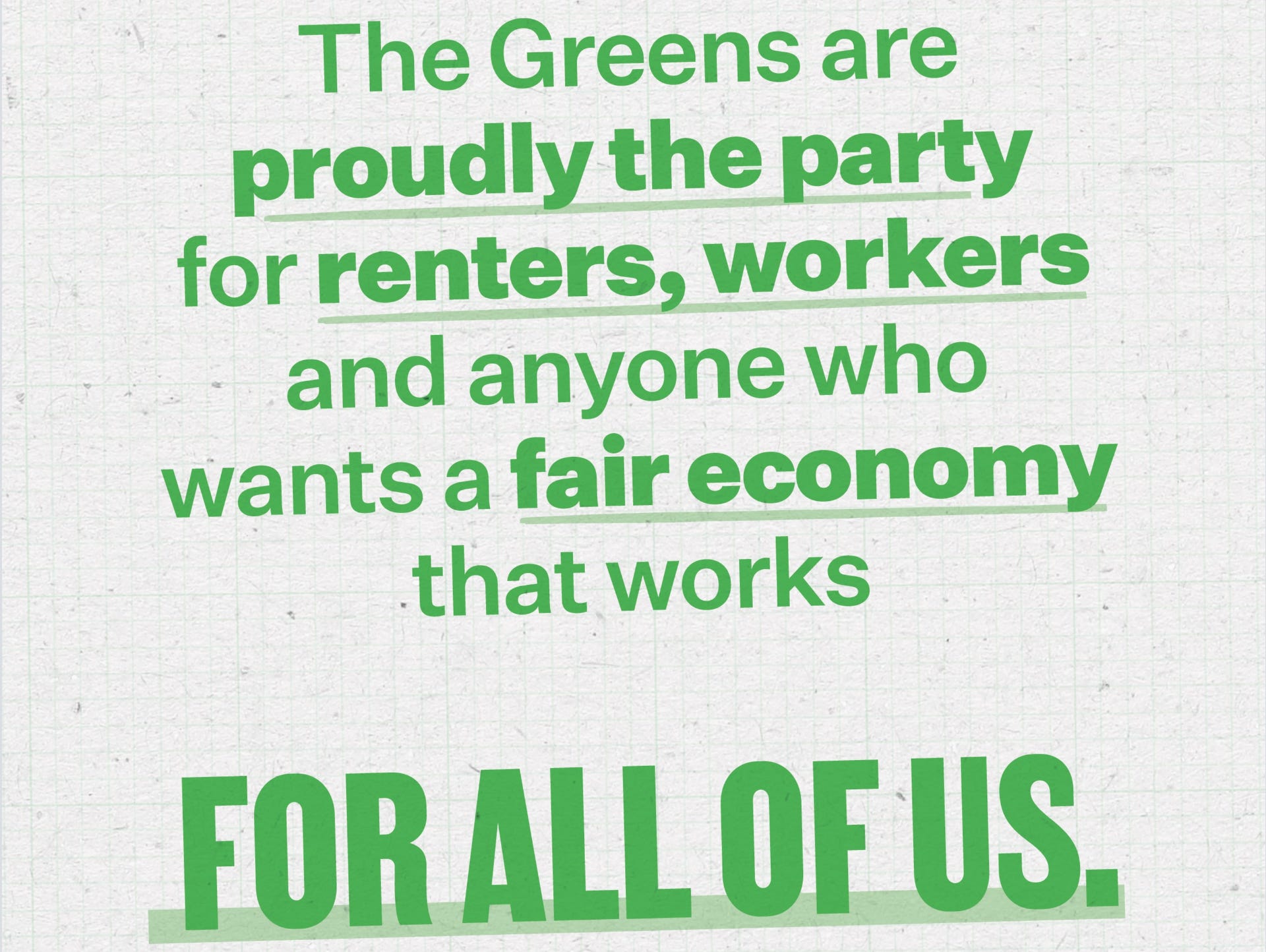
The evidence was there in what the co-leaders said that weekend. The party unveiled its campaign slogan, “For All of Us”, which co-leader Chlöe Swarbrick said was meant for supporters and also “for the people we don’t know and even those we don’t like”. In her speech she told members, “Nobody is ever going to be able to empathise with your world view if they feel they’re under attack”, and that “We have to talk not just to each other, but to those we’ve never talked to before.”
It sounded like a rebuke to a party that has sometimes seemed more comfortable demonstrating its moral superiority than persuading people to support it. Afterwards she told reporters that voters felt politics had become detached from their lives: “They just want politics that actually addresses their material needs.” The Greens were then languishing in the polls, but the strategy that would lift them was already in place.
The same instinct is now being applied to artificial intelligence, one of the anxieties of the moment. At the July meeting the Greens called for new AI data centres to be put on hold for a year while tougher national rules were developed, with Swarbrick telling members, “They extract power, they extract water, and they extract profit.” Today the party went further, announcing a policy to regulate artificial intelligence that Stuff reports is centred on protecting creative work and jobs, under the headline “We don’t work for AI”. This is yet more Zeitgeist positioning.
A question from Parliament’s lawn
The co-leaders’ own accounts of why they changed help explain the shift from culture wars to leftwing populism. In Danyl McLauchlan’s Listener interview with the co-leaders, Marama Davidson reflects on why people who might once have looked to the left are finding political connection elsewhere. She recalls the 2022 occupation of Parliament’s lawn. Some of those outside were people whom MPs inside knew as relatives and friends, and she remembers that “there were Māori standing outside with a tino rangatiratanga flag and a Trump sign.”
Her question for activists like herself was, “What the hell is going on that they see more connection and vision from Trump while they are holding the tino flag than they do from our collective movements that have been around for generations? Where did we fuck up?”
It is a striking admission from a leader whose own family history is steeped in protest. It is also an uncomfortable question for the left, and a more useful one than assuming those people were always going to end up on the other side. Simply condemning those people for supporting the wrong politicians isn’t much of a strategy for winning them back. McLauchlan sums up her view as a movement that “failed to retain people who then found connection and vision elsewhere”.
Much of the Greens’ 2026 campaign reads like an attempt to address that failure. Rather than dismissing politically alienated people for supporting the wrong politicians, the party increasingly wants to offer them a different explanation of why their lives have become so difficult.
A place to belong
Swarbrick has drawn similar lessons. In her Public Interest interview with Ollie Neas earlier this month, she recalled arriving in London on the day of a far-right mobilisation, and finding people on the left “astounded” by how much attention such groups had attracted. Her takeaway is about the need for the left to orientate to discontent and alienation, otherwise such people will be attracted to the populist right. She explains that “people want to belong” and “feel that the economy, the world, their countries, their cities are not working for working people”. Because “the legacy institutions are failing them”, they look for solutions, and at times that means “pinning the tail on the latest structurally marginalised group to blame for all of these issues”.
For Swarbrick, “that’s where the left has a huge moral obligation and responsibility to step in, to tell a far better story, to give people a place to belong”, and “not just to tell a better story but to tell the goddamn truth”. She is clear about where she thinks that truth lies: “people understand that the system is rigged towards corporate profits”.
Her discussion of identity politics is particularly useful. She recalls questioning, during her first term, whether getting more women into elite positions would achieve much without also redistributing resources and decision-making power.
Chris Trotter remains critical of the Greens, but in his account of the interview on his Substack, Swarbrick “eagerly confirms Neas’ suggestion that the Greens had moved on from “Identity Politics” to develop a policy agenda that is frankly and radically redistributive”. He describes her “determination to wrench the camera away from the Greens’ moral lapses, culture-war casualties, and pro-Palestine keffiyehs” as “impressive”. Swarbrick herself presents the change less as a break with the past than, in her words, “an evolution which is definitely at least partially contextual”.
The paywall now starts partway through all Democracy Project newsletters. Please take out a paid sub if you want to support this service and access the full content, including the following sections:
“Populism that punches up”
“Mamdani, Polanski and the Greens”
“The Angry Election”
“From conscience to economic grievance”
