

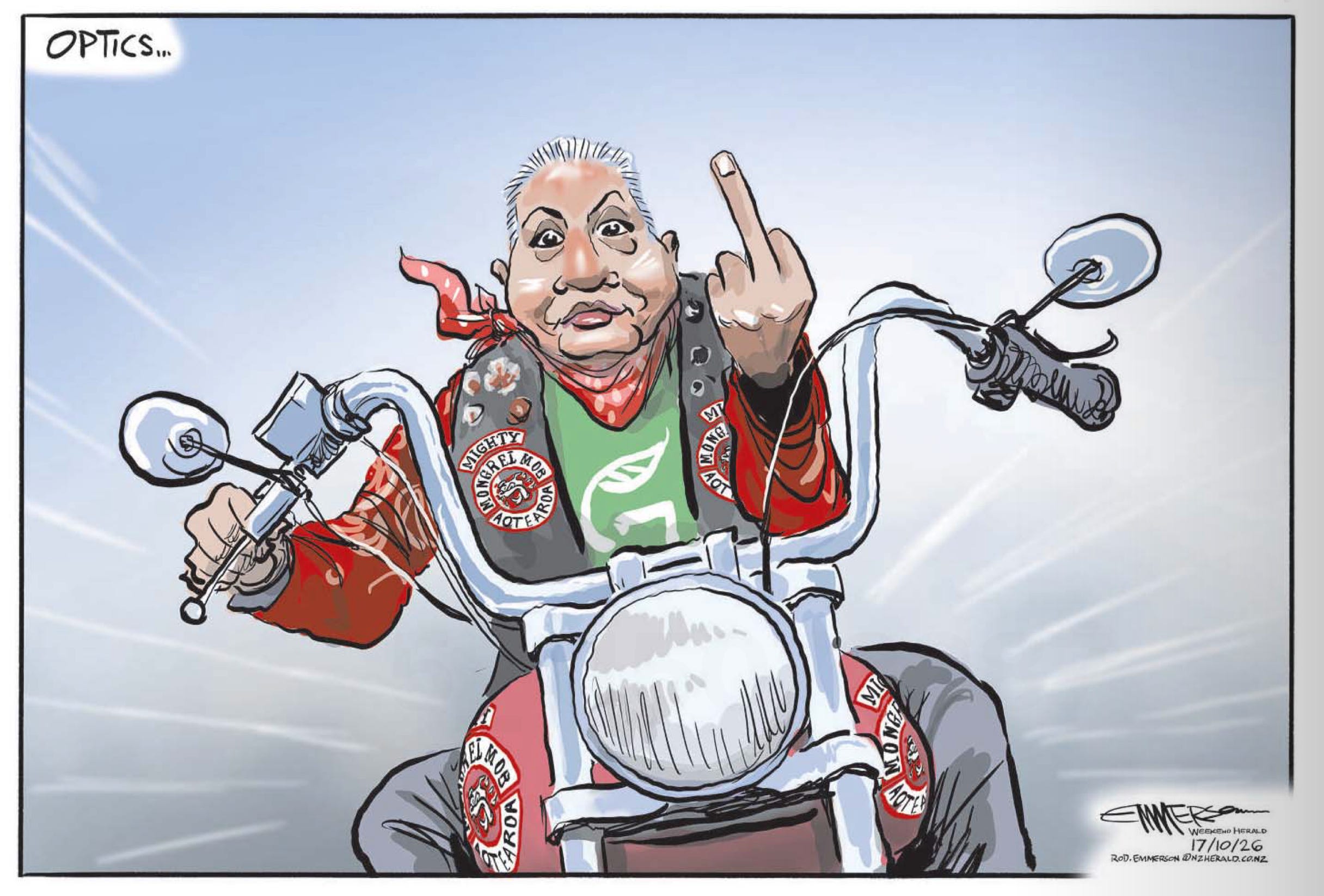
This week’s controversy over Green and Te Pāti Māori politicians posing for photos with Mongrel Mob members has exposed a weakness at the heart of the Greens’ election campaign. The party has climbed to record levels of support this year by focusing on economic issues such as supermarket prices and power bills, while keeping its more contentious social and cultural positions in the background. Those positions haven’t changed, and this week one of them was suddenly at the front of the campaign. The Greens’ economic message has wide appeal, but their stance on gangs is a much harder sell, including to some of the soft voters who lifted them to record highs.
The trouble started when Mongrel Mob life member Harry Tam posted photographs of Green MP Hūhana Lyndon, Green candidate Michel Mulipola and Te Pāti Māori MPs Oriini Kaipara and Hana-Rāwhiti Maipi-Clarke at a gang pad south of Auckland, smiling and giving the thumbs up in front of Mob posters and flags. Tam’s caption described a “Mongrel Mob whānau, health and wellbeing election hui with the Green and Māori Party candidates”. The reaction has been intensely polarised.
Part of the reason is that the debate has mixed up three separate arguments. Nearly everyone accepts that politicians should be able to engage with gang members and their families, and nearly everyone thinks the photos were a political blunder, but there is deep disagreement over whether smiling photos and talk of public funding amount to endorsing a criminal organisation. The other reason is that both major parties have their own history of dealing with gangs, which makes some of the outrage hard to take at face value.
From power bills to gang patches
In my column on Monday, I argued that the party’s polling surge reflected its discovery of economic leftwing populism. The Greens were connecting with voters’ concerns about the cost of living and keeping culture-war controversies out of the headlines, and Sam Sachdeva of Newsroom also credits “a disciplined approach to policy and public messaging”. The gang visit has interrupted that progress, and given the Government an issue it badly needed.
RNZ’s political team noted that law and order ranked only eighth in the September Ipsos Issues Monitor, and that Labour had spent the week attacking the Government over delays to children’s chemotherapy at Starship. On the day of the Herald leaders’ debate, Christopher Luxon said Chris Hipkins had “a new coalition member today, it’s the Mongrel Mob,” and in the debate itself Hipkins agreed, when asked by the moderator, to rule the Greens and Te Pāti Māori out of the police and corrections portfolios. In doing so, he was publicly questioning the judgement of the parties he may need in order to govern. He later told the Herald, “The gangs are perpetrators of misery. Political leaders shouldn’t be cosying up to gangs.”
The response of the Green leadership then made things worse. When the Herald pressed co-leader Marama Davidson on whether the Greens would fund Mob-run drug rehabilitation, she replied, “We are open to funding what works, absolutely.” Audrey Young of the Herald criticised Davidson for “both validating and exacerbating the issue in follow-up stories by resurrecting the possibility of grants to gangs for drug addiction programmes.”
Not a new position for the Greens
Hūhana Lyndon was the only Green MP in the photos, but the party’s response showed this was not a one-off. Davidson’s defence this week was strikingly similar to one she gave five years ago. In May 2021 she and the then Human Rights Commissioner, Paul Hunt, spoke at the Waikato Mongrel Mob’s headquarters. At the party’s AGM that August, speaking about her meetings with women associated with gangs, she said, “I will not ever apologise for that,” adding, “I am proud that as a Green Minister I can do what is right and not just what is popular.” This week she told reporters, “We’re proud and we have done that year and year again,” and told RNZ the next morning, “We don’t change who we are as a political party just for the campaign, you know.”
Co-leader Chlöe Swarbrick was much less comfortable, and the two co-leaders did not appear to be on the same page. Where Davidson was “proud”, Swarbrick would not say whether the visit was a good idea. Asked twice whether she would have advised Lyndon against going, she said, “That didn’t happen,” and that she needed to “understand more of the context as to what has played out here”. She defended engaging with marginalised communities in principle, but stopped short of defending the visit itself.
By Friday both co-leaders appeared frustrated by the continued questions and were trying to get reporters to focus on the cost of living again. Swarbrick said, “It is what it is.” When one journalist tested Davidson’s argument about engaging with all communities by asking whether the Greens would also talk to Mexican cartels, she challenged the question by asking the journalist, “Are you okay?”
The Greens cannot assume their supporters welcome the association. A Curia poll from October 2023, republished by David Farrar this week, found only 7% of Green voters had a positive view of the Mongrel Mob, and 82% a negative one. Farrar’s conclusion was that “Green voters are smart and get it. Green MPs do not.” The poll didn’t ask about engagement or rehabilitation funding, and it can’t tell us what the party’s newer supporters think. RNZ says the Greens’ growth “almost certainly includes some soft centre-left voters, who may have previously voted Labour”.
Earlier this year I described a Green Party that seemed “more interested in pronouns and Palestine than power bills and polluted rivers”. This year’s campaign, under the slogan “For All of Us”, has been about economic issues instead, and Davidson used the same language this week, saying the Greens must “create an Aotearoa that works for all of us.” The Greens’ economic campaign is about standing up for ordinary New Zealanders against powerful interests such as the supermarkets and power companies, and that message is popular. Gangs are different. Many ordinary New Zealanders, including in poorer and Māori communities, see gangs as one of the powerful forces they need protecting from, and they expect politicians to take their side against the gangs.
The paywall now starts partway through all Democracy Project newsletters. Please take out a paid sub if you want to support this service and access the full content, including the following sections:
“Three arguments about gangs, and where the real divide lies”
“National and Labour have worked with gangs too”
“Where is the evidence?”
“Who pays the electoral price?”
“Principle or poor judgement?”
