

The 2026 election campaign will be remembered for gang photos, attack advertising, overhang schemes and the prospect of a hung Parliament, but it has also done something more consequential. After years of timid regulatory reports and reluctant ministers, the argument about the country’s broken markets has moved on from whether governments should confront the companies that dominate groceries, electricity and banking to how they should do it. Some of the answers, from forced break-ups to a state-owned supermarket chain, are genuinely radical. Even National, the traditional party of business, is now campaigning to split Foodstuffs, and Brent Edwards wrote in NBR yesterday that reform of the supermarket sector “appears inevitable, irrespective of which parties form the next government”.
The most encouraging development in this election campaign is the willingness to take on the companies dominating essential markets and ripping off New Zealanders. I have argued for years, most recently in a series of columns on “Broken New Zealand”, that broken markets sit at the heart of the country’s deeper problems, and that politicians have been too timid or too captured to confront them. By Broken New Zealand I mean an economy in which essentials cost too much and public services and wages have stalled, and those companies are a large part of why.
In the Further Analysis section after this column, for paid subscribers: why the campaign confronted the supermarkets but left New Zealand’s longer-term problems in productivity, population, health and infrastructure largely unresolved, and who is to blame for that.
Who promised what
Parties are competing to confront corporate power in essential markets. Every party with a realistic chance of being in the next Parliament took a grocery policy into the election, and all except Act proposed restructuring the dominant groups or creating publicly backed competitors. National’s Foodstuffs split would depend on a Commerce Commission recommendation, Labour would make both groups run their wholesale arms independently so that smaller retailers could obtain supplies on fairer terms, the Greens would bring 120 stores into public ownership as KiwiMart, and Te Pāti Māori would help fund Māori-owned supermarkets. National’s shift matters most, because once it accepts that a failing market can be restructured, future governments of either stripe will find it much harder to argue otherwise.
Labour’s proposed ban on excessive pricing would cover food, power, fuel, transport, telecommunications, banking and insurance. NZ First campaigned on splitting the big gentailers into separate generation and retail businesses, and the Greens proposed a state-owned company to supply firmed power to smaller competitors.
In banking, NZ First wants to buy back BNZ and merge it with Kiwibank, while Labour would open up payments systems to fintechs and create a pathway for payment companies to become digital banks. Danyl McLauchlan’s Listener column this week puts banking and energy among the sectors where “politically connected cartels and oligopolies” are “ruthlessly extracting rent from the diminishing productive economy”.
Why the parties moved
Broken markets are a textbook case of concentrated benefits and diffuse costs: a handful of firms gain a great deal from weak competition and can afford to defend it, while millions of households each lose a little and rarely organise. McLauchlan counts the grocery duopoly among the failures of three decades of political drift: “Clark’s first term saw the merger of Progressive Enterprises and Woolworths, delivering one of the most concentrated grocery sectors in the OECD.”
The Commerce Commission estimated in 2022 that the major grocery retailers were earning excess profits of about $1 million a day, and Andrew Bevin of Newsroom has reported claims that the two supermarket groups are now waging a “full-court press” against break-up efforts. Business leaders responding to the Herald’s Mood of the Boardroom survey scored every supermarket policy below 2 out of 5, from 1.83 for National’s to 1.15 for KiwiMart. Fran O’Sullivan’s reply to the business lobby’s property-rights argument is that “defending private property rights cannot become a convenient slogan for defending incumbent market power.” Competition law, she adds, “exists precisely because the market does not always police itself – the supermarkets are arguably a case in point.”
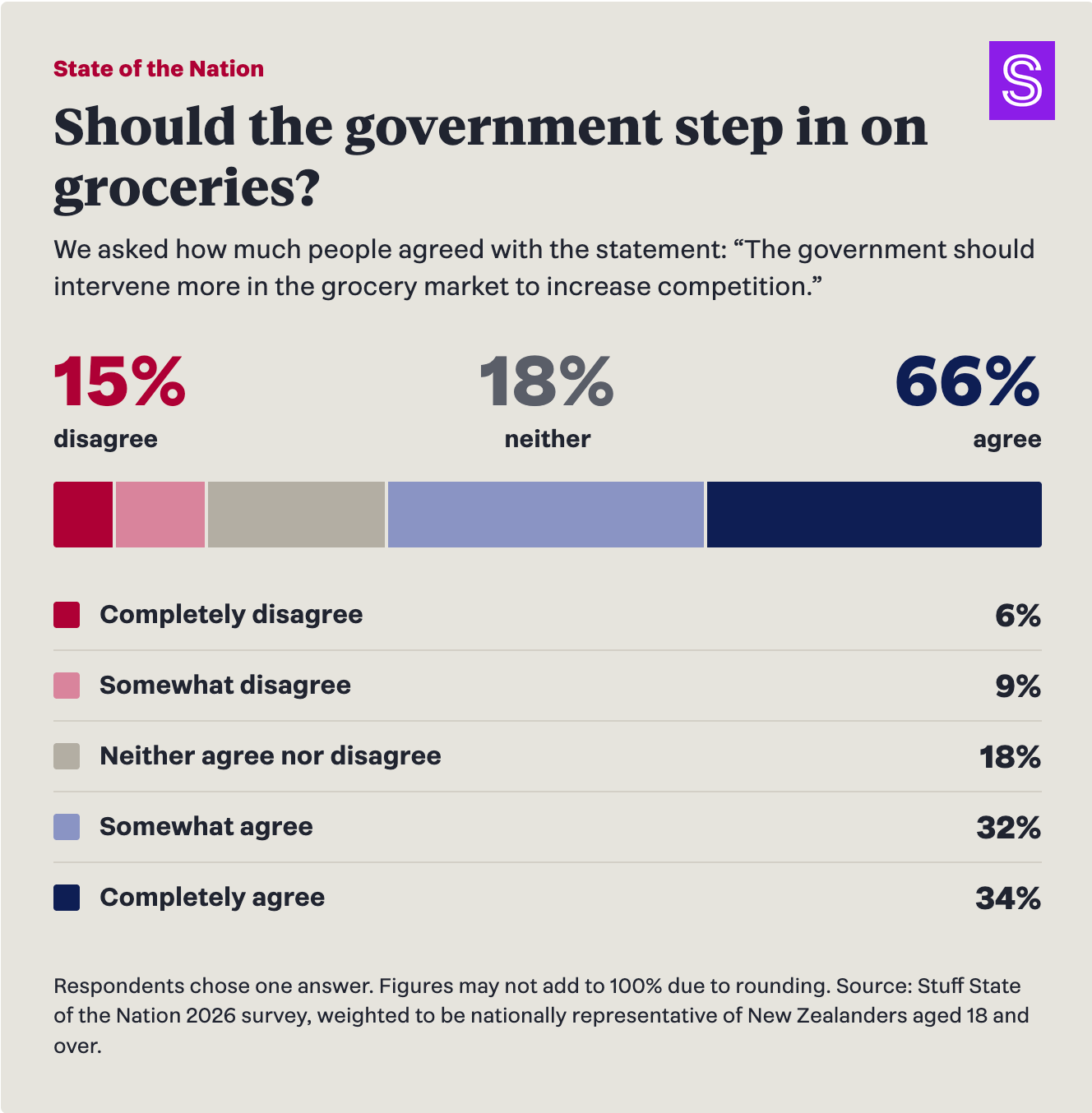
What changed this year was pressure from voters. Stuff’s State of the Nation survey, taken between 11 and 16 September, largely before National and Labour announced their plans, found 66% agreeing that “the government should intervene more in the grocery market to increase competition”, so on market reform the public was ahead of the major parties.
NZ First and the Greens forced the pace, and the smaller parties gave voice to public impatience. NZ First proposed splitting Foodstuffs in April, and the Greens launched KiwiMart on 6 September, ten days before National announced its own plan. Christopher Luxon called the Greens “communists” for proposing to nationalise 120 supermarkets, but the attack did not stop them reaching their best result in 1News-Verian’s polling in the following weeks, which gives their market-reform programme potential weight in coalition negotiations. At the ASB finance debate in October, Opportunity leader Qiulae Wong said she no longer trusted politicians “to take action on the expert advice that the Commerce Commission gives us”.
A first step towards fixing Broken New Zealand
McLauchlan writes this week that “The competition debate is exposing an awkward distinction between a market economy and an economy arranged for the convenience of its incumbent firms.” Jon Duffy, chief executive of Consumer NZ, makes a similar case in the Helen Clark Foundation’s new book, Facing Up to Our Future. Reform, he writes, has often been “incremental and cautious, tinkering at the edges and leaving the underlying drivers of poor market performance largely intact”.
The interventions he canvasses range “from gentle nudges to forced divestiture or increased (or total) public ownership”, which is close to what the parties are now offering. Where leaving things to the market “will only perpetuate the status quo”, he argues, “solutions should focus on how to disrupt those markets”. Duffy puts the political obstacle plainly: “The hardest part will not be coming up with the analysis and potential solutions; it will be finding the political backbone to implement them.” Coalition bargaining and corporate pressure will test that backbone soon enough.
Whatever happens on Saturday, concentrated market power in essential services is now a test the next government will be judged on. The campaign was also far thinner on productivity, jobs, health, population and infrastructure, and The Post’s election editorial today judged that the political class “has not sufficiently or credibly grappled with” the country’s large challenges. Fixing broken markets is only one part of fixing a broken New Zealand, but it is a start that few would have predicted when the year began.
Dr Bryce Edwards
Director of the Democracy Project
In the Further Analysis section after this column: why the campaign did so much less about New Zealand’s longer-term problems in productivity, population, health and infrastructure, even as unemployment reached its highest level in nearly 11 years, how much of the blame lies with voters and the critics themselves, and what to watch for in coalition talks. Paid subscriptions keep this research independent.
Further Reading
Brent Edwards (NBR): The differences between a centre-right and centre-left government (paywalled)
Danyl McLauchlan (Listener): 30 years of drifting off course under MMP demands future governments keep a surer hand on the steering (paywalled)
Jon Duffy (Facing Up to Our Future, Helen Clark Foundation): Broken Markets: When Competition Fails Consumers (book chapter)
Fran O’Sullivan (Herald): Property rights cannot be a slogan for protecting market power (paywalled)
Tim McCready (Herald): Supermarket shake-up policies score below 2 out of 5 in boardroom survey (paywalled)
Andrew Bevin (Newsroom): Inside the supermarket duopoly’s ‘full-court press’ against political interference
Gemma Rasmussen (Consumer NZ): Election 2026: How the main parties plan to improve the grocery sector
Nicholas Jones (Stuff): Fed-up Kiwis want next government to take on power and grocery giants
Audrey Young (Herald): National supermarket shock: Why the ‘party of business’ has taken a hard left turn (paywalled)
Jonathan Milne (Newsroom): ‘I no longer trust these politicians’: Finance debate spells the end of the innocence
Commerce Commission: Grocery market study recommends changes to improve competition and benefit consumers (2022)
The Post: Editorial – The Post’s election endorsement (paywalled)
Previous related Democracy Briefings
Bryce Edwards (Democracy Project): Democracy Briefing: What business thinks of the politicians and parties
Bryce Edwards (Democracy Project): Democracy Briefing: The supermarket election
Bryce Edwards (Democracy Project): Democracy Briefing: National’s supermarket breakup plan channels the Zeitgeist
Bryce Edwards (Democracy Project): Democracy Briefing: The Greens raise the stakes on supermarket reform with KiwiMart
Bryce Edwards (Democracy Project): Democracy Briefing: Why the Greens should ride the populist wave
Bryce Edwards (Democracy Project): Democracy Briefing: The supermarket break-up is back
Bryce Edwards (Democracy Project): Democracy Briefing: The Devil in the detail of NZ First’s supermarket reform
Bryce Edwards (Democracy Project): Democracy Briefing: A Chance to stop big business ripping off New Zealanders
Bryce Edwards (Democracy Project): Integrity Briefing: Can the Greens capture the “Broken New Zealand” Zeitgeist?
