

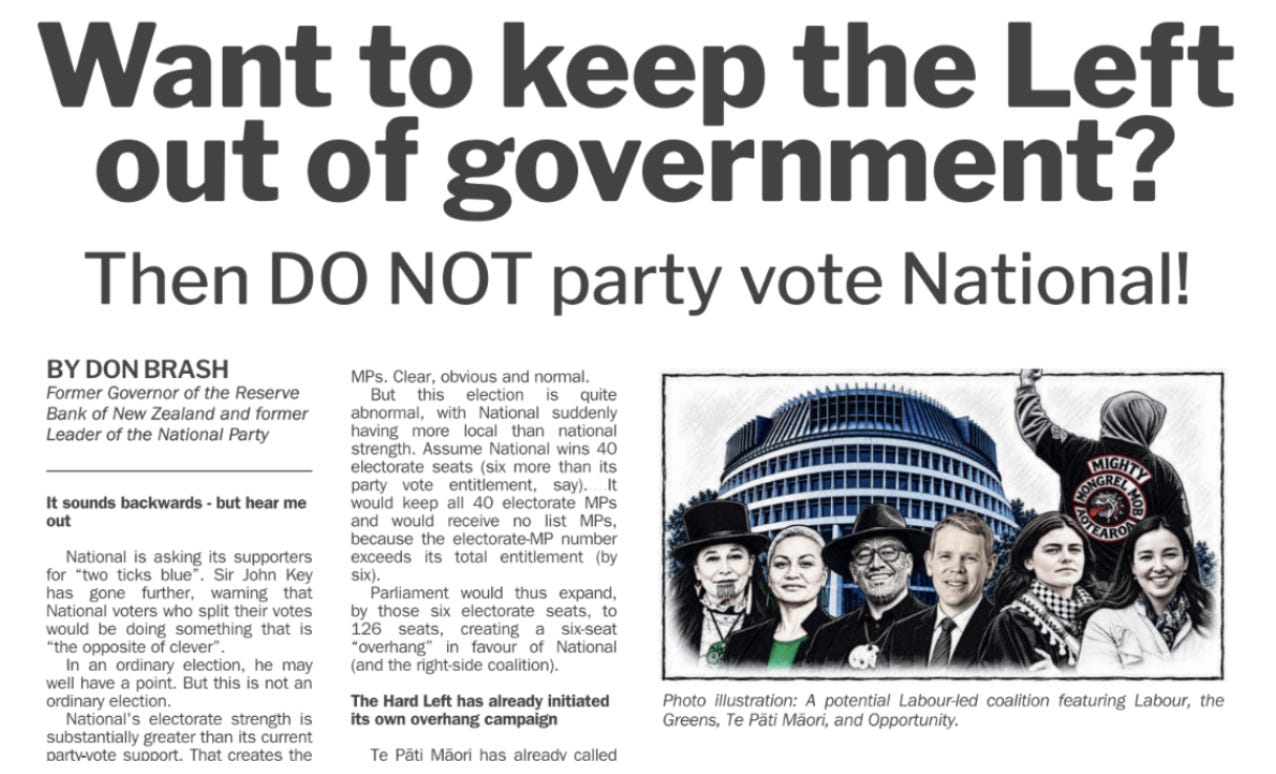
For most of this year, the development most likely to decide the election seemed to be the rise of the Opportunity Party, with its leader Qiulae Wong cast as kingmaker. In the final week of the campaign, that role has passed to the MMP overhang, a rule few voters paid any attention to before this year. The organised efforts to engineer one, by Te Pāti Māori on the left and by wealthy campaigners with the blessing of Act and NZ First on the right, are attempts to win more power than voters are prepared to give, and both should be condemned.
How an overhang works
Under MMP, the party vote sets how many of Parliament’s 120 seats each party receives. As the Electoral Commission explains, a party’s electorate MPs count towards that number and list MPs make up the rest. For example, suppose National wins enough party votes to be entitled to 35 MPs. If it wins 30 electorate seats, it gets another five MPs from its list. But if it wins 40 electorates, all 40 MPs are elected anyway. Parliament simply grows by five seats. Those extra five are the overhang, and the other parties don’t lose any of their normal allocation. Therefore the proportionality of Parliament is distorted, and National has received more seats than it is entitled to.
This can change who governs. Imagine the three rightwing parties collectively winning enough party votes for 59 of Parliament’s usual 120 seats, with the other parties taking 61. Normally, the right would be short of a majority. But if National gained five overhang seats, it would have 64 MPs alongside its coalition partners, against 61 for everyone else. Parliament would have 125 MPs, requiring 63 for a majority. The Government would suddenly have the numbers to remain in office, without its three parties having won any greater share of the party vote.
Overhangs are not new: five MMP Parliaments have had them, mostly through vote-splitting in the Māori electorates, and each involved only one or two overhang seats. This year’s could be on a different scale, because National holds 44 electorates while its party vote has fallen from 38% in 2023 to 29% in the latest 1News-Verian poll and 24.8% in RNZ-Reid Research. The forecasting site “The Overhang” projects an average of eight extra seats for National and three for Te Pāti Māori, which would mean a Parliament of 131 MPs needing 66 for a majority.
None of this is guaranteed. Labour could take more National electorates than expected, the party vote could change considerably, and the latest polls offer quite different pictures of the election. Nor would a National overhang necessarily prove that the vote-splitting advertisements had worked. It might have happened anyway, simply because National’s electorate MPs remain stronger than the party itself.
But an overhang of several seats is now a serious prospect. Something that was largely confined to political obsessives and electoral mathematicians has suddenly become central to the struggle for power.
Why it now matters more than Opportunity
Opportunity, polling around 6% to 7%, could still hold the balance of power, and Wong has said she will talk first to the party with the most seats rather than the most votes. The overhang increasingly decides whether a kingmaker is needed at all, and which party Wong would call. On The Overhang’s forecast, made before the RNZ-Reid poll, the coalition has “a 67% chance of governing without needing Opportunity”, and where Wong does get to choose, National would have more seats more often than not, even though Labour would almost always have more votes. The Herald’s Thomas Coughlan concluded on Saturday that a National overhang “looks quite likely, more likely than Opportunity not making it into Parliament”.
All of this rests on forecasts, and last week’s two big polls point in opposite directions. An overhang decides the election only if National holds most of the electorates its party vote no longer justifies, and the Post’s Henry Cooke reports that on current polling it would need to lose 11 or 12 of them to avoid one. Even so, the main published seat projections all show an overhang, as The Overhang notes.
The strangest campaign of the MMP era
It is hard to imagine a stranger way for a government to finish an election campaign. Act and NZ First have confirmed that they authorised a full-page advertisement running each day in newspapers, written by the former National and Act leader Don Brash and placed by Reality Check Radio, headed “Want to keep the Left out of government? Then DO NOT party vote National!”
Act agreed only after Brash promised a separate advertisement backing its candidates in Epsom and Tāmaki. Sir John Key, whose 2011 cup of tea with John Banks helped Act keep Epsom, now appears in a video urging Epsom voters to back National’s Paul Goldsmith, who may need the seat to stay in Parliament. National has lodged a complaint with the Electoral Commission against a campaign that urges people to vote for its own candidates. The strategy could keep Luxon in office while costing him some of his most senior ministers and leaving Act and NZ First stronger within the Government, which explains why National is fighting it.
Harry Mowbray’s Split Your Vote website was taken offline last week after the Electoral Commission questioned whether it was properly authorised. Mowbray told Sean Plunket on The Platform this morning that it is back up, with its wording changed. He also said that the Electoral Commission has referred him to the Police for investigation.
Gaming MMP from both sides
Te Pāti Māori has deliberately made an electorate-vote strategy central to its campaign. It is encouraging supporters to elect its candidates in the Māori seats while giving their party votes elsewhere, particularly to Labour or the Greens. The aim is to help create a left bloc in Parliament that can become the government even if the right bloc get more votes.
Newsroom’s Tim Murphy today describes the right’s campaigners, from Mowbray and Brash to Voices for Freedom, as an “unlikely, disparate group of minority voices” united by the aim of keeping the left out of government. Te Pāti Māori’s potential overhang is limited by the seven Māori electorates, while National’s 44 electorates give the right scope for a far larger one, although an engineered overhang distorts Parliament in the same way whichever bloc benefits.
Why engineering an overhang is wrong
There is a perfectly respectable case for splitting your votes. Someone might genuinely prefer a National local MP while supporting Act nationally, or want a Te Pāti Māori electorate MP while preferring the Greens on the party vote. MMP allows voters to make those choices, and politicians are entitled to explain how the system works.
But there is something deeply cynical about organised campaigns deliberately trying to make Parliament less proportional. The whole point of introducing MMP was to ensure that parliamentary representation more closely reflected the votes people cast. Now politicians and wealthy campaigners are openly seeking to widen the gap between party support and parliamentary power because it might help their preferred side win.
Any objection should apply to Te Pāti Māori’s campaign just as much as to the right’s. It’s also important to point out that an overhang can occur without a campaign. So if National end up with an overhang this doesn’t necessarily prove that the vote-splitting advertisements worked. It might have happened anyway, simply because National’s electorate MPs remain stronger than the party itself.
The objection is not against people splitting their votes, but to the organised campaigns designed to give a bloc more seats than its share of the party vote, and possibly a majority of seats from a minority of votes. This distorts the proportionality of Parliament, and such proportionality is the reason New Zealanders chose MMP. Henry Cooke has described a strategy that would “let well-organised minorities govern less-organised majorities”, and Mowbray himself has conceded that it “does distort proportional representation”. Voters are also being urged to follow campaigns whose full funding is not yet publicly known, as I reported last week.
If either side governs because of an engineered overhang, it will not have “stolen the election”, but it will hold office with an extremely weakened mandate. Even the pollster David Farrar, a National Party supporter, has suggested that a prime minister who holds the job only because of an overhang should “treat their mandate as somewhat limited”. The Electoral Commission’s 2012 review of MMP and the 2023 Independent Electoral Review both recommended abolishing overhang seats, and neither recommendation was acted on. If an overhang helps decide Saturday’s result, the test for the winner is whether it will close the loophole that helped it.
Dr Bryce Edwards
Director of the Democracy Project
Further Reading: Earlier Democracy Project columns on the overhang
Bryce Edwards (Democracy Project): Democracy Briefing: How both sides could game MMP 24 August 2026. The first column in the series, on Te Pāti Māori’s strategy and the first calls on the right to copy it.
Bryce Edwards (Democracy Project): Democracy Briefing: The campaign to engineer a National overhang 27 September 2026. How the right’s campaign took shape.
Bryce Edwards (Democracy Project): Democracy Briefing: The rightwing “Split Your Vote” campaign 1 October 2026. Harry Mowbray’s campaign and the fight on the right over strategic voting.
Bryce Edwards (Democracy Project): Democracy Briefing: Politicians must act on the overhang campaign 19 October 2026. Why Luxon and Hipkins needed to say how they would handle an engineered overhang, and how to close the loophole.
Bryce Edwards (Democracy Project): Democracy Briefing: Who is paying to engineer the election overhang? 29 October 2026. The Herald advertisements, the party authorisations and the campaign’s undisclosed funding.
In today’s “Further Analysis” section below: I examine some of the best political analysis of the overhang — and some extraordinarily misleading claims. See: “The good, the bad and the ugly of the overhang debate”.
Paid subscriptions fund this research.
