

This week’s open letter from 46 electoral experts asks the wrong people to fix the MMP overhang. The letter, “Keep the ‘P’ in MMP”, calls on the new Parliament to set up an urgent select committee of MPs from every party, to report by mid-2027 on how to protect proportionality before the next election. Its diagnosis is sound, and its signatories, who have quite different politics, have given the rest of us a proposal to argue about. But although MPs will have to vote on any final decision about repairing the electoral system, we should be wary of leaving them to design the solution, because self-interest is likely to distort it. Their track record on electoral law shows they can’t be trusted with the job. Instead, the public needs to be fully involved from the start.
(In the “Further Analysis” section after this column, I compare the main proposals for fixing the overhang and set out who would lose from each.)
The letter is right about the problem
On the preliminary count, 11 overhang seats have produced a Parliament of 131 MPs in which National has six more seats than Labour despite winning fewer party votes. Te Pāti Māori holds five seats on a party vote that earned one. The signatories, led by Andrew Geddis, Lara Greaves and Max Rashbrooke, warn that both sides now know how to manufacture an overhang and will try harder in 2029.
Kerre Woodham says on Newstalk ZB that the letter makes academics look like “poor sports”, but that is unfair. When she put the point to Geddis, he told her the signatories think Te Pāti Māori was wrong to game the system as well: “It’s not about who wins this election.”
“Lock the politicians in a room”
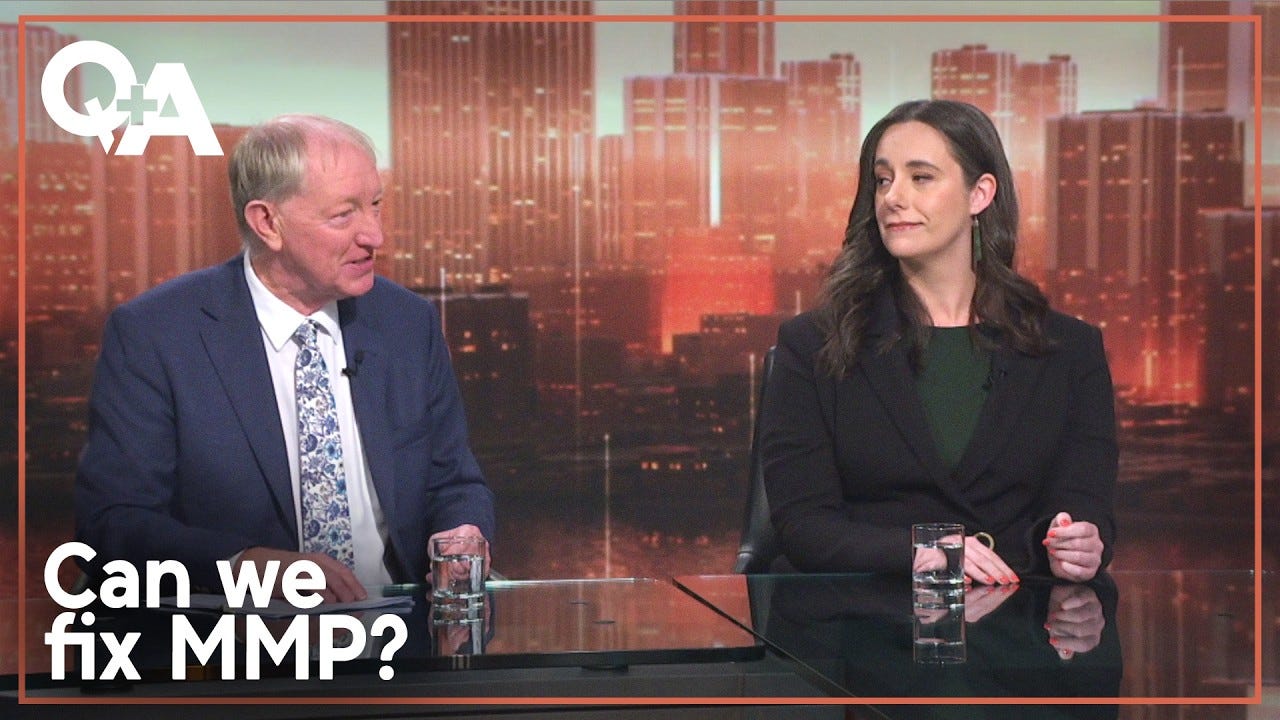
The letter goes wrong on method. Its authors want MPs to do the thinking, with the public’s role limited to making submissions to their inquiry, and they are blunt about it. Greaves, a Victoria University political scientist, said on TVNZ’s Q+A last Sunday: “Let’s lock the politicians in a room.” On the Herald’s Ryan Bridge Today programme this week she said the country didn’t need another review, or necessarily need more academics or retired judges: “We need the MPs to sit down with the solutions and figure it out”.
Greaves’ impatience is understandable. She was a member of the Independent Electoral Review panel set up by the last Labour Government, whose 2023 recommendations politicians largely ignored. The Electoral Commission’s 2012 review of MMP was shelved by self-interested politicians in the same way. She is right that the country doesn’t need another panel of academics and retired judges, but her conclusion, to hand the job to the politicians themselves, is still very wrong.
The letter does ask the inquiry to take public submissions, along with advice from public servants and experts, and to consider Te Tiriti o Waitangi. Both earlier reviews consulted the public too, and the 2012 review alone received about 4,700 submissions. But neither generated the kind of wider public debate that would have made it costly for politicians to ignore them. Submissions also come late in the process: by the time anyone writes one, somebody else has usually decided what question is being answered. A local group that calls its own meeting, by contrast, gets to decide what to ask its MP. Handing the job straight to MPs, with submissions as the only way in, would shut the public out even further.
For the letter writers, part of the appeal of simply getting politicians to fix it is speed, since an outside inquiry would take longer. But in electoral law, hasty changes often go very badly. Giving politicians the first say should be kept for a real emergency, such as a snap election, and the next scheduled election is three years away.
Panel beaters designing intersections
The big problem the open letter misses is that politicians are often the worst people to lead electoral reform. They have too much at stake in the outcome, and given the chance they will design the rules to suit themselves.
Geddis has supplied a strong argument against his own letter. Some people, he acknowledged to RNZ this week, think letting politicians design electoral systems is “like allowing panel beaters to design intersections”. Those people are right, and it is odd that he still wants the committee “doing the thinking about it”.
The new Parliament might well be particularly conflicted on the overhang, because a large number of its MPs were either elected through it or stand to benefit from it. On the preliminary count, every one of National’s 42 MPs holds an electorate, and four of Te Pāti Māori’s five are overhang MPs. When these MPs examine the proposals for dealing with the overhang, they will find that some of the fixes would cost them their seats. A Parliament enlarged by the overhang would be writing the overhang rule.
The open letter cites two earlier parliamentary committees as models. The first, the MMP Review Committee of 2000–01, split on most of the big questions, and the government then announced that “no changes to the MMP system would be initiated”. The letter’s own test, that changes be “acceptable to as many political parties as possible”, invites the same result by handing a veto to whichever party stands to lose.
MPs also helped create the problem. The Royal Commission that designed MMP recommended 60 electorate seats and 60 list seats, but Parliament has let the list shrink to 49, which makes overhangs easier.
We’ve also recently seen what happens when one side has the numbers to get its way on electoral law. First, the Ardern Labour Government introduced election-day enrolment over National’s objections. Then the Luxon National-led Government unilaterally closed enrolment for this election 13 days before polling day.
Should we have seen the overhang coming?
Max Rashbrooke told RNZ this week that he “didn’t see this coming”, but others had. As far back as 1986, the Royal Commission had considered the possibility that parties would try to manipulate the system, though it thought any such attempt would be “both difficult to implement and likely to attract an electoral backlash”.
Grant McLachlan described a scheme involving friendly independents in 2013. Edward Hitchcock warned of a possible 20-seat overhang in 2021. And Geddis said before the election that the 2023 panel saw the risk “but no one did anything”. I started writing about both sides gaming MMP in August, collected the earlier columns on 2 November and was still asking who paid for the ads on election eve, but none of it prompted politicians to act.
Doubts about the select committee route
Even the signatories disagree about how to proceed. Two days before the letter appeared, Oliver Hartwich of the New Zealand Initiative, who signed it, told RNZ he wanted a Royal Commission with a year to report, followed by a referendum. Michael Swanson, another signatory, writes that “many of us didn’t draft the letter”, and he worries that the overhang “will be dealt with in isolation”, with other connected issues ignored.
From the left, the blogger No Right Turn calls a select committee “entirely the wrong vehicle”. He says politicians “have shown repeatedly that they can not be trusted to get their grubby paws in the electoral system”, and concludes that “having the politicians as first reviewers is a guarantee of a partisan, politicised outcome”.
The case for a citizens’ assembly
NBR’s political editor Brent Edwards has warned against rushing the job, pointing out how hard it is for ordinary voters to make their case on a technical subject when a committee is in a hurry. Former MP Peter Dunne sees a role for citizens’ assemblies.
A better approach would be for Parliament to agree on a timetable and fund a citizens’ assembly with the power to put proposals to the country, to begin work once local groups and the media have argued out the options. The assembly could call MPs as witnesses and get the Electoral Commission to run the figures on each proposal. It could publish a shortlist of preferred overhang fixes with its reasons, and Parliament would then be required to respond. If a change would alter what either of our two MMP votes does, it could be put to a referendum. After all, New Zealanders chose MMP in 1993 and voted to keep it in the 2011 referendum Parliament organised. A future government would think twice before overturning a verdict like that.
A more democratic process for fixing the MMP overhang
It is going to be a long time before Parliament can even start work properly, probably not until February, and delays in forming a government could push that out further. If those delays lead to a second election, there would be a case, as I argued earlier this month, for MPs to quickly pass a narrow, cross-party overhang fix that expires after the new election.
Short of that, there is now a great opportunity for public debate on the issue. Trusting the politicians to fix it would kick the issue into touch, and if the rest of us simply wait for a select committee to report, we will have kicked the public debate into touch ourselves. It would be vastly better to let a public consensus develop about the best fix. Rules with public backing also tend to last, as MMP has. Election-day enrolment, imposed over one side’s objections, was used at only two elections before the other side had the numbers to scrap it.
We need a proper exchange of ideas and arguments in the media, and public forums where anyone can have their say. Local meetings could start with a single question: if a candidate comes first in an electorate, should they always get the seat? Newspapers could run the strongest case on each side, and if an option later drops off a committee’s shortlist, voters who have argued about it will be in a position to ask their MP why. The debate shouldn’t be left to academics, politicians and other eminent figures, as is the usual way. A citizens’ assembly could then turn it into recommendations, with a referendum on anything fundamental. Let’s create a genuinely grassroots and democratic process for solving this problem.
The Democracy Project that I run is a tiny platform, but I’m very happy to lend it to encourage public participation and a real contest of ideas, including by publishing the case for competing proposals and finding ways to host forums and public debate. Anyone who is interested in this more bottom-up way of doing politics, whether a group that wants to hold a discussion or someone with a fix they are prepared to defend in public, should get in touch. Let’s not leave it to the politicians, once again, to dominate the process and write the rules in their own interests.
Dr Bryce Edwards
Director of the Democracy Project
My pre-election columns on the overhang issue:
24 August: How both sides could game MMP
27 September: The campaign to engineer a National overhang
1 October: The rightwing ‘Split Your Vote’ campaign
19 October: Politicians must act on the overhang campaign
29 October: Who is paying to engineer the election overhang?
2 November: The overhang that could decide the election
6 November: We still don’t know who paid to change our votes
In the “Further Analysis” section below, for paying subscribers, I compare five kinds of remedy for the overhang and set out what each would cost and which parties and MPs would lose. A version of one fix put forward by both official reviews would, on the preliminary votes, leave Labour ten seats behind National in a smaller Parliament, despite Labour winning more party votes.
Paid subscriptions fund this work.